


This article was automatically translated from the original Turkish version.
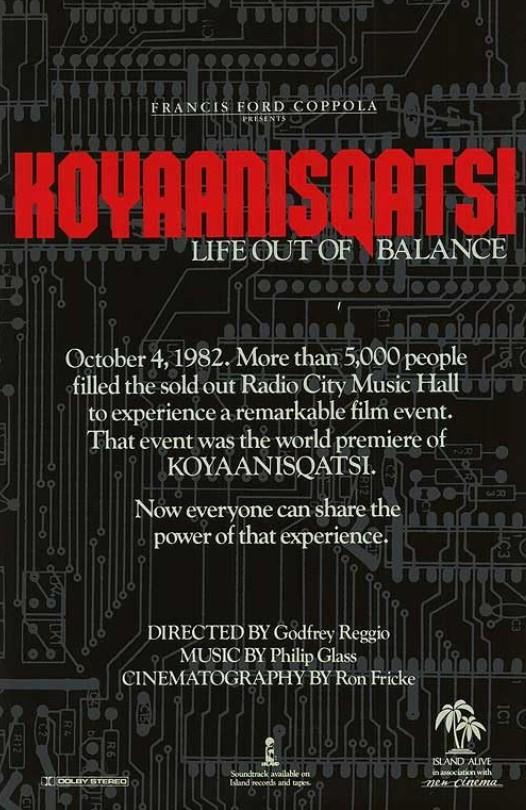
Koyaanisqatsi
Director(s) | Godfrey Reggio | ||||||||
|---|---|---|---|---|---|---|---|---|---|
Producer(s) | Godfrey Reggio, Lawrence Taub | ||||||||
Screenplay(s) | Godfrey Reggio Alton Walpole Michael Hoenig Ron Fricke | ||||||||
Cinematographer(s) | Ron Fricke | ||||||||
Production Year | 1982 | ||||||||
Duration | 86 minutes | ||||||||
Language(s) | Dialogue-free | ||||||||
Genre | Documentary Art Film Experimental | ||||||||
IMDb Rating | 8.2 | ||||||||
Koyaanisqatsi is a 1982 experimental documentary film directed by Godfrey Reggio, with a screenplay by Godfrey Reggio, Ron Fricke and Michael Hoenig, music composed by Philip Glass, and cinematography by Ron Fricke. The film takes its title from a term in the Hopi language meaning “life out of balance.” Lacking dialogue, the film is structured entirely through visual and auditory elements, diverging from traditional narrative forms.
Koyaanisqatsi film trailer (Rotten Tomatoes Classic Trailers)
The film presents the relationship between nature, humanity and technology through imagery. Themes such as urbanization, industrialization, energy consumption and modern lifestyle practices are visualized using time-lapse and slow-motion techniques. The concept of time is conveyed throughout the film through contrasting visual dynamics, particularly in the transitions between scenes depicting the slow pace of the natural environment and the rapid pace of urban life.
The film contains no narrator, text or characters. This structure enables the viewer to engage directly with the content through visual and auditory means. Rather than focusing on individual stories, it centers on the collective human experience. In this regard, the film is classified not as a cinematic narrative but as a visual conceptual structure.
Individual characters are absent in the film; human figures are presented anonymously. People in settings such as public transportation, shopping centers and workplaces are depicted in a deindividualized manner, alluding to the mass nature of modern life.
The film’s production spanned approximately five years, with filming taking place across various regions of the United States. The film primarily employs time-lapse and slow-motion techniques, which are synchronized with Philip Glass’s minimalist musical composition. Cinematographer Ron Fricke’s framing is designed to create a visual contrast between the natural environment and urban life.
Koyaanisqatsi is the first film in a trilogy known as the Qatsi Trilogy, completed by Powaqqatsi (1988) and Naqoyqatsi (2002). The trilogy as a whole focuses on the impact of modern society on nature and humanity. The film has been the subject of academic study in environmental research, experimental cinema and media studies.
Ebert, Roger. “Koyaanisqatsi.” Roger Ebert Official Website. Accessed May 5, 2025. https://www.rogerebert.com/reviews/koyaanisqatsi-1983
IMDb. "Koyaanisqatsi (1982)." IMDb. Accessed May 5, 2025. https://www.imdb.com/title/tt0085809/
Rotten Tomatoes Classic Trailers. "Koyaanisqatsi (1982)." YouTube. Accessed May 5, 2025. https://www.youtube.com/watch?v=tDW-1JIa2gI
Rotten Tomatoes. "Koyaanisqatsi." Rotten Tomatoes. Accessed May 5, 2025. https://www.rottentomatoes.com/m/koyaanisqatsi
Koyaanisqatsi
Director(s) | Godfrey Reggio | ||||||||
|---|---|---|---|---|---|---|---|---|---|
Producer(s) | Godfrey Reggio, Lawrence Taub | ||||||||
Screenplay(s) | Godfrey Reggio Alton Walpole Michael Hoenig Ron Fricke | ||||||||
Cinematographer(s) | Ron Fricke | ||||||||
Production Year | 1982 | ||||||||
Duration | 86 minutes | ||||||||
Language(s) | Dialogue-free | ||||||||
Genre | Documentary Art Film Experimental | ||||||||
IMDb Rating | 8.2 | ||||||||
No Discussion Added Yet
Start discussion for "Koyaanisqatsi (Film)" article
Subject and Thematic Structure
Use of Characters
Production Process and Technical Features
Cultural Context