KURE Kids Header Line
badge icon

This content was originally written in Turkish for children and is automatically translated into English using artificial intelligence.

Komodo Dragon: The World's Largest Lizard

Last Updated: 07/05/2026

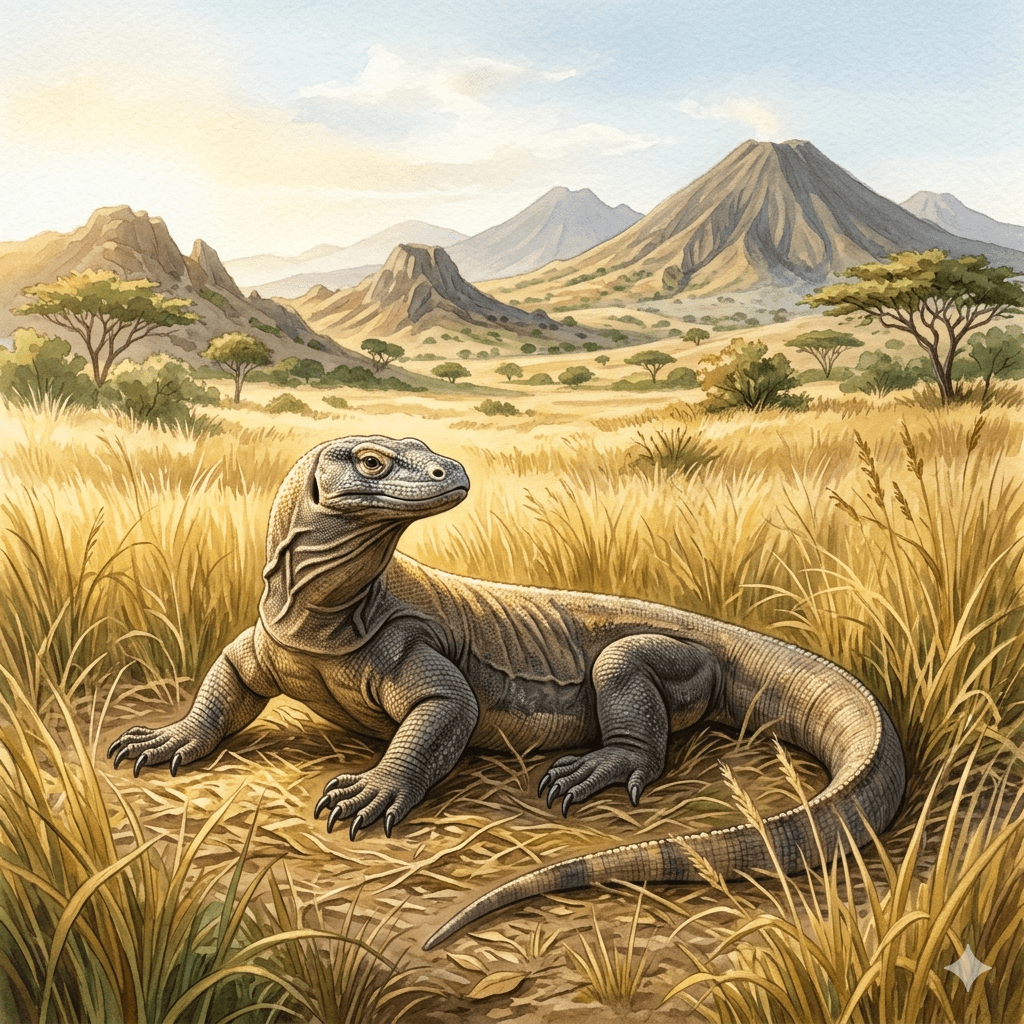
Let us imagine: could dragons from fairy tales actually exist? Although they do not breathe fire, a gigantic lizard species that closely resembles them lives on our planet: Komodo dragon! These creatures, the largest lizards in the world, are among nature’s most fascinating animals due to their massive size and powerful build.
Komodo Dragon (Image Generated by Artificial Intelligence)

Where Do They Live? 🏝️

To see Komodo dragons in the wild, we must travel to the far reaches of the world—to the islands of Indonesia. These giant lizards inhabit warm tropical savannas on islands such as Komodo, Flores, Rinca, and Padar.


When the weather becomes very hot, they dig burrows in the soil to cool down, and use them to rest comfortably at night. They greatly enjoy wandering among tall yellow grasses, shrubs, and sometimes on sandy beaches.

What Are Their Physical Characteristics? 📏

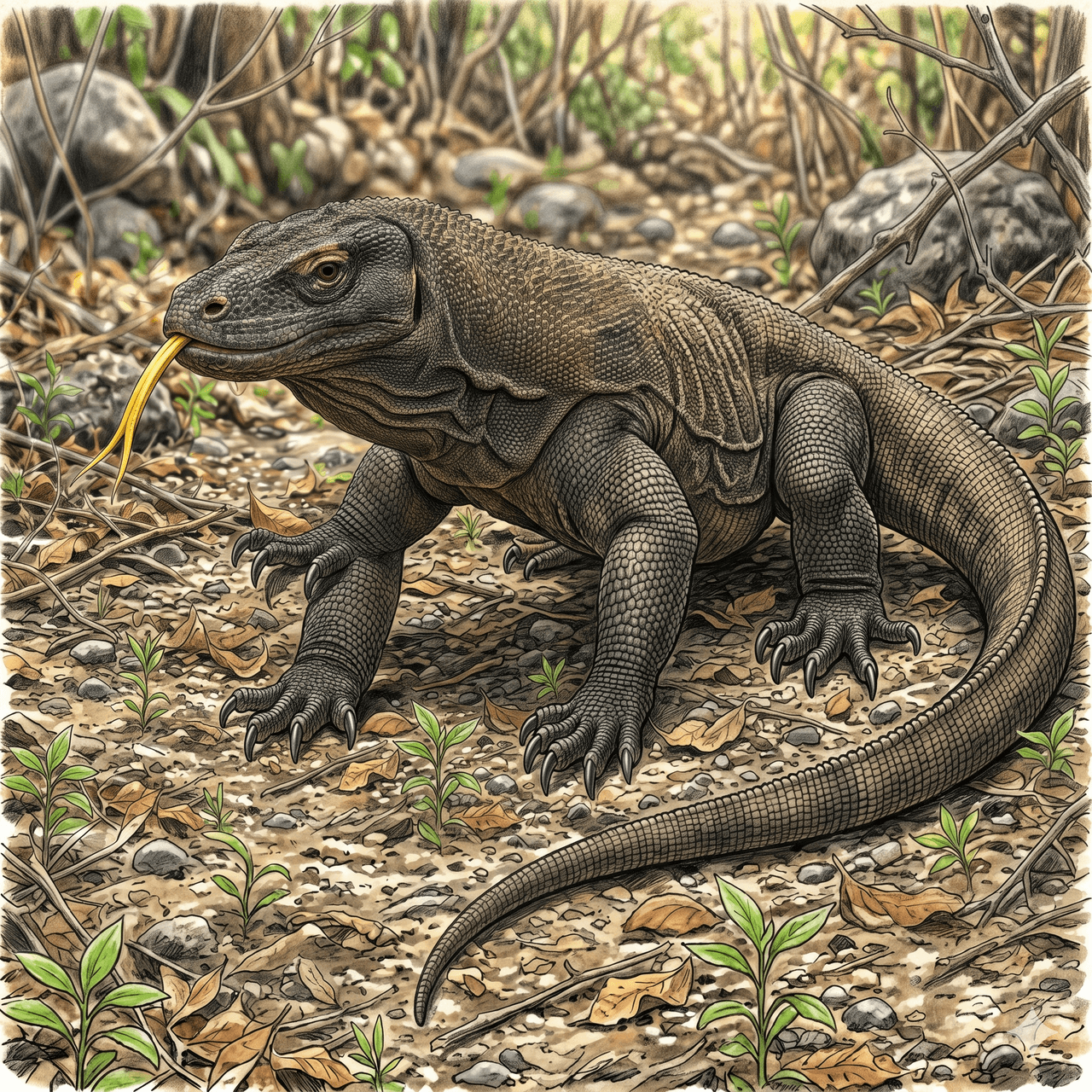
How large do you think a Komodo dragon can grow? An adult Komodo dragon can reach a length of up to three meters and weigh as much as 165 kilograms! That means their body length can rival that of a small car you might see on the road.


When young, they have yellow and black stripes, but as they mature their color changes from brown to grayish-red. Their skin is covered in thick, armor-like scales, similar to those of a knight’s armor. They also possess long, forked, yellow tongues that they use to detect scents in their environment.

Komodo Dragon (Image Generated by Artificial Intelligence)

How Do They Feed and Grow? 🥩

These giant lizards are skilled hunters in the wild. They feed on large animals such as deer, wild boar, and water buffalo. Their stomachs and skulls are so flexible that they can easily swallow enormous meals whole.


Komodo dragon hatchlings, however, begin life very differently. Immediately after hatching, they climb trees to escape predators and spend their early years living among the branches. While in the trees, they feed on insects, grasshoppers, and small lizards to grow. Once they reach about 1.2 meters in length and gain sufficient strength, they descend from the trees and begin their terrestrial life.

Don't Forget to Look at These!
Science and Technology
cat img
History and Culture
cat img
Art and Literature
cat img
image
Most Read
Yanmayan El Deneyi
arrow
Last Added
Rüzgar Değirmenii
arrow
ilham-notu-bg
INSPIRATION NOTE FOR CURIOUS KIDS!

When Komodo dragons cannot see far away, they can locate things kilometers off by sampling the air with their tongues. What if you closed your eyes and tried to guess what is happening around you by listening to the scents with your nose alone?

KURE Kids Kure Card Pin Icon
KURE Kids Kure Card Book Icon
Gemini_Generated_Image_.png

Komodo Dragon

🦎 Scientific Name

Varanus komodoensis

🌍 Habitat

Indonesian islands

📏 Length

Up to 3 meters

⚖️ Weight

Up to 165 kilograms

⏳ Average Lifespan

50 years in the wild

🍖 Feeding Method

Carnivorous and scavenger

🥚 Number of Eggs

Between 15 and 30

🏃 Speed

Up to 20 kilometers per hour

🛑 Protection Status

Endangered species

Who Wrote?
Kids Writing
AuthorEsra Nur BulutJuly 5, 2026
bottom-bg-effect-bottom
bottom-bg-effect-top

Komodo dragons are among nature’s most unique animals, distinguished by their massive size, armor-like scales, and fascinating arboreal lives during their juvenile stage. Unfortunately, their survival is threatened due to the loss of their habitats. It is our collective responsibility to learn about these remarkable “world dragons” and protect the natural environments that serve as their homes, in order to sustain the richness of our planet.

Bibliographies

Doğabilim. "Dünyanın en büyük kertenkelesi: Komodo ejderi (Varanus komodoensis)." Date Published: June 4, 2022. Accessed April 17, 2026. https://dogabilim.org/dunyanin-en-buyuk-kertenkelesi-komodo-ejderi-varanus-komodoensis/

Lawwell, Leanne. "Varanus komodoensis." Animal Diversity Web. Date Published: February 10, 2006. Accessed April 17, 2026. https://animaldiversity.org/accounts/Varanus_komodoensis/

San Diego Zoo Animals & Plants. "Komodo Dragon." Accessed April 17, 2026. https://animals.sandiegozoo.org/animals/komodo-dragon

ilham-notu-bg
ilham-notu-bg
ilham-notu-bg
HEYY!
Did You Know?
These?
Lamb
Lamb