This article was automatically translated from the original Turkish version.
Type of Geographical Indication | Mahreç Sign | ||||||||
|---|---|---|---|---|---|---|---|---|---|
Registration Number | 1762 | ||||||||
Registration Date | 18.08.2025 | ||||||||
Product / Product Group(s) | Processed and Unprocessed Fruits Vegetables and Mushrooms | ||||||||
Province(s) | Eskişehir | ||||||||
Applicant/Registrant(s) | Eskişehir Chamber of Commerce | ||||||||
Agricultural product registered as a geographical indication by the Turkish Patent and Trademark Office upon application by the Eskişehir Chamber of Commerce. This squash, known by its Latin name Cucurbita moschata, has been cultivated for many years in the districts of Tepebaşı and Odunpazarı within the province of Eskişehir. It is specifically referred to by this name due to its widespread production in the Kızılinler neighbourhood of Tepebaşı. The distinctive characteristics of the product stem from the climatic conditions of the growing area, particularly its proximity to the Porsuk Creek, the coolness of the continental climate, the significant difference between day and night temperatures, and traditional cultivation methods. The registration process was completed on 18.08.2025 under number 1762.
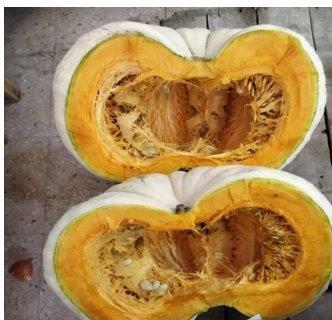
The skin of the Kızılinler bal kabağı ranges from white to grey tones. The flesh is yellow to orange in colour and has a partially sweet texture. The fruit may be elongated cylindrical, round, or flattened round in shape and exhibits slicing properties. The plant has a trailing growth habit with dense branching. Its leaves are dark green, broad, and hairy. The minimum brix value specified for the flesh is at least 5%. Thanks to suitable climatic and cultivation conditions, as well as deep, porous soils rich in minerals and organic matter, the weight of the fruit can exceed 20 kilograms. Major uses include preparation of squash dessert, jam, meals, and börek. The seeds are white to grey-cream in colour, broadly oval, and medium to large in size.
The cultivation of Kızılinler bal kabağı is carried out in open fields and involves the following stages:
The cultivation and all production stages of the Kızılinler bal kabağı must be carried out exclusively within the boundaries of the Tepebaşı and Odunpazarı districts of the province of Eskişehir, which confer its reputation and geographical identity.
Monitoring activities are conducted by a minimum three-member monitoring body composed of representatives from the Eskişehir Chamber of Commerce and the Eskişehir Provincial Directorate of Agriculture and Forestry, under the coordination of the Eskişehir Chamber of Commerce. Monitoring is carried out at least once annually; additional inspections may be conducted in response to complaints or as necessary. The key criteria assessed during monitoring include:
Any non-conformities identified are reported to the relevant parties, and monitoring results are documented and submitted annually to the Türk Patent ve Marka Kurumu in accordance with Law No. 6769 on Industrial Property.
Turk Patent and Trademark Office. "Kızılinler Bal Kabağı." Geographical Indications Portal. Accessed October 25, 2025. https://ci.turkpatent.gov.tr/cografi-isaretler/detay/12085
Turkish Patent and Trademark Office. "Kızılinler bal kabağı." Geographical Indication Registration Certificate. Accessed October 25, 2025. https://ci.turkpatent.gov.tr/Files/GeographicalSigns/e9ecd220-dcca-46f2-a350-d7f8768a2573.pdf

Type of Geographical Indication | Mahreç Sign | ||||||||
|---|---|---|---|---|---|---|---|---|---|
Registration Number | 1762 | ||||||||
Registration Date | 18.08.2025 | ||||||||
Product / Product Group(s) | Processed and Unprocessed Fruits Vegetables and Mushrooms | ||||||||
Province(s) | Eskişehir | ||||||||
Applicant/Registrant(s) | Eskişehir Chamber of Commerce | ||||||||
Product Characteristics
Cultivation Method
Geographical Boundary and Monitoring