


This article was automatically translated from the original Turkish version.
Köşek, derived from the Persian word keşk, is one of the oldest dishes in traditional Turk cuisine. Although its origins trace back to Central Asia, its preparation evolved and diversified as the Turks migrated to Anatolia, leading to regional variations and enriched recipes. Today, it is widely prepared across Iraq, Syria, Egypt, Southern Caucasus, and the Balkans.
Köşek is prepared throughout nearly every region of Türkiye and is consumed daily, but its preparation has become a tradition during socially significant ceremonies such as festivals, weddings, and military send-offs. In various parts of Anatolia, köşek is also known by different names such as herse, dövme pilavı, dövme aşı, aşür, etli aşüre.
The joint participation of men and women in preparing köşek, along with the rituals surrounding the dish, constitutes the Ceremonial Köşek Tradition. It is specially prepared and distributed during circumcision ceremonies, weddings, festivals, pilgrimages, communal rain prayers, mevlits, during the month of Muharram, auspicious occasions, and Hıdırellez.
This tradition is observed throughout Türkiye, but is especially prevalent in Çorum, Çankırı, Amasya, Sinop, Adana, Erzincan, Tokat, Tekirdağ, Aydın, Muş, Muğla, Uşak, Sivas, Kırşehir, İzmir, Antalya, Afyonkarahisar, and Kastamonu. Köşek is especially prepared in rural areas using the imece communal labor system. For family-specific ceremonies, the family provides the ingredients; for communal events, the community contributes according to their means. However, in all cases, the labor for preparing köşek is provided by the village population.
Every stage of preparing köşek—from the prolonged pounding of wheat and meat to constant stirring during cooking—carries symbolic meaning. When köşek is prepared for a wedding, the man sent to procure the wheat shaves meticulously, dons new clothing, and fetches the wheat from town. The wheat is then brought to the wedding accompanied by the sounds of davul and zurna. Through these customs, the ceremony reflects social unity and solidarity.
The Ceremonial Köşek Tradition was inscribed on UNESCO’s Representative List of the Intangible Cultural Heritage of Humanity in 2011.
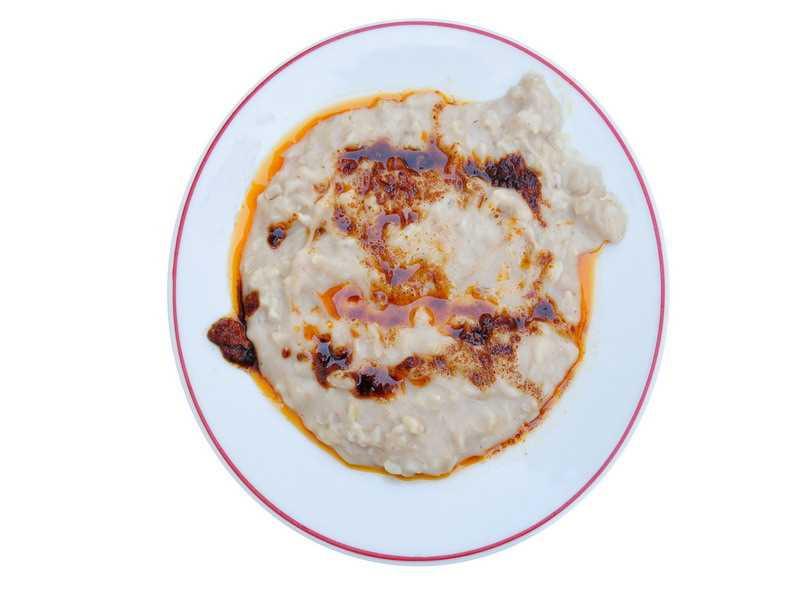
Köşek (Türkiye Kültür Portalı)
Köşek, a special occasion dish, is commonly prepared during weddings, festivals, and village celebrations. Each region has its own unique recipe. Some of these regions include Bursa, Merzifon, Afyonkarahisar, Ağrı, Aydın, Amasya, Adapazarı, Ordu, and Karabük.
The cleaned and washed 1 kg of wheat is boiled in a large pot. Once the wheat is thoroughly cooked and the kernels have split, the water is drained and the wheat is pounded. Separately, 1 kg of lamb is boiled. After cooking, the meat is removed from the broth and shredded into fine strands. The boiled and pounded wheat is transferred to a large pot, and the lamb broth is added. The shredded meat is then mixed into the wheat. The mixture is stirred continuously with a wooden spoon while being pounded on the side, until it reaches a gum-like consistency. In a separate pan, butter is heated and red pepper is sautéed. The finished köşek is served hot, with the red pepper sauce drizzled on top.
Türkiye Kültür Portalı. "Keşkek - Aydın." Accessed March 21, 2025.https://www.kulturportali.gov.tr/turkiye/aydin/neyenir/keskek623951
Türkiye Kültür Portalı. "Tören Keşkeği Geleneği." Accessed March 21, 2025.https://www.kulturportali.gov.tr/portal/torenkeskegigelenegi.
Çekiç, İbrahim, and Ali Özkan. "Geleneksel Tören Keşkeğinin Türk Gastronomisindeki Yeri ve Önemi." Uluslararası Türkçe Edebiyat Kültür Eğitim Dergisi 11, no. 1 (January 2022): 422–435.
İstanbul Gedik Üniversitesi. "Keşkek Hikayesi." Accessed March 21, 2025.https://uzemigunsem.gedik.edu.tr/keskek-hikayesi.

Ceremonial Köşek Tradition
Köşek Recipe (From the Aydın Region)
Ingredients
Preparation