This article was automatically translated from the original Turkish version.
+1 More
Name | Kepler-22b | ||||||||
|---|---|---|---|---|---|---|---|---|---|
Planet Type | Exoplanet (Super Earth) | ||||||||
Discovery Year(s) | 2011 | ||||||||
Star Type | G-type main-sequence star | ||||||||
Radius | Approximately 2.4 times the size of Earth | ||||||||
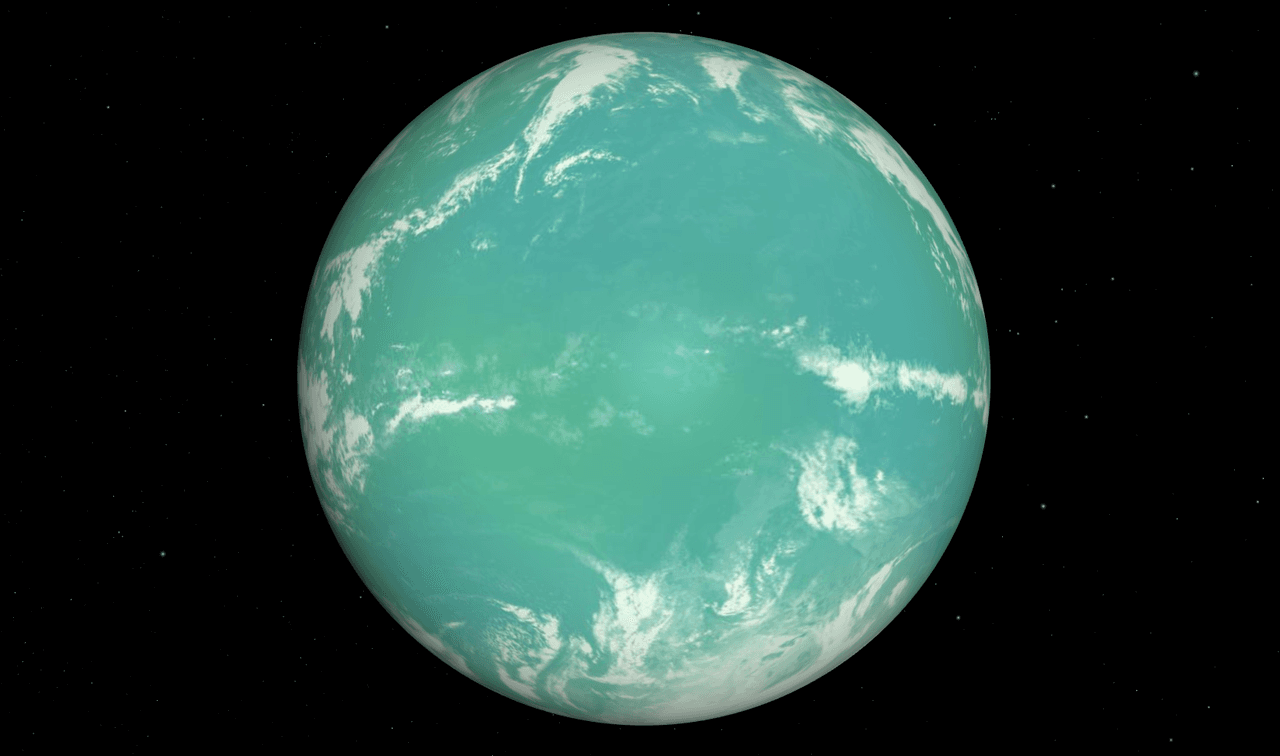
Kepler-22b is an exoplanet orbiting the G-type main-sequence star Kepler-22 and located within the star’s habitable zone. Planet was detected by NASA’s Kepler Space Telescope using the transit method and confirmed in 2011. Kepler-22b holds a special place in exoplanet research as the first transiting exoplanet confirmed to reside within the habitable zone.
Kepler-22b was discovered as part of NASA’s Kepler Mission. The Kepler Space Telescope aimed to detect planetary transits by observing periodic dips in the brightness of stars. Regular brightness reductions observed in Kepler-22 revealed the presence of a planetary candidate; subsequent observational analyses confirmed its planetary nature. Long-term photometric data and statistical evaluations were used to verify the discovery.
Kepler-22 is a G-type main-sequence star with spectral properties similar to those of the Sun. The star is located approximately 600 light years away. Kepler-22’s mass and luminosity are key factors determining the position of its habitable zone, within which Kepler-22b’s orbit lies.
Kepler-22b has an orbital period of approximately 289.9 Earth days. The planet’s orbital radius is estimated at approximately 0.81 astronomical units. 【1】 This orbital distance ensures that the amount of stellar energy received by the planet falls within a range that could permit liquid water to exist. However, this does not imply that surface conditions have been directly observed.
Kepler-22b has a radius approximately 2.4 times that of Earth. This measurement classifies the planet as a “super-Earth”. Since its mass has not been directly measured, its density and internal structure remain uncertain. Current data suggest that Kepler-22b could have a rocky, water-rich or thick gaseous composition, but it is not possible to determine which of these scenarios is accurate.
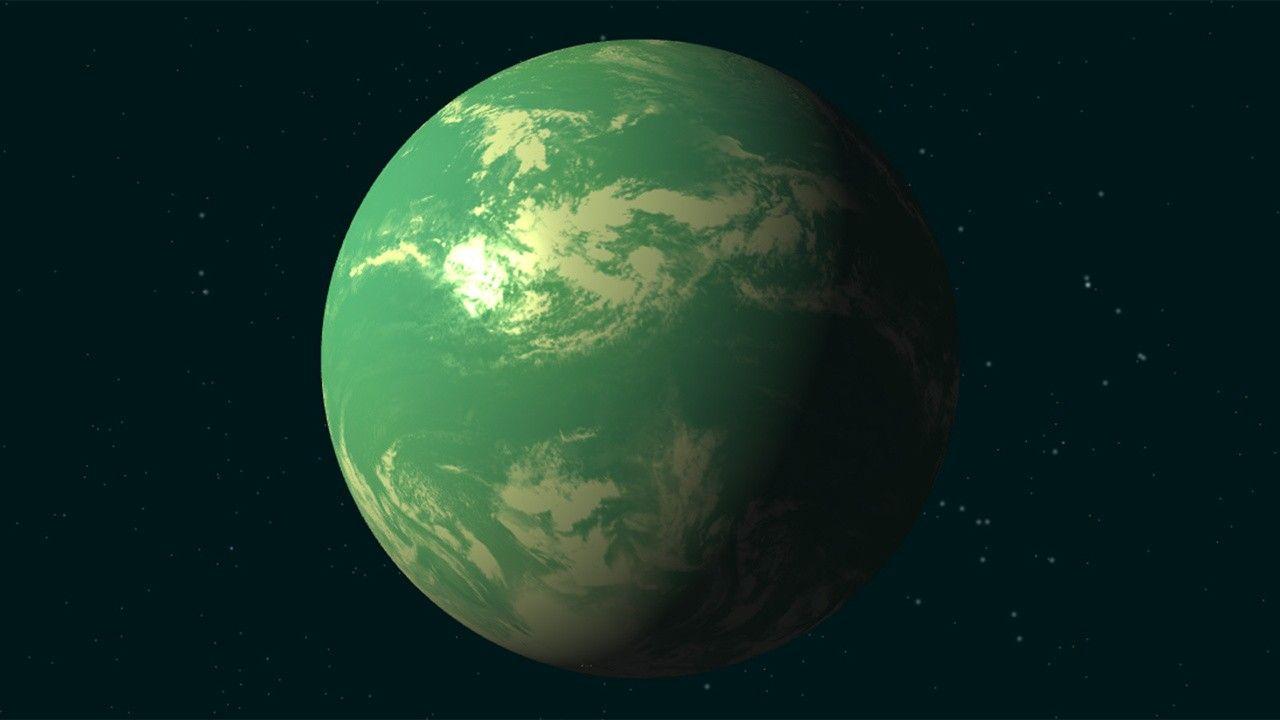
Kepler-22b (NASA)
No direct observational data on Kepler-22b’s atmosphere have been obtained. However, its size suggests the possibility of a thicker atmosphere than Earth’s. Scientific studies propose that such super-Earths may possess dense gaseous envelopes or high-pressure water-vapor atmospheres. Nevertheless, the existence and composition of Kepler-22b’s atmosphere remain unconfirmed.
Although Kepler-22b resides within the habitable zone, it does not provide direct evidence of habitability. The concept of the habitable zone refers only to the range of stellar energy receipt; without knowledge of surface temperature, atmospheric structure and chemical composition, no definitive assessment of habitability can be made.【2】 Nevertheless, Kepler-22b serves as an important comparative example in the study of exoplanets located within habitable zones.
The discovery of Kepler-22b has contributed to the statistical analysis of habitable zone exoplanets. This planet has been used as a reference object in the analysis of data from the Kepler mission and has served as a foundational example for modeling and comparative studies conducted in subsequent years. Additionally, Kepler-22b is frequently cited in research highlighting the physical and orbital diversity of super-Earth class planets.
Borucki, William J., David Koch, Gibor Basri, Natalie Batalha, Timothy Brown, Douglas Caldwell, John Christensen-Dalsgaard, et al. “Kepler-22b: A 2.4 EARTH-RADIUS PLANET IN THE HABITABLE ZONE OF A SUN-LIKE STAR.” *The Astrophysical Journal* 745, no. 2 (2012): 1–16. Accessed January 5, 2026.https://iopscience.iop.org/article/10.1088/0004-637X/745/2/120/meta
D. M. Kipping, D. Forgan, J. Hartman, D. Nesvorný, G. Á. Bakos, A. Schmitt, and L. Buchhav. “THE HUNT FOR EXOMOONS WITH KEPLER (HEK). III. THE FIRST SEARCH FOR AN EXOMOON AROUND A HABITABLE-ZONE PLANET.” *The Astrophysical Journal* 777, no. 2 (2013): 1–17. Accessed January 5, 2026.https://iopscience.iop.org/article/10.1088/0004-637X/777/2/134/meta
David Neubauer, Aron Vrtala, Johannes J. Leitner, Maria Gertrude Firneis, Regina Hitzenberger. "The life supporting zone of Kepler-22b and the Kepler planetary candidates: KOI268.01, KOI701.03, KOI854.01 and KOI1026.01."
NASA. "Kepler-22b." *NASA Scientific Exoplanet Catalog*. Accessed January 5, 2026.https://science.nasa.gov/exoplanet-catalog/kepler-22b/
Planetary and Space Science 73, no. 1 (2012): 397-406. Accessed January 5, 2026.
The Planetary Society. "Kepler-22b: Closer to Finding an Earth." The Planetary Society. Accessed January 5, 2026.https://www.planetary.org/space-images/kepler-22b-closer-to-finding-an-earth
[1]
D. M. Kipping, D. Forgan, J. Hartman, D. Nesvorný, G. Á. Bakos, A. Schmitt, ve L. Buchhav. “THE HUNT FOR EXOMOONS WITH KEPLER (HEK). III. THE FIRST SEARCH FOR AN EXOMOON AROUND A HABITABLE-ZONE PLANET,” The Astrophysical Journal 777, no. 2 (2013): syf 4, https://iopscience.iop.org/article/10.1088/0004-637X/777/2/134/meta
[2]
Borucki, William J., David Koch, Gibor Basri, Natalie Batalha, Timothy Brown, Douglas Caldwell, John Christensen-Dalsgaard ve diğerleri, “Kepler-22b: A 2.4 EARTH-RADIUS PLANET IN THE HABITABLE ZONE OF A SUN-LIKE STAR,” The Astrophysical Journal 745, no. 2 (2012): syf 15, https://iopscience.iop.org/article/10.1088/0004-637X/745/2/120/meta

Name | Kepler-22b | ||||||||
|---|---|---|---|---|---|---|---|---|---|
Planet Type | Exoplanet (Super Earth) | ||||||||
Discovery Year(s) | 2011 | ||||||||
Star Type | G-type main-sequence star | ||||||||
Radius | Approximately 2.4 times the size of Earth | ||||||||
Discovery Process
Host Star: Kepler-22
Orbital Characteristics
Physical Characteristics
Atmosphere and Composition Debates
Significance in the Habitable Zone Context
Role in Scientific Research