


This article was automatically translated from the original Turkish version.
+1 More
Location | Kemaliye Village Bursa Keles | ||||||||
|---|---|---|---|---|---|---|---|---|---|
Founder(s) | Hacı Osman son of Hacı Mehmet (local tradition) | ||||||||
Material(s) | Rubble stone wood | ||||||||
Important Features | Penwork botanical motifs, depiction of the Kaaba, symbolic representations, wooden minbar and ceiling boss | ||||||||
The Kemaliye Village Mosque, located in Kemaliye Village, Keles District of Bursa Province, is an important rural mosque constructed in the last quarter of the 19th century and reflecting the architectural and decorative sensibilities of its time. The structure is regarded as one of the notable examples of Ottoman religious architecture during the Westernization period, distinguished by its penwork decorations and rich woodwork. The mosque is also closely associated with the social and Sufi heritage of the village.
Kemaliye Village is situated approximately 8–11 km south of the Keles district center, on a sloping terrain oriented east-west. The settlement, mentioned in Ottoman chronicles, was established through the resettlement of the Kızılkeçili Yörüks and was known as “Kızılkise” until the Republican era. Remains of Byzantine-era architecture and a tekke, once known to have existed but now lost, were present in the village. The village’s Sufi legacy is also represented by the sacred beard relic preserved within the mosque and the banner inscribed with “Ya Hazreti Sultan Pir Şâbân-ı Velî.”
Although the exact construction date and founder of the mosque are unknown, local historical studies indicate that it was commissioned by Hacı Osman, son of Hacı Mehmet. The inscription “sene 1291” (1874–1875) above the entrance door likely indicates the date of the decorations and possibly the construction of the building. According to oral sources, the mosque’s decorative elements were executed by foreign artisans, particularly Greek painters. The structure and its ornamentation were restored in 2010 by the Bursa Metropolitan Municipality.
The mosque consists of a rectangular prayer hall oriented north-south and a final congregation area located to the north. The exterior walls are constructed using rubble stone and wood in a rubble technique. Wall thickness is approximately 90 cm. On the southern wall of the prayer hall is a semi-cylindrical mihrab niche; to its west is a wooden minbar and to its east a wooden pulpit. In the northern part of the prayer hall, a women’s gallery with a square plan rests on four wooden pillars and is accessed via a hidden staircase in the northwestern corner. At the center of the wooden ceiling is a recessed square section containing circular decorative elements executed in ajur technique. The ceiling boss and moldings are adorned with floral and leaf motifs.
Lighting is provided by two arched windows symmetrically placed on the qibla wall of the prayer hall and one arched window each on the eastern and western walls. In the final congregation area, there are four windows on the northern wall and one each on the eastern and western walls. The minaret, located approximately 2–3 meters northwest of the mosque, was reconstructed in reinforced concrete in the 1980s; photographs from the village archive confirm that the original minaret was made of wood.
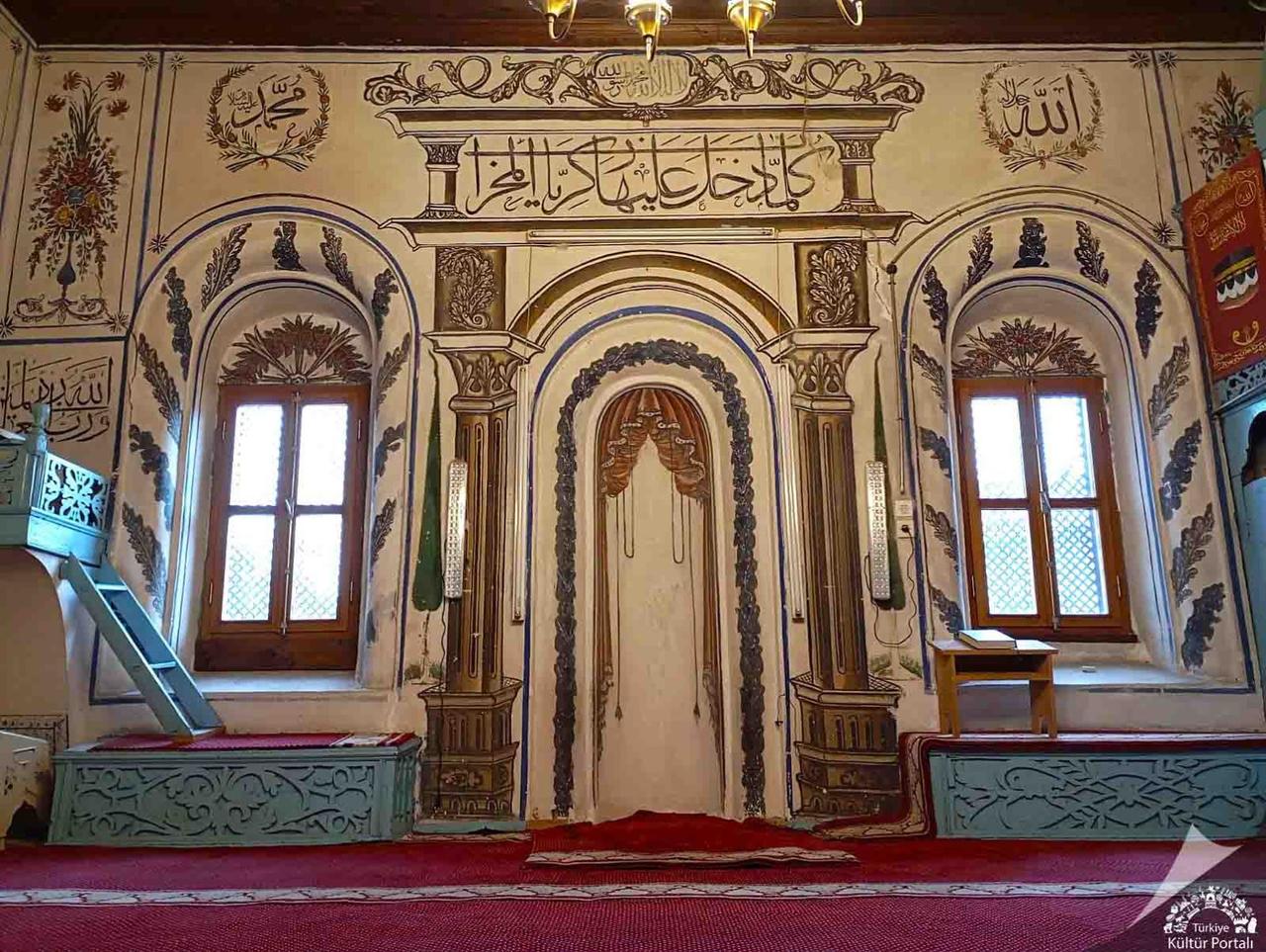
Despite its plain exterior, the Kemaliye Village Mosque stands out for its rich interior decorations. The walls of the prayer hall and final congregation area are adorned with penwork decorations featuring vegetal, architectural, and figurative motifs. The wall surfaces are divided horizontally into three main zones: the upper section contains panels of square and rectangular shapes decorated with floral bouquets, cypress trees, architectural structures, and depictions of the Kaaba. The lower section is painted to imitate marble.
The semi-cylindrical mihrab niche on the southern wall is decorated with a red velvet curtain motif and framed by baroque-style vegetal borders. On either side of the mihrab are fluted columns in the Ionian style, with capitals featuring kenger and acanthus leaves. Between the columns is the verse “Küllema dehale Zekeriyya’l-mihrab,” while above it appears the inscription “La ilahe illallah Muhammedün Resulullah.”
The wooden minbar is decorated with carved vegetal motifs on its balustrades and stair railings. The pulpit has a square plan, is supported by wooden consoles, and features a simple railing.
In the building, the names of Allah, Muhammad, the Four Caliphs, Hasan and Husayn, along with various Quranic verses, are written in black sulus, talik, and kufic scripts. Panels featuring Surah Al-Fath, Surah Al-Buruj, and the Basmala are particularly notable. Although there is no deliberate compositional arrangement in the placement of the inscriptions, they are generally framed by vegetal motifs.
The Kemaliye Village Mosque is one of the rare surviving examples of the penwork decorative style characteristic of Ottoman rural mosques during the Westernization period. Its rich repertoire of vegetal motifs, architectural depictions, and symbolic elements—such as the cypress, sheaf of grain, watermelon-dagger, and banners—allow for Sufi interpretations. This decorative program, reflecting the religious and aesthetic preferences of the local community, demonstrates the increasing prevalence of pictorial representation in Anatolian religious architecture in the late 19th century.
Algaç, Şeyda. “Bursa/Keles Kemaliye Köyü Camii ve Duvar Resimleri.” *Art-Sanat* 18 (2022): 1–31. https://doi.org/10.26650/artsanat.2022.18.1032694.
Gülgen, Hicabi. “Dinî Mimaride Batılılaşma Dönemi Duvar Resimlerine Bir Örnek: Kemaliye Köyü Camii.” *Uludağ İlahiyat Dergisi* 33/1 (June 2024): 57–83. https://doi.org/10.51447/uluid.1470769.
Ministry of Culture and Tourism. "Kemaliye Köyü Camii." Kültür Portalı. Accessed August 16, 2025. https://kulturportali.gov.tr/turkiye/bursa/gezilecekyer/kemaliye-koyu-camii
Location | Kemaliye Village Bursa Keles | ||||||||
|---|---|---|---|---|---|---|---|---|---|
Founder(s) | Hacı Osman son of Hacı Mehmet (local tradition) | ||||||||
Material(s) | Rubble stone wood | ||||||||
Important Features | Penwork botanical motifs, depiction of the Kaaba, symbolic representations, wooden minbar and ceiling boss | ||||||||
No Discussion Added Yet
Start discussion for "Kemaliye Village Mosque" article
Location and History
Architectural Features
Decorative Program
Mihrab
Minbar and Pulpit
Wall Paintings
Inscriptions
Art Historical Significance