


This article was automatically translated from the original Turkish version.
Karate
Origin | Japan | ||||||||
|---|---|---|---|---|---|---|---|---|---|
Field | Martial Arts | ||||||||
Clothing Names | Karate-gi | ||||||||
Students' Names | Karate-ka | ||||||||
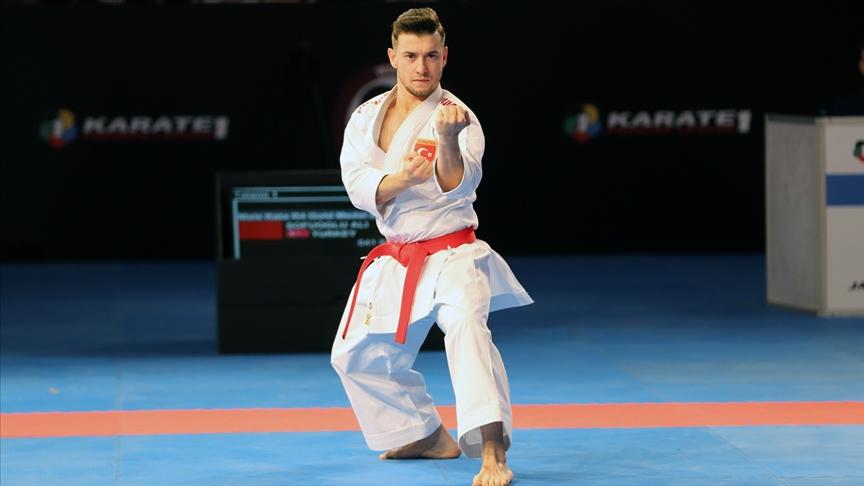
Karate is a martial discipline composed of dynamic attack and defense techniques that employ all parts of the body in an active manner, defined as a martial art without weapons. It is derived from the Japanese words “kara” (empty) and “te” (hand), meaning “empty hand.” The term “Karate-Do” is used to express its adoption as a philosophy of life, with the suffix “do” (way) added to signify the path of personal development.

2013 Mediterranean Games, Photo: Anadolu Agency.
The history of Karate-Do extends back to Indian and Chinese like Asian cultural traditions. Various martial arts transmitted along the Silk Road to China were blended with local techniques and later transferred to Okinawa Island. Located in the Pacific Ocean and the largest of the Formosa island chain, Okinawa has historically been subject to invasions and occupations by China and Japan due to its geopolitical position, accelerating cultural and military interaction on the island. The islanders combined diverse combat techniques with their own fighting philosophy to develop a unique system known as Okinawa-Te, which forms the foundation of modern karate.
Recognized as the founder of modern karate, Funakoshi Gichin was born into an Okinawan samurai family and received training at an early age from renowned masters such as Anko Itosu and Azato Yatsune. While pursuing his education, Funakoshi continued his karate studies and, after being appointed as a teacher, began systematizing karate, deepening the process by sharing his methods with his instructors.
In 1906, Funakoshi introduced his method at the Okinawa Tang Te dojo. Observing growing interest in martial arts in Japan, he decided to bring karate to the Japanese mainland. He gained widespread acclaim through demonstrations at festivals and, encouraged by Dr. Jigoro Kano, the founder of modern judo, and artist Hoan Kasugi, settled in Tokyo. There, he published his first book in 1922, spearheaded the establishment of the Tokyo Military Karate Dojo, and contributed to the founding of numerous university dojos, beginning with the Keio University Karate Club. In 1936, the world’s first karate dojo, built by his students and named “Shotokan,” became synonymous with the method he developed.
Under Funakoshi’s leadership, karate gained great popularity in Japan, prompting Okinawan masters to establish their own schools on the mainland. Today, four major traditional karate schools are recognized worldwide: Shotokan, Shito-Ryu (Kenwa Mabuni, 1893–1957), Goju-Ryu (Chojun Miyagi, 1888–1953), and Wado-Ryu (Hironori Ohtsuka, 1893–1957).
Shotokan is the first form of modern karate developed by Funakoshi Gichin. It emphasizes a balanced development of speed, power, and technique variety. It is the most widely practiced karate style globally. Training consists of three main components:
W.S.K.F. was established in 1990 by Japanese instructor Hitoshi Kasuya (8th Dan). The federation aims to preserve the standards of Shotokan worldwide and has spread to over 70 countries. Kasuya supports the international karate community by organizing two training seminars annually. Some dojos in Türkiye are members of this federation.
In karate training, practitioners’ levels are indicated by belts of different colors. The beginner level is the white belt, and as experience increases, the belt color darkens until reaching black. Colored belts represent Kyu ranks, while the black belt signifies mastery at the Dan level.
The belt ranks are as follows:
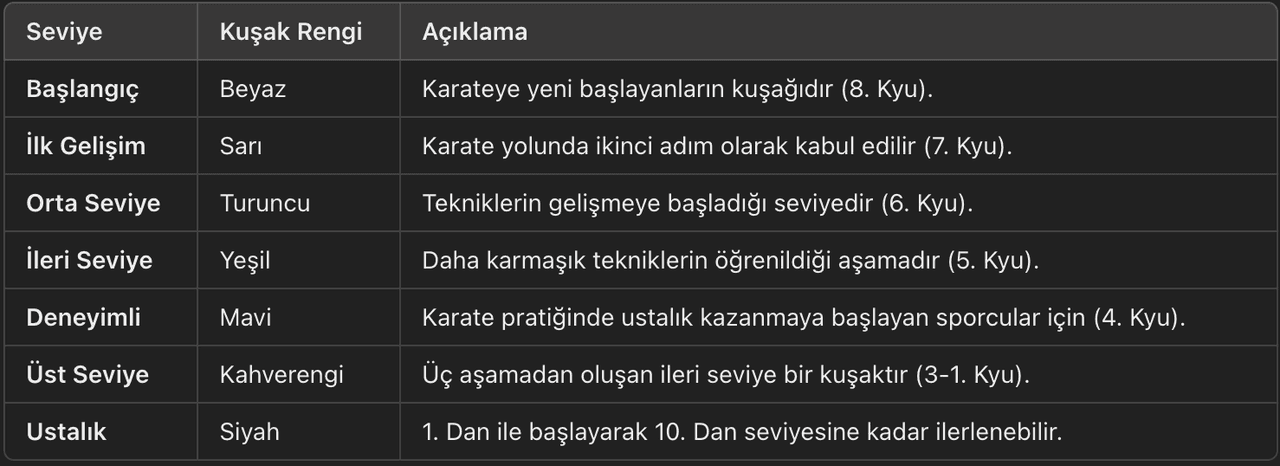
Rank levels and corresponding colors in karate.
Karate gained national federations in Europe in the 1960s, with the first European championship held in 1966 and the first world championship in 1970. In Türkiye, karate activities were initiated in Istanbul between 1969 and 1970 by Sensei Hakkı Koşar. Within a short time, integration with the European and global karate community was achieved, and Turk athletes drew attention through their achievements in international competitions.
"Karate Nedir?" Karate Turkey, March 5, 2025. Accessed March 5, 2025.https://karateturkey.org/karate-nedir/.
"Karate Tarihçesi." Türkiye Karate Federasyonu, March 5, 2025. Accessed March 5, 2025.
"Karate-Do." Orta Doğu Teknik Üniversitesi Karate-Do Kulübü, March 5, 2025. Accessed March 5, 2025.https://kdo.metu.edu.tr/karate-do/.

Karate
Origin | Japan | ||||||||
|---|---|---|---|---|---|---|---|---|---|
Field | Martial Arts | ||||||||
Clothing Names | Karate-gi | ||||||||
Students' Names | Karate-ka | ||||||||
Origins and Development
Funakoshi Gichin and Modern Karate
The Four Traditional Japanese Karate Schools
Shotokan Karate-Do
World Shotokan Karate-Do Federation (W.S.K.F.)
Details and Training
Karate-Do in Türkiye