


This article was automatically translated from the original Turkish version.
+2 More
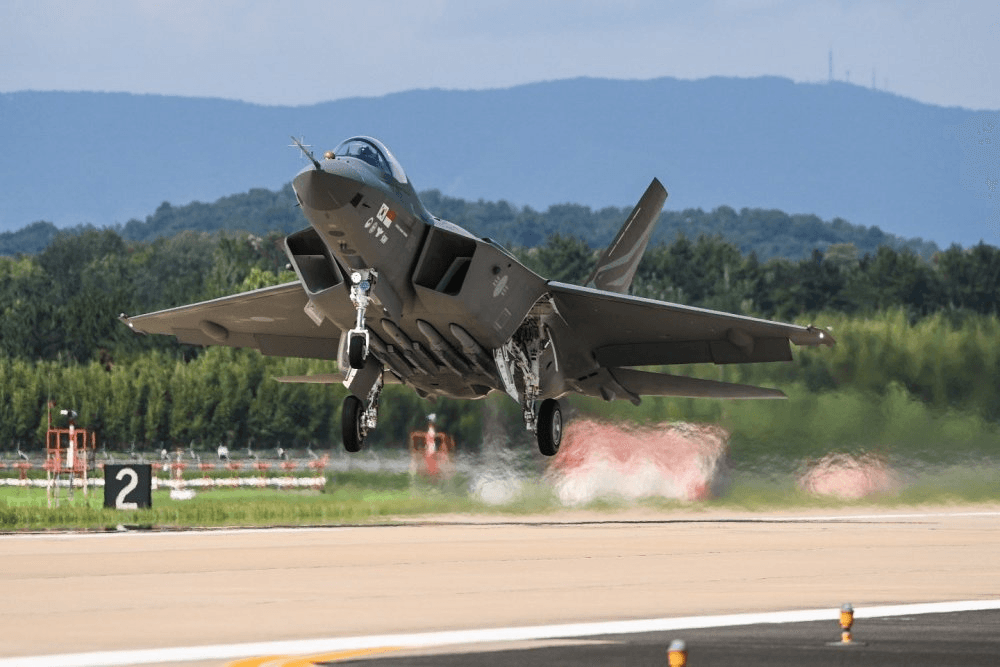
KAI KF-21 Boramae
Producer | Korea Aerospace Industries (KAI) and Indonesia | ||||||||
|---|---|---|---|---|---|---|---|---|---|
First Flight | 19 July 2022 (prototype) | ||||||||
Entry into Service | Planned: 2026 (Republic of Korea Air Force) | ||||||||
Aircraft Type | 4.5th generation multirole fighter aircraft | ||||||||
Length | 16.9 metres | ||||||||
Wingspan | 11.2 metres | ||||||||
Height | 4.7 metres | ||||||||
Maximum Takeoff Weight (MTOW) | 25,400 kg | ||||||||
Engine | 2 × General Electric F414-GE-400K turbofan | ||||||||
Maximum Speed | Mach 1.81 | ||||||||
Thrust | each approximately 22,000 lbf (97.9 kN) | ||||||||
KAI KF-21 Boramae is a twin-engine, multirole fighter aircraft classified as a 4.5-generation platform, jointly developed by Türkiye and Indonesia. "Boramae" means "falcon" in Korean, a name symbolizing the aircraft’s agility and air-to-air combat capabilities. Designed for the Republic of Korea Air Force (ROKAF) and the Indonesian National Armed Forces Air Force (TNI-AU), the KF-21 is capable of performing both air-to-air and air-to-ground missions with high effectiveness. The KF-21 project represents South Korea’s second domestically developed fighter jet program, following the FA-50 Golden Eagle, a light attack and trainer aircraft. This initiative aims to enhance South Korea’s technological independence in its defense industry, demonstrate advanced fighter aircraft development capabilities, and modernize its air forces.

KAI KF-21 Boramae (savunmatr)
The KF-21 project emerged from the need for a technologically superior platform to replace aging fighter aircraft such as the F-4 Phantom II and F-5 Freedom Fighter, which had served South Korea for decades but no longer met the demands of modern combat environments. The primary contractor is Korea Aerospace Industries (KAI), South Korea’s leading aerospace and defense company, while Indonesia joined as a key partner to share development costs and secure technology transfer. The project is also known as the "Korean Fighter eXperimental" (KF-X).
The development of the KF-21 is planned in two main phases:
Future development phases may include the integration of internal weapons bays to reduce the aircraft’s radar cross-section (RCS) and enhance its stealth characteristics.
KAI KF-21 Boramae (Haci Producitons)
South Korea aims to receive at least 40 KF-21 Block 1 aircraft by 2028 as part of its air force modernization program, and to increase this number to a total of 120 by 2032. With Indonesia’s participation as a partner, it is expected that Indonesia will also procure a specified number of KF-21s.
Under the KF-21 project, various variants are planned to meet different operational requirements. The currently known primary variants include:
Army Recognition. "South Korea's KF-21 Boramae Twin-Seater Fighter Jet Steps Closer to Deployment Following Latest Test Flight." Accessed May 1, 2025.https://armyrecognition.com/news/aerospace-news/2025/south-koreas-kf-21-boramae-twin-seater-fighter-jet-steps-closer-to-deployment-following-latest-test-flight.
Army Recognition. "South Korea’s KAI KF-21 Set to Become World’s Safest Fifth-Gen Fighter Jet." Accessed May 1, 2025.https://armyrecognition.com/focus-analysis-conflicts/army/defence-security-industry-technology/south-koreas-kai-kf-21-set-to-become-worlds-safest-fifth-gen-fighter-jet.
Defence Security Asia. "South Korea Develops Three Distinct Variants of KF-21 Boramae Fighter Jet." Accessed May 1, 2025.https://defencesecurityasia.com/en/south-korea-develops-three-distinct-variants-of-kf-21-boramae-fighter-jet-2/#google_vignette. Korea Aerospace Industries. "KF-21 Boramae." Accessed May 1, 2025.https://m.koreaaero.com/EN/Business/KF21.aspx.
MilitaryFactory.com. "KAI KF-21 Boramae (KF-X) 5th Generation Multirole Fighter Aircraft." Accessed May 1, 2025.https://www.militaryfactory.com/aircraft/detail.php?aircraft_id=1035
SavunmaTR. "Fotoğraf." Accessed May 1, 2025.https://www.savunmatr.com/wp-content/uploads/2024/06/kai-kf-21-1140x815.jpg.https://www.savunmatr.com/wp-content/uploads/2024/09/kf21.jpeg
SavunmaTR. "KAI KF-21 Boramae Nedir, Özellikleri Nelerdir?" Accessed May 1, 2025.
YouTube. "KAI KF-21 Boramae." Accessed May 1, 2025.https://www.youtube.com/watch?v=0mvSZ45HnWQ

KAI KF-21 Boramae
Producer | Korea Aerospace Industries (KAI) and Indonesia | ||||||||
|---|---|---|---|---|---|---|---|---|---|
First Flight | 19 July 2022 (prototype) | ||||||||
Entry into Service | Planned: 2026 (Republic of Korea Air Force) | ||||||||
Aircraft Type | 4.5th generation multirole fighter aircraft | ||||||||
Length | 16.9 metres | ||||||||
Wingspan | 11.2 metres | ||||||||
Height | 4.7 metres | ||||||||
Maximum Takeoff Weight (MTOW) | 25,400 kg | ||||||||
Engine | 2 × General Electric F414-GE-400K turbofan | ||||||||
Maximum Speed | Mach 1.81 | ||||||||
Thrust | each approximately 22,000 lbf (97.9 kN) | ||||||||
Development Process: Partnership and Phases
Technical Specifications (Estimated Values)
Operational Expectations and Variants