


This article was automatically translated from the original Turkish version.
+1 More
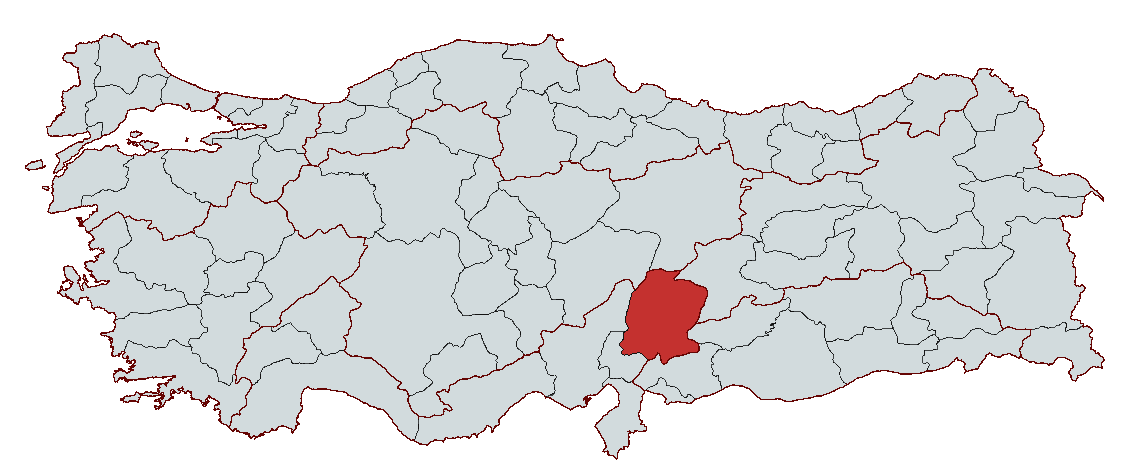
Kahramanmaraş
Country | Türkiye | ||||||||
|---|---|---|---|---|---|---|---|---|---|
Region | Mediterranean | ||||||||
Population | 1,134,105 people | ||||||||
Area | 14,525 km² | ||||||||
Climate Type | Mediterranean and Continental Climate Transition | ||||||||
Important Structure | Taş Han Kahramanmaraş Castle Germanicia Ancient City Mosaics Eshab-ı Kehf Külliyesi | ||||||||
Area Code(s) | 344 | ||||||||
License Plate Code | 46 | ||||||||
Governor | Mükerrem Ünlüler | ||||||||
Mayor | Fırat Görgel | ||||||||
Kahramanmaraş is one of the significant cities of Türkiye’s Mediterranean Region, located in the region and distinguished by its historical and cultural richness. With an area of approximately 14,525 square kilometers, Kahramanmaraş is among the medium-sized provinces of the country and has served as a home to various civilizations throughout history, thereby incorporating diverse cultural elements. The city is particularly renowned for its ice cream, coppersmithing art, and rich cuisine.
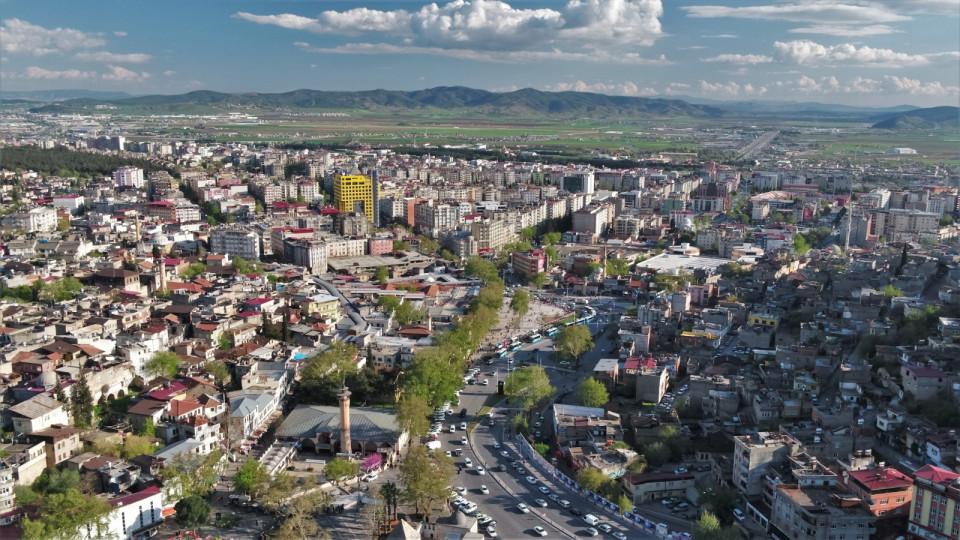
Kahramanmaraş Center (Source)
There are differing views regarding the origin and meaning of the name Maraş. According to the renowned historian Herodotus, the city was founded by the Hittite commander Maraj, after whom it was named “Maraj.” In antiquity, the city was known as “Markasi”; when the Roman Empire took control of the region in the 1st century AD, it was renamed “Germanikeia” in honor of Emperor Caligula. During the Byzantine period, it was referred to as “Marasion.”
After the Muslim conquest of the region, the city’s original name was adapted to conform to the Arabic alphabet, becoming known as “Mer’aş.” Since the Arabic alphabet lacks the letter “J,” the name underwent this transformation. Others claim that the name Maraş derives from the verb “Re’aşa,” meaning “earthquake” or “tremor.”
During the Ottoman period, the region was also known as “Zülkadir” following the establishment of the Dulkadiroğulları Beylik. In the Republican era, due to its heroic resistance during the War of Independence, the city’s name was officially changed to “Kahramanmaraş” on 7 February 1973.
Research conducted in the Döngel Caves indicates that human settlement in the region began in the Upper Paleolithic Age and continued through the Neolithic and Early Bronze Ages. During the Middle Bronze Age (2000–1500 BC), the region lay at a crucial crossroads connecting Syria and Mesopotamia with Cappadocia and other parts of Anatolia along major caravan routes.
Markasi (Maraş) was the center of Gurgum, one of the Hittite states established during the decline of the Hittite Empire. Gurgum alternately submitted to the Urartians and Assyrians over successive periods. In the 7th century BC, Markasi suffered invasions by the Cimmerians and Scythians, later falling under Median and Persian rule, and finally coming under Macedonian control in 333 BC. The region changed hands repeatedly between the Kingdom of Pontus and Rome, ultimately becoming part of the Roman Empire, when its name was changed to Germanikeia.
Following the brief establishment of a kingdom in the region by the Roman commander Lucullus, Pompey reincorporated Markasi into Roman territory in 64 BC. The city, renamed Germanikeia in honor of Emperor Caligula, was known as Marasion during the Byzantine era. The region, subjected to Arab raids, frequently changed hands due to conflicts between the Byzantines and the Arabs.
Anatolia was Turkified by the Seljuks in the 11th and 12th centuries and came to be known to Westerners as “Türkiye” (Turcia). Maraş came under Seljuk control in 1079 and was subsequently governed by the Danişmendids, Crusaders, the Armenian Kingdom of Cilicia, the Ayyubids, and the Mamluks.
In 1335, Dulkadiroğulları Bey Karaca, together with his son Halil Bey, seized Maraş and established a large beylik encompassing Maraş, Besni, Malatya, Harput, and Elbistan. Maraş passed under Dulkadiroğulları rule in 1339 and remained under their governance until 1515. In 1515, the Ottomans ended the Dulkadiroğulları Beylik, annexed Maraş, and in 1522 incorporated it into the Zulkadiriye Eyalet.
After Yavuz Sultan Selim incorporated the beylik into the Ottoman Empire in 1515, Maraş became a beylik encompassing the sanjaks of Malatya, Gaziantep, Zülkadriye, and Sümeysat, and remained an important province center. In the late Ottoman period, from 1866 onward, Maraş was attached to the Aleppo Vilayet and became the Maraş Sanjak, incorporating the kazas of Elbistan, Göksun, Pazarcık, and Andırın. This sanjak was bordered by the Sivas Eyalet to the north, the Malatya Sanjak to the east, the Aleppo center Sanjak to the south, and the Adana Vilayet to the southwest. The sanjak center was established at the foot of Ahır Dağı, 154 kilometers from Aleppo’s provincial capital. The sanjak’s geography consisted of a partially flat and mostly mountainous terrain.
In 1915, Maraş became an independent sanjak and from 1920 onward was elevated to a province with the districts of Andırın, Göksun, Elbistan, and Pazarcık. The districts of Afşin and Türkoğlu were added in 1944 and 1960 respectively.
Following the Armistice of Mudros, Maraş was occupied by the British on 22 February 1919, but they soon withdrew and handed control to the French. The resistance against the French, initiated on 31 October 1919 under the leadership of Sütçü İmam, received strong support from the local population.
The Flag Incident on 27 November 1919 intensified opposition to the occupation. On 21 January 1920, the struggle in the city intensified through clashes with Arabs and Harabe forces. After 22 days and nights of resistance, the people of Maraş achieved a major victory and forced the French to withdraw from the city on 11 February 1920.
On 5 April 1925, the Grand National Assembly of Türkiye awarded Maraş the Independence Medal, and on 7 February 1973, the city’s name was officially changed to Kahramanmaraş. Throughout the 20th century, Kahramanmaraş witnessed significant developments in industry and agriculture and has now become one of the region’s most important industrial and trade centers.
Kahramanmaraş is located in the northeastern part of Türkiye’s Mediterranean Region. It borders Sivas and Malatya to the north, Kayseri and Adana to the west, Osmaniye and Gaziantep to the south, and Adıyaman to the east. The city, situated at an elevation of 610 meters above sea level, has historically served as an important transportation hub. Its strategic position at the intersection of roads connecting Kayseri, Sivas, Malatya, Besni, Gaziantep, Antakya, and Adana strengthens its significance.
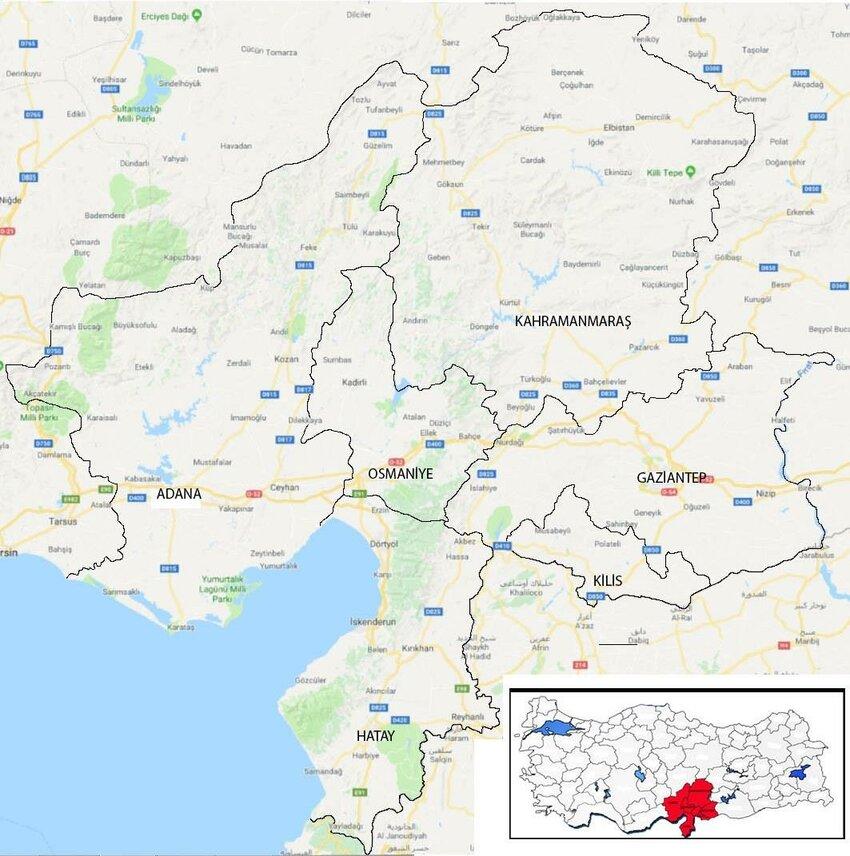
The region exhibits characteristics of both Mediterranean and continental climates. Summers are hot and dry, while winters are cold and rainy. High temperatures are recorded during the summer months, and snowfall is prevalent, especially in higher elevations during winter.
The Afşin-Elbistan lignite deposits are among Türkiye’s largest and play a critical role in energy production. Additionally, traditional crafts such as woodworking and coppersmithing have developed significantly, drawing upon the region’s natural resources.
Kahramanmaraş’s population has changed over the years. According to the 2025 estimated data from the Address-Based Population Registration System (ADNKS), the province’s total population is projected at 1,134,105. This figure is calculated based on previous years’ population growth rates. With an area of 14,525 km², the population density is 78 people per square kilometer.
Educational levels differ between rural and urban areas. Literacy rates are lower in rural regions, while education levels are higher in the city center. This situation is considered one of the factors encouraging migration from rural areas to the urban center.
Onikişubat is the most populous district of Kahramanmaraş, with a population of 436,385. Dulkadiroğlu, the second most populous district, has a population of 217,530. Elbistan, with a population of 130,246, is the third most populous district. These three districts constitute a significant portion of the city’s total population.
Finally, the 7.8 magnitude earthquake on 6 February 2023 caused extensive destruction in Kahramanmaraş and significantly affected population mobility. After the earthquake, many residents were forced to migrate to neighboring provinces and other regions.
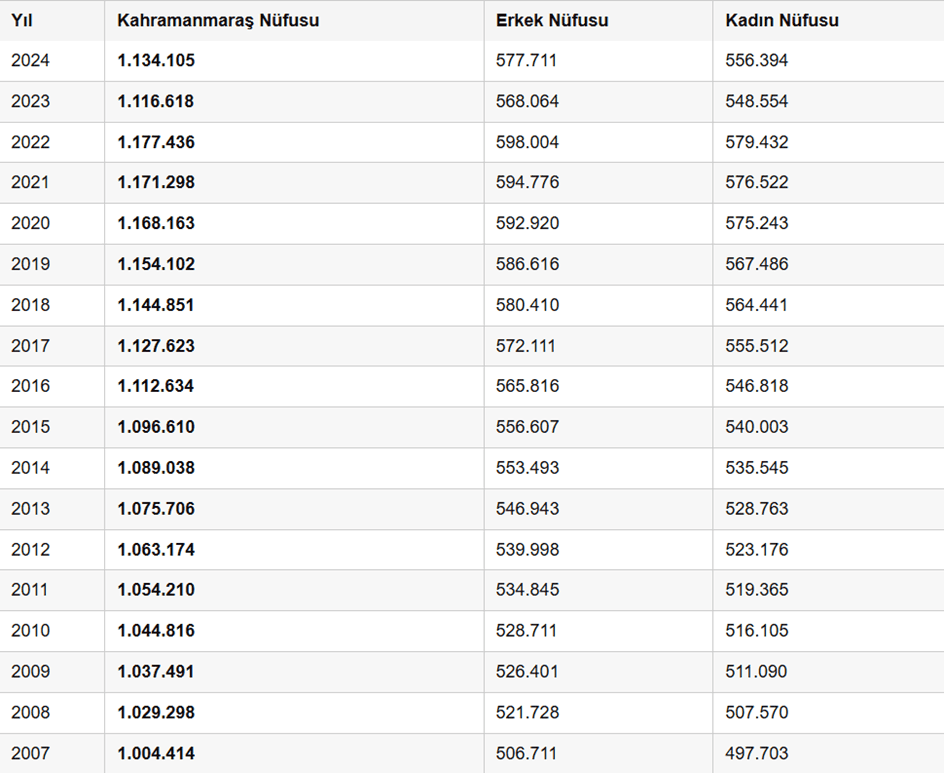
Kahramanmaraş Population by Year (Source)
Kahramanmaraş consists of 11 districts. According to 2024 population data, the districts’ populations are as follows:
The city’s total population is recorded as 1,134,105.
Main Industries: Textile, food, metal processing, and energy sectors form the foundation of Kahramanmaraş’s economy.
Trade and Industry: Organized industrial zones and manufacturing facilities producing yarn and fabric play a major role in the city’s economic structure.
Tourism: Kapıcam Nature Park, the ancient mosaics of Germanicia, and historic guesthouses attract tourists.
Kahramanmaraş is one of Türkiye’s important cultural centers, known for its rich historical heritage, cuisine culture, and traditional crafts. The city, recognized for its geographical indications, traditional crafts, and unique flavors, transmits its cultural values from generation to generation.
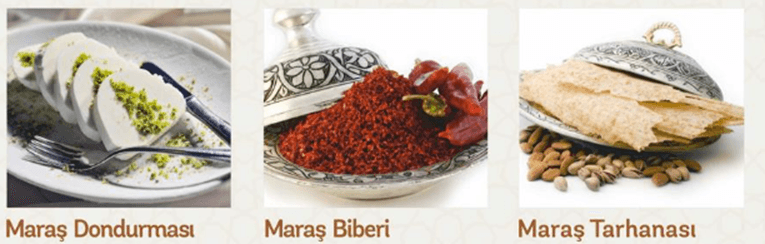
Geographical indications are important certifications that define a product’s unique qualities, reputation, and origin. These certifications ensure the protection, promotion, and transmission of products produced according to specific production criteria. Within Kahramanmaraş’s rich culinary culture and traditional crafts, 30 products have received geographical indication certification. Some of the most representative values reflecting the city’s cultural heritage and craftsmanship include:
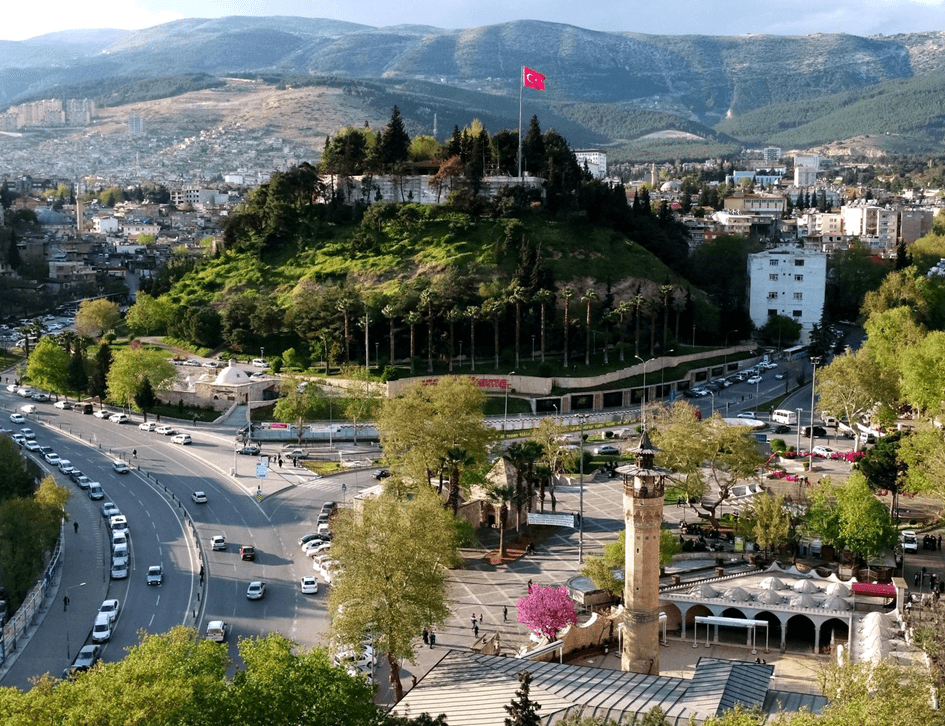
Kahramanmaraş Castle (Source)
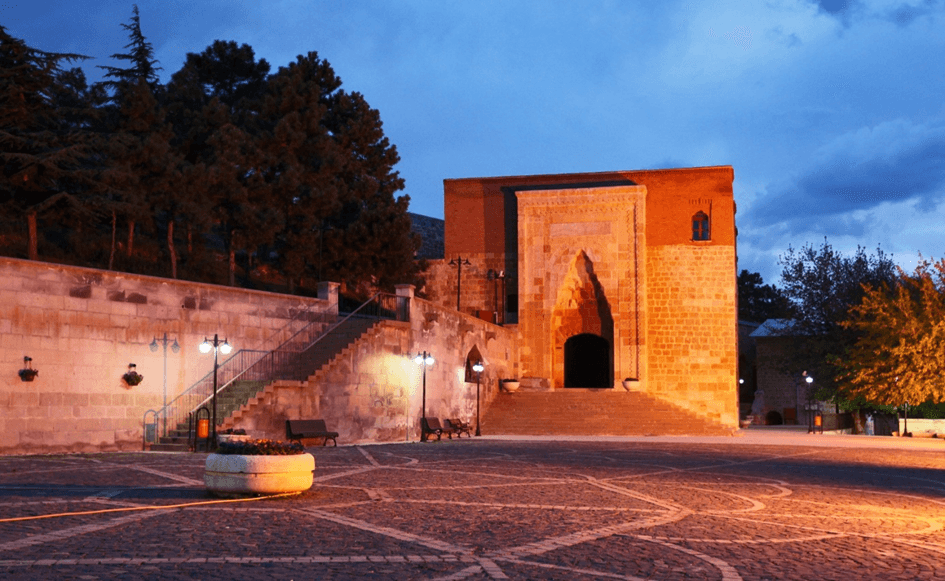
Eshab-ı Kehf Külliyesi (Source)
Kahramanmaraş is a city known as the “City of Poets.” Many important poets and writers who shaped Turkish literature were born here and reflected the city’s cultural fabric and social structure in their works. Kahramanmaraş’s literary identity is rooted in both divan poetry and folk literature.
Yedi Güzel Adam: Kahramanmaraş has hosted the literary figures known as the “Yedi Güzel Adam” (Seven Beautiful Men). These writers gathered around the “Mavera” magazine in the 1970s and produced significant works that shaped Turkish thought and literature. The poets and writers known as the “Yedi Güzel Adam” are:
These writers opened a new chapter in literature and intellectual life through their writings in magazines such as Mavera, Edebiyat, and Diriliş from the 1970s onward.
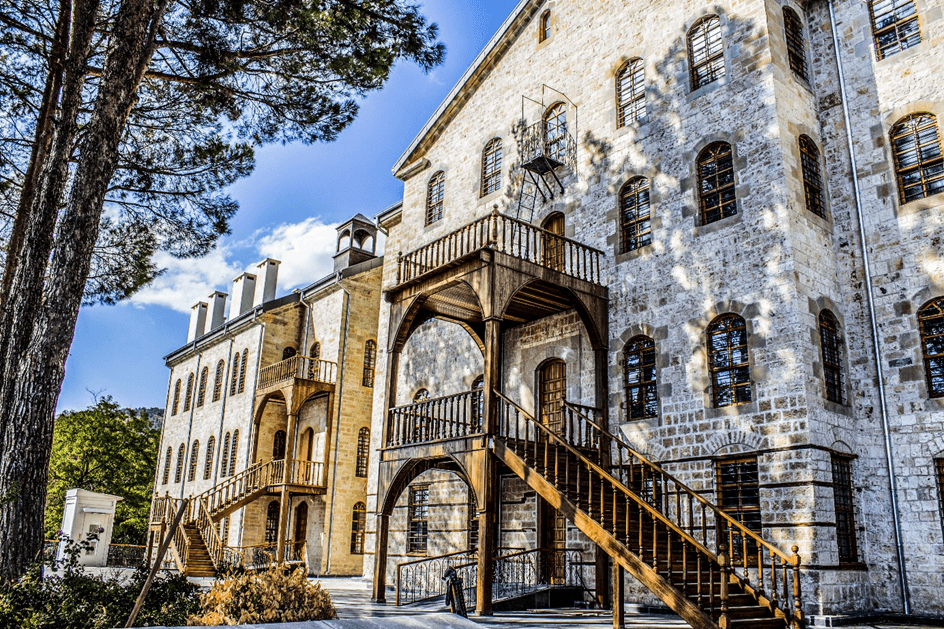
Yedi Güzel Adam Literature Museum (Source)
Kahramanmaraş is also an important center for folk literature. The Aşık tradition has remained alive in the city for centuries. Aşıks preserved oral literature by transforming the people’s emotions and thoughts into verse and addressing social events.
Abdurrahim Karakoç (1932–2012): His poem “Mihriban,” rooted in the folk poetry tradition, has become one of the most famous pieces of Turkish folk music and has been composed and performed by many artists.
He merged the folk literature tradition with modern poetic sensibility through poems containing social criticism and satire. Works such as “Vur Emri,” “Hasan’a Mektuplar,” and “İsyanlı Sükût” reached wide audiences.
Aşık Mahzuni Şerif (1940–2002): One of the most important ozans produced by Kahramanmaraş, he left deep marks in folk music, particularly known for his critical poems on social issues. Works such as “Dostum Dostum,” “Dom Dom Kurşunu,” and “Yuh Yuh” stirred great reverberation.
Folk Music: Maraş folk songs typically address themes of love, exile, heroism, and melancholy. Notable regional songs include “Fadime’nin Düğünü,” “Maraş’tan Bir News Came,” “Gelin Oldun Gidiyorsun,” and “Zülüf Dökülmüş Yüze.”
Regional Instruments and Musical Culture: The most commonly used instruments in Kahramanmaraş music are:
Musical Culture and Festivals: The musical culture of Kahramanmaraş manifests in many aspects of life, from weddings and holidays to festivals. The annual International Kahramanmaraş Poetry and Literature Days are among the most important events bringing together poets and folk music artists.
Kahramanmaraş is accessible by road, air, and rail. Kahramanmaraş Airport provides domestic flight services. The city also has strong road connections to neighboring provinces. Rail transport plays a significant role in freight logistics.
The city has a well-developed health infrastructure with numerous public and private hospitals. Kahramanmaraş Sütçü İmam University serves as the city’s most important higher education institution, contributing significantly to academic and health sectors through its various faculties and research hospital. Additionally, the education infrastructure has been strengthened by numerous public and private schools.
Anadolu’yu Geziyorum. Kahramanmaraş’ta Gezilecek Yerler. Accessed February 12, 2025.https://anadoluyugeziyorum.com/gezi-rehberi/kahramanmaras-ta-gezilecek--yerler.
Devlet Hava Meydanları İşletmesi (DHMİ). *Kahramanmaraş Havalimanı - Şehir Tarihçesi*. Accessed February 12, 2025.https://www.dhmi.gov.tr/Sayfalar/Havalimani/Kahramanmaras/SehirTarihcesi.aspx.
Doğu Akdeniz Kalkınma Ajansı (DOĞAKA). *İlk Bakışta Kahramanmaraş*. Accessed February 12, 2025.https://www.dogaka.gov.tr/dogu-akdeniz/kahramanmaras/ilk-bakista-kahramanmaras.
Kahramanmaraş Büyükşehir Municipality. "22 Gün 22 Gece Savaş ve Maraş’ın Düşman İşgalinden Kurtuluşu." Accessed February 12, 2025.https://kahramanmaras.bel.tr/22-gun-22-gece-savas-ve-marasin-dusman-isgalinden-kurtulusu.
Kahramanmaraş Büyükşehir Municipality. "Tarihi Kahramanmaraş Kalesi Görselleri." Accessed February 12, 2025.https://kahramanmaras.bel.tr/foto-galeri/tarihi-kahramanmaras-kalesi-gorselleri.
Kahramanmaraş Büyükşehir Municipality. "Yedi Güzel Adam Edebiyat Müzesi." Accessed February 12, 2025.https://kahramanmaras.bel.tr/yedi-guzel-adam-edebiyat-muzesi.
Kahramanmaraş Valiliği. *Kahramanmaraş Tarihçesi*. Accessed February 12, 2025.http://www.kahramanmaras.gov.tr/tarihce1.
Kahramanmaraş’ta Yatırım. Kültür ve Turizm Sektörü. Accessed February 12, 2025.https://www.kahramanmarastayatirim.com/sektorler/kultur-ve-turizm.
Mücerret. "Maraş’ta Yaşatılan Edebiyat Türkiye’yi Aşacak Noktaya Geldi." Accessed February 12, 2025.https://www.mucerret.com/roportaj/marasta-yasatilan-edebiyat-turkiyeyi-asacak-noktaya-geldi/.
Nüfusu.com. "Kahramanmaraş Nüfusu." Accessed February 12, 2025.https://www.nufusu.com/il/kahramanmaras nufusu#:~:text=Kahramanmara%C5%9F%20n%C3%BCfusu%20bir%20%C3%B6nceki%20y%C4%B1la,%2C%20%49%2C06%20kad%C4%B1nd%C4%B1r
Onikişubat Kaymakamlığı. *Kahramanmaraş Tarihi*. Accessed February 12, 2025.http://www.onikisubat.gov.tr/tarihdetay.
T.C. Kültür ve Turizm Bakanlığı, Kültür Portalı. "Ekinözü Çeşmeleri." Accessed February 12, 2025.https://www.kulturportali.gov.tr/turkiye/kahramanmaras/gezilecekyer/ekinozu-cmeleri.
T.C. Kültür ve Turizm Bakanlığı, Kültür Portalı. "Kahramanmaraş’ta Gezilecek Yerler." Accessed February 12, 2025.https://www.kulturportali.gov.tr/turkiye/kahramanmaras/gezilecekyer.
T.C. Kültür ve Turizm Bakanlığı. *Kahramanmaraş Coğrafi İşaretleri*. Accessed February 12, 2025.https://kahramanmaras.ktb.gov.tr/TR-250981/kahramanmaras-cografi-isaretleri.html.
T.C. Kültür ve Turizm Bakanlığı. *Kahramanmaraş Genel Bilgiler*. Accessed February 12, 2025.https://kahramanmaras.ktb.gov.tr/TR-142132/genel-bilgiler.html.
T.C. Kültür ve Turizm Bakanlığı. *Kahramanmaraş Yöresel Mutfağı*. Accessed February 12, 2025.https://kahramanmaras.ktb.gov.tr/TR-151915/yoresel-mutfak.html.
Yetişgin, Mehmet. "22 Gün 22 Gece Savaş ve Maraş’ın Düşman İşgalinden Kurtuluşu." Atatürk Araştırma Merkezi Dergisi. Accessed February 12, 2025.https://atamdergi.gov.tr/tam-metin/127/tur.
Kahramanmaraş
Country | Türkiye | ||||||||
|---|---|---|---|---|---|---|---|---|---|
Region | Mediterranean | ||||||||
Population | 1,134,105 people | ||||||||
Area | 14,525 km² | ||||||||
Climate Type | Mediterranean and Continental Climate Transition | ||||||||
Important Structure | Taş Han Kahramanmaraş Castle Germanicia Ancient City Mosaics Eshab-ı Kehf Külliyesi | ||||||||
Area Code(s) | 344 | ||||||||
License Plate Code | 46 | ||||||||
Governor | Mükerrem Ünlüler | ||||||||
Mayor | Fırat Görgel | ||||||||
No Discussion Added Yet
Start discussion for "Kahramanmaraş (Province)" article
Etymology
History
Prehistoric Period and Early Settlements
Hittites and Antiquity
Roman and Byzantine Periods
Seljuk, Crusader, and Mamluk Periods
Ottoman Period
National Struggle Period
Republican Era and Present Day
Geography
Location and Boundaries
Climate
Natural Resources
Demographic Structure
Districts and Populations
Economy
Culture, Art, and Tourism
Geographical Indications and Regional Cuisine
Places to Visit
Historical and Cultural Sites
Natural Beauties
Spas and Mineral Springs
Literature and Music
Literature
Folk Literature and Aşık Tradition in Maraş
Infrastructure
Transportation
Health and Education