


This article was automatically translated from the original Turkish version.
Just War Theory and Legitimate Defense
Description | The just war concept is a philosophical system that debates whether war is legitimate within a framework of specific ethical rules. Throughout history, the moral and legal aspects of war have been addressed, leading to the development of certain principles. | ||||||||
|---|---|---|---|---|---|---|---|---|---|
Basic Principle | Jus ad bellum (the right to go to war) and jus in bello (moral rules during war). | ||||||||
Historical Origins | It has a developmental process extending from antiquity through the Middle Ages to modern international law. | ||||||||
Prominent Theorists | Figures such as Cicero, Augustine, Thomas Aquinas, and Michael Walzer are among the thinkers who shaped the just war theory. | ||||||||
Contemporary Perspective | Within the framework of modern international law, documents such as the United Nations Charter are important texts that have influenced the just war doctrine. | ||||||||
The increasing lethality of advanced military technology-based weapons used in modern technology warfare is further heightening the sensitivity of commentary and evaluation regarding just war. Although the just war theory is not a new concept, it has begun to be invoked again frequently. Its renewed formulation attempts to define criteria that serve as a cover for military interventions carried out under the banners of democracy and human rights. Just war theory does not anticipate aggression. The simple distinction between offense and defense is embedded in the concept of legitimate defense. In contemporary usage, legitimate defense is no longer employed solely in its traditional definition (preventative legitimate defense) as a punitive measure by powerful actors; it also appears as pre-emptive legitimate defense. Indeed, judging wars as just or unjust is not particularly logical. Theorizing the actions of the powerful and using international law to frame these actions as legally justified undoubtedly requires immense power.
Within less than half a century after the Second World War, conflicts such as Vietnam, the Arab-Israeli, Gulf, and Afghan Wars brought about significant changes in the scale of warfare, modes of combat, and the doctrines and principles employed. During this period, conflicts ranged from low- and medium-intensity engagements to large-scale combined land, sea, and air operations. The transformation in the structure and scale of modern warfare has added new dimensions to the concepts of war and military operations. Future planners of warfare and policymakers will be compelled to consider both the capabilities emerging from technological advances in weapons and military equipment, and the continuously evolving nature of the international political situation and the battlefield environment. Parallel to these developments, new concepts regarding war have emerged. Examples include Information Warfare, Asymmetric Warfare, Parallel War, Hybrid War, and Unlimited War. The late phase of the Cold War and especially the concepts that emerged after it have played a role in the development of certain theories.
Although these types of warfare appear as new concepts, they are not new wars or strategies. In fact, almost all of them are as old as war itself. For hundreds, even thousands of years, the weaker have sought different ways and methods to neutralize the technological and numerical superiority of their stronger adversaries.
2,500 years ago, Sun Tzu said, “The supreme art of war is to subdue the enemy without fighting” and established the philosophy of “applying the most natural maneuver with the least expenditure of force.” Although this thought is philosophical, it is also economical. Today, it is not only poor countries or organizations lacking technological and numerical superiority that prioritize economics in their struggles against rivals; even powerful and wealthy nations and organizations treat efficiency—achieving maximum benefit with minimal expenditure and effort—as a fundamental principle.
The ancient Chinese military strategist Zhuge Liang, in the 3rd century BCE, said: “…The wise win the war before it begins, while the foolish fight to win… Therefore, high walls and deep moats do not guarantee security. Strong armor and effective weapons do not guarantee strength. If the enemy prefers to remain united, attack where they are unprepared; if the enemy is forming a battle line, confront them where they least expect it.” This explains why the world’s superpower, the USA, passively watched the 11 September attacks. The emergence of asymmetric methods has directed those possessing power and technology toward seeking even more lethal weapons and technologies. This has led to greater civilian casualties and consequently to the development of theories about whether wars are just or unjust. The extreme sensitivity of Western public opinion to human losses in military operations continues to increase the sensitivity of the issue. It is undoubtedly correct to state that the legal underpinning of the use of force has also gained importance.
The Law of War has three components. The first is ‘jus ad bellum,’ which encompasses the rules governing the declaration of war, namely the conditions and justifications for going to war. The second component, ‘jus in bello,’ concerns actions during war. ‘Jus in bello’ is today expressed as humanitarian law. The third component, ‘jus post bellum,’ relates to the end of war and the activities required afterward. Here, views concerning the conditions and justifications for declaring war are most commonly known as the just war concept.
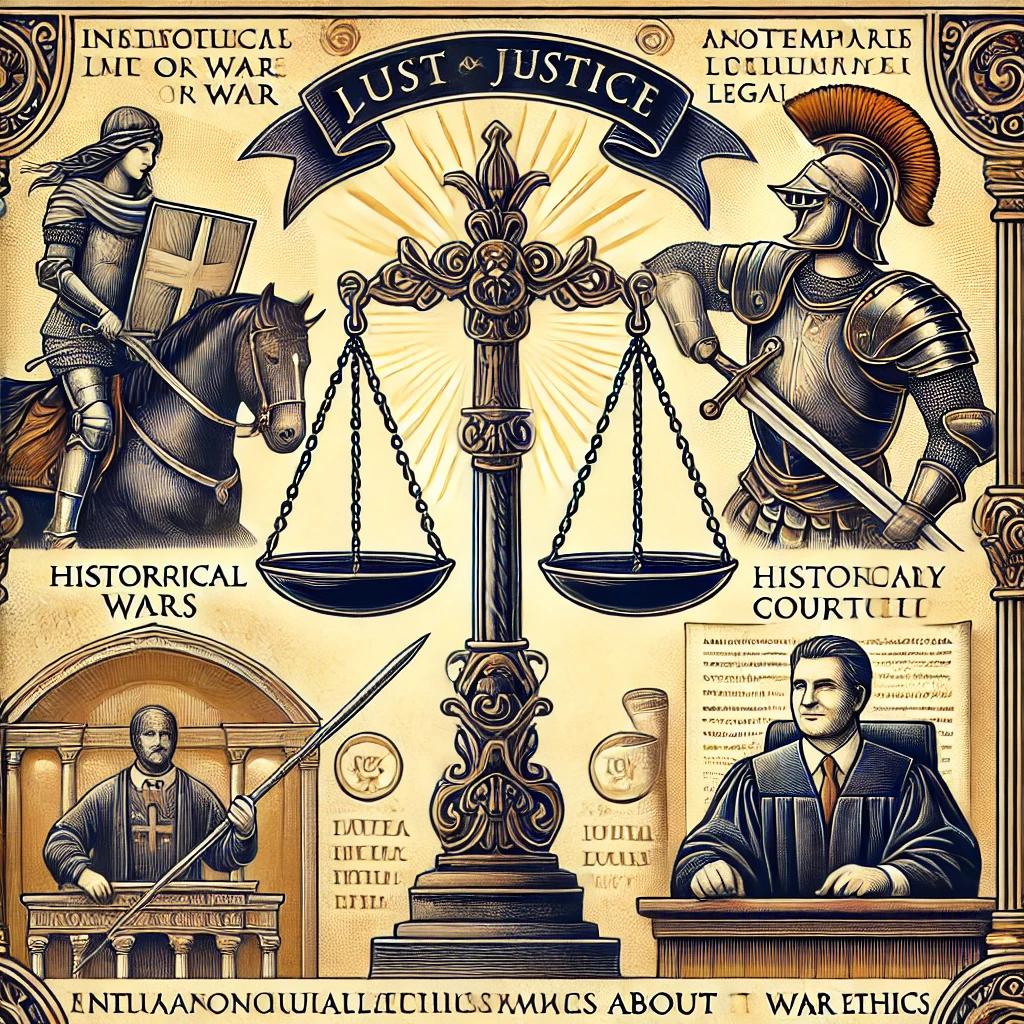
Explaining the two distinct dimensions of just war theory—jus ad bellum and jus in bello—is essential for establishing the conceptual framework of the subject.

Image generated by artificial intelligence.
The jus ad bellum principle establishes specific criteria to determine whether a war is justifiable under certain circumstances. These criteria generally include: a just cause, legitimate authority, right intention or good faith, proportionality—meaning the use of force must not cause harm beyond the intended goal—last resort, the aim of achieving peace, and finally, a reasonable chance of success.
Just cause is the first and most important condition of jus ad bellum. Almost all just war theorists agree that wars initiated for aggression cannot be considered just. Thus, it can be argued that the only legitimate cause for a just war is defense. However, this proposition is flexible when it comes to determining which actions constitute unjust aggression. Although it is true that defense is the sole just cause for a just war, just war theorists have at times included offensive wars within the scope of defense. The sole condition proposed here is that even if the war has an offensive character, its purpose must be to respond to a prior wrong.
Legitimate authority is a highly contested condition. Generally, just war theorists refer to the state’s sovereign power or authority as legitimate authority. According to this view, if this sovereign power is legitimate, it will not exhibit arbitrary rule, and therefore, the right to declare war may be granted to such legitimate authority. In just war theory, only legitimate authority has the right to declare war; otherwise, the possibility of the war being just vanishes.
Right intention or good faith requires general consensus that war must be waged for the public good and not for personal or imperialist, unjust interests. In just war theory, national interests cannot be accepted as a pretext for offensive action; in such cases, the war is deemed unjust. However, it is generally accepted that there may be situations in which an attack is the only means to achieve a good intention, such as forcibly establishing peace. In just war theory, the condition of a reasonable chance of success is also important, as it is with just cause and good intention. This condition aims to prevent the wasteful expenditure of human and economic resources on an action with no prospect of success.
Proportionality condition is technically a criterion of jus in bello, but as part of jus ad bellum, it concerns avoiding harm beyond the intended goal of using force. A just war must have a just cause and, accordingly, a legitimate objective, which must also be consistent with other principles.
The jus in bello principle, which justifies the use of force in war, has two key conditions: immunity of civilians and proportionality. Civilian immunity is a criterion for identifying legitimate targets in war. According to just war theory, failing to distinguish between targets undermines the justice of the war. As long as no distinction is made, non-combatants and innocents may become targets. Combatants have consciously chosen to join armed forces and are therefore legitimate targets. Non-combatants, civilians, or innocents have not made such a choice, so their killing is unjust.
Although just war theory prohibits the killing of civilians, it also accepts that in some circumstances civilian deaths may be unavoidable. Just war theory explains this situation through the concept of “double effect.” Double effect justifies, in a sense, civilian deaths by asserting that they were not intended but occurred accidentally. The distinction between civilians and non-civilians, which already posed significant problems for classical just war theory, has become even more problematic in the modern era, where mass warfare has made the issue central.
In a just war, proportionality is the criterion that determines whether the degree and manner of violence used are morally acceptable. According to the principle of proportionality, the violence applied in a just war must be appropriate to the intended goal. This differs from proportionality under jus ad bellum. Proportionality under jus in bello is a measure aimed at reducing the intensity and destructiveness of war.
Generally, the conceptual framework of just war can be established based on the principles of jus ad bellum and jus in bello and the criteria they contain. However, the content of the just war concept, with its long historical past, has been shaped by vastly different periods and intellectual traditions. Examining the historical and intellectual contributions to just war theory within its historical process will enable a more sound contemporary evaluation of its content and theory.
Claude stated that the justice of war can be examined according to three different views:
First view, pacifism, holds that all forms of war are unjust from the perspective of all parties involved. Pacifists are particularly represented by early Christians. Although present from the beginning, this view has never become the dominant perspective on the justice of war.
Second view is the just war doctrine. Just war doctrine argues that at least one side in a conflict has a just cause for war. Some wars are unjust, while others are just. Every war requires a justification, and every war demands such a justification.
Third view does not consider the justice of war a relevant issue. There is no need to justify the use of force.
In the Western world, the natural law perspective, which emerged alongside Christianity, focuses on the conditions under which the declaration of war may be considered legitimate. The emergence of nation-states and the recognition of their equal sovereignty led to the notion that the sovereign state has the right to declare war, even in the absence of a superior or comprehensive power or philosophy. The just war doctrine, absent from 19th-century international law literature or mentioned only historically without much attention, gained new momentum after Article 231 of the 1919 Treaty of Versailles declared Germany guilty of initiating the war along with its allies. Until the 1960s, the new just war doctrine emphasized peace and held that war could be just only in cases of legitimate defense. From the 1960s onward, however, it reverted in a sense to medieval thinking, and “good wars” began to be discussed. In recent international law, the widely accepted concepts of “war against terrorism” and “preventive war” are continuations of this same thinking.
Since the publication of Michael Walzer’s Just and Unjust Wars in 1977, the concept of just and unjust wars has become the source of numerous debates and countless publications. Like John Rawls’s Theory of Justice, Walzer helped initiate a classic debate in political theory. While Rawls presented a universal political theory emphasizing historical obligations through an analytical philosophical method, Walzer emphasizes historical experience to confront the successes of traditional philosophy and the realities of policy and current events. Walzer attempts to substantiate his just war theory by using historical events to support political judgments.
Walzer evaluates the Vietnam War as a just war, emphasizing authors such as Augustine, Thomas Aquinas, and Grotius. Leaving aside the concepts, the actions occurring in the world evoke Thucydides’s famous observation: “The strong do what they have the power to do and the weak accept what they must.” He thus asserted that the weak are always subject to the strong. This situation not only constitutes injustice but also threatens the continuity of the human species in our current era.
Walzer, praised for the debates he generated on just war, also evaluated the occupations of Kosovo and Afghanistan as “just wars,” describing the latter as a “victory of just war theory.” However, in both cases, he bases his arguments on assumptions, ignoring clear facts. “Just war” allows powerful states to exempt themselves from the fundamental principles of the world order they helped create and normalize.
Recently, particularly the USA, has invoked the concept of just war while promoting positive values such as freedom and human rights. The simple distinction between offense and defense is embedded in the concept of legitimate defense. Today, legitimate defense is no longer used solely in its traditional definition (preventative legitimate defense) as a punitive measure by powerful actors; it also appears as pre-emptive legitimate defense. Thus, the adaptation of just war theory to the present day involves establishing criteria to prove the legitimacy of the powerful, thereby justifying the actions of the strong.
Following the end of the Second World War, the new international legal order established the rules on the law of war in the United Nations Charter, the Geneva Conventions, and the Nuremberg Principles adopted by the United Nations General Assembly. The use of force without the approval of the Security Council or outside the scope of Article 51 of the UN Charter, until the Security Council takes necessary measures, is prohibited.
Paragraph 4 of Article 2 of the United Nations Charter limits the powers of states to use force as follows: “All Members shall refrain in their international relations from the threat or use of force against the territorial integrity or political independence of any state, or in any other manner inconsistent with the Purposes of the United Nations.”
The United Nations Charter introduces exceptions to the prohibition on the use of force through another article. Article 51 states: “Nothing in the present Charter shall impair the inherent right of individual or collective self-defense if an armed attack occurs against a Member of the United Nations, until the Security Council has taken measures necessary to maintain international peace and security. Measures taken by Members in the exercise of this right of self-defense shall be immediately reported to the Security Council and shall in no way affect the authority and responsibility of the Security Council under the present Charter to take at any time such action as it deems necessary in order to maintain or restore international peace and security.” The Charter outlines two exceptions to the prohibition on the use of force: the right of legitimate defense of a state subjected to an armed attack, and the measures to be taken by the United Nations Security Council to maintain international peace.
Some just war theorists evaluate the occupations of Kosovo and Afghanistan as “just wars.” These evaluations generally rest on assumptions. Unfortunately, such theories fail to go beyond providing a veneer for the conduct of powerful states on the international stage and lack grounding in scientific data and analysis.
The U.S. National Security Strategy published on September 18, 2002, guaranteed the right to carry out what it termed “pre-emptive war.” But this was far more dangerous than preventative war, as it anticipated launching operations based on suspicion.
At a 2004 UN panel on Article 51 of the UN Charter and unilateral preventative intervention, the following conclusion was reached: “There is no need to expand or narrow the well-established scope of Article 51… In a world filled with hidden threats, accepting the legality of unilateral preventative action at the expense of the global order and the principle of non-intervention upon which it still rests would be a great loss. Granting permission to one is granting permission to all.”
On September 11, 2001, the most tragic and terrifying terrorist attacks in human history occurred. As a result, approximately 3,000 innocent people lost their lives, and the American public, perhaps for the first time in history, felt the concepts of fear, death, and enemy so intimately. After the attacks on the World Trade Center, the Pentagon, and the White House, the American public experienced profound security concerns, and all these events negatively affected the U.S. economy. The September 11, 2001 terrorist attacks are not only horrific but also critically important for the changes they brought to the international system. Many Western states, in the name of ensuring national security, launched campaigns against domestic and foreign opponents.
Following the terrorist attacks, with few exceptions, world states set aside their post-Cold War rivalry with the USA and joined the U.S.-led “Global War on Terror.” International organizations such as the UN, NATO, and the EU supported the USA. Under U.S. leadership, many regional powers and states joined a struggle to build a new world purged of “terrorism” and “states supporting terrorism.” The first phase of this struggle began in Afghanistan, a country historically saturated with wars. The Afghan Intervention is considered an extremely significant event due to its role as a pivotal moment in constructing the new era and its consequences. Prior to and after the Afghan Intervention, the UN shifted from a decision-making body to one that merely ratified decisions, suffering a loss of prestige, and international legal rules and agreements were disregarded. Before September 11, Americans paid little attention to freedom and security issues elsewhere in the world, believing themselves safe and free within their own territory. For them, America was a zone of freedom; they assumed freedom and security problems would never reach America. The principle established by Admiral Mahan, one of the most important figures in American strategy, who in 1904 advised Roosevelt to “Keep War Always Far from the American Continent,” was not implemented, and for the first time since the American Civil War, Americans carried such profound security concerns. The U.S. military intervention in Afghanistan resulted in immense suffering and death among many Afghan civilians.
Criteria to be considered before resorting to this approach:
Criteria to be observed during war:
To what extent did the USA adhere to these criteria before and during the Afghan War?
First, the USA declared war on terrorism and clearly identified the goal of combating terrorism wherever it exists.
Second, the criterion of “just cause.” Under this criterion, a state resorts to war to “protect the innocent” and “ensure humane living and the protection of natural rights.” Was this the USA’s goal? The evidence is troubling. Some states allied with the USA in this war had previously directly or indirectly supported terrorism. For example, Pakistan and Saudi Arabia had ideological and financial ties to Bin Laden. Additionally, during the Afghan-Soviet War, the USA provided $40 million in humanitarian aid to the Taliban.
Third, the legitimacy of “right intention” in this war is questionable. Political leaders likely believed it necessary to respond immediately to such an enemy to satisfy public opinion. Could the possibility of killing innocent civilians be a valid reason merely to appease domestic public opinion?
Fourth, the USA bombed Afghanistan in a manner that likely caused the deaths of many non-combatant civilians. Although Donald Rumsfeld repeatedly stated in daily press briefings that “our target is not civilians,” targeting civilian settlements inherently meant civilians would die, and many did.
Fifth, U.S. actions displaced hundreds of thousands of people and disrupted humanitarian aid, which was already poorly managed in the country. Directly or indirectly, U.S. actions resulted in civilian losses numbering in the hundreds of thousands, violating the principle of proportionality.
Sixth, the question is whether this war was winnable. In the war against terrorism, achieving a definitive outcome is never possible.
Finally, was this war a last resort? The U.S. military operation against Afghanistan was declared and launched immediately after September 11, almost unilaterally. The possibility of civilian casualties was undoubtedly known at the outset. Therefore, despite numerous alternative means available to the powerful, a military operation was launched against a country.
To what extent must each criterion of just war be met to make a war just? In other words, if even one criterion is lacking, is the war just? Indeed, judging wars as just or unjust is not particularly logical. Theorizing the actions of the powerful and using international law to frame these actions as legally justified undoubtedly requires immense power.
Setting aside the above criteria, except for legitimate defense, there can be no justification for aggression. Therefore, legitimate defense must be conceptually redefined to include pre-emptive and preventative dimensions. This can also be described as creating concepts and ensuring others understand them.
In conclusion, the lethality of advanced technology-based weapons has increased. Their use in modern military operations continues to heighten the sensitivity of commentary and evaluation regarding just war. Although just war theory is not a new concept, its content and criteria are being redefined. The criteria used are being deliberately shaped to serve as a cover for military interventions carried out under the banners of democracy and human rights. Just war permits the use of proportionate force only within the framework of legitimate defense. Therefore, the definition of legitimate defense has gained importance, yet distortions are being made regarding how this concept can be applied in ambiguous situations. Beyond its known definition (preventative legitimate defense), pre-emptive legitimate defense is also being presented as legitimate defense by those in power.
It is doubtful that judging wars as just or unjust will lead us to sound and logical analyses. Theorizing the actions of the powerful and using international law to frame these actions as legally justified undoubtedly requires immense power.
Chomsky, Noam. “A Just War? Hardly.” Khaleej Times, 2006.http://www.chomsky.info/articles/20060509.htm.
Ereker, Fahri Atilla. “İlkçağlardan Günümüze Haklı Savaş Kavramı.” Uluslararası İlişkiler Dergisi 1, no. 3 (2004): 1–36.https://dergipark.org.tr/tr/download/article-file/539579
Moseley, Alexander. "Just War Theory." Accessed February 17, 2025.http://www.iep.utm.edu/justwar/.
Nussbaum, Arthur. "Just War: A Legal Concept?" Michigan Law Review 42, no. 3 (1943): 453.https://doi.org/10.2307/1283519
Uzun, Eray. “Haklı Savaş Düşüncesinin Batılı Kökleri: İlk Çağlardan Yirminci Yüzyıla Jus Ad Bellum Kavramı.” Uluslararası Hukuk ve Politika 6, no. 21 (2010): 19–33.https://app.trdizin.gov.tr/makale/T1RjeU1UTXo/hakli-savas-dusuncesinin-batili-kokleri-ilk-caglardan-yirminci-yuzyila-jus-ad-bellum-kavrami.
Walzer, Michael. *Just and Unjust Wars: A Moral Argument with Historical Illustrations.* New York: Basic Books, 2006.http://digilib.fisip.undip.ac.id/index.php?p=show_detail&id=38897.
Zu, Sun-Tzu. Savaş Sanatı. Kastaş Yayınları, 2008.

Just War Theory and Legitimate Defense
Description | The just war concept is a philosophical system that debates whether war is legitimate within a framework of specific ethical rules. Throughout history, the moral and legal aspects of war have been addressed, leading to the development of certain principles. | ||||||||
|---|---|---|---|---|---|---|---|---|---|
Basic Principle | Jus ad bellum (the right to go to war) and jus in bello (moral rules during war). | ||||||||
Historical Origins | It has a developmental process extending from antiquity through the Middle Ages to modern international law. | ||||||||
Prominent Theorists | Figures such as Cicero, Augustine, Thomas Aquinas, and Michael Walzer are among the thinkers who shaped the just war theory. | ||||||||
Contemporary Perspective | Within the framework of modern international law, documents such as the United Nations Charter are important texts that have influenced the just war doctrine. | ||||||||
No Discussion Added Yet
Start discussion for "Just War Theory and Legitimate Defense" article
Just War
Components of the Law of War
Just War Theory
Jus ad bellum
Jus in bello
History of Just War
Legitimate Defense
Powers to Use Force
Criteria of Just War (Before War)
Criteria of Just War (During War)
Evaluation of the Afghan War in Terms of Just War Criteria