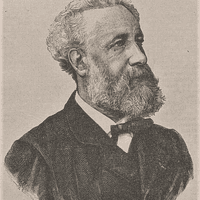

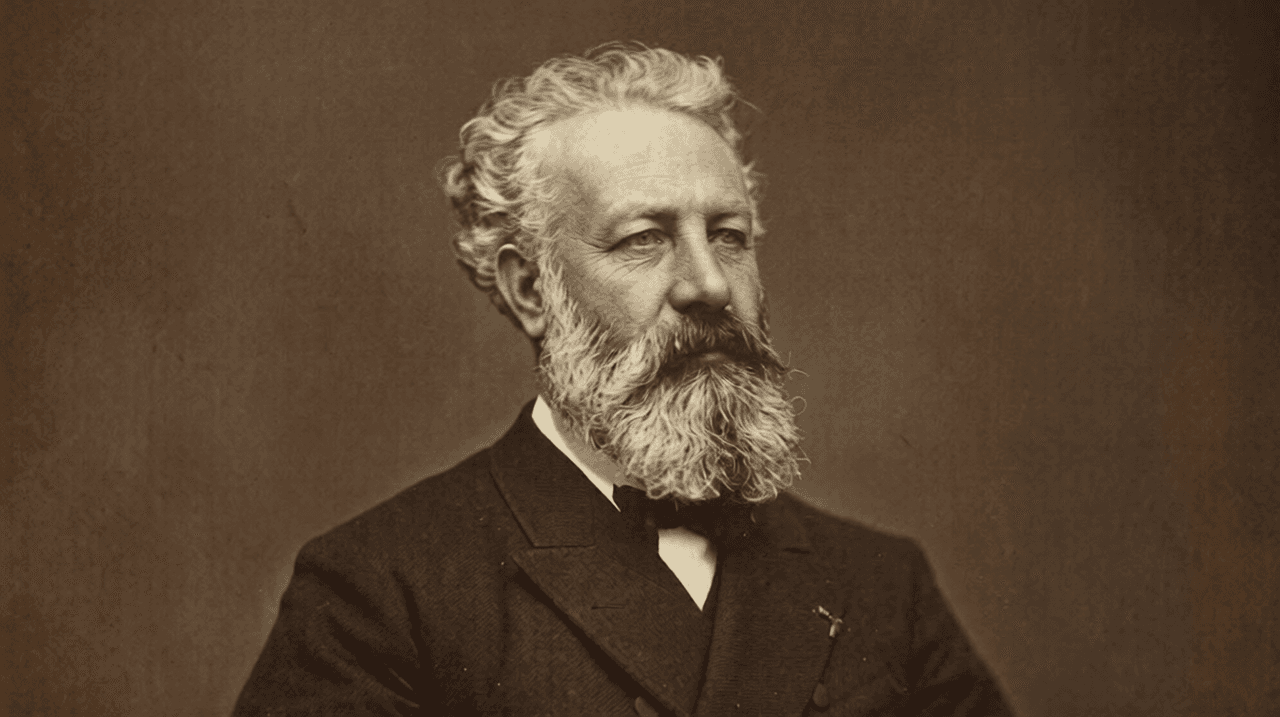

Doğum tarihi | 1828-02-08 | ||||||||
|---|---|---|---|---|---|---|---|---|---|
Ölüm tarihi | 1905-03-24 | ||||||||
Place of Death | Amiens, France | ||||||||
Place of Birth | Nantes, France | ||||||||
Profession(s) | Writer Playwright Poet | ||||||||
Honor Medal | Légion d'honneur (French State Decoration) | ||||||||
Literary Title | Father of Science Fiction (mentioned together with H.G. Wells) | ||||||||
Major Works | Five Weeks in a Balloon (1863), Journey to the Center of the Earth (1864), A Journey to the Moon (1865), Twenty Thousand Leagues Under the Sea (1870), Around the World in Eighty Days (1872) | ||||||||
Important Series | Extraordinary Voyages (Voyages Extraordinaires) | ||||||||
Literary Genre | Science Fiction, Adventure, Travel Literature | ||||||||
Full Name | Jules Gabriel Verne | ||||||||
Jules Verne (8 February 1828 – 24 March 1905) is a French poet, novelist and playwright. He is best known for his series of novels titled Voyages Extraordinaires, published in collaboration with publisher Pierre-Jules Hetzel. In his works, he combined technical elements such as submarines, space travel and aerial vehicles with the scientific data of his time through adventure fiction. According to UNESCO’s translation database, Jules Verne is among the most translated authors in the world.【1】
Jules Verne was born on 8 February 1828 in Nantes, France. In 1847 he moved to Paris to study law and graduated from the Faculty of Law in 1850. During his studies in Paris he met literary figures such as Alexandre Dumas and Victor Hugo and wrote plays and opera librettos. After graduation he continued his literary activities and scientific research rather than pursuing a career in law.
Verne’s development as a writer gained momentum with his meeting with publisher Pierre-Jules Hetzel in 1862.【2】 As a result of a long-term contract signed between the two, Verne’s works, which combined scientific data with fiction, began to be published. The first work of this collaboration, Cinq Semaines en Ballon (1863), marked the beginning of the Voyages Extraordinaires novel series. Under the publishing policy established by Hetzel, these works were structured to include technical information on disciplines such as geography, biology and astronomy.
Verne incorporated into his works technologies that did not yet exist or were still in development during the 19th century, based on the scientific knowledge of his time.【3】 Some of these descriptions later became technically feasible:
Jules Verne employed a method that integrated technical information with adventure narrative:
Verne’s works have had diverse influences on the development of science fiction as a literary genre and on the scientific community:
Verne’s principal works and their associated technical fields are as follows:
"Jules Verne, 1893." Photograph. 1893. Picryl. Accessed [Insert Date]. https://picryl.com/media/jules-verne-1893-9fa584.
Atelier Nadar. "Jules Verne (1828-1905), Schriftsteller." Photograph. 1828–1905. *Picryl*. https://picryl.com/media/atelier-nadar-jules-verne-1828-1905-schriftsteller-zeno-fotografie-ad7e08.
Doğanay, Gülmelek. "Egemen Söylemin Bir Aracı Olarak Edebiyat: Jules Verne’in Olağanüstü Yolculuklar Anlatısı." *Selçuk Üniversitesi Edebiyat Fakültesi Dergisi (SEFAD)*, no. 46 (2021): 319–336. https://doi.org/10.21497/sefad.1031802.
Morkoç, Hasan. "Edebiyat ve Bilim: Jules Verne ve J.-H. Rosny Aîné’nin (Joseph Henri Honoré Boex) Yapıtlarında Bilimkurgu." PhD thesis, Ankara Üniversitesi Sosyal Bilimler Enstitüsü, 2025. https://tez.yok.gov.tr/UlusalTezMerkezi/TezGoster?key=CtwiQkYvArAb95Ufpfs_vtVsVewDZ_SGG5fnKeLM9jfs_62LiJJSm0tPCpHRT0Ko
Nural, Edanur Kırkpınar. "Jules Verne’in Eserlerindeki Tema ve İletilerin Türkçe Öğretim Programı Bağlamında İncelenmesi ve Değerlendirilmesi." Master's thesis, Muğla Sıtkı Koçman Üniversitesi Eğitim Bilimleri Enstitüsü, 2019. https://tez.yok.gov.tr/UlusalTezMerkezi/TezGoster?key=npGs9H39x7G6401x51yqpJcteseWwNzjzf6iENheeUmXQdcBtuKPOI21U-2hfC7D
Çelik, Aslı. "Çocuk Edebiyatı Çevirisinde Yaratım: Jules Verne’in 'Seksen Günde Devri Âlem' Eserinin Türkçeye Çevirilerinin İncelenmesi." Master's thesis, Kırıkkale Üniversitesi Sosyal Bilimler Enstitüsü, 2018. https://tez.yok.gov.tr/UlusalTezMerkezi/TezGoster?key=as2oTjW5jfr9IKSvmCdJYr42JoIfMIBPlrmikBLOsAUucOHy5FUb15j9PIPl4HdP
[1]
Gülmelek Doğanay, "Egemen Söylemin Bir Aracı Olarak Edebiyat: Jules Verne’in Olağanüstü Yolculuklar Anlatısı," Selçuk Üniversitesi Edebiyat Fakültesi Dergisi (SEFAD), sy. 46 (2021): 319-336. https://doi.org/10.21497/sefad.1031802.
[2]
Gülmelek Doğanay. (a.g.e), sy. 46.
[3]
Gülmelek Doğanay. (a.g.e), sy. 46.
Doğum tarihi | 1828-02-08 | ||||||||
|---|---|---|---|---|---|---|---|---|---|
Ölüm tarihi | 1905-03-24 | ||||||||
Place of Death | Amiens, France | ||||||||
Place of Birth | Nantes, France | ||||||||
Profession(s) | Writer Playwright Poet | ||||||||
Honor Medal | Légion d'honneur (French State Decoration) | ||||||||
Literary Title | Father of Science Fiction (mentioned together with H.G. Wells) | ||||||||
Major Works | Five Weeks in a Balloon (1863), Journey to the Center of the Earth (1864), A Journey to the Moon (1865), Twenty Thousand Leagues Under the Sea (1870), Around the World in Eighty Days (1872) | ||||||||
Important Series | Extraordinary Voyages (Voyages Extraordinaires) | ||||||||
Literary Genre | Science Fiction, Adventure, Travel Literature | ||||||||
Full Name | Jules Gabriel Verne | ||||||||
Life and Education
Literary Career and Pierre-Jules Hetzel
Technological Predictions and Technical Descriptions
Writing Technique and Style
Literary Impact and Reception
Selected Bibliography