This article was automatically translated from the original Turkish version.
A Curious Journey from Tiny Hands to the Sky
There are days that fill the heart with hope. A child smiles, a star twinkles, a curiosity becomes a question…
Last week was exactly such a day for us. We looked up at the sky with the children. But we did not just look; we became curious, asked questions, learned, and imagined.
And that day, all of us grew a little bit. Because science is not just knowledge; it is sharing, dreaming, and exploring together.
Now I will take you through what happened that day. Come, let us explore together the starlit story of our astronomy workshop…
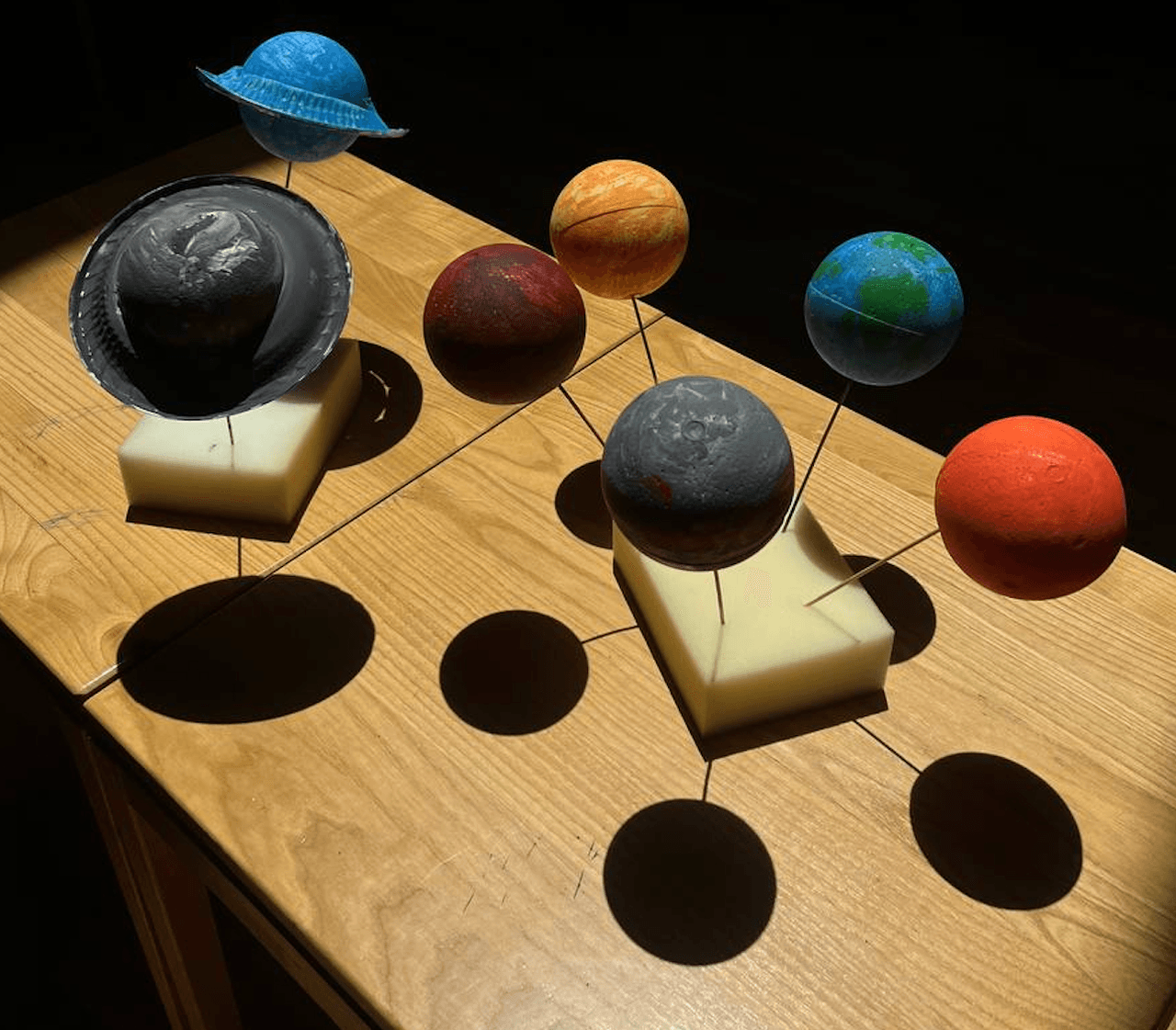
The Solar System (Photo: Hatice Mehlika BİTEN)
The first light of our activities came from the Sun. In our Solar System workshop, we asked the children: “Is the Sun a planet or a star?”
One child immediately replied:
I think the Sun is a star… but hotter than the others!
We smiled. The first seed of knowledge had been planted. Together, we learned about the planets, compared their sizes, and asked: “If you could be any planet, which one would you be?”
The answers were wonderful:
I would be Venus, because my name is as beautiful as it is!
I would be Jupiter! The biggest, the strongest!
Then the children designed their own planets. In those moments when colors burst forth and imagination spilled into space, we were merely guides. Planets were drawn, painted, and given stories.
As the children played, they also gained a new awareness: Earth is unique. And space is far larger than we imagine.
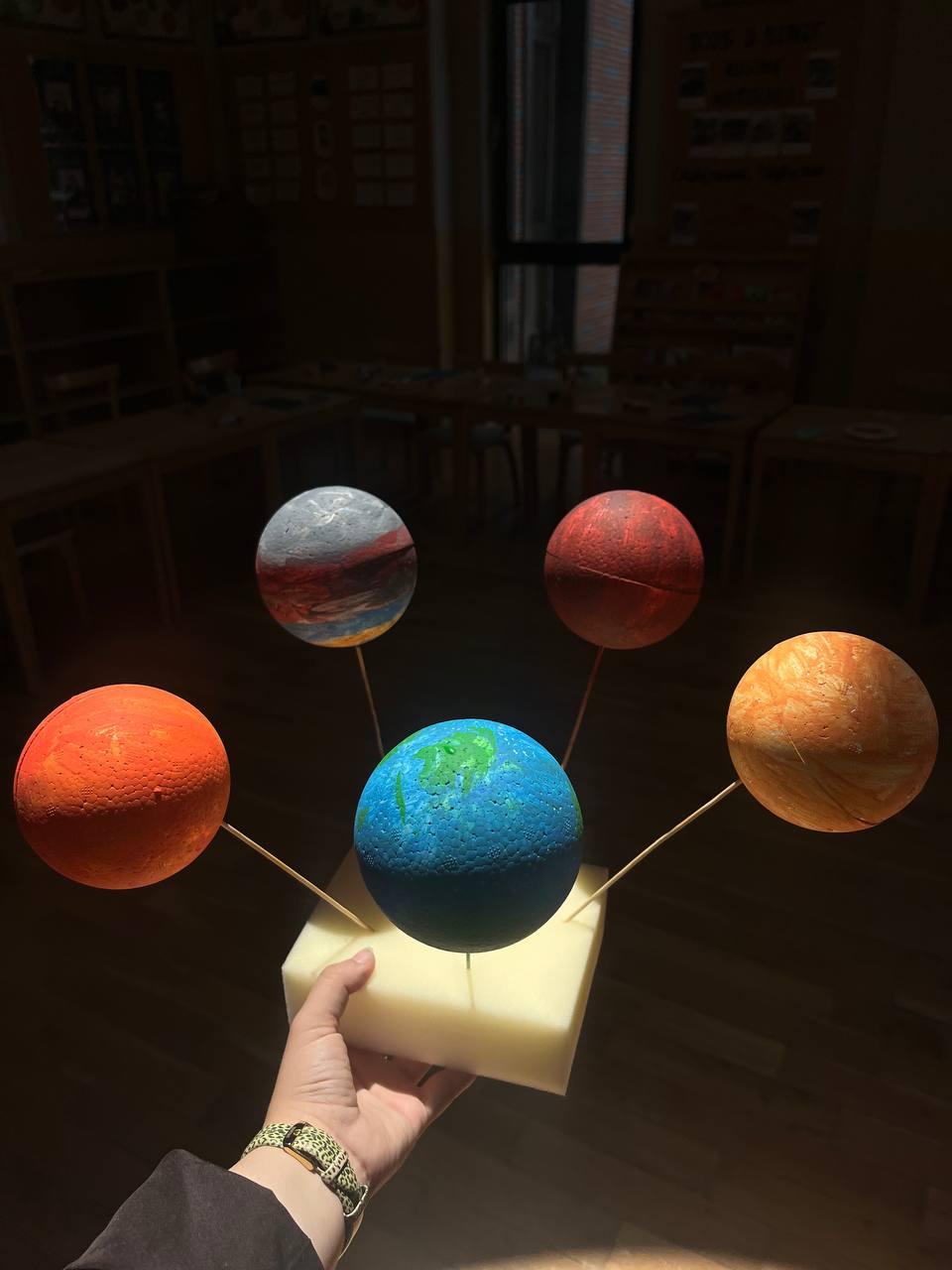
The Solar System (Photo: Hatice Mehlika BİTEN)
From the infinite expanse of space, we descended into the depths of our planet.
In the Layers of the Earth workshop, the children built their own models of Earth using foam balls, modeling clay, and colored paper.
They learned the layers:
The crust, the mantle, the outer core, the inner core… Each was a piece of the world discovered with wonder by tiny hands.
One child looked at the yellow clay in his hands and said:
This is like lava. But I thought it was ice cream.
We smiled. Because science sometimes begins with ice cream. At the end of the workshop, the children took to the stage with their models and explained Earth. Each introduced their own layer, each becoming a scientist in their own words.
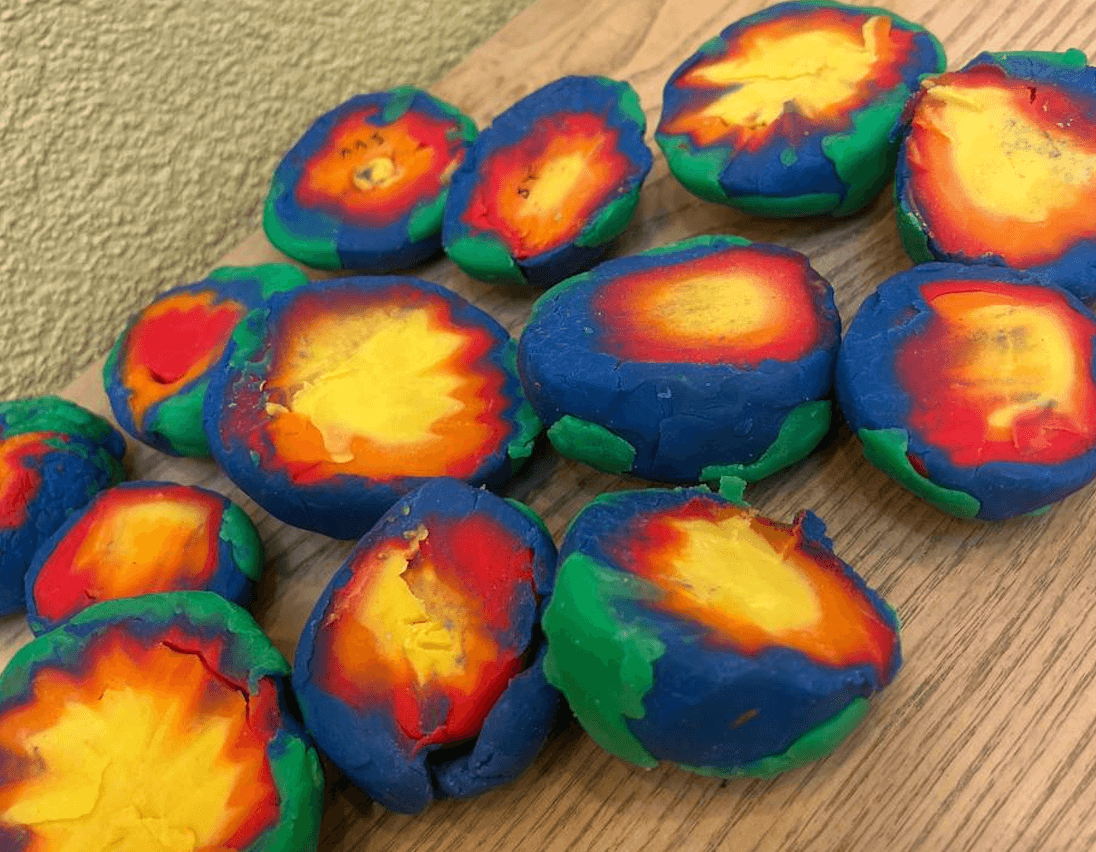
Layers of the Earth (Photo: Hatice Mehlika BİTEN)
And we arrived at the most enchanting moment: the Nebula Workshop.
We asked what a nebula was. We called it “the home of baby stars.” With cotton, wire, and paint, the children created their own nebulae. Colors met, glimmers danced, and dreams transformed into nebulae. At the end of the workshop, each child presented their “imaginary universe.”
The line that stayed with us most was:
My nebula gives birth to a thought. Its name is “The Cloud of Ideas.”
At that moment, we said to ourselves:
This was not just an art activity. It was a journey that made the children feel the universe itself.
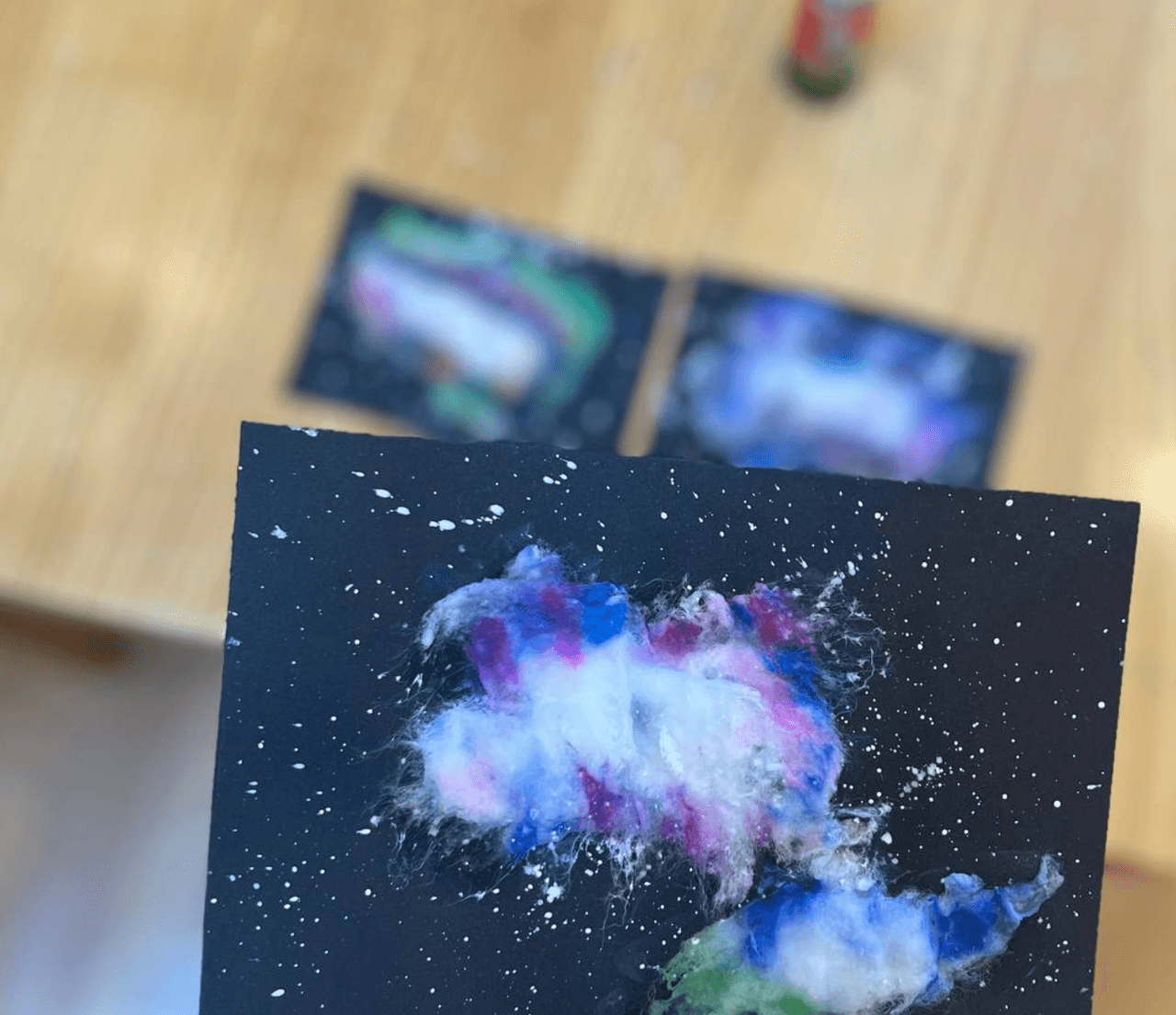
Nebula Workshop (Photo: Hatice Mehlika BİTEN)
We dedicated the final day of our workshop series to the Sun. Early in the morning, we set up our telescopes and, for the first time, dared to look directly at the Sun—with special filters, of course! The children were initially surprised: “We’re not supposed to look at the Sun, our eyes will burn!” But when they saw it through the telescope, they were spellbound. For the first time, they saw dark spots on the Sun’s surface, known as solar spots. One child asked: “Why are these tiny spots there?” At that moment, science and curiosity met once again. We explained to them that these spots result from changes in the Sun’s magnetic field, and that the Sun itself has its own “atmosphere.” And in that instant, the Sun ceased to be merely a source of heat and became, in their eyes, a living star. This observation gave the children both the discipline of astronomy and the thrill of direct contact with a star in the universe.
And we know that what was observed that day was not only the Sun.
For the first time, curiosity ignited within each child.
These workshops did not simply impart knowledge to the children.
They taught them to be curious,
To ask questions,
To create,
To dream,
And to share.
And they taught us something too:
When we combine science with play, storytelling, and art, learning becomes a natural breath for children.
The sky is vast.
But children’s imaginations are even greater.
Our task is not merely to give them a telescope.
It is to be beside them as they gaze at the sky.
To smile in answer to their questions.
To search together, even when we do not know the answer.
To show them not the stars, but how they might reach the stars.
Perhaps one of them will truly discover a new planet.
Perhaps a child will name a star.
Perhaps they will simply find peace when they look up at the night sky.
All of this is possible.
Because every journey that begins with a child’s curiosity can become the greatest discovery of the universe.
Our endless thanks to all the children, volunteers, parents, and educators who walked this journey with us under the sky.
May there always be children who grow with science, gaze with love, and move forward with wonder!
Accessed November 26, 2025.
Chaisson, Eric, and Steve McMillan. Astronomy Today. 9th ed. Boston: Pearson, 2017.
NASA. "What Is a Nebula?" Accessed July 5, 2025.
☀️ Our Starting Point: The Solar System Workshop
🌍 Then We Came Back Down to Earth: The Layers of the Earth Workshop
🌌 Nebulae: The Colorful Explosion of Imagination
🔭 And the Grand Finale: Sun Observation Day
What the Workshops Taught
Every Child Who Looks at the Sky Is a Young Scientist
Acknowledgment