At KÜRE Encyclopedia, we use cookies to provide you with the most efficient and enjoyable experience possible.
With your consent, we may personalize our content and services based on your browsing history and preferences. If you choose to allow only essential cookies, some features may operate with limited functionality.

This article was automatically translated from the original Turkish version.
+1 More
First İssue | 1908-12-28 | ||||||||
|---|---|---|---|---|---|---|---|---|---|
Last İssue | 1911-03-01 | ||||||||
Total Published İssues | 27 | ||||||||
Topics Covered | and other social sciences sociology Economics | ||||||||
Founders | Rıza Tevfik (Bölükbaşı) Ahmed Şuayb Mehmed Cavid Bey (Minister of Finance) | ||||||||
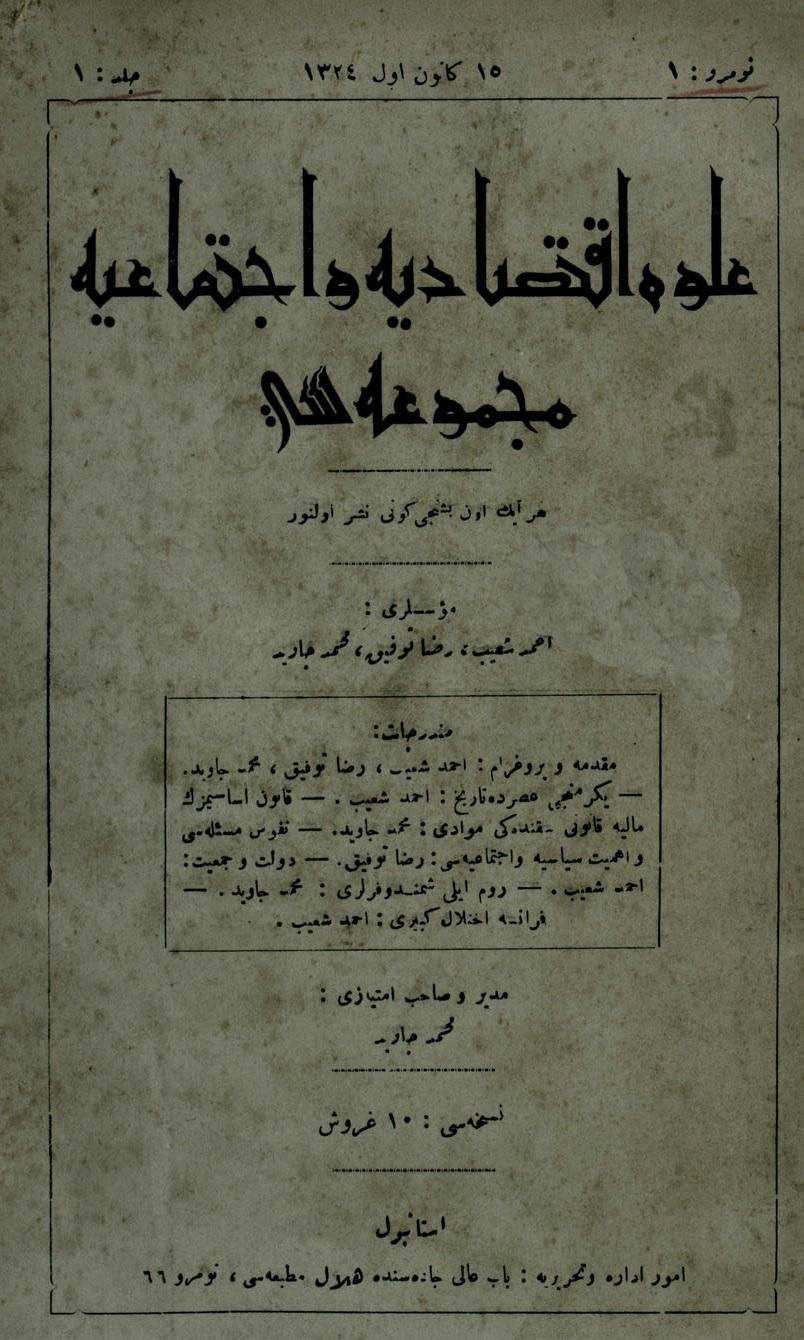
Ulûm-ı İktisadiye ve İçtimaiye Mecmuası (UIİM) is the first liberal and social science journal published in Türkiye between 1908 and 1911. It made significant contributions to Ottoman intellectual life by addressing economic and social issues within the ideological climate of the Second Constitutional Era.
Ulûm-ı İktisadiye ve İçtimaiye Mecmuası (UIİM) is an important intellectual journal that began publication in the final phase of Ottoman Empire following the declaration of the Second Constitutional Era. It holds the distinction of being the first liberal journal published in Türkiye and one of the earliest periodicals in the social sciences to appear in Turkish. The journal provided a platform for the dissemination and debate of new ideas among Ottoman intellectuals by focusing on economic and social problems.
The first issue was published on 15 Kânun-ı Evvel 1324 (28 December 1908). Publication continued until 14 March 1911, resulting in a total of 27 issues. The final issue held in the National Library bears the date of 1 March 1327 (1911) and is part of the third volume.
UIİM is recognized as the first periodical in Türkiye to give serious and prominent emphasis to sociology. Through its articles on economic and social sciences, it played a pioneering role in introducing Western scientific developments to the Ottoman intellectual world. Generally, it is described as Türkiye’s first liberal journal. This characterization is significantly supported by the writings of its founder Mehmed Cavid Bey, who defended economic liberalism. However, it has also been noted that labeling the ideas of other founders Ahmed Şuayb and Rıza Tevfik Bey as “fully liberal” may constitute an overgeneralization. The journal distinguished itself by examining economic and social issues through an independent interdisciplinary approach.
The period during which Ulûm-ı İktisadiye ve İçtimaiye Mecmuası was published coincides with Second Constitutional Era, a time of major transformation and upheaval in the Ottoman Empire. This era was marked by significant historical and social dynamics that deeply influenced the journal’s content and mission.
The declaration of the Second Constitutional Era in 1908 raised expectations of liberty and constitutional governance within Ottoman society and created an environment of intensified political and intellectual debate. During this period, numerous new newspapers and journals emerged, providing space for diverse ideologies and intellectual currents. Ulûm-ı İktisadiye ve İçtimaiye Mecmuası was a product of this rich intellectual milieu. Its emergence reflected the efforts of Ottoman intellectuals to follow Western scientific and philosophical developments and apply them to the problems of their own society. In particular, intellectuals seeking to prevent the state’s decline and find solutions to major social issues aimed to directly adopt ideas from their source in France and adapt them to Turkish social structures.
The Westernization movement, which accelerated during the Tanzimat Period, continued into the Second Constitutional Era. Ottoman intellectuals closely monitored scientific, technological, and social developments in the West in search of solutions to the empire’s crises. Among the ideas adopted from the West, economic and social thought held a central place. However, the empire struggled with serious economic problems, particularly foreign debt and economic dependency. This situation created the conditions for the journal’s predominant focus on economic issues and the intense debates over different economic policies.
Ulûm-ı İktisadiye ve İçtimaiye Mecmuası represents a turning point in the development of sociology in Türkiye. Although the first sociology course in Türkiye was delivered by Ziya Gökalp in 1914, scholars indicate that thinkers engaged with sociology and their activities began well before 1914. During its publication period, the journal gave “serious and prominent emphasis” to sociology, presenting some of the earliest examples of examining social problems through scientific methods. This journal is regarded as one of the key sources of sociological thought and led efforts to adapt Western sociological theories—particularly Positivism and Evolutionary Sociology—to Ottoman society. Unlike other periodicals that treated social issues as peripheral topics, UIİM clearly identified social problems as one of its two central concerns.
Three key figures played decisive roles in launching Ulûm-ı İktisadiye ve İçtimaiye Mecmuası and shaping its intellectual direction: Mehmed Cavid Bey, Ahmed Şuayb, and Rıza Tevfik Bey. These individuals shaped the journal’s liberal and positivist approaches in the fields of economics and social sciences.
One of the journal’s founders, Mehmed Cavid Bey, gained prominence through his writings that defended liberalism, particularly in economic theory. His liberal economic views were instrumental in characterizing the journal as Türkiye’s first liberal publication. Cavid Bey’s liberalism manifested primarily in the economic sphere. As a leading statesman of the era who also served as Minister of Finance, his economic perspectives were effectively communicated to the public through the journal.
Another important founder of the journal, Ahmed Şuayb, contributed significantly through his ideas. While sources suggest that labeling his views as “fully liberal” may be an overgeneralization, he nonetheless enriched the journal’s intellectual depth. Ahmed Şuayb’s overall intellectual framework and influence, alongside Mehmed Cavid Bey’s liberal economy stance, helped shape the journal’s multidimensional intellectual structure.
Rıza Tevfik Bey, among the journal’s founders, made important contributions through his philosophical and sociological perspectives. Like Ahmed Şuayb, it has been noted that restricting Rıza Tevfik Bey’s ideas solely to liberalism may be an overgeneralization. As a philosopher, he added depth to the period’s debates in the field of social sciences.
While sources do not explicitly name other direct contributors beyond these three figures, it is clear that the journal featured articles by leading intellectuals of the era, offering a platform for diverse perspectives to be discussed.
Ulûm-ı İktisadiye ve İçtimaiye Mecmuası reflected the complex intellectual structure of the Second Constitutional Era by encompassing diverse yet interrelated ideological and philosophical approaches. These approaches formed the foundation of the journal’s proposed solutions to economic and social problems.
The journal is commonly described as Türkiye’s first liberal journal. This characterization is largely based on the writings of its founder Mehmed Cavid Bey, who defended liberalism primarily in economic theory. However, it has also been emphasized that labeling the ideas of other founders Ahmed Şuayb and Rıza Tevfik Bey as “fully liberal” may constitute an overgeneralization. This indicates that the journal’s understanding of liberalism was not monolithic but capable of incorporating multiple interpretations. Liberal economic policies, free market economy, and the role of foreign capital became central topics of debate.
The journal’s sociological approach clearly reflects the influence of Positivism. It argued that social problems should be studied using scientific methods and the positivist understanding of knowledge. Ottoman intellectuals sought rational and scientific solutions to societal issues by treating society as a laboratory. This approach significantly influenced the early development of sociology in Türkiye, promoting the idea that social reality must be understood through observation and experimentation.
Evolutionary thought, particularly the ideas of Herbert Spencer known as “Social Darwinism,” also left a clear imprint on the journal. Society was viewed as a living organism in a constant process of development and progress. This evolutionary perspective regarded social change as a natural process and encouraged sociology as a means to understand the laws governing such change. Topics such as “Mücadele-i Hayatiye ve Tekâmül-i Cemiyet” (Struggle for Life and the Evolution of Society) were explored in the journal, reflecting this evolutionary outlook.
Some thinkers in the journal adopted an “organismic” approach, viewing society as an organism. This perspective argued that society is more than the sum of its individuals and possesses an internal unity. Institutions and relationships within society were seen as interdependent and functional, like organs in a body. This understanding emphasized the importance of social order and solidarity while also laying the groundwork for social engineering and reform efforts.
The relationship between the individual and society was another major area of debate. While liberal thought emphasized individual freedom and rights, the role of social order and the state was not neglected. In particular, sociological approaches examined the individual’s position within social structures and the impact of social factors on the individual. One of the journal’s primary aims was to strike a balance between preserving individual freedoms and strengthening the social structure when addressing social problems.
Overall, Ulûm-ı İktisadiye ve İçtimaiye Mecmuası made a significant contribution to the intellectual debates of its time by interpreting Western ideologies such as liberalism, positivism, and evolutionism within the unique conditions of Ottoman society.
Ulûm-ı İktisadiye ve İçtimaiye Mecmuası hosted various debates on economic policy within the context of efforts to address the economic challenges of the Second Constitutional Era. While the journal primarily served as a platform for liberal economic views, it also provided space for alternative approaches such as National Economy.
Generally described as Türkiye’s first liberal journal, its most important representative was Mehmed Cavid Bey, one of its founders and the Minister of Finance. Cavid Bey vigorously defended liberalism, particularly in economic theory.
A significant portion of liberal economists supported the entry of foreign capital into the Ottoman economy as a means of development. According to this view, foreign capital would facilitate technology transfer and accelerate economic growth by increasing capital accumulation.
Although the journal followed a liberal line, it also published criticisms of liberal economic policies. In particular, proponents of “National Economics” argued that uncontrolled foreign capital and free trade would render the Ottoman economy externally dependent and hinder domestic industry.
During the Second Constitutional Era, the idea of “National Economics” emerged as an alternative to liberal economics. Key figures in this movement included Yusuf Akçura and Tekinalp. National Economics arose as the economic manifestation of ideologies such as Ottomanism and Islamism alongside Turkism.
Advocates of National Economics argued for the protection and promotion of domestic industry and production. In this context, they proposed protective and incentive policies such as increasing customs duties, supporting local merchants, and encouraging greater state intervention in the economy.
While not entirely opposed to foreign capital, National Economists argued that foreign capital should enter into partnerships with domestic capital and be subject to specific restrictions. The goal was to achieve balanced economic development while prioritizing national interests.
Sources indicate that Ulûm-ı İktisadiye ve İçtimaiye Mecmuası primarily focused on liberal and national economic debates. There is no direct or detailed information regarding socialist economic thought. Although the journal sought solutions to social problems, its foundational approaches were liberal and nationalist. If socialist ideas were mentioned at all, they were presented critically or as opposing viewpoints.
During its publication period, Ulûm-ı İktisadiye ve İçtimaiye Mecmuası played a central role in the development and dissemination of sociological thought in Ottoman-Turkish intellectual life. The journal did not limit itself to economic issues but also provided a serious platform for in-depth engagement with social problems.
The journal believed in the power of social sciences, particularly sociology, to solve social problems. Ottoman intellectuals aimed to analyze the social structure using scientific methods and to implement reforms based on these analyses as a way out of the empire’s crises.
The sociological thought in the journal also addressed the relationship between the state and society. Ottoman intellectuals emphasized the state’s role in shaping social structures and maintaining social order. Sociological analyses offered a framework for understanding how the state interacted with social factors and how social change affected the state. By examining social problems not merely at the individual level but also at the structural level, the journal underscored the state’s responsibility in confronting them.
Ulûm-ı İktisadiye ve İçtimaiye Mecmuası approached major social issues of the era—such as education, poverty, and social morality—through a sociological lens. It sought to explain the origins and solutions of these problems using scientific data and theoretical frameworks. Resolving the empire’s major social problems and preventing state collapse were among the foremost priorities of the intellectuals who founded the journal. Sociology was viewed as a “recipe for salvation” in achieving these goals.
Although the first sociology course in Türkiye was delivered by Ziya Gökalp in 1914, the journal gave “serious and prominent emphasis” to sociology during its publication period. This established Ulûm-ı İktisadiye ve İçtimaiye Mecmuası as one of the key precursors to the institutionalization of sociological thought and the discipline of sociology in the Ottoman Empire. The journal reflected a belief in the potential of sociological research and analysis to understand and manage social change.
The sociological thought in the journal was clearly influenced by leading Western sociologists such as Émile Durkheim and Herbert Spencer. Spencer’s evolutionary and organismic views on society found expression in articles such as “Mücadele-i Hayatiye ve Tekâmül-i Cemiyet.” While direct reflections of Durkheim’s sociology are not explicitly stated, Durkheimian themes such as social solidarity, norms, and the scientific nature of social phenomena can be sensed in the journal’s general sociological approach. Ottoman intellectuals specifically sought to adopt sociology directly from France and adapt it to their own social structures.
During its publication period and afterward, Ulûm-ı İktisadiye ve İçtimaiye Mecmuası attracted various critiques and debates regarding its general approach, its interpretation of Western ideas, and its relationship with political actors of the time.
According to a critique cited from the work of Doğan and Alkan (2010), the articles selected for study were presented in a repetitive “summary-quote-summary-interpretation” pattern, giving the impression that the journal’s main body consisted of concatenated article summaries. This suggests that the journal tended more toward compiling diverse viewpoints than conducting in-depth analysis of specific topics. It has also been noted that attempting to derive comprehensive analyses of all authors’ views based on just one or two articles may reflect a selective approach—highlighting only those elements that fit a preconceived interpretation.
Some debates and critiques in the journal targeted the Committee of Union and Progress’s (CUP) understanding and application of Western ideas. Sources suggest that the CUP’s economic and political policies and state ideals have not been sufficiently examined or have been overlooked (Doğan and Alkan, 2010:161). This indirectly implies that the CUP-aligned views or their proponents in the journal sometimes engaged with Western ideas superficially. Although the journal followed a liberal line, its content occasionally conflicted with the centralist and state-centric outlook of the CUP, which held power during the period.
Ulûm-ı İktisadiye ve İçtimaiye Mecmuası facilitated important debates by providing space not only for liberal economic views but also for alternative currents such as “National Economics.” While liberal economists emphasized the importance of foreign capital, National Economists advocated for protecting domestic production and greater state intervention in the economy. These ideological differences were clearly articulated in the journal’s pages, presenting readers with the diversity of economic thought in the era. These debates reflected the Ottoman Empire’s efforts to determine strategies for achieving economic independence and development.
Demir, Zekeriya. “İttihat Ve Terakki Dönemi İktisat Politikası Tartışmaları”. Tarih Ve Gelecek Dergisi 7, no. 1 (March 2021): 180–220. https://doi.org/10.21551/jhf.886638
Doğan, İbrahim. “Sosyolojik Düşüncenin Osmanlı’daki Kaynakları: Ulûm-ı İktisâdiye ve İçtimâiye Mecmuası Örneği.” Ankara University Journal of Faculty of Educational Sciences (JFES) 32, no. 1 (1999). https://doi.org/10.1501/Egifak_0000001158
Erdoğan, Ayşenur. “Meşrutiyet'in Evrimci Dergisi: Ulûm-ı İktisadiye ve İçtimaiye Mecmuası.” Journal of Sociology / Sosyoloji Dergisi, no. 28 (2014).
Nair, Güney. “Sosyal Bilimler Alanında Türk Toplumunda Yayınlanan İlk Dergi: Ulum-u İktisadiye ve İçtimaiye Mecmuası.”Cumhuriyet Üniversitesi Fen-Edebiyat Fakültesi Sosyal Bilimler Dergisi 48, no. 2 (2024): 213–223. https://doi.org/10.17776/cumusosbil.89292.1518159
Ulum-u İktisadiye ve İctimaiye Mecmuası.TBMM Açık Access Archive. Accessed July 15, 2025. https://acikerisim.tbmm.gov.tr/items/f790580c-254d-4a8c-93b8-058112fb32a3

First İssue | 1908-12-28 | ||||||||
|---|---|---|---|---|---|---|---|---|---|
Last İssue | 1911-03-01 | ||||||||
Total Published İssues | 27 | ||||||||
Topics Covered | and other social sciences sociology Economics | ||||||||
Founders | Rıza Tevfik (Bölükbaşı) Ahmed Şuayb Mehmed Cavid Bey (Minister of Finance) | ||||||||
No Discussion Added Yet
Start discussion for "Journal of Economic and Social Sciences" article
Overview of Ulûm-ı İktisadiye ve İçtimaiye Mecmuası
Definition and Significance
Publication Dates and Number of Issues
Character as Türkiye’s First Liberal and Social Science Journal
Historical and Social Context
The Constitutional Era and Intellectual Climate
Westernization and Economic Decline of the Ottoman State
The Introduction and Development of Sociology in Türkiye
Founders and Key Contributors
Mehmed Cavid Bey (Minister of Finance)
Ahmed Şuayb (Publications and Intellectual Contributions)
Rıza Tevfik (Bölükbaşı) (Philosopher)
Other Important Authors and Thinkers
Ideological and Philosophical Approaches in the Journal
Economic Policy Debates
Liberal Economic Policies
Formation and Representatives
Foreign Capital and Development
Criticism of Liberal Economic Policies
National Economic Policies
Rise and Key Representatives
Protective and Incentive Policies
Domestic and Foreign Capital Partnership
Socialist Economic Thought and Criticism
Sociological Thought and Contributions
Critiques and Debates