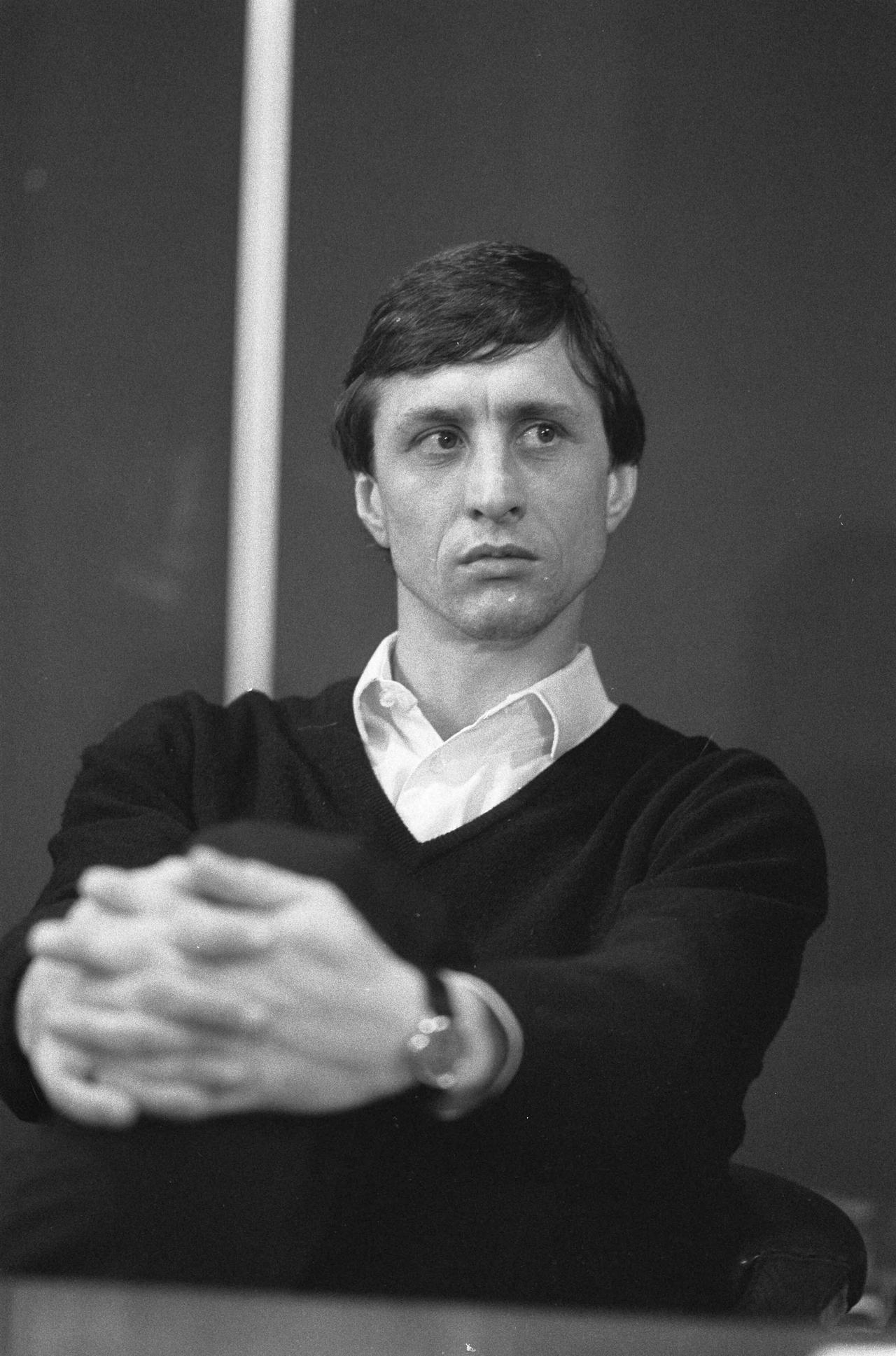

Full Name | Hendrik Johannes Cruijff | ||||||||
|---|---|---|---|---|---|---|---|---|---|
Birth | 25 April 1947 | ||||||||
Place of Birth | Amsterdam, Netherlands | ||||||||
Position | Forward Attacking Midfielder | ||||||||
Clubs Played For | Ajax Los Angeles Aztecs Feyenoord Levante Washington Diplomats Barcelona | ||||||||
National Team | Netherlands National Team (1966–1977) | ||||||||
Managerial Career | Ajax (1985–1988) Barcelona (1988–1996) | ||||||||
Death | 24 March 2016 | ||||||||
Place of Death | Barcelona, Spain | ||||||||
Johan Cruyff, a Dutch footballer and coach, is regarded as a pivotal figure in the transformation of modern football not only for his playing ability but also for the philosophy of play he developed. His influence at both Ajax and Barcelona extended beyond on-field performance, shaping the clubs’ youth structures, playing styles, and management approaches. The evolution of the “Total Football” concept is directly linked to Cruyff’s career both as a player and as a coach. His role in institutionalizing the La Masia football academy ensured the sustainability of a football philosophy that has influenced generations.
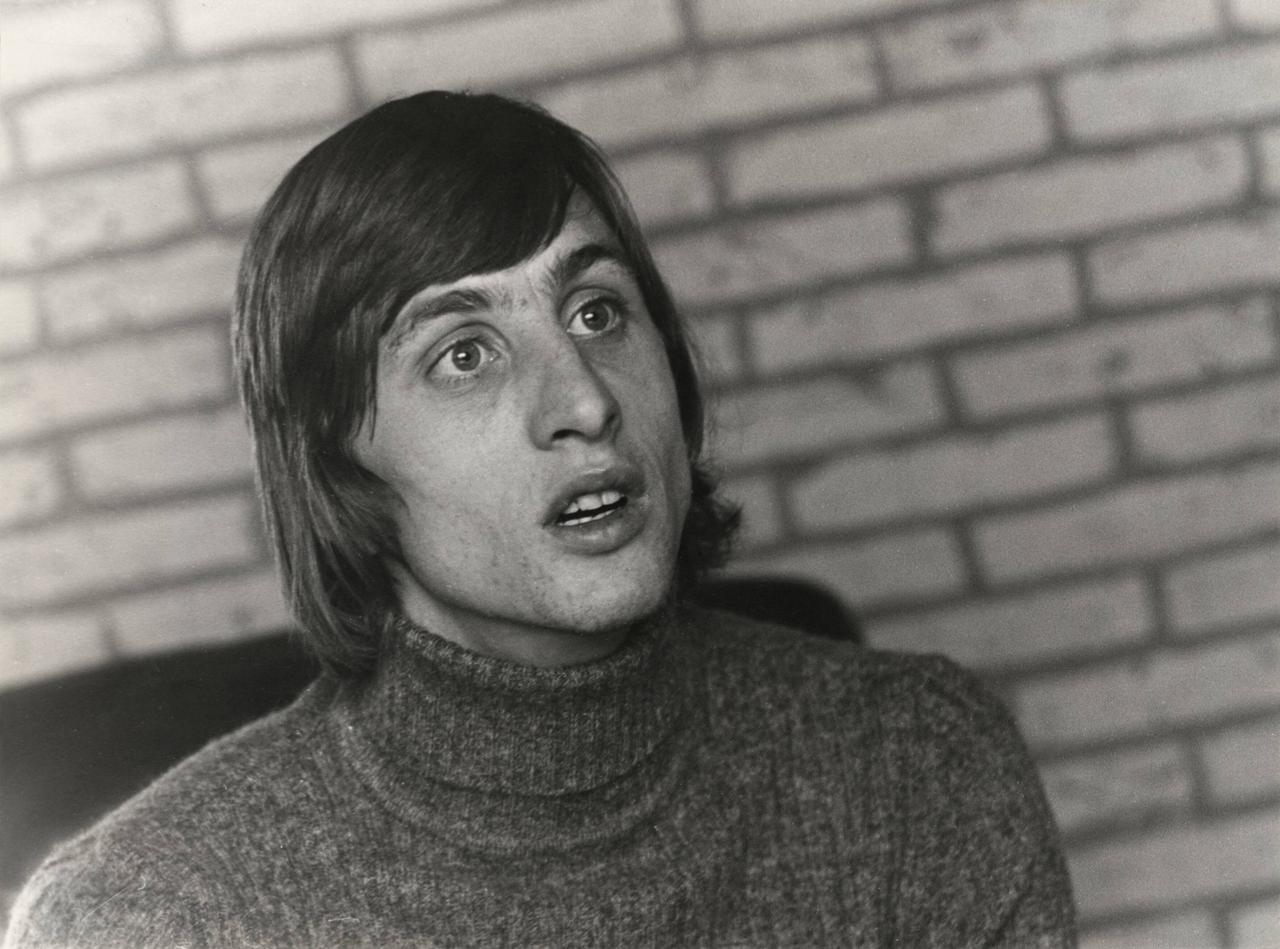
Portrait of Johan Cruyff during an interview. 2 December 1971. (Nationaal Archief)
Born Hendrik Johannes Cruijff on 25 April 1947 in Amsterdam, Netherlands, his mother was a cleaner and his father ran a greengrocer’s shop. The death of his father, Manus Cruijff, from a heart attack in 1959 had a profound psychological and social impact on Johan, prompting him to engage with life beyond football at an early age and shaping his personal development. At the age of ten, Cruyff joined Ajax’s youth academy and quickly attracted attention for his technical skill and football intelligence.
In 1964, at the age of 17, Cruyff began his professional career with Ajax’s first team. In the 1965–66 season, he scored 25 goals and helped the club win the league title. From the late 1960s onward, as Ajax rose to prominence in Europe, Cruyff gained international recognition.
Winning nine Dutch Eredivisie titles and six KNVB Cups with Ajax, Cruyff etched his name in history by leading the club to three consecutive European Cup victories between 1971 and 1973. This success demonstrated how Ajax’s collective football philosophy, under Cruyff’s leadership, reached an international level. Additionally, he was named Footballer of the Year in 1968 and 1972, and Sportsman of the Year in 1973 and 1974.
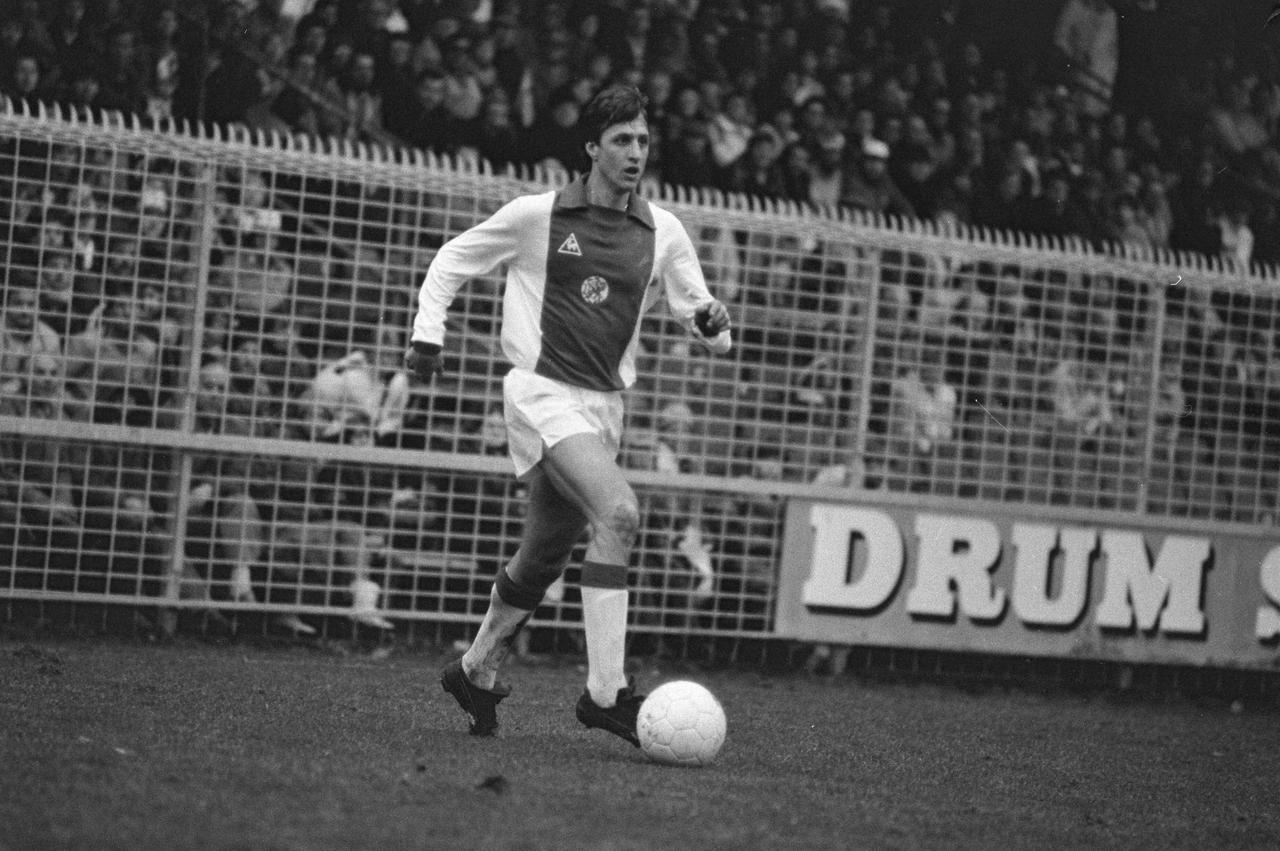
Johan Cruyff in the Ajax vs Harleem match, 4–1, 6 December 1981. (Nationaal Archief)
In 1973, Cruyff transferred to FC Barcelona for one of the highest transfer fees of the era, 1.9 million euros. In his first season, he delivered a standout performance, leading the Catalan club to its first La Liga title in 14 years. A 5–0 victory over Real Madrid further elevated his status among fans and football authorities.
During his five-year tenure at Barcelona, he won one La Liga title and one Copa del Rey. His innovations extended beyond sporting success, transforming the club’s football culture. His technical intelligence, agility, and ability to read the game allowed him to play in multiple positions—from midfield to attack—enhancing Barcelona’s tactical flexibility.
After his first European career, Cruyff continued his football journey in the United States. Between 1979 and 1981, he played for Los Angeles Aztecs, Washington Diplomats, and briefly for Levante. While contributing to the development of American football, his performance during this period declined.
Returning to Ajax in 1981, Cruyff won two league titles over two seasons. However, due to economic and structural disagreements with the club’s management, he left Ajax in 1983 and transferred to Feyenoord, Ajax’s fiercest rival—a move that caused significant controversy. Nevertheless, in his single season with Feyenoord, he won both the league and the cup, concluding his playing career. In 1984, the year he retired, Cruyff was named Footballer of the Year.
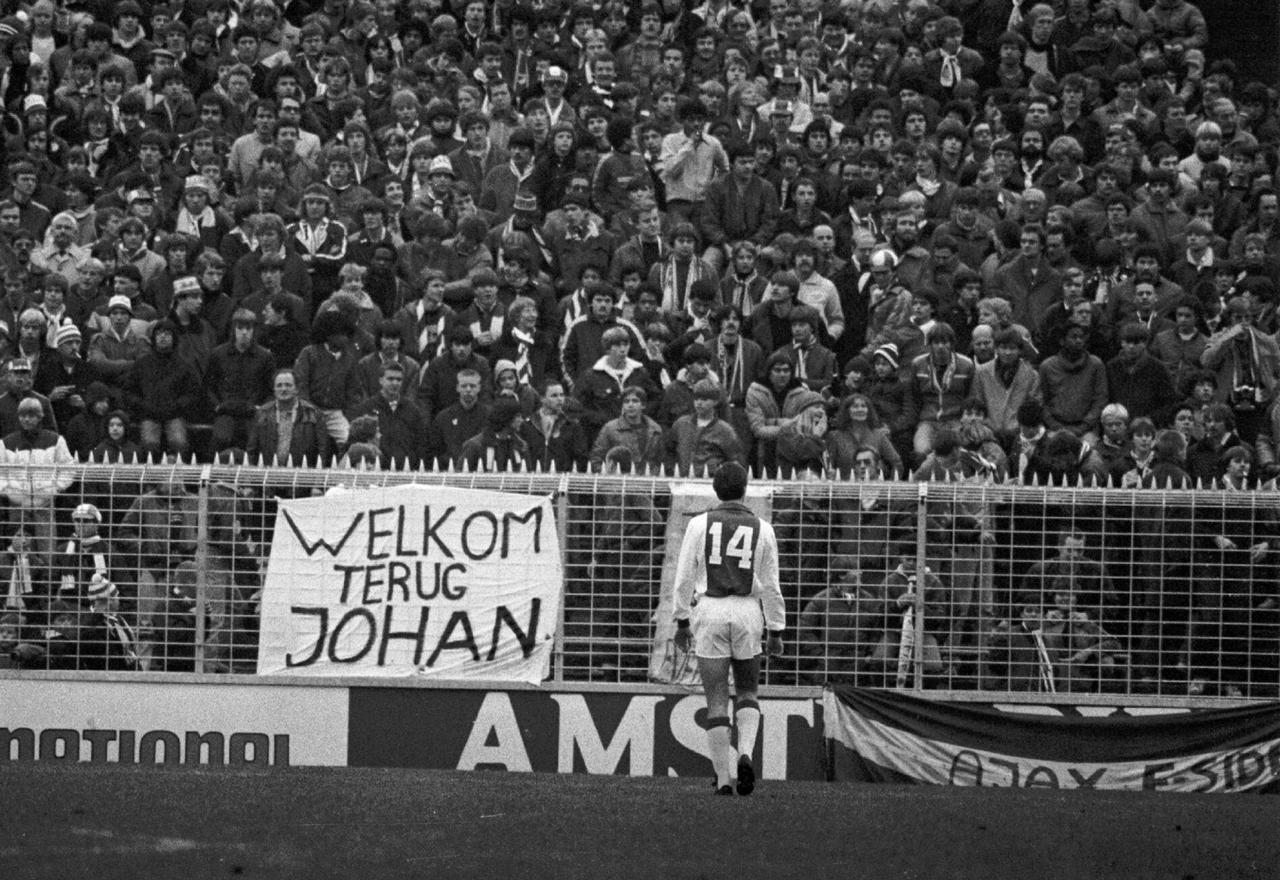
‘Welcome back, Johan.’ 6 December 1981. (Nationaal Archief)
Cruyff made his debut for the Netherlands national team in 1966. He scored 33 goals in 48 appearances, served as team captain, and distinguished himself as a playmaker. One of his most significant performances came at the 1974 FIFA World Cup. Under Cruyff’s leadership, the Netherlands advanced to the final by defeating Argentina, East Germany, and Brazil. The “Total Football” philosophy he directed, characterized by fluid positional interchange, gave the team a decisive edge over opponents. Although they lost 2–1 to West Germany in the final, Cruyff’s individual performance stood out as one of the tournament’s most memorable. He was awarded the Golden Ball as the best player of the 1974 World Cup.
Cruyff did not participate in the 1978 World Cup, a decision that sparked various speculations. Although his international career was not as lengthy as his club career, it left a lasting impact.
Shortly after retiring as a player, Cruyff began his coaching career at Ajax. He established a system that prioritized young talent. While managing the club between 1985 and 1988, he led Ajax to victory in the European Cup Winners’ Cup by entrusting youth players with key roles. When he took charge of FC Barcelona in 1988, the club was in sporting and administrative crisis. Cruyff built the squad known as the “Dream Team.”
Between 1991 and 1994, Barcelona won four consecutive La Liga titles. In 1992, they defeated Sampdoria 1–0 in the final at Wembley to claim the club’s first European Cup. Cruyff ensured the systematic operation of La Masia through his emphasis on youth development. During his tenure, he also won numerous domestic and international trophies, including the Spanish Super Cup, Copa del Rey, and UEFA Super Cup. He left the club in 1996 following ideological disagreements with the president.
Cruyff’s coaching philosophy became synonymous with a system based on ball possession, positional play, and intricate passing networks. This system was later developed and sustained by one of his protégés, Pep Guardiola.
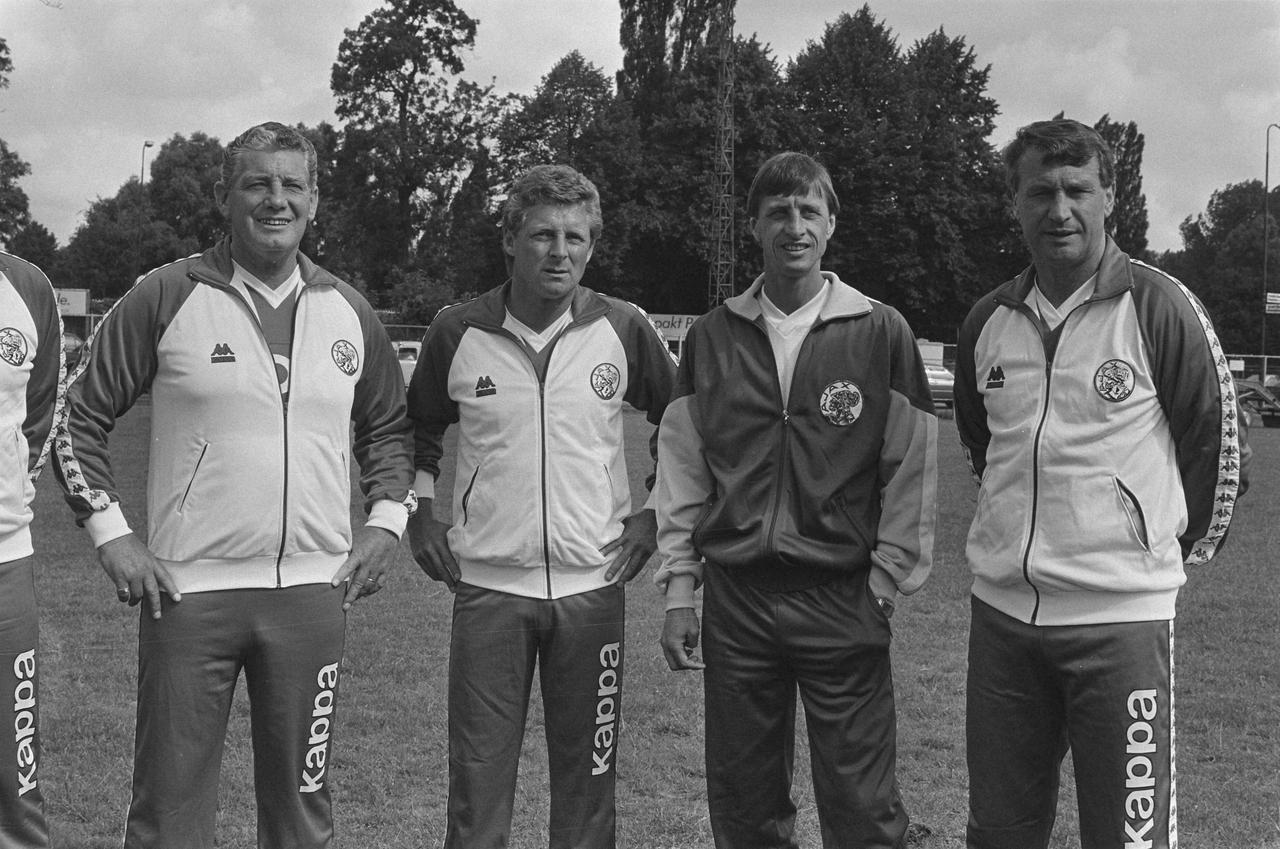
As Ajax Head Coach. 15 July 1985. (Nationaal Archief)
Cruyff’s football philosophy, rooted in “Total Football,” emphasized continuous ball retention and fluid movement. He advocated for versatile players who provided width in attack and compactness in defense. This approach laid the foundation for what later became known as “tiki-taka.” Cruyff’s philosophy became the cornerstone of the youth development systems at both Ajax and Barcelona.
Cruyff played an active role in developing La Masia, FC Barcelona’s youth academy, and became a defining figure in the club’s youth policy. His approach influenced not only tactics but also education and management. Players such as Xavi Hernández, Andrés Iniesta, and Lionel Messi were products of this system. Cruyff’s football academies and the Johan Cruyff Foundation continue to operate worldwide, supporting children’s development through sport.
Pep Guardiola, one of his students and a current coach, said of Cruyff: “He is the person who has had the greatest impact on football in the world, both as a player and as a coach.”【1】
Compilation on Johan Cruyff’s Football (FCBComps HD)
Cruyff married Danny Coster in 1968. The couple had three children: Jordi, Susila, and Chantal. His son Jordi Cruyff also pursued professional football and coaching. Cruyff smoked for many years and underwent heart surgery in 1991 as a result. After this event, he quit smoking and became an advocate for healthy living. In 2015, he was diagnosed with lung cancer. Despite undergoing treatment, he succumbed to the illness and passed away on 24 March 2016 in Barcelona, Spain, at the age of 68.
Following his death, the Spanish government awarded him the Royal Medal of Sports Merit. A statue of him was erected near Camp Nou Stadium. The modern football facility named Estadi Johan Cruyff, where the club’s youth teams play, was opened in his honor. Extensive commemorative ceremonies were held in both the Netherlands and Spain after his passing.
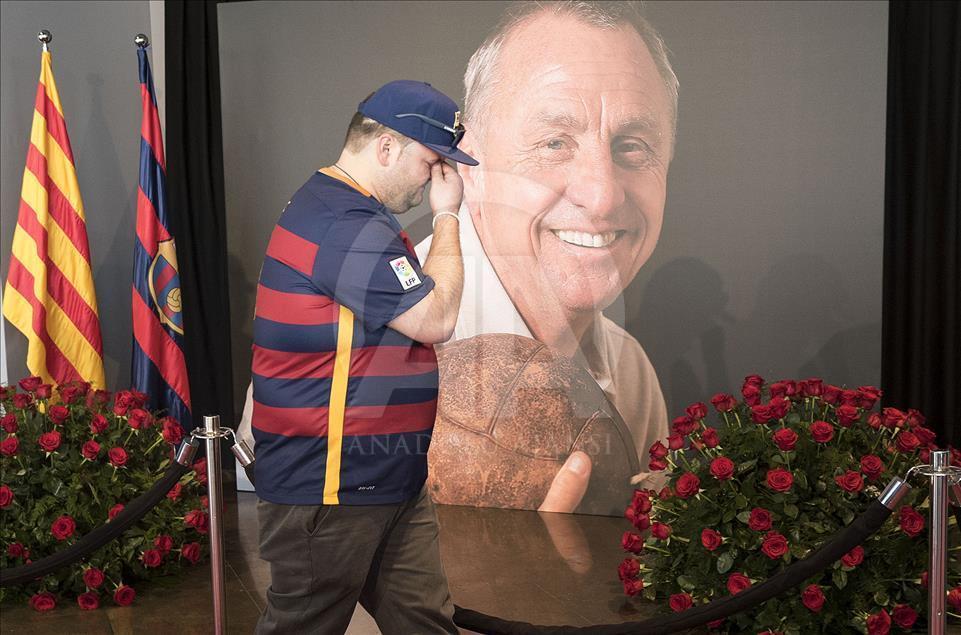
Commemoration Ceremony Held in His Honor After His Death (Anadolu Ajansı)
Johan Cruyff was a figure who contributed significantly to structural and tactical changes in European football during the second half of the 20th century, both as a player and as a coach. It is well documented that the clubs he was associated with adopted his playing systems, prioritized youth development, and helped popularize specific tactical approaches. His achievements at both national and club levels have been frequently analyzed in football literature. The methods he implemented became foundational models for later generations of clubs such as Ajax and Barcelona, and coaches like Pep Guardiola. In this context, Cruyff’s work holds a reference status for a defining era in the organizational and tactical evolution of football.
BBC Türkçe. “Hollandalı Efsane Futbolcu Johan Cruyff Hayatını Kaybetti.” Accessed July 18, 2025.https://www.bbc.com/turkce/haberler/2016/03/160324_cruyff
Biyografiler. "Johan Cruyff Kimdir?" Accessed July 18, 2025.https://www.biyografiler.com/kimdir/johan-cruyff
Delikmen, Kemal. “Futbol Efsanesi Cruyff’un Başarılarla Dolu Hikayesi.” Anadolu Ajansı. Accessed July 18, 2025.https://www.aa.com.tr/tr/spor/futbol-efsanesi-cruyffun-basarilarla-dolu-hikayesi/543339
Erdem, Onur. “Hollandalı Efsane Cruyff Hayatını Kaybetti.” Türkiye Futbol Federasyonu. Accessed July 18, 2025.https://www.tff.org/default.aspx?pageID=286&ftxtID=24827
FC Barcelona. “Johan Cruyff: An Incomparable Legend.” FC Barcelona. Accessed July 18, 2025.https://www.fcbarcelona.com/en/card/1629219/johan-cruyff-an-incomparable-legend
FCBComps HD. "Johan Cruyff • Skills • Goals." YouTube. Accessed July 18, 2025.https://www.youtube.com/watch?v=Y-BpXEMr6LU
FIFA. "Johan Cruyff." Accessed July 18, 2025.https://www.fifa.com/en/archive/johan-cruyff
Football Makes History. "Johan Cruyff." Football Makes History. Accessed July 18, 2025.https://footballmakeshistory.eu/johan-cruyff/
Guardian Sport. “The Life of Johan Cruyff: From Holland’s Total Football to Barcelona Dominance.” The Guardian. Accessed July 18, 2025.https://www.theguardian.com/football/2016/mar/24/johan-cruyff-life-holland-barcelona-ajax
Johan Cruyff Foundation. “About Johan Cruyff.” Accessed July 18, 2025.https://www.cruyff-foundation.org/en/about/johan-cruyff/
Johan Cruyff Institute. “World of Johan Cruyff.” Johan Cruyff Institute. Accessed July 18, 2025.https://johancruyffinstitute.com/wojc/
Llop, Albert. “Barcelona’da Johan Cruyff İçin Anma Töreni Düzenlendi.” Anadolu Ajansı. Accessed July 18, 2025.https://www.aa.com.tr/tr/pg/foto-galeri/barselonada-johan-cruyff-icin-anma-toreni-duzenlendi/0
Nationaal Archief. "Cruijff met de bal." Nationaal Archief. Accessed July 18, 2025.https://www.nationaalarchief.nl/onderzoeken/fotocollectie/ad0a856a-d0b4-102d-bcf8-003048976d84?searchKey=e3a924e79047f548c347faa8e879e5f6
Nationaal Archief. "Johan Cruijff." Nationaal Archief. Accessed July 18, 2025.https://www.nationaalarchief.nl/onderzoeken/fotocollectie/35429da6-b410-a382-e063-6df0900a6686?searchKey=9c3444b4db18e661c9f112ef6c82a582
Nationaal Archief. "Johan Cruijff." Nationaal Archief. Accessed July 18, 2025.https://www.nationaalarchief.nl/onderzoeken/fotocollectie/ac6f4f96-d0b4-102d-bcf8-003048976d84?searchKey=192a028713b1be48a631529b78db502a
Nationaal Archief. "Johan Cruijff." Nationaal Archief. Accessed July 18, 2025.https://www.nationaalarchief.nl/onderzoeken/fotocollectie/ad0a78ae-d0b4-102d-bcf8-003048976d84?searchKey=04f0d5c040b93720de689710cbce8f5f
Nationaal Archief. “Johan Cruyff.” Nationaal Archief. Accessed July 18, 2025.https://www.nationaalarchief.nl/onderzoeken/fotocollectie/35429da7-fd57-a382-e063-6df0900a6686?searchKey=9e1f59d0d7bf28a04087615c9dfb3dc8
Nationaal Archief. “Persdag Ajax.” Nationaal Archief. Accessed July 18, 2025.https://www.nationaalarchief.nl/onderzoeken/fotocollectie/ad488478-d0b4-102d-bcf8-003048976d84?searchKey=ffbf0aaebaf8c5875e9691c1f9d6a839
Socrates Dergi. “Önce Eğlence.” Accessed July 18, 2025.https://socratesdergi.com/yazi/once-eglence
Transfermarkt. "Johan Cruyff – Oyuncu Profili." Transfermarkt. Accessed July 18, 2025.https://www.transfermarkt.com.tr/johan-cruyff/profil/spieler/8021
Transfermarkt. "Johan Cruyff – Teknik Direktör Profili." Transfermarkt. Accessed July 18, 2025.https://www.transfermarkt.com.tr/johan-cruyff/profil/trainer/553/sort/anzahl.desc
[1]
Pep Guardiola, "Johan Cruyff" FIFA. Erişim 18 Temmuz 2025. https://www.fifa.com/en/archive/johan-cruyff

Full Name | Hendrik Johannes Cruijff | ||||||||
|---|---|---|---|---|---|---|---|---|---|
Birth | 25 April 1947 | ||||||||
Place of Birth | Amsterdam, Netherlands | ||||||||
Position | Forward Attacking Midfielder | ||||||||
Clubs Played For | Ajax Los Angeles Aztecs Feyenoord Levante Washington Diplomats Barcelona | ||||||||
National Team | Netherlands National Team (1966–1977) | ||||||||
Managerial Career | Ajax (1985–1988) Barcelona (1988–1996) | ||||||||
Death | 24 March 2016 | ||||||||
Place of Death | Barcelona, Spain | ||||||||
Early Life and Football Beginnings
Club Career
Ajax (1964–1973)
Barcelona Career (1973–1978)
Years in the USA, Return to Ajax and Feyenoord (1979–1984)
Netherlands National Team and the 1974 FIFA World Cup
Coaching Career
Football Philosophy, Education, and Legacy
Personal Life and Death
Major Achievements
As a Player
As a Coach