


This article was automatically translated from the original Turkish version.
+2 More
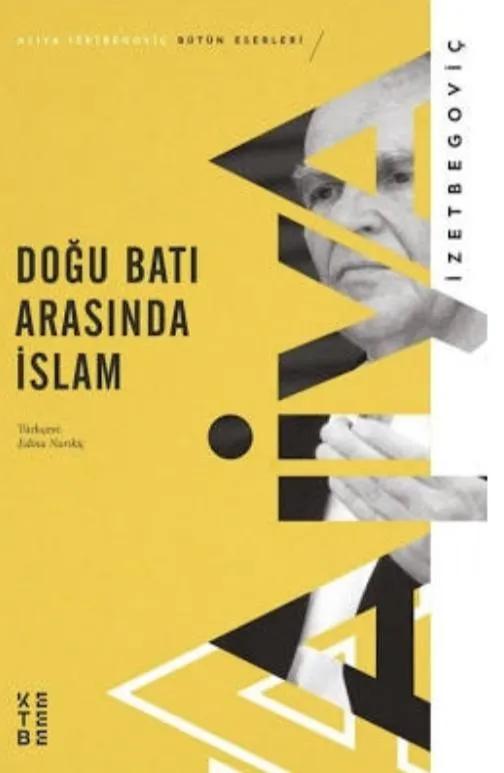
Islam Between East and West
Author | Aliya Izetbegović | ||||||||
|---|---|---|---|---|---|---|---|---|---|
Publisher | Ketebe Yayınları | ||||||||
Translator | Edina Nurikić | ||||||||
First Publication Date(s) | 1980 | ||||||||
Number of Pages | 400 pages | ||||||||
Islam Between East and West, written byAliya Izzetbegovićin 1980, provides a detailed examination of the historical, philosophical, cultural and ethical interactions between Islamic thought and Eastern and Western civilizations.The bookexamines, from an academic perspective, the exchange of knowledge and mutual influences between these two civilizations from the early periods of Islam to the modern era. The work is divided into two main sections titled “The Foundations of Western Thought” and “Islam as a Bipolar Unity”, and offers a profound analysis of how Islam’s universal message has been shaped in different geographical contexts and its role within the East-West dialectic.
The book situates the relationship between Islam and Eastern and Western civilizations within a historical framework, beginning with the emergence of Islam. Particularly between the 8th and 13th centuries, the advances made by the Islamic world in science, philosophy, medicine and astronomy played a critical role in shaping Western civilization. In regions such as Al-Andalus, the collaborative efforts of Muslim, Christian and Jewish scholars stand as one of the most prominent examples of this interaction.
AristotleandPlato, among other Western philosophers, had their works translated into Arabic and interpreted by Islamic thinkers, forming the intellectual foundation of the Western Renaissance. The book emphasizes that this transmission of knowledge was not unidirectional; philosophical and scientific ideas also flowed from the West to the Islamic world. For instance, Islamic mathematical models and optical studies are identified as foundational pillars of the scientific revolution in the West. Moreover, Islamic civilization’s innovations in paper-making techniques and early printing practices accelerated the dissemination of knowledge in the West and strengthened cultural exchange.
The book examines the theological and philosophical structure of Islam through a comparative approach, contrasting it with interpretations from both Eastern and Western traditions. It categorizes worldviews into three groups: religious, materialist and Islamic. In the religious view, existence is defined as spirit; in the materialist view, as matter; and in the Islamic view, as the unity of spirit and matter. Islam is characterized by dualism, which represents a structure that unites the material and spiritual dimensions of existence.
Mystical currents such as Sufism are noted to share similarities with Christian mysticism in the West, yet have developed their own distinct identity. The universal message of Islam is explored in detail as having been synthesized with Indian and Persian traditions in the East and with Hellenistic thought in the West. Judaism is presented as worldly in orientation, Christianity as spiritual, while Islam is portrayed as a religion that balances both elements. In this context, it is argued that Islam offers a way out of the paradoxes of the modern age, particularly by addressing the question of whether a dualistic life can be lived consciously and meaningfully.
The Qur’an states: “You will not have faith until you spend of what you love.” It does not say: Believe so that you may become good. On the contrary, it says: Be good so that you may have faith. The answer to the question “How do I begin to believe? How do I strengthen my faith?” is this: Do good. It is easier to find God through good deeds than through contemplation alone.【1】
The book comprehensively analyzes the influence of Islamic civilization’s achievements in art, architecture, science and education on the West. The Umayyad architecture of Al-Andalus inspired Gothic architecture in the West; decorative arts and geometric patterns from mosques left enduring traces in Western art. In the field of science, the introduction of disciplines such as algebra, astronomy and optics into Western universities reflects the intellectual legacy of Islam.
Izzetbegović asserts that art is intrinsically tied to the human personality and closely linked to religion; the historical use of churches as art galleries and religiously inspired musical compositions support this connection. The distinction between culture and civilization is a central theme of the work: civilization is grounded in technological progress, while culture is rooted in human education and self-mastery. The moral strength of primitive societies is presented as a failure in a world where modern civilizations produce soulless buildings and cultureless cities. The architectural expression of repressive regimes reveals a life confined away from humanity’s spiritual needs.
The book underscores the deep connection between ethics and religion, asserting that moral behavior is shaped by intention rather than outcome. It notes that ethical conduct among atheists often reflects upbringing acquired in childhood, yet defends the view that “ethical atheism” still rests on a religious foundation. The dualism inherent in Islam is explained in detail through its rituals: prayer is linked to astronomy, fasting to medical benefits, and pilgrimage to commercial and social dimensions. The need for astronomical calculations to determine prayer times, the spiritual and physical benefits of fasting, and the role of pilgrimage as both a religious rite and a platform for gathering and trade are presented as examples of this dualism.
At the conclusion of the book, the acceptance of fate and surrender are defined as Islam’s greatest call; this theme is summarized in the phrase: “O surrender! Your name is Islam.” Surrender is presented as a virtue that teaches humanity to perceive life as it is, and to cultivate patience and endurance.
Apaydın, Halil. “Alija İzzetbegoviç’in ‘Doğu ve Batı Arasında İslam’ Adlı Kitabındaki Bazı Düşünceleri Üzerine Bir Değerlendirme.” *KSÜ İlahiyat Fakültesi Dergisi* 6, no. 2 (2016): 67–82.https://dergipark.org.tr/tr/pub/ksuifd/issue/10244/245238
Duran, Asim. “Doğu Batı Diyalektiği Bağlamında Dini Gelenekleri Yeniden Düşünmek: Ali Şeriati ve Aliya İzzetbegoviç Üzerine Bazı Karşılaştırmalar.” *I. Uluslararası Bir Bilge Bir Ülke Sempozyumu: Aliya İzetbegoviç ve Bosna-Hersek Bildiriler Kitabı* (2018): 120–133.https://www.academia.edu/38087438/Do%C4%9Fu_Bat%C4%B1_Diyalekti%C4%9Fi_Ba%C4%9Flam%C4%B1nda_Dini_Gelenekleri_Yeniden_D%C3%BC%C5%9F%C3%BCnmek_Ali_%C5%9Eeriati_ve_Aliya_%C4%B0zzetbegovi%C3%A7_%C3%9Czerine_Baz%C4%B1_Kar%C5%9F%C4%B1la%C5%9Ft%C4%B1rmalar
Sevimli, Maşite. "Doğu ve Batı Arasında İslam." *Hitit Sosyal Bilimler Dergisi* 10, no. 2 (2021): 686–688.https://dergipark.org.tr/tr/pub/hititsosbil/issue/30629/305986
İzetbegoviç, Aliya. Doğu ve Batı Arasında İslam. Trans. Edina Nurikiç. Istanbul: Ketebe Yayınları, 2019.
[1]
Ketebe Yayınları, Doğu Batı Arasında İslam (İstanbul: Ketebe Yayınları, 2019), 184.

Islam Between East and West
Author | Aliya Izetbegović | ||||||||
|---|---|---|---|---|---|---|---|---|---|
Publisher | Ketebe Yayınları | ||||||||
Translator | Edina Nurikić | ||||||||
First Publication Date(s) | 1980 | ||||||||
Number of Pages | 400 pages | ||||||||
No Discussion Added Yet
Start discussion for "Islam Between East and West (Book)" article
Historical Context
Philosophical and Religious Framework
Cultural Interactions
Ethics and Surrender