


This article was automatically translated from the original Turkish version.
+2 More
International Women's Day (IWD)
International Name | International Women's Day | ||||||||
|---|---|---|---|---|---|---|---|---|---|
First Celebration | 1977-03-08 | ||||||||
Purpose(s) | To celebrate women's social to raise awareness for gender equality cultural and political achievements economic | ||||||||
Common Activities | Marches, Panels, Campaigns, Exhibitions, Social media campaigns | ||||||||
Symbolic Color | Purple | ||||||||
Related Topics | Gender, Women's movement, Feminism, Human rights | ||||||||
International Women’s Day (IWD) is a global observance held annually on 8 March to celebrate the social, economic, cultural and political achievements of women. It also serves as a call to action for accelerating gender equality and provides a platform for addressing ongoing issues related to women’s rights. On this day, numerous events are organized worldwide to commemorate women’s accomplishments and to advocate for gender equality.
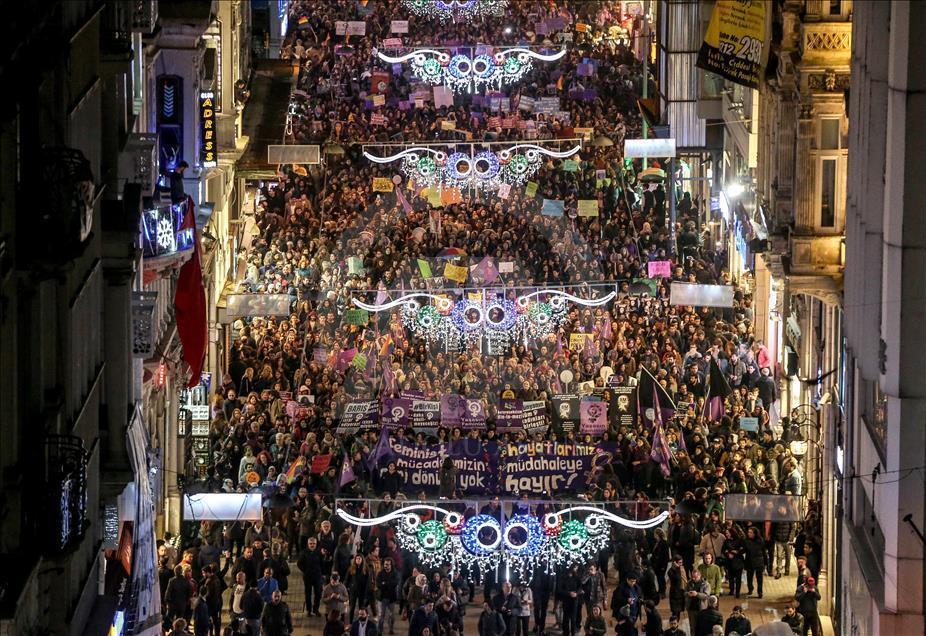
8 March Women’s Day March (AA)
The origins of International Women’s Day date back to the early 20th century and are closely linked to labor movements in Europe and North America. One of the first major women’s labor actions occurred on 8 March 1857 in New York, when approximately 40,000 women textile workers went on strike demanding better working conditions, shorter working hours and equal pay. During the strike, a factory fire broke out, resulting in the deaths of 129 female workers. This event later became a symbol of women’s struggle against workplace inequality.
The proposal to commemorate 8 March as “Women’s Day” was put forward in the 1910s by German politician Clara Zetkin. Zetkin suggested designating 8 March as International Women’s Day to serve as a symbolic date honoring the struggle of working women for their rights. Her proposal was adopted and the day began to be celebrated globally.
The color purple has gradually become the symbolic color of the women’s movement. It represents women’s demands for equality, freedom and resistance, serving as a visual expression of their calls for social and economic equity. Purple is also recognized as a color that signifies resistance against discrimination faced by women and enhances the global visibility of this struggle.
In the 1970s, the United Nations highlighted the persistence of gender inequality and its emergence as an international issue for collective action. The year 1975 was declared by the United Nations as International Women’s Year. During this period, women’s participation in the workforce increased, yet the majority of employed women remained concentrated in unskilled and part-time jobs. Issues such as working hours, wages and unionization rates became the most pressing challenges for women in the labor market.
The United Nations declared the years 1976 to 1985 as the United Nations Decade for Women, during which themes such as equality, development and peace gained prominence. Discussions also focused on increasing women’s participation in the labor force, improving access to health care and education, and expanding their role in political life. In the 1980s, various reforms and institutional measures were taken to enhance women’s presence in politics and public administration.
Women’s position in social life has historically been shaped by patriarchal societal structures.【1】 These structures have hindered women’s participation in public life and often rendered them invisible. However, as women’s participation in education, politics and the labor force has increased, awareness of social gender inequality has also grown. The most prominent areas of gender disparity are found under the categories of “Politics” and “Management”.
In Türkiye, the position of women in public life has undergone significant changes over the years. Since the 1990s, women’s issues have been increasingly discussed both in academic circles and at the level of social policy formulation. While women’s participation in the labor force has risen, there has been growing emphasis on the need to increase the representation of women in public administration.
The 8 March Feminist Night March emerged in 2003 from an action initiated by a group of women in Taksim demanding gender equality. Over time, it evolved into an annual event. Initially organized as a protest against war, the march gradually transformed into a movement addressing a range of social issues including femicide, patriarchy, the right to abortion, violence and social gender inequality. The event, officially named the “Feminist Night March” in 2005, has continued each year with growing participation, though it has at times been banned for various reasons.
BBC News Türkçe. “8 Mart Dünya Kadınlar Günü Nasıl Ortaya Çıktı, Neden Önemli?” Accessed April 24, 2025. www.bbc.com/turkce/articles/cn7v2vd1kryo.
BBC News Türkçe. “8 Mart Yürüyüşü: Polisin Engellemesine Rağmen Kadınlar Cihangir’de Bir Araya Geldi.” Accessed April 24, 2025. www.bbc.com/turkce/haberler-turkiye-60669033.
Euronews. "‘Feminist Gece Yürüyüşü’: Kadınlar Yasağa Rağmen Sokakları Doldurdu." Accessed April 24, 2025. https://tr.euronews.com/2023/03/08/dunya-kadinlar-gunu-turkiyenin-cesitli-noktalarinda-feminist-gece-yuruyusu-yapildi.
International Women’s Day. "About International Women’s Day." Accessed April 24, 2025. www.internationalwomensday.com/About.
Sallan, Songül. “8 Mart Dünya Kadınlar Günü ve Kamu Hayatında Türk Kadınının Konumu.” *Ankara Üniversitesi Dil ve Tarih-Coğrafya Fakültesi Dergisi*, 1993, pp. 159–168. https://atif.sobiad.com/index.jsp?modul=article&ID=86s0u3QBu-adCBSE-3rp.
Özmen, Özlem. “Türkiye’de 8 Mart Kadınlar Günü’nün Tarihsel Süreci.” *EMO Kadın Bülteni*, no. 3 (April 2015): 36–38. Accessed April 24, 2025. https://www.emo.org.tr/ekler/6f61faf23114cb3_ek.pdf?dergi=990.
[1]
Bu genel yapının aksine bazı coğrafyalarda anaerkil toplumların varlığı da görülmüştür. Yahudi toplumu bu konuda en bilinen örnektir.


International Women's Day (IWD)
International Name | International Women's Day | ||||||||
|---|---|---|---|---|---|---|---|---|---|
First Celebration | 1977-03-08 | ||||||||
Purpose(s) | To celebrate women's social to raise awareness for gender equality cultural and political achievements economic | ||||||||
Common Activities | Marches, Panels, Campaigns, Exhibitions, Social media campaigns | ||||||||
Symbolic Color | Purple | ||||||||
Related Topics | Gender, Women's movement, Feminism, Human rights | ||||||||
No Discussion Added Yet
Start discussion for "International Women's Day" article
Historical Background
International Women’s Day and the United Nations
Women’s Presence in Public Life and Social Gender Inequality
Feminist Night March