


This article was automatically translated from the original Turkish version.
Integration point (Turkish: entegrasyon noktası) are special points within an element in the Finite Element Method (FEM) where physical quantities such as stress, strain, and energy density are numerically calculated. In finite element software such as ANSYS, these points are used to enhance the solution accuracy at the element level.
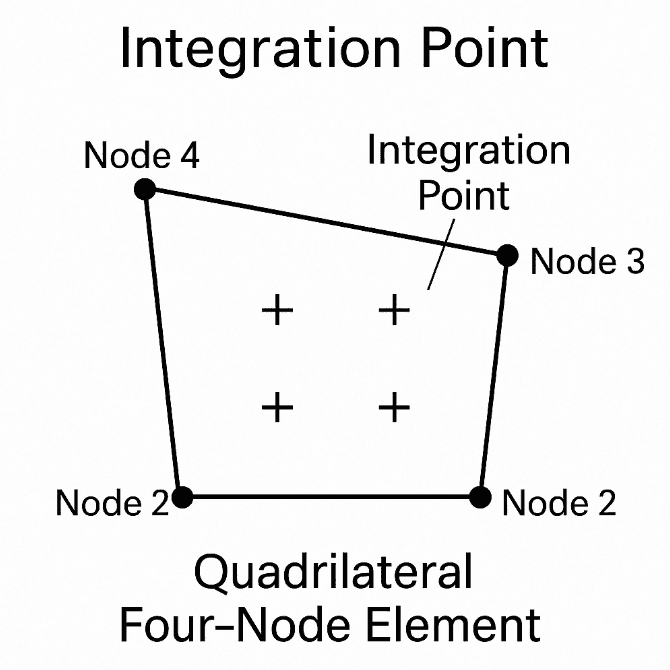
Node and Integration Point (generated by artificial intelligence)
Integration points are used for numerical integration of field quantities within elements in finite element analysis. For this purpose, numerical integration methods such as Gauss-Legendre (Gauss quadrature) gibi are commonly employed. In these methods, the value of an integral over a continuous domain is approximated as a weighted sum of function values at specific points, which are termed integration points.
At each integration point, quantities such as stress, strain, plastic deformation, and energy dissipation within the element are evaluated. These points are typically located at positions different from the element’s node points, and their number varies depending on the element geometry and the chosen integration order.
For example:
In ANSYS software, quantities such as stress and strain obtained after the solution are by default calculated at the integration points. However, for visualization purposes, these results may need to be transferred to the node points. Such transfer is typically performed using interpolation or averaging methods. Consequently, results directly obtained from integration points generally provide higher accuracy.
Integration points enable more accurate and localized solutions, particularly in regions of high strain such as areas where plastic deformation begins. Therefore, evaluating data from integration points is critical for correctly identifying stress concentrations in engineering analyses.
Madier, Dominique. Practical Finite Element Analysis for Mechanical Engineers. 2021.

Definition and Function
Application and Characteristics
Nodal and Integration Point Results
Technical Importance