


This article was automatically translated from the original Turkish version.
Intake manifold is the pipe network structure in an internal combustion engine that distributes fresh air (and fuel mixture in some systems) evenly to the engine cylinders.
Its function is to connect the throttle body (or carburetor) with the intake ports on the cylinder head, ensuring that each cylinder receives a balanced air or air-fuel mixture.
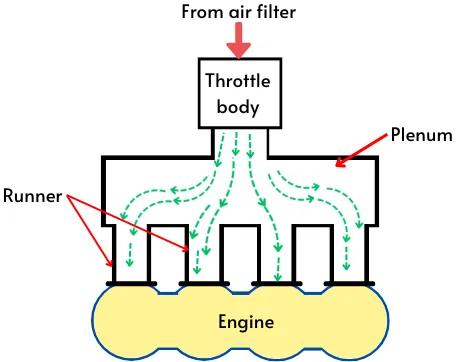
Emme Manifoldu Şematik Görsel (Kaynak: Mechcontent)
The intake manifold is a critical component that directly affects engine performance. Its main functions are:
Air, after passing through the air filter and throttle body, enters a chamber known as the "plenum." From there, it is distributed through individual pipes called "runners" that lead to each cylinder. The plenum volume and runner length are decisive factors in determining the engine's power characteristics.
The intake manifold consists of several main sections:
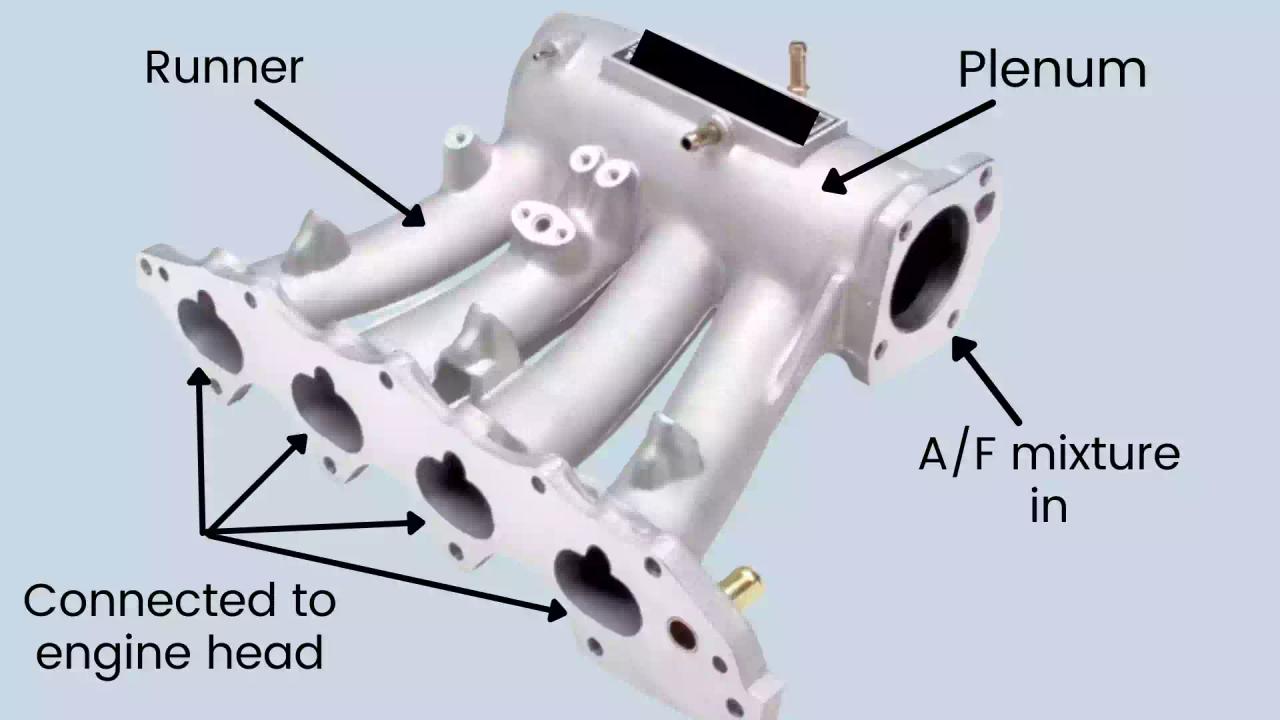
Emme Manifoldu Yapısı (Kaynak: Mechcontent)
Key criteria considered when designing an intake manifold:
MechContent. “Intake Manifold.” MechContent. Accessed April 26, 2025.https://mechcontent.com/internal-combustion-engine/intake-manifold/.
Porter, Matthew A. Intake Manifold Design Using Computational Fluid Dynamics. University of New South Wales at the Australian Defence Force Academy. Accessed April 26, 2025.
State of Speed. "What Is an Intake Manifold?" State of Speed, November 10, 2018.https://stateofspeed.com/2018/11/10/what-is-an-intake-manifold/.

Function and Operating Principle
Wet and Dry Manifolds
Structural Features
Design Criteria