


This article was automatically translated from the original Turkish version.
+1 More
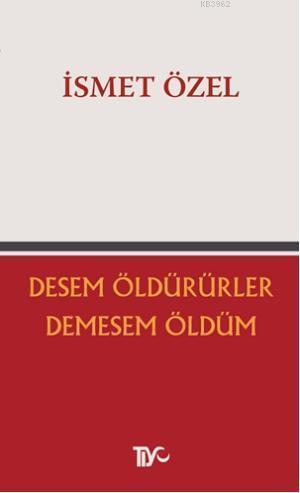
They Say They Kill, I Say I Died (Book)
Author(s) | İsmet Özel | ||||||||
|---|---|---|---|---|---|---|---|---|---|
Publisher(s) | TİYO Yayınları | ||||||||
Year of Publication | 2012 | ||||||||
Number of Pages | 384 pages | ||||||||
Type(s) | Essay - Analysis | ||||||||
Desem Öldürürler Demesem Öldüm is an essay collection by Turkish poet and writer İsmet Özel, published in 2012 by TİYO Yayınları. The work is a compilation of column articles written by Özel between 2011 and 2012, along with texts published on the website istiklalmarsidernegi.org.tr.
The book offers a critical perspective on Turkish identity, Islam, and the social and political issues of modern Türkiye. Written in İsmet Özel’s distinctive style, the book is notable for being printed in both Ottoman Turkish and Turkish of Türkiye, positioning it as a unique work in Turkish publishing. The title symbolizes Özel’s dilemma between speaking out against historical and cultural falsehoods in Türkiye and remaining silent, and the book thoroughly interrogates this tension.
Desem Öldürürler Demesem Öldüm is a collection of essays in which İsmet Özel reflects on Türkiye’s recent history, the concepts of Turkism and Islam, and the ideological contradictions imposed on Türkiye by the modern world. It is the first publication by TİYO Yayınları and the second book by Özel to be printed in Ottoman Turkish, following his earlier work Küfrün İhsanı Olmaz.
The book centers on İsmet Özel’s critiques of Turkish society’s perceptions of identity, religion, and history. In the work, Özel emphasizes the following:
The book does not claim to present an ultimate truth; Özel states that his words have neither endangered his life nor secured his survival. This underscores the introspective and paradoxical nature of the work.
İsmet Özel (b. 1944, Kayseri) is one of Turkey’s leading poets and thinkers. A graduate of the Department of French Language and Literature at Hacettepe University, Özel studied for a time at the Faculty of Political Sciences and taught French for eighteen years at the State Conservatory. He co-founded the journal Halkın Dostları with Ataol Behramoğlu. Since the 1960s, Özel’s poetry has evolved from a socialist worldview to one rooted in Islam and Turkism. Desem Öldürürler Demesem Öldüm is a mature work reflecting this ideological transformation and embodies his distinctive style.
Desem Öldürürler Demesem Öldüm was received with interest by İsmet Özel’s readership upon publication, though its complex and dense style made it difficult for some readers to comprehend. The book has notably contributed to ideological debates in Türkiye through its emphasis on Turkic and Islamic identity. According to reader responses, the work demands patient and unbiased reading; while some find Özel’s ideas “fierce” and challenging, his observations are widely admired for their historical accuracy and sharpness. As the first publication of TİYO, the official organ of the İstiklal Marşı Derneği, the book carries the character of a manifesto reflecting the association’s ideological orientation.
Özel, İsmet. Desem Öldürürler Demesem Öldüm. İstanbul: TİYO Yayınları, 2015.

They Say They Kill, I Say I Died (Book)
Author(s) | İsmet Özel | ||||||||
|---|---|---|---|---|---|---|---|---|---|
Publisher(s) | TİYO Yayınları | ||||||||
Year of Publication | 2012 | ||||||||
Number of Pages | 384 pages | ||||||||
Type(s) | Essay - Analysis | ||||||||
No Discussion Added Yet
Start discussion for "If I Say “They Kill the Desem,” I Am Dead (Book)" article
Content and Structure
Themes and Central Arguments
The Author and His Approach
Reception and Impact