This article was automatically translated from the original Turkish version.
+1 More
X-Ray Sources | X-ray binaries | ||||||||
|---|---|---|---|---|---|---|---|---|---|
Dust and Extinction | High reddening | ||||||||
Star Clusters | Various clusters | ||||||||
Wolf-Rayet Stars | Current | ||||||||
Star Composition | Very old population | ||||||||
Galaxy Type | Dwarf irregular | ||||||||
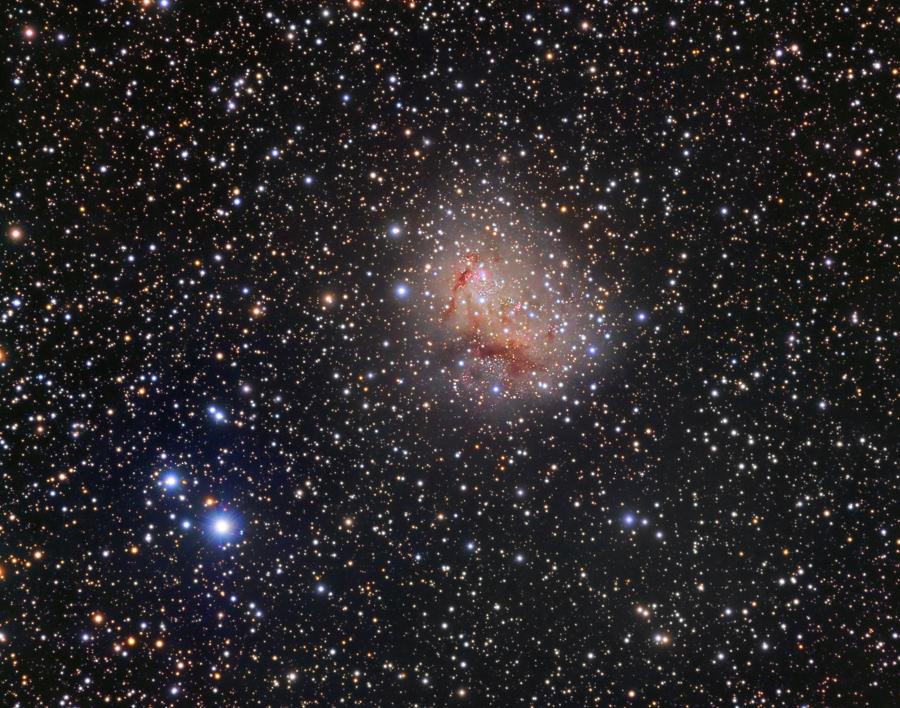
IC 10 is a dwarf starburst galaxy located within the Local Group, exhibiting intense star formation activity. The galaxy has been the subject of various observational studies concerning its stellar content, star formation history, star clusters, Wolf-Rayet stars, X-ray sources, and distance measurements.
IC 10 is an irregular dwarf galaxy characterized by intense star formation activity. Examination of its stellar content reveals the coexistence of both young and older stellar populations. BThis indicates that IC 10 has undergone a complex evolutionary process with episodes of star formation occurring at different times.【1】
The star clusters within the galaxy exhibit diverse ages and properties, supporting this variety. In particular, the presence of young star clusters indicates that active star formation is still ongoing in IC 10.【2】 Furthermore, the high number of massive stars and the detection of numerous Wolf-Rayet stars reveal that IC 10 possesses the physical conditions associated with intense star formation processes.【3】
The physical properties of IC 10 have been studied not only through optical observations but also via X-ray observations. The X-ray sources detected in the galaxy indicate the presence of high-energy binary systems, revealing that IC 10 possesses a dynamic and energetic structure.【4】
Distance measurements are essential for understanding IC 10 as a member of the Local Group.【5】 Additionally, images obtained from space telescopes have revealed the galaxy’s irregular morphology and star-forming regions, contributing to a better understanding of its physical structure.【6】
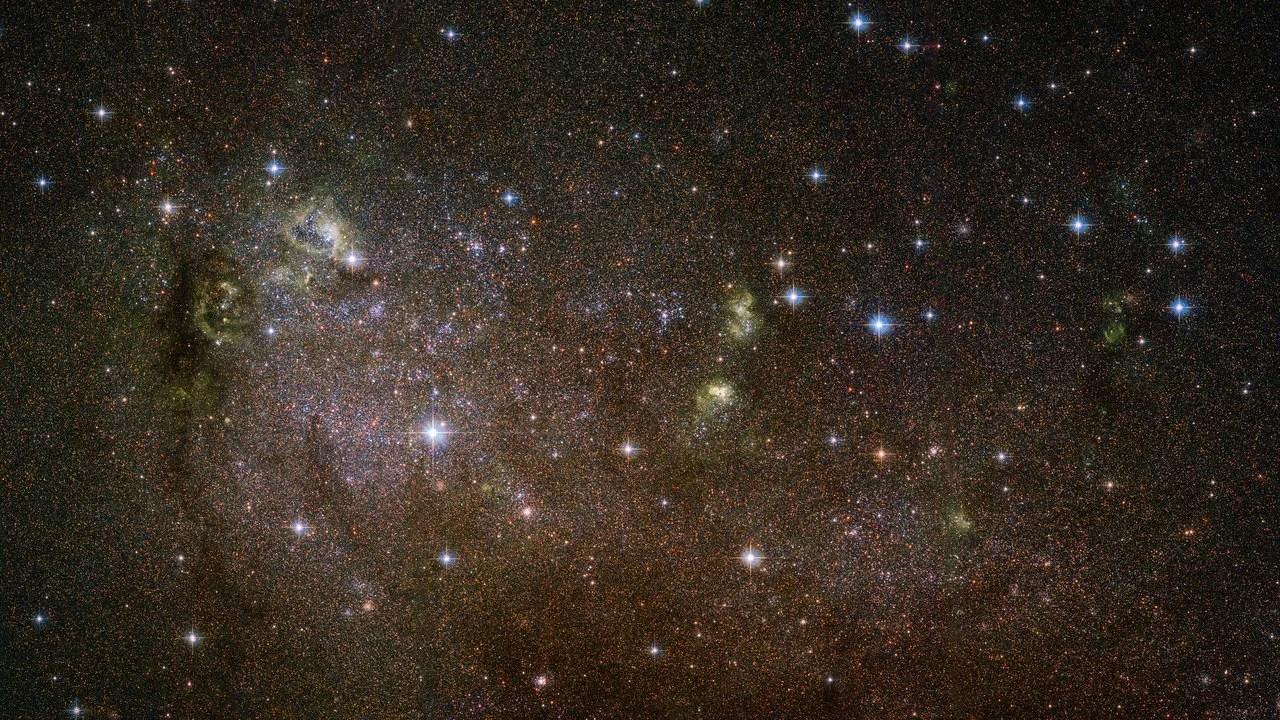
IC 10 (NASA)
IC 10 is a galaxy hosting stellar populations of various ages. Research has shown that both young and old stars are present, indicating a complex star formation history.【7】
The star clusters in the galaxy display varying ages and metallicities, providing key data for understanding star formation processes. In particular, the presence of young star clusters confirms that active star formation continues in IC 10.【8】
Analysis of the star formation history reveals that IC 10 has experienced episodes of intense but short-lived star production, characteristic of “starburst” phases.【9】
Moreover, the abundance of massive stars, particularly the high concentration of Wolf-Rayet stars, serves as a key indicator of intense star formation activity in IC 10. These stars are studied in connection with the galaxy’s brief but vigorous star formation episodes.【10】
IC 10 possesses a rich system of star clusters that provide significant insights into its star formation history. These clusters reflect the galaxy’s complex stellar population through their diverse ages and properties. Young clusters demonstrate that active star formation is still ongoing.
Among the massive stars in the galaxy, Wolf-Rayet stars are particularly notable. These represent the final evolutionary stages of massive stars and are regarded as indicators of intense star formation processes in IC 10.
The distribution and number of Wolf-Rayet stars are directly linked to the galaxy’s starburst characteristics. These stars provide researchers with critical data for understanding the galaxy’s energetic and dynamic structure. Observations of star clusters and Wolf-Rayet stars collectively offer comprehensive insights into IC 10’s star formation activity and evolutionary state.【11】
The X-ray sources detected in IC 10 enable the study of high-energy astrophysical processes in the galaxy. These sources are typically associated with binary systems containing neutron stars or black holes.
Observations have shown that IC 10 is rich in X-ray binary systems, which contribute significantly to its dynamic and energetic structure. The distribution and properties of X-ray sources have been interpreted in relation to the galaxy’s star formation activity.
These data serve as an important tool for understanding the galaxy’s star formation history and evolutionary processes. X-ray observations, combined with optical and other wavelength data, allow for a detailed analysis of the galaxy’s structural and physical properties.
IC 10 has been extensively studied through observations across multiple wavelengths. Optical observations have revealed its star-forming regions and irregular morphology, while data from space telescopes have enabled more detailed investigations of these regions. Imaging studies have played a crucial role in determining the galaxy’s structural features and the distribution of its star clusters.
Both surface brightness distributions and analyses of individual stellar populations have been employed in studying the galaxy. These methods have revealed the presence of young and old stars in IC 10, as well as the varying ages and metallicities of its star clusters. In particular, the distribution of Wolf-Rayet stars provides critical data for understanding the galaxy’s starburst activity.
In addition, X-ray observations have enabled the study of high-energy binary systems and their contributions to the galaxy’s dynamic and energetic structure. Multi-wavelength observational approaches provide a holistic perspective on the relationships between the galaxy’s star formation history, massive stellar population, and X-ray sources.
All these observational studies have established a comprehensive foundation for understanding IC 10’s structural, physical, and star formation processes, and enable the investigation of its evolutionary history in the context of its position within the Local Group.【12】
Bhattacharya, Sayantan, Silas G. T. Laycock, Breanna A. Binder, and Dimitris M. Christodoulou. “Chandra Observations of the X-Ray Binary Population in the Field of the Dwarf Galaxy IC 10.” Astronomy 4, no. 4 (2025): 26. Accessed February 2, 2026. https://www.researchgate.net/publication/398686785_Chandra_Observations_of_the_X-Ray_Binary_Population_in_the_Field_of_the_Dwarf_Galaxy_IC_10
Gholami, Mahtab, Atefeh Javadi, Jacco Th. van Loon, Habib Khosroshahi, and Elham Saremi. “Star Formation History for the Starburst Dwarf Galaxy in the Local Group, IC 10.” *IAU Symposium 373, Proceedings of the International Astronomical Union* (2023). Accessed February 2, 2026. https://www.researchgate.net/publication/371462857_Star_formation_history_for_the_starburst_dwarf_galaxy_in_the_Local_Group_IC_10
Lim, Sungsoon, and Myung Gyoon Lee. “The Star Cluster System in the Local Group Starburst Galaxy IC 10.” *The Astrophysical Journal* 804, no. 2 (2015): 123. Accessed February 2, 2026. https://www.researchgate.net/publication/273471713_The_Star_Cluster_System_in_the_Local_Group_Starburst_Galaxy_IC_10
Massey, Philip, and Shadrian Holmes. “Wolf-Rayet Stars in IC 10: Probing the Nearest Starburst.” *The Astrophysical Journal* 580, no. 1 (2002): L35–L38. Accessed February 2, 2026. https://www.researchgate.net/publication/231155187_Wolf-Rayet_Stars_in_IC_10_Probing_the_Nearest_Starburst
NASA, and ESA. “IC 10 (Hubble Image).” *NASA Science*. June 21, 2019. Accessed February 2, 2026. https://science.nasa.gov/missions/hubble/hubble-captures-elusive-irregular-galaxy/
NASA. “Starburst Galaxy IC 10.” *Astronomy Picture of the Day*. January 4, 2012. Accessed February 2, 2026. https://apod.nasa.gov/apod/ap120104.html
Sanna, N., G. Bono, P. B. Stetson, A. Pietrinferni, M. Monelli, S. Cassisi, R. Buonanno, E. Sabbi, F. Caputo, and A. R. Walker. “On the Stellar Content of the Starburst Galaxy IC10.” *The Astrophysical Journal* 699, no. 2 (2009): L84–L87. Accessed March 2, 2026. https://www.researchgate.net/publication/231033207_On_the_Stellar_Content_of_the_Starburst_Galaxy_IC10
[1]
Mahtab Gholami vd., “Star Formation History for the Starburst Dwarf Galaxy in the Local Group, IC 10,” IAU Symposium 373, Proceedings of the International Astronomical Union (2023): 2-3, https://www.researchgate.net/publication/398686785_Chandra_Observations_of_the_X-Ray_Binary_Population_in_the_Field_of_the_Dwarf_Galaxy_IC_10
[2]
Sungsoon Lim ve Myung Gyoon Lee, “The Star Cluster System in the Local Group Starburst Galaxy IC 10,” The Astrophysical Journal 804, no. 2 (2015): 123, https://www.researchgate.net/publication/273471713_The_Star_Cluster_System_in_the_Local_Group_Starburst_Galaxy_IC_10
[3]
Philip Massey ve Shadrian Holmes, “Wolf-Rayet Stars in IC 10: Probing the Nearest Starburst,” The Astrophysical Journal 580, no. 1 (2002): L35, https://www.researchgate.net/publication/231155187_Wolf-Rayet_Stars_in_IC_10_Probing_the_Nearest_Starburst
[4]
Sayantan Bhattacharya vd., “Chandra Observations of the X-Ray Binary Population in the Field of the Dwarf Galaxy IC 10,” Astronomy 4, no. 4 (2025): 26, https://www.researchgate.net/publication/398686785_Chandra_Observations_of_the_X-Ray_Binary_Population_in_the_Field_of_the_Dwarf_Galaxy_IC_10
[5]
Sayantan Bhattacharya vd., “Chandra Observations of the X-Ray Binary Population in the Field of the Dwarf Galaxy IC 10,” 26.
[6]
Sayantan Bhattacharya vd., “Chandra Observations of the X-Ray Binary Population in the Field of the Dwarf Galaxy IC 10,” 26.
[7]
Sayantan Bhattacharya vd., “Chandra Observations of the X-Ray Binary Population in the Field of the Dwarf Galaxy IC 10,” 26.
[8]
Sungsoon Lim ve Myung Gyoon Lee, “The Star Cluster System in the Local Group Starburst Galaxy IC 10,” 123.
[9]
Mahtab Gholami vd., “Star Formation History for the Starburst Dwarf Galaxy in the Local Group, IC 10,” IAU Symposium 373, Proceedings of the International Astronomical Union (2023): 2-3.
[10]
Philip Massey ve Shadrian Holmes, “Wolf-Rayet Stars in IC 10: Probing the Nearest Starburst,” L35.
[11]
Sungsoon Lim ve Myung Gyoon Lee, “The Star Cluster System in the Local Group Starburst Galaxy IC 10,” 123.
[12]
Mahtab Gholami vd., “Star Formation History for the Starburst Dwarf Galaxy in the Local Group, IC 10,” 2-3.
Sayantan Bhattacharya vd., “Chandra Observations of the X-Ray Binary Population in the Field of the Dwarf Galaxy IC 10,” 26.

X-Ray Sources | X-ray binaries | ||||||||
|---|---|---|---|---|---|---|---|---|---|
Dust and Extinction | High reddening | ||||||||
Star Clusters | Various clusters | ||||||||
Wolf-Rayet Stars | Current | ||||||||
Star Composition | Very old population | ||||||||
Galaxy Type | Dwarf irregular | ||||||||
Physical Properties and Distance
Stellar Content and Star Formation
Star Clusters and Wolf-Rayet Stars
X-Ray Sources
Research Areas and Observational Approaches