


This article was automatically translated from the original Turkish version.
Have you ever seen a Broadway while passing through Sığırçayı? I saw one. It was white. Three of its wheels had fallen off, held in place by a plastic clamp. I wanted to write “the monster with only one wheel left,” but that would have been too simple. Cafer would have blushed at me for writing something like that. There were rotting parts beside it, behind it. These were normal—just a typical village cart. That was all its purpose: to go to Göynücek, fetch something, and come back.
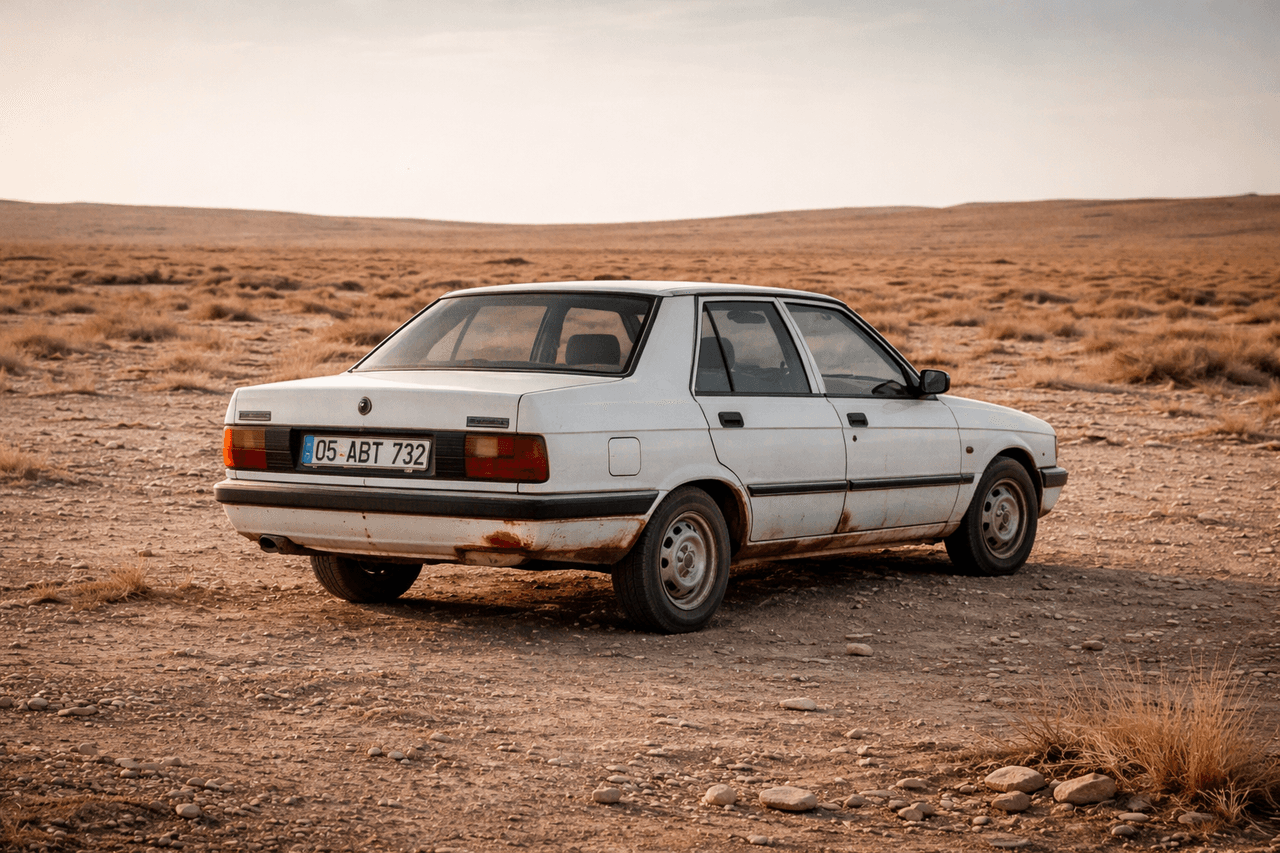
Broadway in Sığırçayı (Generated by AI, Because I Never Saw It.)
Actually, do you know the real truth? I never passed through Sığırçayı at all. Naturally, I never saw a Broadway. If Cafer saw what I wrote, he’d blush at me. He might even scold me. He could say, “So why are you writing this nonsense then?” But if I had passed through Sığırçayı and seen a Broadway, it would almost certainly have looked just as I described. It might not even have had a spare wheel; the seat cushions could have been torn, and under the sun it might have been steaming. Don’t think I didn’t describe it well enough.
“For God’s sake, why are you yammering like this?” Cafer said. I told you—he’d blush at me. He might even yell. Sometimes he calls me “zırtapoz,” and he doesn’t hold back. “I don’t know,” I said. “I just felt like writing this.” “Does everything that crosses your mind get written down?” he asked, still annoyed. “I didn’t write it just because it popped into my head. It’s been in my mind for a long time; I just couldn’t prepare myself to write it.” “Don’t lie,” he said. “You don’t say ‘I’m avoiding it, I’m procrastinating’—you say ‘I’m preparing.’ Is this mess your prepared version?” I can’t even deny that. I used to sit for pages every day and write. It’s been about a year now since I’ve managed to turn thought into action in writing. “You’ve been neglecting writing lately,” he said. I stayed silent again, as if agreeing. What could I say? “No, I’m thinking”? Thinking about what? The Broadway? Sığırçayı?
He looked at the text, skipped around, and read it aloud. “What is this?” he asked. “Is this even writing? Where’s the meaning, where’s the structure, where’s the emphasis, where’s the language?” He was partly right and partly wrong. I’d actually been thinking the same thing just moments ago, but I didn’t tell him. Do I have to be Ziya Paşa now, for heaven’s sake? I’m playing my own tune, singing my own song—to whom? Aren’t we in the postmodern age now? I’m grateful I can pick up a pen and scribble something for myself, and then he comes to judge me. I don’t write to fit his program—I write for myself. “Meaning is what you want to see,” I said. A pretentious remark. Fine if it lands. If it doesn’t, I’ll swallow a truckload of his words.
It didn’t land. “Look at you, Paşa,” he said, teasing me. Let him tease me, let his nonsense, his bluster, his clamor pass. “Where did you learn this literature?” he asked. “Reception aesthetics,” I replied. “Who gave you this idea?” he pressed. “Stanley Fish,” I said. “Fine, shut up and don’t give me lectures. You’ll start citing sources next and the editor will come knocking.” “Fine,” I said. “Isn’t that right? If he wants sources, we’ll give them. We’re not making this up out of thin air.” “You’ll write a blog and put fifty sources in it,” he said. He’s right—what can I say? Cafer knows me better than I know myself.
Meanwhile, my mind is still stuck on that Broadway. One wheel gone, held together by a plastic clamp. Forced, makeshift, incomplete, broken, decaying.
“Are you reading poetry?” Cafer asked. “I used to, but I stopped.” Melahat, curious, gestured with her hand as if to say, “Why?” “Didn’t I tell you already in an earlier piece? You didn’t read it?” I said. “I got tired of academic posturing. You immediately cite your own writing. Besides, I never read that piece.” “No one read it anyway,” I said. “Collect your scattered writings, compile them into a book, and go around saying ‘I have a book.’” “Cafer,” I said, “no one reads writing for free. Books cost money—who’s going to read them, for heaven’s sake? You can’t even read a single page, so how can you read a whole book?”
He started rambling again. To be honest, I didn’t listen. The louder he spoke, the more the noise grew. I kept shuttling between the Broadway and the noise. I didn’t even need to borrow copyright—it’s as if someone gave it to me and I just didn’t take it. Or maybe I was supposed to fill my empty stomach first, like a hungry bear doesn’t dance, or whatever nonsense he was spouting. He went on about the postmodern age, calling it meaningless noise, claiming it was like extracting a camel from a flea, that everything was trash. I didn’t want to listen, but he wasn’t entirely wrong. He talked for minutes, then stopped. If Cafer had the strength, he’d have definitely slapped me on the back of the neck.
I wanted to give myself to the writing. I wanted to write again after so long—just scribble, even if no one read it, just to make something exist in my inner world, to give life to things I couldn’t name. I once intended to write beautiful things. I did write them. I swear. Cafer still didn’t like them—he thought they were nonsense—but Seray liked them. I always send my writing to her anyway. She understands it, finds structure in it, approves of it, appreciates it. I don’t understand it, and she doesn’t either. We get by. Those who understand don’t like it.
Actually, I’m a little afraid. I feel as if I can’t recapture the old feeling anymore. It’s as if I can’t write the way I used to. The words won’t flow as they once did; writing will no longer be a natural reflex. Back then, there was almost no distance between thinking and writing; now I feel like I have to cling to every sentence.
I used to be like a typewriter, truly. I swear. If you don’t believe me, ask Seray. I sent her my writings every day. Like Ahmet Mithat Efendi, I wrote constantly. Some friends used to call me “Ahmet Mithat Efendi” because I wrote so much. Now, not at all.
1995 (Ólafur Arnalds)
“Tell me something—what’s happening in the world? Talk about wars, deaths, broken loves. Are you going to write like grass grows? What can you say about a car you’ve never seen? Write about beauty, write about cruelty. Inform people, steer them away from mistakes, write about museums, write about places to visit.” He listed them all. I didn’t tell him because I didn’t want his head to swell. Besides, I didn’t even listen to half of it. Finally, I got angry. “Cafer, am I a tour guide?” I said.
I turned back to the writing. I tried not to listen to him. The more he spoke, the more he ranted. He acted as if he knew my intentions, as if he wanted my good, and so on, all that nonsense. I forgot what I was even supposed to write. I picked up my pen with a sudden rush. I resolved to scribble, to give life to something.
I saw a Broadway while passing through Sığırçayı. May God curse that Broadway.
Akkaya, Yusuf Bilal. "Sığırçayı'ndan Geçerken Bir Broadway Gördüm." Unpublished story. Date Written: March 22, 2026.
Arnalds, Ólafur. "Ólafur Arnalds - 1995 ft. Dagný Arnalds." YouTube. Accessed March 23, 2026. https://www.youtube.com/watch?v=VonLk1UUlhA
Moran, Berna. Edebiyat Kuramları ve Eleştiri. İstanbul: İletişim Yayınları, 2021.