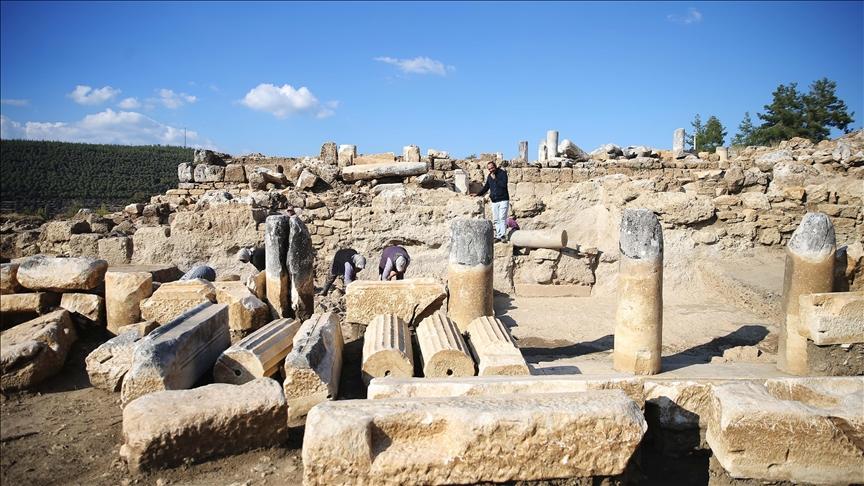


This article was automatically translated from the original Turkish version.
+2 More
Province(s) | Muğla | ||||||||
|---|---|---|---|---|---|---|---|---|---|
Name(s) | Hyllarima Ancient City | ||||||||
Historical Features | City that minted coins during the Roman period | ||||||||
Archaeological Findings | Multi-layered settlement traces Monumental fountain structure from the Hellenistic period Agora shops | ||||||||
Main Structures | Monumental terraces Tumuli and burial structures Council building (bouleuterion) Agora (commercial center) Theater | ||||||||
Ancient Area | Caria | ||||||||
District | Kavaklıdere | ||||||||
Hyllarima Ancient City is an ancient settlement located within the boundaries of Kavaklıdere district in Muğla province, situated in the interior region of Caria. The city lies between the valleys of Marsyas (Çine Çayı) and Harpasos (Akçay), along a key transit route connecting Inner Caria to the coastal areas.
Hyllarima Ancient City is located near Derebağ Village in Kavaklıdere district of Muğla province, within the interior region of Caria. The city occupies a strategic position between the Marsyas and Harpasos valleys, along a vital transit route linking the Meander Valley to Inner Caria and further to the coastal regions.【3】 This location enabled the city to function as a crucial link between Inner Caria and the coastal regions.
The area where the settlement was established features a topography favorable for defense. It is evident that the eastern part of the city was built on an elevated and rocky terrain, which contributed significantly to its protection.
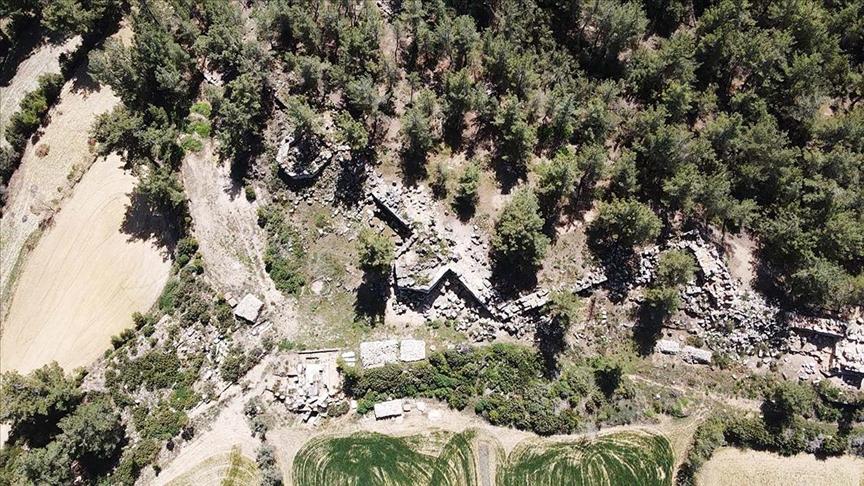
Hyllarima Ancient City (Anadolu Ajansı)
Hyllarima and surrounding research has revealed that the history of settlement in the region extends back to the Bronze Age. Findings indicate that the area was inhabited continuously from the 3rd millennium BCE through various historical periods, demonstrating a long-standing pattern of occupation. The presence of settlement traces from multiple eras within and near the ancient city underscores its enduring significance throughout history.【4】
The historical development of the city became particularly prominent during the Classical, Hellenistic, and Roman periods. It is evident that during these eras the urban fabric of the city took shape and public buildings were constructed.
Archaeological findings demonstrate that the settlement underwent repeated reorganization and continued development across different periods. The architectural remains and settlement traces uncovered in Hyllarima reveal a multi-layered structure shaped by its long historical trajectory.【5】
Hyllarima Ancient City is a walled settlement planned in harmony with the natural topography. The approximately two-kilometer-long city walls encircled the settlement and were constructed for defensive purposes. The eastern part of the settlement is situated on a rugged and elevated terrain that facilitated defense, while the western section contains predominantly residential and domestic structures.
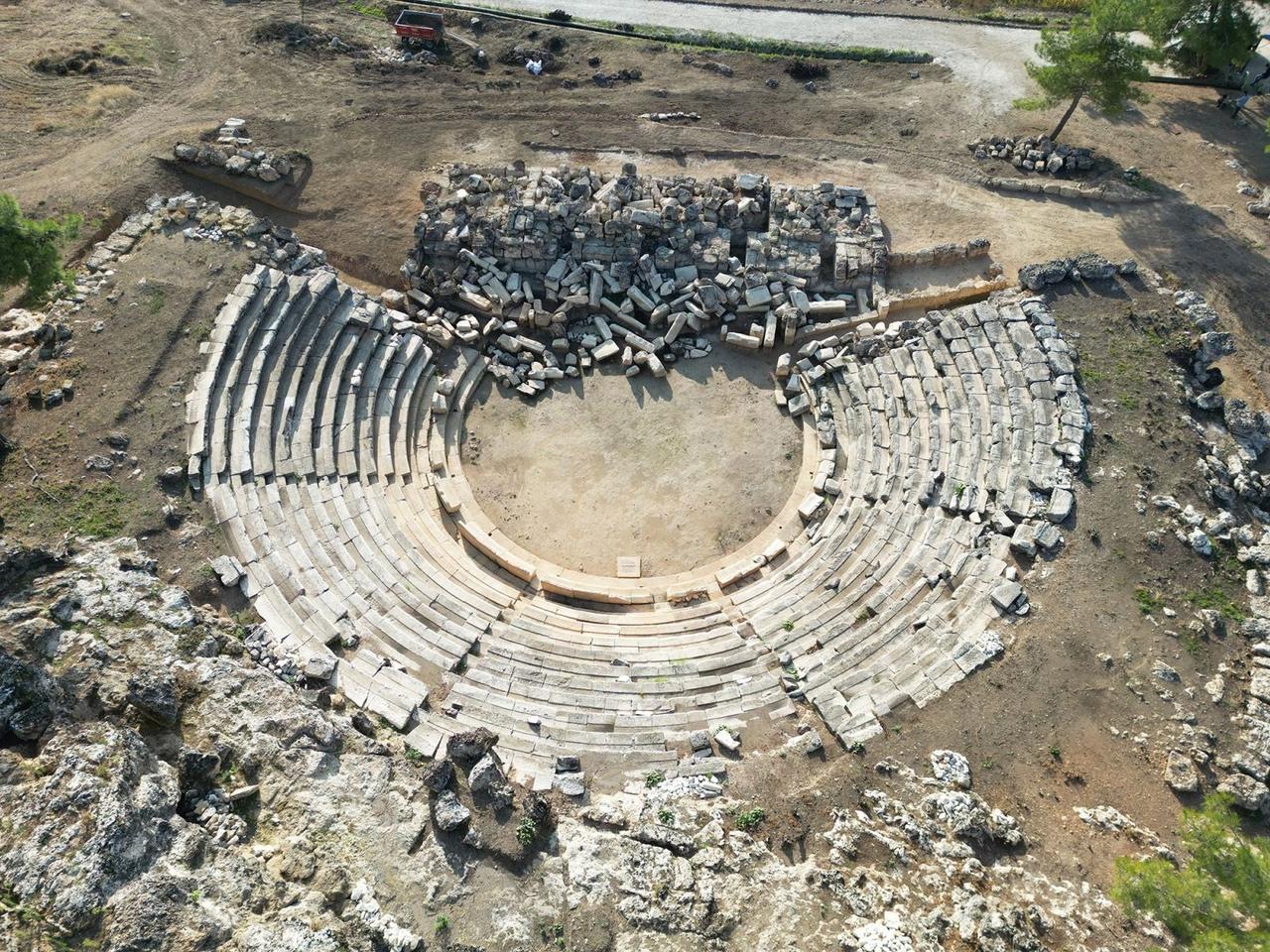
Hyllarima Theatre (Muğla Sıtkı Koçman University Department of Archaeology)
The urban plan features a main street oriented east-west, which served as the central axis connecting the city’s key public buildings and played a decisive role in its organization. The development of structures along this street indicates that Hyllarima was a planned settlement.
Public buildings in Hyllarima are concentrated in specific areas. The theatre is one of the city’s most significant structures, built into the sloping terrain. Remains of the seating areas and stage structure provide insight into its use and architectural design.
Agora formed the center of the city’s commercial and social life. Excavations around the agora have uncovered remains of shops. These shops were arranged in a linear pattern, indicating concentrated commercial activity in this area. Additionally, the presence of structural layers from different periods in the agora confirms its long-term use.【7】
The bouleuterion, or council house, is interpreted as the structure where public administrative activities were conducted. Remains of tumuli, rock-cut tombs, and monumental graves have been identified in the city. The necropolis is located in the southeast of the settlement.
Hyllarima also features monumental terraces and architectural remains with diverse functions. It has been determined that the stone used in construction was largely sourced locally, while higher-quality stone, including marble, was selected for monumental structures.
Archaeological findings reveal that the city possessed a sophisticated urban structure during the Hellenistic and Roman periods.
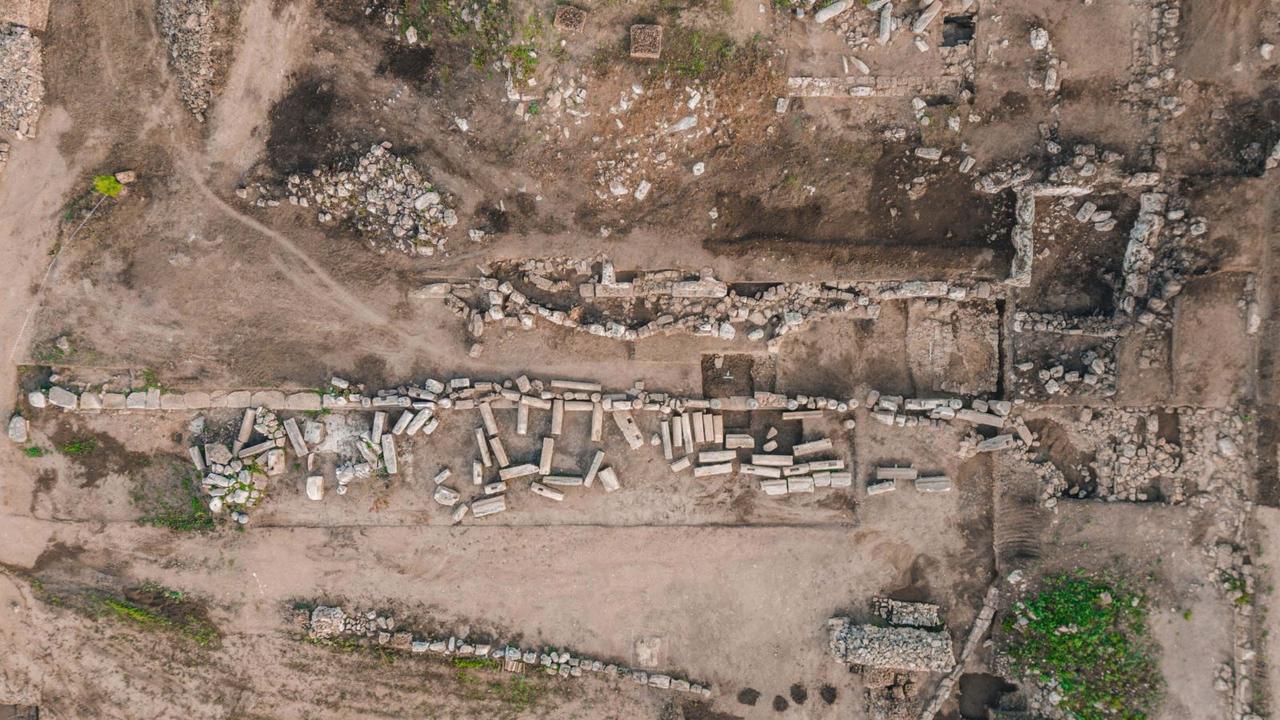
Hyllarima Agora (Muğla Sıtkı Koçman University Department of Archaeology)
Archaeological work at Hyllarima Ancient City aims to uncover settlement layers and architectural remains from various historical periods. Excavations have clearly identified the locations of key public and monumental structures such as the theatre, agora, and tumuli within the city’s urban plan.
The area surrounding the agora has emerged as a primary focus of excavation activities. Excavations here have revealed remains of shops associated with commercial activity. These structures were found arranged in a systematic layout and show evidence of prolonged use. The discovery of structural layers from multiple periods indicates that the area was either continuously occupied or repeatedly reused over time.
Research at the site has also uncovered architectural features and usage traces related to the theatre. Excavations and restorations in the theatre area have yielded archaeological data concerning its stage and seating sections.
The architectural remains uncovered during archaeological investigations demonstrate that the settlement had a multi-layered structure. Remains from different historical periods reveal that Hyllarima had a long history of continuous habitation and underwent repeated reorganization over time.
The investigations have also provided information on construction techniques and material properties used in the settlement. The stones used in the city walls and monumental terraces were sourced from local quarries, while the marble used in monumental buildings was transported from marble quarries located to the east of the city.【9】
Anadolu Ajansı. “Hyllarima Antik Kenti’nde agoradaki dükkanlar gün yüzüne çıkarıldı.” Accessed April 12, 2026. https://www.aa.com.tr/tr/kultur/hyllarima-antik-kentinde-agoradaki-dukkanlar-gun-yuzune-cikarildi/3723459
Kavaklıdere Kaymakamlığı. “Hyllarima Antik Kenti.” kavaklidere.gov.tr. Accessed April 12, 2026. https://www.kavaklidere.gov.tr/hillerima-hyllarima-antik-kenti
Muğla Sıtkı Koçman Üniversitesi. "Hyllarima." arekoloji.mu.edu.tr. Accessed April 12, 2026. https://arkeoloji.mu.edu.tr/tr/hyllarima-6899
Muğla Valiliği. “Hyllarima Antik Kentindeki Tiyatro ve Tümülüs Turizme Kazandırıldı.” mugla.gov.tr. Accessed April 28, 2026. https://www.mugla.gov.tr/hyllarima-antik-kentindeki-tiyatro-ve-tumulus-turizme-kazandirildi
Muğla İl Kültür ve Turizm Müdürlüğü. “Nereye Gidilir?” mugla.ktb.gov.tr. Accessed April 28, 2026. https://mugla.ktb.gov.tr/TR-296393/nereye-gidilir.html
T.C. Presidency of Communication. "Kavaklıdere’de Muğla’nın gizli hazinesi turizme açılıyor." iletilisim.gov.tr. Accessed April 12, 2026. https://www.iletisim.gov.tr/turkce/yerel_basin/detay/kavakliderede-muglanin-gizli-hazinesi-turizme-aciliyor
[3]
Muğla Sıtkı Koçman University, “Hyllarima,” arekoloji.mu.edu.tr, Accessed 12 April 2026, https://arkeoloji.mu.edu.tr/tr/hyllarima-6899
[4]
Muğla Sıtkı Koçman University, “Hyllarima,” arekoloji.mu.edu.tr, Accessed 12 April 2026, https://arkeoloji.mu.edu.tr/tr/hyllarima-6899
[5]
Republic of Türkiye Presidency of Communication, “The Hidden Treasure of Muğla in Kavaklıdere Opens to Tourism,” iletisim.gov.tr, accessed 12 April 2026, https://www.iletisim.gov.tr/turkce/yerel_basin/detay/kavakliderede-muglanin-gizli-hazinesi-turizme-aciliyor
[7]
Anadolu Ajansı, “Shops in the Agora of Hyllarima Ancient City Exposed,” Anadolu Ajansı, accessed 12 April 2026, https://www.aa.com.tr/tr/kultur/hyllarima-antik-kentinde-agoradaki-dukkanlar-gun-yuzune-cikarildi/3723459
[9]
Kavaklıdere District Governorship, “Hyllarima Ancient City,” kavaklidere.gov.tr, accessed 12 April 2026, https://www.kavaklidere.gov.tr/hillerima-hyllarima-antik-kenti

Province(s) | Muğla | ||||||||
|---|---|---|---|---|---|---|---|---|---|
Name(s) | Hyllarima Ancient City | ||||||||
Historical Features | City that minted coins during the Roman period | ||||||||
Archaeological Findings | Multi-layered settlement traces Monumental fountain structure from the Hellenistic period Agora shops | ||||||||
Main Structures | Monumental terraces Tumuli and burial structures Council building (bouleuterion) Agora (commercial center) Theater | ||||||||
Ancient Area | Caria | ||||||||
District | Kavaklıdere | ||||||||
No Discussion Added Yet
Start discussion for "Hyllarima Ancient City" article
Geographical Location and Historical Development
Urban Structure and Architecture
Archaeological Investigations