


This article was automatically translated from the original Turkish version.
+1 More
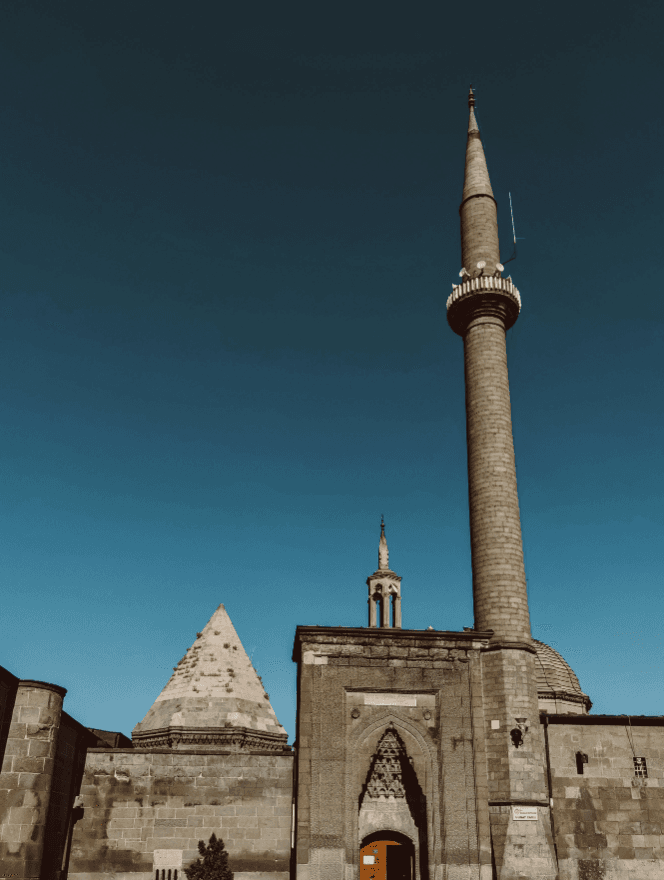
Hunat Hatun Külliyesi
Location | Hunat Neighborhood Melikgazi Kayseri Türkiye | ||||||||
|---|---|---|---|---|---|---|---|---|---|
Construction Date(s) | 1237 (Hijri 634) | ||||||||
Period | Anatolian Seljuk Period | ||||||||
Coordinates | 35.4874° E 38.7225° N | ||||||||
Patron | Mahperi Huand Hatun (Hunat Hatun) – wife of I. Alaeddin Keykubad and mother of II. Gıyaseddin Keyhüsrev | ||||||||
Hunat Hatun Külliyesi is a complex of buildings located east of İç Kale, outside the city walls, in the city center of Kayseri, Türkiye. It is regarded as one of the finest examples of Anatolian Seljuk architecture. The külliye consists of a mosque, a medrese, a tomb, and a hamam. The founder is Mahperi Hatun, wife of I. Alaeddin Keykubad and mother of II. Gıyaseddin Keyhüsrev. The title “Hatun,” by which she is known in popular tradition as “Hunat,” was originally “Huand”; over time, this title was Turkified into “Hunat” in the name of the complex.
The külliye was constructed between 1237 and 1238 (H. 635). Precise construction dates are recorded in Arabic inscriptions above the western and eastern portal doors of the mosque. These inscriptions state that Mahperi Hatun commissioned the mosque’s construction during the sultanate of her son, II. Gıyaseddin Keyhüsrev.
Evliya Çelebi mentions an imaret associated with the külliye, but no such structure has been identified to date. There are differing views regarding the sequence of construction. Gabriel and Kuban argue that the mosque was built first, followed by the medrese and the tomb; Karamağaralı, however, asserts that the medrese was the original structure of the complex.
Mahmut Akok, on the other hand, states that the mosque and medrese were designed simultaneously, with the tomb added in a second phase.
The main structure of the külliye, the Hunat Hatun Mosque, is a rectangular building measuring 56 by 46.5 meters with multiple pillars. The mosque has three entrances: to the north, east, and west. The portal doors are classic examples of Seljuk architecture, adorned with geometric and vegetal ornamentation. A prominent feature is the band of calligraphic verses in celî sülüs script above the western portal. The mihrab, located on the qibla wall, is decorated with shell-shaped niches, muqarnas vaulting, and marble columns. The minbar was constructed using kündekârî technique and has survived to the present day with some damage.
The central open space of the mosque was covered by a dome in the 18th century; this dome was later reconstructed during the reign of II. Abdülhamid in the 19th century. The mosque was originally without a minaret; the current minaret was added later in Ottoman style.
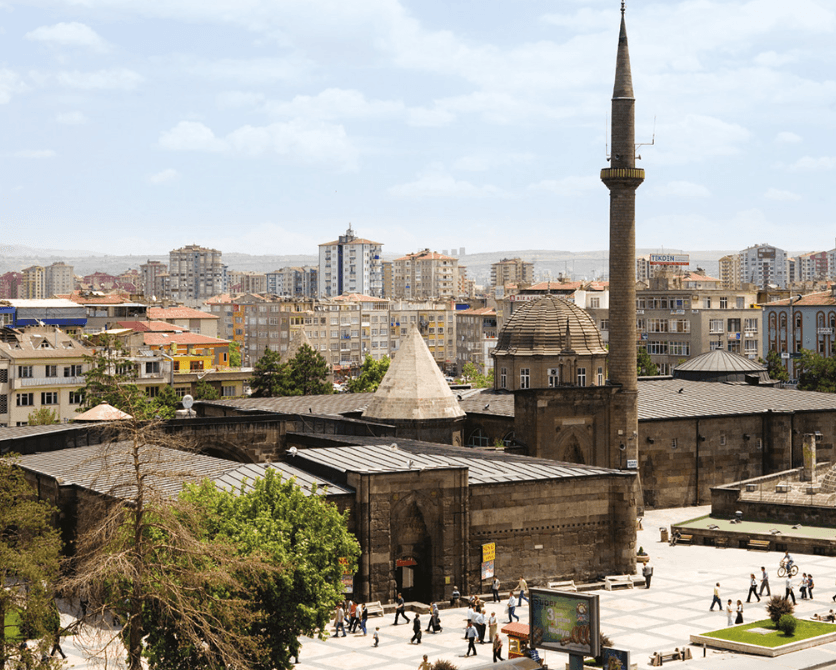
Hunat Hatun Cami (Kayseri Büyükşehir Belediyesi)
Huand Hatun Medrese has a rectangular plan with an open courtyard and two iwans. The southern, western, and northern sides of the courtyard are surrounded by pointed-arch arcades. On the eastern side, a summer iwan is flanked by winter classrooms. The library, founded in 1751 by Hacı Halil Efendi, was transferred to the Raşid Efendi Library in 1917 after the cessation of medrese education.
Prismatic and cylindrical towers at the corners of the medrese provide structural support and enhance its monumental appearance. Decoration is characterized by simplicity, with fine stonework being the primary ornamental feature.
Hunat Hatun Tomb is an octagonal, two-story, domed structure located southeast of the medrese. The lower level contains sarcophagi, while the upper level features a mihrab-equipped space and three sarcophagus-like containers. One of these containers belongs to Mahperi Hatun; the other two are likely for her daughter Selçuki Hatun and another female member of the dynasty. The exterior façade is decorated with muqarnas cornices, ornamental columns, and a band of Ayet’el-Kürsi.
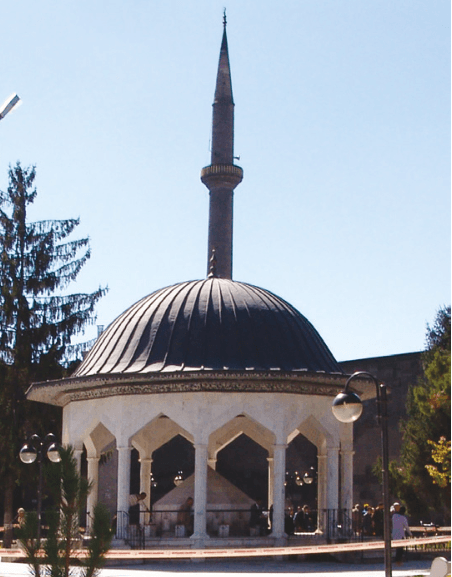
Hunat Hatun Türbesi (Kayseri Büyükşehir Belediyesi)
Hunat Hamam is divided into two sections for women and men. The structure is positioned diagonally relative to the main külliye plan. The men’s section was later lowered in height. During recent restoration works, figural tiles similar to those from Kubadabad were uncovered. The hamam has been under private ownership since 1929.
The Hunat Hatun Mosque was managed under the waqf system during the Seljuk period, but no restoration records from that era have survived. The first major restorations during the Ottoman period date to 1726–1727 (H. 1140), as documented in records confirming the enclosure of the central open space with a dome and the addition of the minaret and mahfil.
Drawings made by Texier in 1834 show the courtyard still open, suggesting that the 18th-century dome was later demolished and rebuilt in 1899 under II. Abdülhamid. In the 20th century, researchers including Albert Gabriel, Mahmut Akok, and Ali Saim Ülgen prepared detailed surveys and restorations, and various restoration reports were compiled.
The most comprehensive restoration work during the Republican period was carried out by the General Directorate of Foundations. The restoration process was completed in the 2000s, after which the complex was reopened for worship and visitation.
Akok, Mahmut. Kayseri’de Hunad Mimarî Külliyesinin Rölövesi. Ankara: Millî Eğitim Bakanlığı Eski Eserler ve Müzeler Genel Müdürlüğü Rölöve Bürosu, 1967.
Akşehirlioğlu, Ayşegül, and Can Şakir Binan. “Hunat Hatun Cami’nin Osmanlı’dan Günümüze Geçirdiği Onarımlar.” *Bilimname* 45, no. 2 (2021): 379–426.https://doi.org/10.28949/bilimname.952124
Eyice, Semavi. "Hunat Hatun." Türkiye Diyanet Vakfı İslâm Ansiklopedisi, vol. 18 (1998): 530–531. Accessed April 22, 2025.
Islam Thought Atlas. "Mahperi Huand (Hunat) Hatun Külliyesi." Accessed April 22, 2025.https://islamdusunceatlasi.org/mahperi-huand-hunat-hatun-kulliyesi/3464
Kayseri Büyükşehir Municipality. “Hunat Hatun Külliyesi.” Accessed April 22, 2025.https://www.kayseri.bel.tr/kesfet-listeleme/hunat-hatun-kulliyesi
Kayseri Valiliği. “T.C. Kayseri Valiliği Resmî Web Sitesi.” Accessed April 22, 2025.https://www.kayseri.gov.tr/

Hunat Hatun Külliyesi
Location | Hunat Neighborhood Melikgazi Kayseri Türkiye | ||||||||
|---|---|---|---|---|---|---|---|---|---|
Construction Date(s) | 1237 (Hijri 634) | ||||||||
Period | Anatolian Seljuk Period | ||||||||
Coordinates | 35.4874° E 38.7225° N | ||||||||
Patron | Mahperi Huand Hatun (Hunat Hatun) – wife of I. Alaeddin Keykubad and mother of II. Gıyaseddin Keyhüsrev | ||||||||
No Discussion Added Yet
Start discussion for "Hunat Hatun Külliyesi" article
History
Architectural Features
Mosque
Medrese
Tomb
Hamam
Restorations and Conservation