


This article was automatically translated from the original Turkish version.
+1 More
History of Science Centers
Subject | Historical Development and Social Function of Science Centers | ||||||||
|---|---|---|---|---|---|---|---|---|---|
Period | 19th and 20th centuries | ||||||||
Geography | Canada England France Germany United States of America Austria | ||||||||
Representatives | Oskar von Miller Rene Descartes John Dewey Jean Baptiste Perrin | ||||||||
Prominent Institutions and Exhibitions | Exploratorium (1969 San Francisco) and Ontario Science Centre (1969 Toronto) Conservatoire National des Arts et Métiers (1798 France) The Great Exhibition (1851 London) Deutsches Museum (1903 Munich) Palais de la Découverte (1937 Paris) Chicago Museum of Science and Industry (1933) | ||||||||
Efforts to ensure that scientific knowledge does not remain confined to expert circles but reaches broader segments of society have laid the groundwork for the emergence of science museums and science centers. These institutions have not only made the historical development of scientific thought visible but have also socialized the processes of experiencing and understanding science. Originating in the Enlightenment era, these institutions have evolved over time beyond mere exhibition spaces into venues for educational, interactive, and democratic information sharing.
The need to establish science museums and centers arose from initiatives aimed at helping society understand advances in science and technology. The history of science museums and centers dates back to the 1600s. ASTC【1】 defines science centers as “institutions that respond to growing public interest in science and technology within the framework of scientific and ethical principles, ensure direct and equal public access to science, and are independent of profit motives while focusing on interaction.”
Another definition describes science centers as “places funded by public or private sector resources, non-profit and oriented toward the public good, which bring together individuals from different age groups and varying levels of background knowledge to make science and technology understandable and accessible to society, enhance public appreciation of science and technology, and encourage visitors to experiment and explore through experimental and practical activities.”
Three milestones are identified in the development of science and technology museums. The first is the emergence of direct scientific thought in the 19th century, which made natural sciences the focus of public interest. The second is the rise of physics and chemistry communities, which communicated with society through experiments combining curiosity and reason, organizing demonstrations. In 1730 in France, Abbé Nollet described “experimental physics” as an amateur pleasure and popular entertainment.
The third development, resulting from these two trends, is the establishment of world exhibitions focused on technology and industry. The first initiative for a technology museum emerged from René Descartes’ proposal during the Enlightenment, suggesting a museum to display scientific tools and mechanical models.
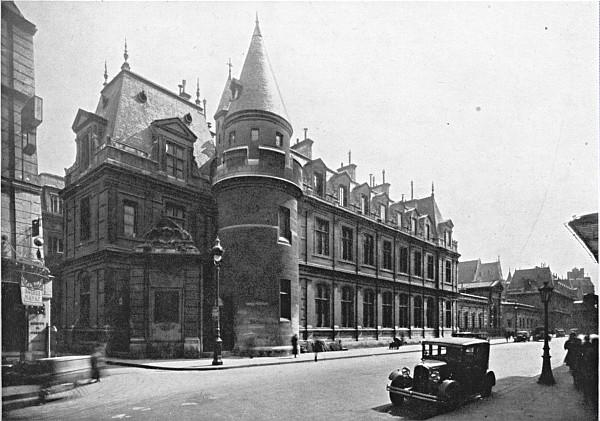
Conservatoire National des Arts et Métiers (CNAM)
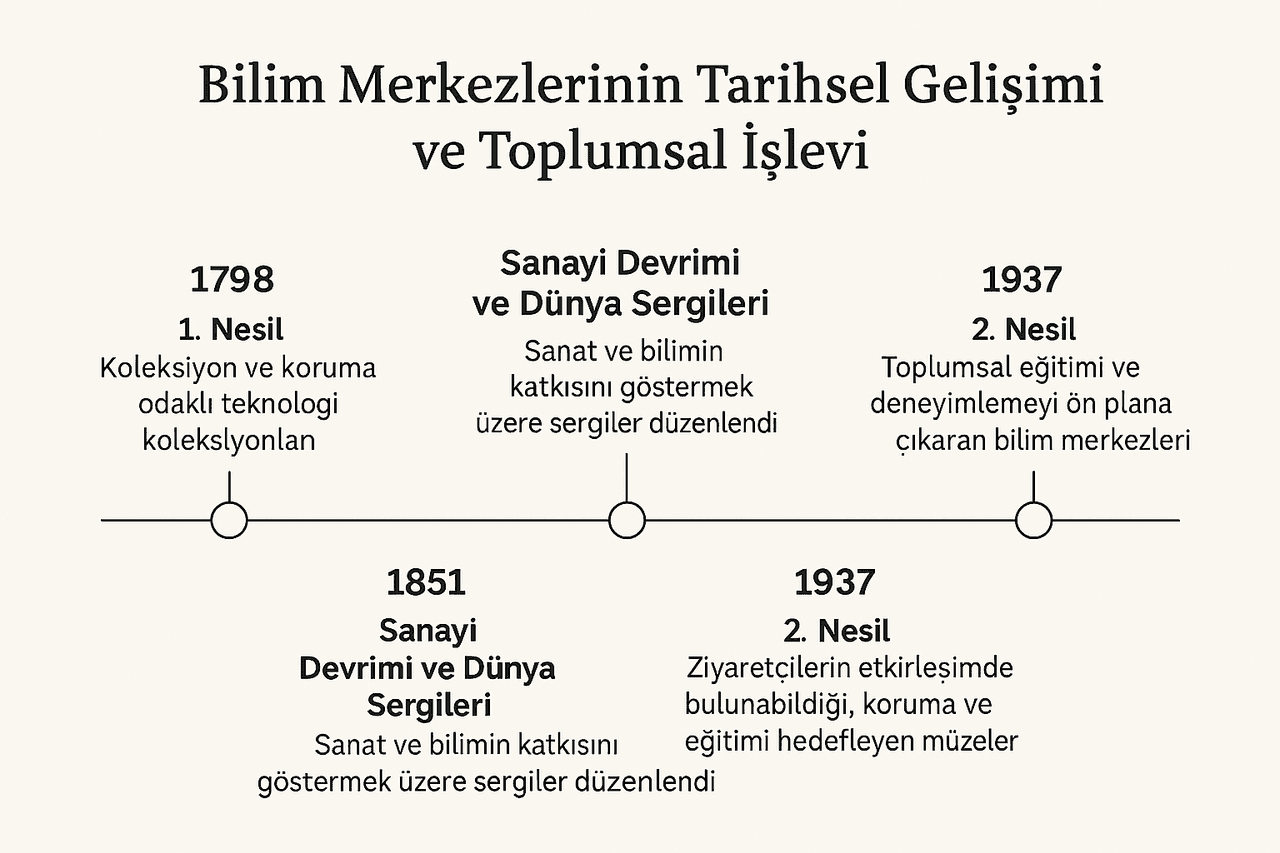
Influenced by these developments, technology collections and educational centers were established with functions of preservation, collection, research, and education, aiming to introduce technical and commercial arts, promote industrial development, and explain the manufacture and use of tools and machines. These institutions are referred to as “first-generation” institutions, with the earliest example being the Conservatoire National des Arts et Métiers, founded in 1798.【2】
The primary driving force behind the development of science and technology museums has been the world expositions that accompanied the Industrial Revolution. These expositions were organized to demonstrate how technological advances, accelerating during this period, could contribute to art and science and to industrial production processes. After the expositions ended, the buildings constructed for these events became the foundation for permanent museums.
In England, following “The Great Exhibition” held at the Crystal Palace, the South Kensington Museums (Science Museum, Natural History Museum, and Victoria & Albert Museum) were established along Exhibition Road. Similarly, industrial products and artifacts related to agriculture and mechanization displayed at the 1873 Vienna International Exposition were later reorganized to form the Technical Museum of Vienna. In the United States, the Smithsonian Institution opened various exhibitions at the Philadelphia Centennial Exposition of 1876, the first official world fair featuring themes of machinery, agriculture, and horticulture.
Oskar von Miller, founder of the Deutsches Museum in Munich, was inspired by the Exposition Internationale de l’Électricité, the first international fair focused on electricity, held in Paris in 1881. As a result, a second generation of science and industry museums emerged, aiming for preservation, collection, research, and social education. Among these museums, the Deutsches Museum, regarded as the precursor to modern science centers, distinguished itself from earlier models by providing extensive space for contemporary examples of science and technology and allowing visitors to interact directly with exhibits.
The Palais de la Découverte, established in Paris in 1937 as part of an international exposition, was made permanent a year later. Alongside this, some museums moved beyond merely collecting and displaying objects to developing systems based on direct visitor interaction and prioritizing learning. In this context, they aimed to be democratic and accessible to all, provide comprehensible content, and organize multilingual guided tours.
Three key factors have been decisive in the development of science and technology museums and in laying the foundations of their current structures: strong connections with educational institutions, theatrical presentations that sustain visitor interest, and the desire to promote learning in an engaging environment. After the opening of the Palais de la Découverte in 1937, French physicist Jean Baptiste Perrin clearly articulated this approach: “What we seek is to present to visitors the everyday research of science, shaped not by grand experiments but made accessible without lowering its level. In doing so, we aim to make a scientific culture beneficial to everyone, regardless of profession, publicly available.” This approach became a guiding principle not only for the Palais de la Découverte but for all subsequent science museums and centers, which have taken on the responsibility of communicating and sharing this scientific culture.
In the 1920s, the United States’ leadership in scientific research and its success in converting scientific knowledge into industrial products had a global impact on science museums, significantly increasing public interest in this field. During this period, the idea of establishing a true science museum, led by the American Association of Museums, entered the agenda.
Extensive studies were conducted, drawing on European science museums as models, examining both content and pedagogical approaches. These studies revealed that scientists and universities made significant contributions to developing the content of science museums. Additionally, it was observed that dynamic exhibits and mechanical models made European museums more engaging and interactive for visitors. These findings became an important reference point in shaping museum designs in the United States.
In line with these developments, the principle of “learning by doing” increasingly came to the forefront in the transformation of science museums in the United States. New pedagogical approaches emerging in education between 1925 and 1935 influenced the functions and structures of science museums. John Dewey’s educational philosophy, centered on experiential and hands-on learning, offered an innovative perspective not only in educational science but also in museology.
Incorporating these new educational perspectives, the foundation of the Chicago Museum of Science and Industry was laid. This museum, adopting the philosophy of “a museum for everyone,” offered a more inclusive and interactive model than its predecessors. By the 1930s, environments and programs were designed to move beyond traditional museology and provide visitors with new learning experiences. This shift transformed science museums from mere institutions for transmitting knowledge into structures that actively encourage participation in the learning process.
In the 1970s, the rapid advancement of technology brought significant transformations to science museums. During this period, science and technology centers emerged, emphasizing social education and classified as “third-generation” institutions. Their emergence stemmed from the need to approach technology and industrial knowledge from a new perspective and to share this knowledge interactively with society. The Exploratorium in San Francisco, opened in 1969, and the Ontario Science Centre in Toronto are among the pioneering examples of this new approach. These institutions attracted attention through innovative designs that went beyond traditional exhibition models to directly encourage visitors to experience and explore.
Kalkan Hüseyin ve Türk Cumhur. "Bilim Merkezleri ve Bilim Müzelerinin Tarihi." Her Yönüyle Bilim Merkezi. Konya: Çizgi Yayınları, 2017.
Karadeniz Ceren. "Bilim Merkezlerinin Toplumsal İşlevi." Her Yönüyle Bilim Merkezi. Konya: Çizgi Yayınları, 2017.
Schiele Bernard. "Science Museums and Science Centers." Handbook of Public Communication of Science and Technology. London: Routledge, 2008.
[1]
ASTC: Association of Science-Technology Centers
[2]
Conservatoire National des Arts et Métiers (CNAM): Ulusal Sanat ve Zanaat Konservatuvarı

History of Science Centers
Subject | Historical Development and Social Function of Science Centers | ||||||||
|---|---|---|---|---|---|---|---|---|---|
Period | 19th and 20th centuries | ||||||||
Geography | Canada England France Germany United States of America Austria | ||||||||
Representatives | Oskar von Miller Rene Descartes John Dewey Jean Baptiste Perrin | ||||||||
Prominent Institutions and Exhibitions | Exploratorium (1969 San Francisco) and Ontario Science Centre (1969 Toronto) Conservatoire National des Arts et Métiers (1798 France) The Great Exhibition (1851 London) Deutsches Museum (1903 Munich) Palais de la Découverte (1937 Paris) Chicago Museum of Science and Industry (1933) | ||||||||
No Discussion Added Yet
Start discussion for "History of Science Centers" article
The Emergence and Social Role of Science Centers
Early Stages of Development of Science and Technology Museums
The Industrial Revolution, World Expositions, and the Rise of Modern Science Museums
Key Factors Influencing the Development of Science and Technology Museums
America and the Development of Science Museums
Learning by Doing and Its Impact on Science Museums
The Rise of Technology and Third-Generation Science Centers