

This article was automatically translated from the original Turkish version.
Scientific Name(s) | Linaria cannabina | ||||||||
|---|---|---|---|---|---|---|---|---|---|
Team(s) | Passeriformes | ||||||||
Weight(s)(Text) | 15–20 g | ||||||||
Family(ies) | Fringillidae | ||||||||
Conservation Status (IUCN) | Least Concern (LC) | ||||||||
Wingspan | 21–25 cm | ||||||||
Order | Average 13 cm | ||||||||
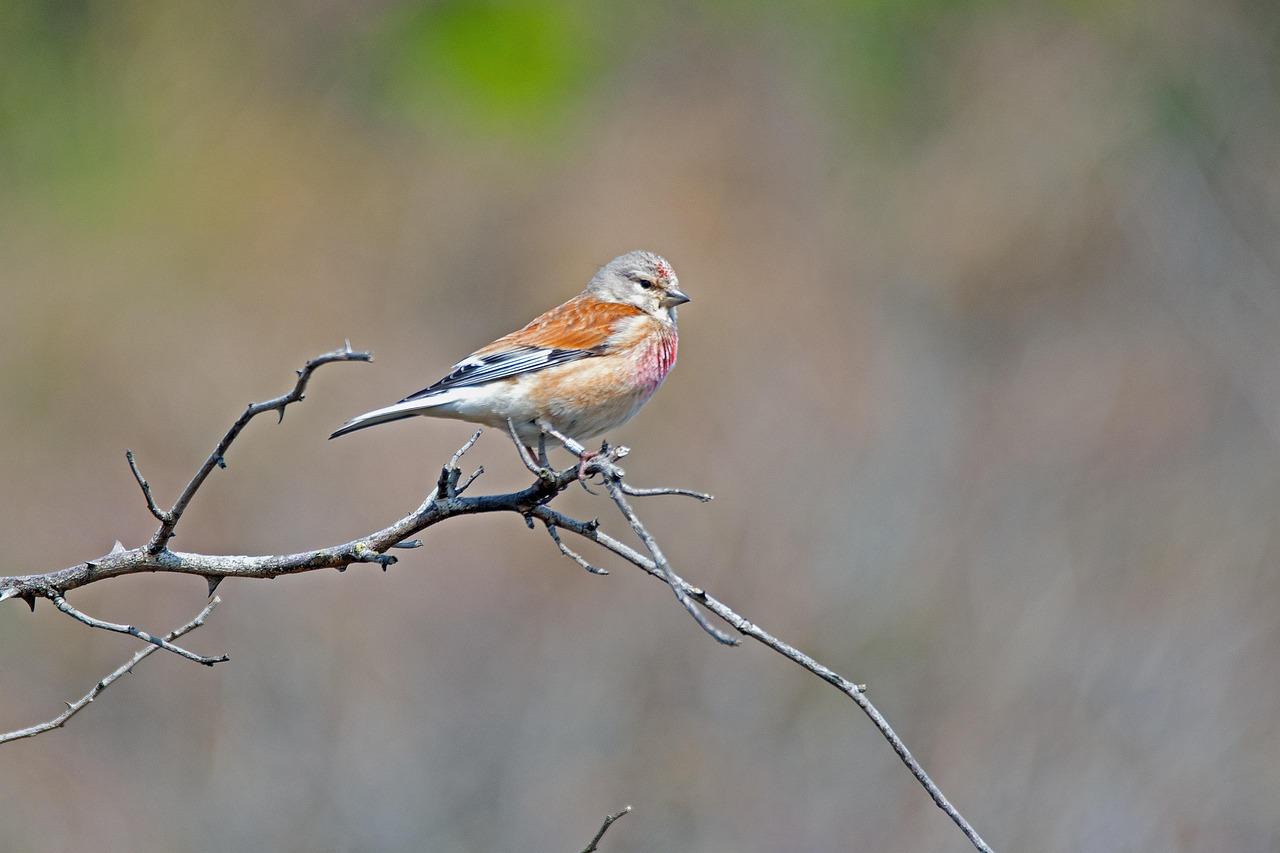
Linnet is a small songbird belonging to the finch family (Fringillidae). It measures about 13 cm in length and is distinguished by its long, forked tail. Prominent white stripes run along its wings and tail, forming broad white panels on open wings. Its bill is gray or horn-colored, and its legs are dark gray, nearly black.
During the breeding season, the male is notable for its gray-brown head, bright red forehead and breast, white belly, and white rump. Its back is reddish-brown, and its wings are blackish with white panels. Outside the breeding season, the red plumage fades, turning pinkish and becoming inconspicuous at a distance. The female has a more subdued appearance: brown tones, lightly streaked back, yellowish-brown underparts with fine streaking.
It has thin, pale lines above and below the eye, and pale cheek patches. The white markings on the wings and tail are less prominent than in the male. In captivity, the red coloration on the male’s head often disappears.
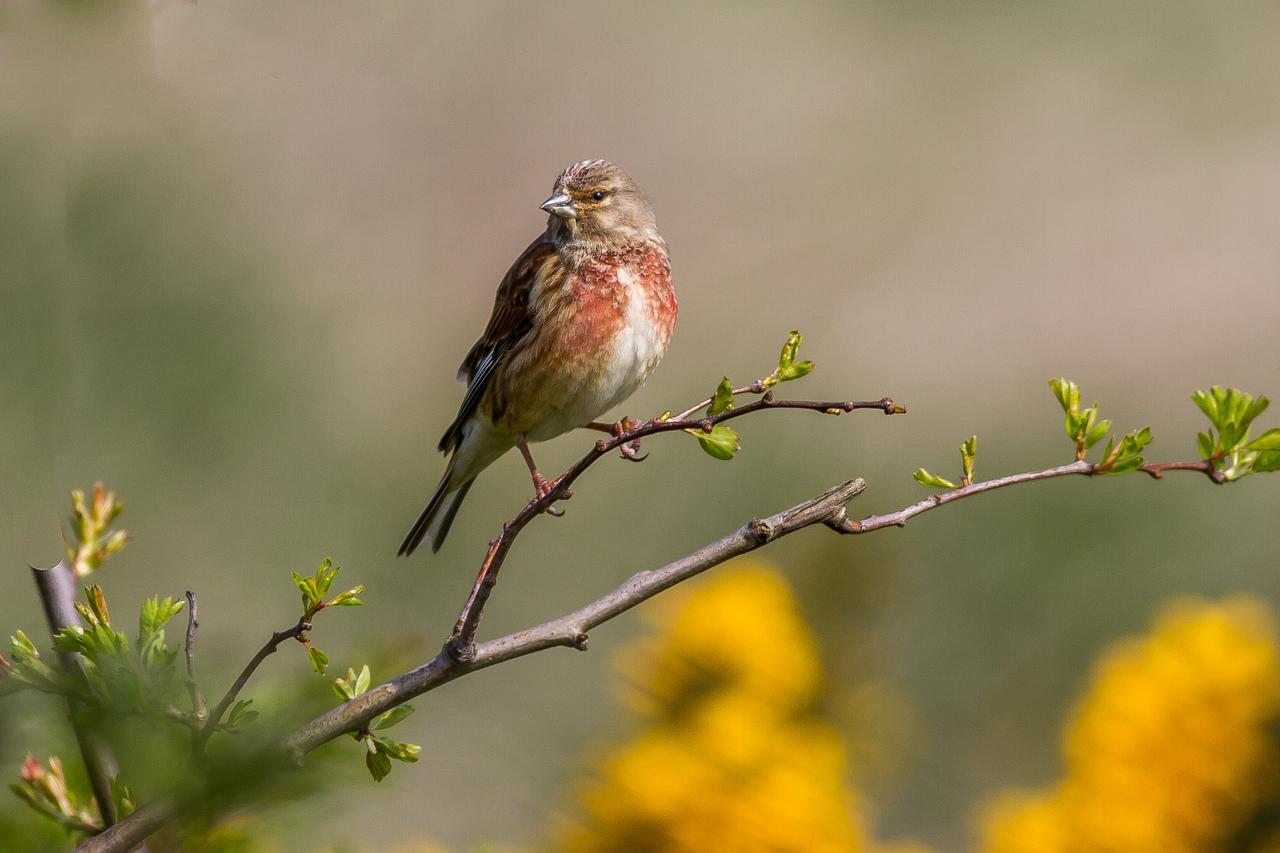
Linnet (flickr)
The linnet is widely distributed across Europe, Western Asia, and North Africa. In Türkiye, it is a resident species found throughout nearly all regions year-round. It is particularly common as a summer migrant in northern and eastern Anatolia. Globally, it has an extensive breeding range of approximately 10.9 million km².
The linnet inhabits open areas with trees and scrub, maquis, rocky and stony terrain, agricultural fields, parks, and gardens. In winter, it is more frequently observed in low shrubs, dense grasslands, and farmlands surrounded by hedges. It may also use densely vegetated cemeteries for nesting and foraging.
The linnet’s primary food consists of plant seeds, including those of wild herbs, dandelions, thistles, and sprouts. Compared to other finch species, it consumes more insects and invertebrates, especially during the breeding season when insects become crucial for feeding chicks. In winter, it feeds on the ground and in low shrubs alongside other seed-eating finches, often forming flocks.
The breeding season lasts from late March to mid-August, and the species may raise two broods per year. It is monogamous. The female builds the nest, while the male accompanies her during this period. The nest is typically constructed in dense shrubs, young tree branches, or thorny plants. Clutch size ranges from 4 to 7 eggs, with an incubation period of 11 to 13 days. Both male and female take turns incubating the eggs.
The linnet is a social bird, often recognized by its cheerful song. In winter, it forms small flocks and moves in mixed groups with other seed-eating birds such as the chaffinch, siskin, and goldfinch. Pairs form strong bonds.
The linnet is a resident species across most of Türkiye. In some regions, particularly eastern Anatolia, it occurs as a summer migrant. During winter, it moves in flocks.
The linnet is a very common species worldwide and is listed as “Least Concern” on the IUCN Red List. However, changes in agricultural practices, the use of herbicides and fertilizers, removal of hedges and scrub, intensive grazing, and the decline of suitable nesting habitats have led to population declines in certain areas.
Flickr. “Linnet Rainham Marshes April 2015 JPG.” Accessed July 10, 2025. https://flic.kr/p/2npbCjF
ORNİTO. "Ketenkuşu." Ornito.org. Accessed August 16, 2025. https://ornito.org/Bird/Detail/264.
Pixabay. "Keten bezi, Kuş, Dal görseli JPG." Accessed August 16, 2025. https://pixabay.com/tr/photos/keten-bezi-ku%C5%9F-dal-hayvan-7614478/.
İzmir Bird Paradise. "Ketenkuşu." T.C. İzmir Bird Paradise Protection and Development Association. Accessed August 16, 2025. https://izmirkuscenneti.gov.tr/2022/12/05/ketenkusu/.

Scientific Name(s) | Linaria cannabina | ||||||||
|---|---|---|---|---|---|---|---|---|---|
Team(s) | Passeriformes | ||||||||
Weight(s)(Text) | 15–20 g | ||||||||
Family(ies) | Fringillidae | ||||||||
Conservation Status (IUCN) | Least Concern (LC) | ||||||||
Wingspan | 21–25 cm | ||||||||
Order | Average 13 cm | ||||||||
No Discussion Added Yet
Start discussion for "Hemp Linnet (Linaria cannabina)" article
Distribution
Habitat
Diet
Biology and Breeding
Behavior
Migration
Population and Conservation Status