


This article was automatically translated from the original Turkish version.
Helmeted Hornbill
Type Name | Helmeted Hornbill | ||||||||
|---|---|---|---|---|---|---|---|---|---|
Scientific Name(s) | Rhinoplax vigil | ||||||||
Size(s) | Approximately 1–1.2 m in length | ||||||||
Weight(s) | Male: ~3.1 kg Female: ~2.7 kg | ||||||||
Habitat | Lowland tropical forests | ||||||||
Distribution(s) | Borneo Sumatra Malay Peninsula southern Thailand Southern Myanmar | ||||||||
Conservation Status (IUCN) | Critically Endangered | ||||||||
The Helmeted Hornbill is a large bird species belonging to the Bucerotidae family (hornbills). Its scientific name is Rhinoplax vigil, and it is particularly notable for its large, solid keratin-based "casque" on the head. This structure is used in combat between males during territorial defense and mate selection.
The Helmeted Hornbill is endemic to the Sundaic region of Southeast Asia. It is found in southern Myanmar, southern Thailand, the Malay Peninsula, Sumatra, and Borneo. This species inhabits lowland tropical forests and is highly dependent on old-growth forests.
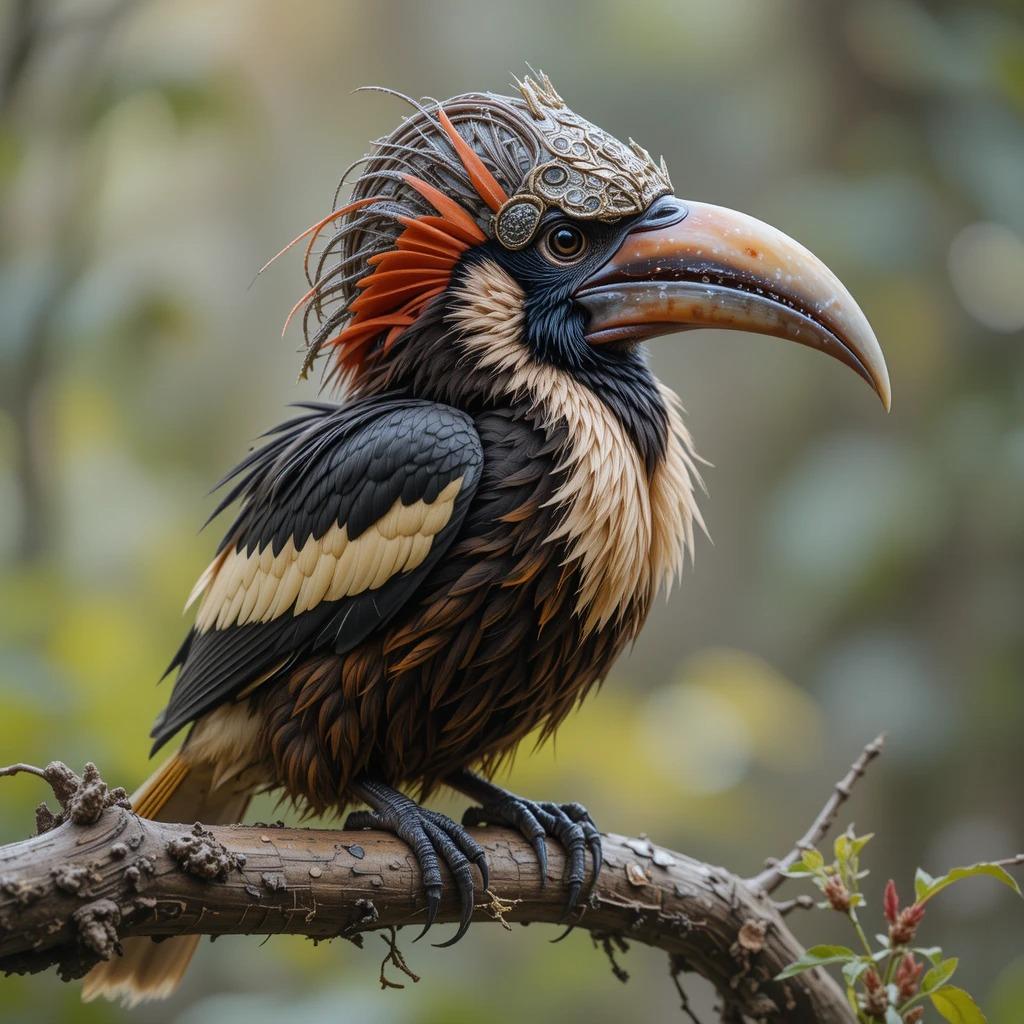
Generated by artificial intelligence.
This bird species measures approximately 1 to 1.2 meters in length. Males weigh an average of 3.1 kg, while females weigh about 2.7 kg. It is distinguished by its long central tail feathers and dark brown-black plumage. The casque constitutes approximately 11% of its body weight and is nearly solid, unlike the casques of other hornbills.
The Helmeted Hornbill primarily feeds on fruit, especially figs, but also consumes insects and small invertebrates. Males engage in aerial collisions using their casques to defend territories.
The Helmeted Hornbill is classified as Critically Endangered on the IUCN Red List. This status is due to intense poaching and habitat loss. Its casque, known as "casque ivory," is in high demand in the illegal wildlife trade. As a result, the population of this species is declining rapidly.
Animalia.bio. "Helmeted Hornbill (Rhinoplax vigil)." 2024. Accessed May 3, 2025. https://animalia.bio/helmeted-hornbill
BirdLife International. "Species Factsheet: Helmeted Hornbill (Rhinoplax vigil)." BirdLife DataZone, 2024. Accessed May 3, 2025. https://datazone.birdlife.org/species/factsheet/helmeted-hornbill-rhinoplax-vigil
IUCN Hornbill Specialist Group. "Helmeted Hornbill." 2024. Accessed May 3, 2025. https://iucnhornbills.org/helmeted-hornbill/
IUCN. *Rhinoplax vigil: Helmeted Hornbill.* The IUCN Red List of Threatened Species 2020. Accessed May 3, 2025. https://www.iucnredlist.org/species/22682464/184587039
Helmeted Hornbill
Type Name | Helmeted Hornbill | ||||||||
|---|---|---|---|---|---|---|---|---|---|
Scientific Name(s) | Rhinoplax vigil | ||||||||
Size(s) | Approximately 1–1.2 m in length | ||||||||
Weight(s) | Male: ~3.1 kg Female: ~2.7 kg | ||||||||
Habitat | Lowland tropical forests | ||||||||
Distribution(s) | Borneo Sumatra Malay Peninsula southern Thailand Southern Myanmar | ||||||||
Conservation Status (IUCN) | Critically Endangered | ||||||||
No Discussion Added Yet
Start discussion for "Helmeted Hornbill (Rhinoplax vigil)" article
Distribution and Habitat
Physical Characteristics
Behavior and Diet