

Hekimoğlu Ali Paşa Camii
Located on one of Istanbul’s famous seven hills, in the district of Fatih, the Hekimoğlu Ali Paşa Camii is a historical structure dating back to the Ottoman period. Built between 1734 and 1735, this edifice was designed not only as a place of worship but also as a large center serving the daily needs of the community.
Sections and Layout of the Külliye
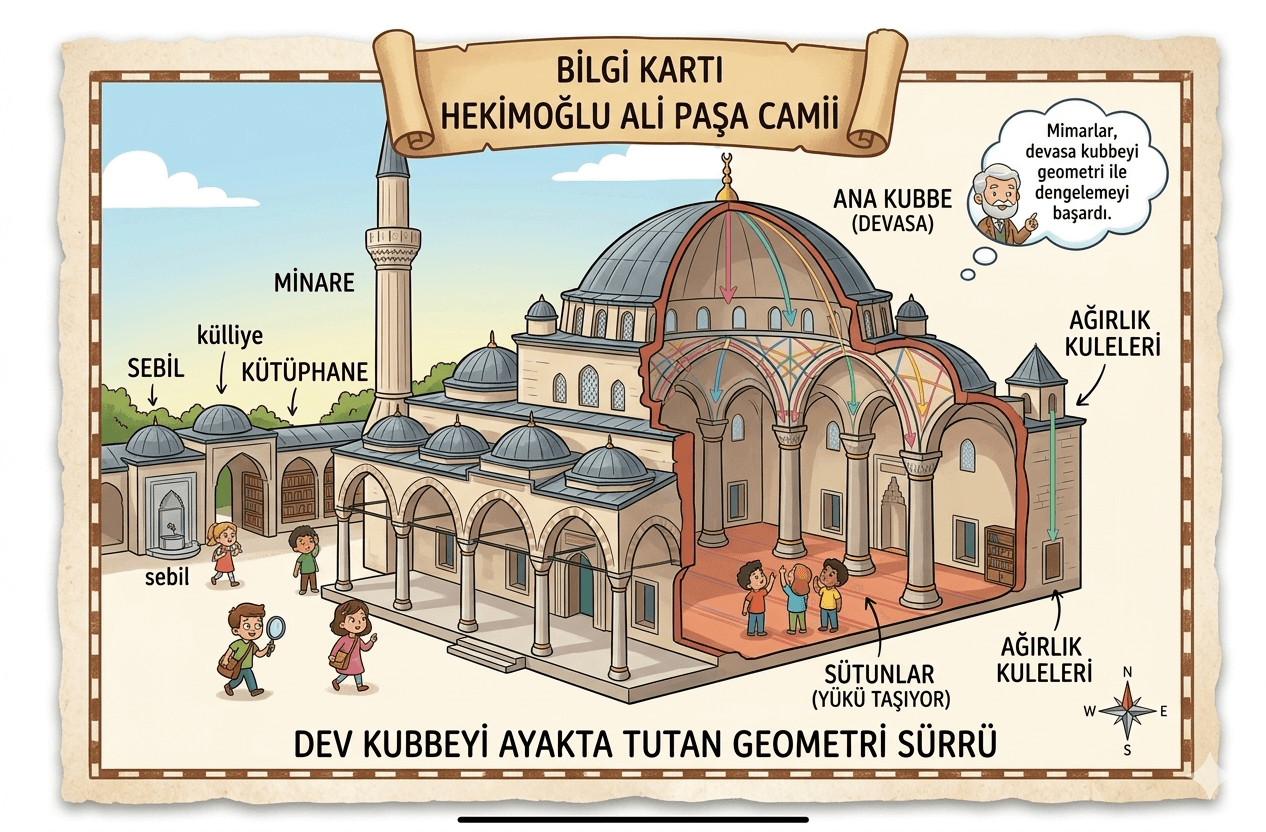
Surrounding this mosque, commissioned by Hekimoğlu Ali Paşa who served as grand vizier during the Ottoman era, are other structures built for public benefit. Since mosques in earlier times were also centers of education and social life, the mosque’s courtyard and surroundings include a library, fountains and a sebil for access to clean drinking water, and a large şadırvan (pool) at its center. Such historical complexes, which simultaneously fulfilled multiple community needs, are known as "külliye."
Main Structure and Dome Features
Upon entering the mosque, constructed from solid cut stone, the most striking feature is the massive central dome supported by six large columns. Ottoman architects, without modern technological tools, successfully distributed the weight of this enormous dome to the smaller half-domes on either side and to the supporting columns using only mathematical and geometric principles. Additionally, the numerous windows arranged in rows along the walls ensure that the interior remains consistently bright and spacious.
Interior Space and Decorative Details
The mihrab, where the imam leads prayers, and the minber, from which sermons are delivered, are both crafted entirely from white marble and adorned with floral and branch motifs in keeping with the artistic sensibilities of the period. Within the mosque there is also a special section known as the "hünkâr kasrı", reserved for the sultans and state officials to pray when visiting. The historical inscriptions and marble carvings above the main entrance demonstrate the fine craftsmanship of Ottoman stonemasonry.
Külliye Gate and Restoration Process
The main entrance gate of the külliye is located approximately 100 meters from the mosque courtyard, at the intersection of streets. This historic stone gate, worn over the years, was carefully restored in 2023 by expert teams. During the restoration, each stone of the gate was individually removed, cleaned, and missing parts were replaced with materials matching the original. The gate was also reinforced to prevent collapse and returned to its original sturdy condition.
A Journey Through Time
291 years ago, in 1735, architects constructed this mosque without modern technological tools, successfully distributing the weight of its massive dome across the columns through precise mathematical calculations.