


This article was automatically translated from the original Turkish version.
Heckscher-Ohlin Theory (H-O Theory) is an external trade theory developed to explain the causes of international trade based on differences in factor endowments. The theory was first proposed in 1919 by Swedish economist Eli Heckscher and later systematized by his student Bertil Ohlin in 1933. The H-O Theory extends Ricardo’s theory of comparative advantage by arguing that the fundamental determinant of trade between countries is differences in factor endowments. Unlike Ricardo’s theory, the Heckscher-Ohlin model views the relative abundance of production factors—such as labor, capital, and natural resources like production factors—not technological differences—as the primary source of trade.
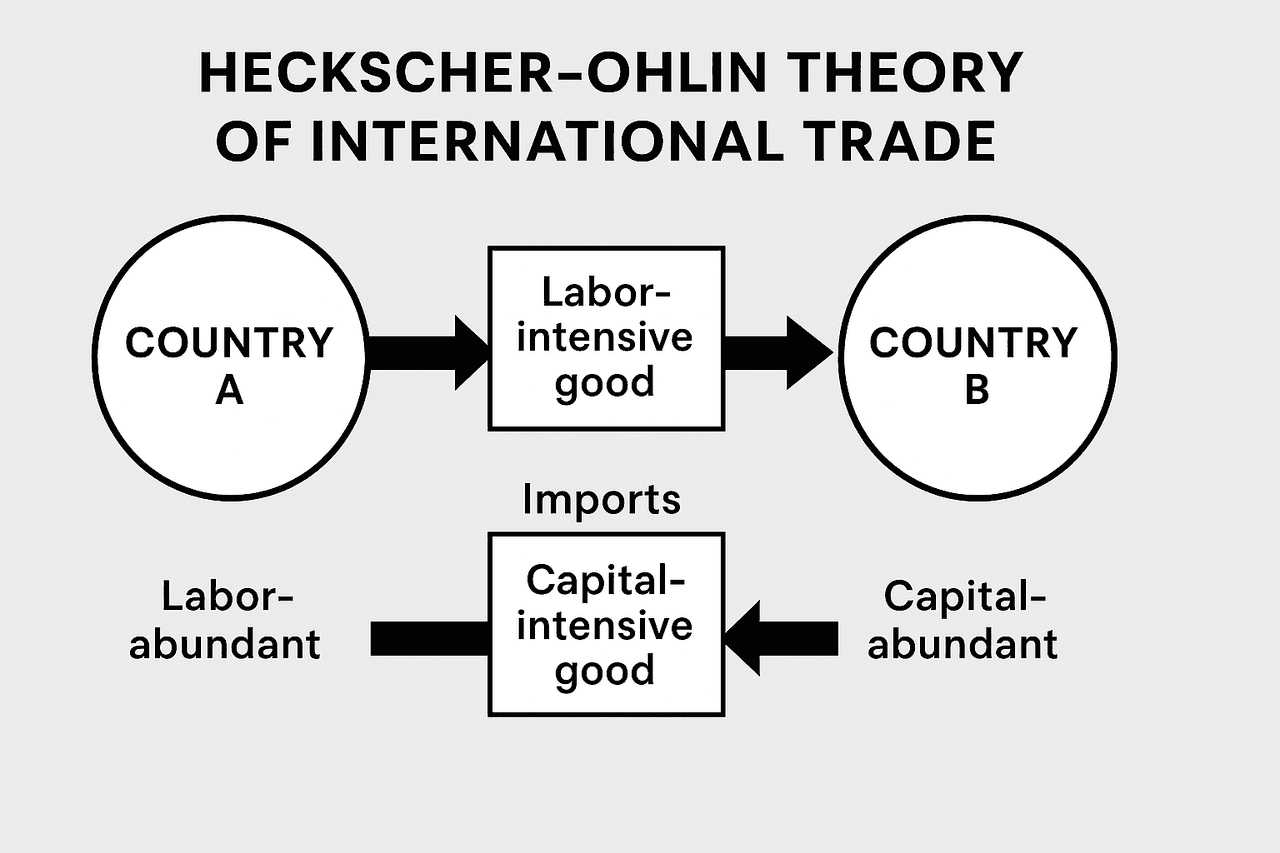
Generated with artificial intelligence.
The H-O model is built on two countries, two goods, and two factors of production (the 2x2x2 model). Its core assumptions are as follows:
1. There are two countries (A and B), two goods (X and Y), and two factors of production (labor and capital).
2. The key difference between countries lies in the relative abundance of production factors. A labor-abundant country has more labor relative to other countries and is expected to have relatively lower labor costs.
3. Goods are produced using different proportions of production factors. One good may be labor-intensive while the other is capital-intensive.
4. Production technology is identical across all countries. Thus, differences in production are solely due to differences in factor abundance.
5. Free trade exists between countries and there are no trade barriers.
6. Factor prices are determined under perfect competition. Factor owners allocate their resources to sectors offering the highest returns.
7. Factors of production cannot move between countries but are perfectly mobile within each country.
Under these assumptions, the Factor Proportions Theory is established. According to this theory, a country exports goods that intensively use its abundant factor and imports goods that intensively use its scarce factor. For example, a labor-abundant country such as China tends to export labor-intensive goods like textiles and apparel, while a capital-abundant country such as Germany is more likely to export capital-intensive goods such as automobiles and machinery.
Based on the assumptions above, the theorem concludes: “A country specializes in producing goods that intensively use its abundant factor and exports those goods.” This conclusion asserts that international trade is directly linked to countries’ factor endowments. With contributions from Paul Samuelson, the Factor Price Equalization Theorem argues that free trade will equalize returns to factors across countries. “If trade is free, factor prices between countries will converge over time.” For instance, when a labor-abundant country opens up to foreign trade, demand for labor-intensive goods increases, leading to higher wages. Conversely, in capital-abundant countries, demand for labor declines and wages may fall. As a result, labor wages in both countries tend to converge over time.
Empirical tests of the Heckscher-Ohlin model have yielded mixed results. One of the most well-known is the “Leontief Paradox.”
Heckscher-Ohlin Theory, despite being introduced in the mid-20th century, continues to exert significant influence on international trade theory and economic policy. However, in light of modern economic changes and global trade dynamics, the theory has undergone revisions to account for more complex and diverse factors. Nevertheless, the H-O model’s fundamental approach—explaining trade patterns through differences in factor endowments—remains firmly established in contemporary economic literature.
With the rapid advancement of globalization, the H-O Theory’s perspective on factor endowments provides insight into the causes of trade. Developing countries, in particular, specialize in labor-intensive sectors to leverage low-cost production advantages, consistent with the predictions of the H-O model. For example, countries such as China, India, and Brazil have accelerated their integration into global markets by becoming more efficient in labor-intensive production processes.
However, the impact of globalization has also introduced new trade theories—such as Krugman’s theories of economies of scale and product differentiation—and technological advancements that play a critical role. In modern trade dynamics, factors such as techno-economic disparities, innovation, and economies of scale shape trade not only through the abundance of production factors but also through consumer demand and market structures. Therefore, integrating innovative trade theories with the H-O Theory enhances our understanding of international trade.
In recent years, the proliferation of global value chains has introduced a new trade model that transcends some of the H-O model’s classical assumptions. Value chains refer to multinational corporations structuring production processes across different geographic regions to gain cost advantages. In this context, the convergence of capital- and labor-intensive sectors adds a new dimension to the theoretical framework of the H-O Theory. For instance, developing countries do not merely produce labor-intensive goods; they also participate in assembly and processing stages, integrating into more advanced phases of production.
Today, due to rapid changes in technology and information flows, countries have adopted comprehensive specialization strategies. This has made trade patterns more complex than could be explained solely by factor intensities. High-technology products and innovative sectors have become central to trade.
Modern trade theories now incorporate dimensions such as environmental sustainability, labor rights, and social factors. While the H-O Theory does not directly address these elements, issues like environmentally friendly production and human rights violations are widely discussed in the context of environmental ethics and social responsibility. A system already dominates in which trade is shaped not only by differences in factor endowments but also by new trade barriers defined by environmental and social standards.
For example, concepts such as green trade and ethical supply chains represent innovations not covered by the H-O model but that play a crucial role in shaping contemporary international trade. In this context, developed countries produce environmentally sensitive goods, while developing countries can produce at lower environmental costs. This leads to trade being shaped not only by labor and capital abundance but also by environmental factors.
It is also a fact that today’s trade is shaped not only by economic factors but also by political and strategic preferences. Although the H-O Theory assumes that trade is primarily driven by market forces, today factors such as state intervention, trade wars, customs tariffs, and trade blocs also influence trade patterns. Events such as the U.S.-China trade war, Brexit, and new trade agreements demonstrate that trade cannot be explained solely by the abundance of production factors.
The current relevance of the H-O model lies in its enduring foundational role within debates on the reshaping of global trade and state trade policies. States have increasingly turned trade policy into a powerful tool that affects factor endowments and thereby alters trade patterns.
Fze, A. (2024, March 12). *The Advantages & Disadvantages of international trade*.https://www.linkedin.com/pulse/advantages-disadvantages-international-trade-aftrade-1gtde/
Heckscher, Eli, and Bertil Ohlin. Heckscher-Ohlin Trade Theory. New York: Routledge, 1991.
Obstfeld, Maurice, and Krugman, Paul. International Economics: Theory and Policy. 10th ed. Boston: Pearson, 2014.
WTO (World Trade Organization). World Trade Report 2019: The Future of Trade in Services. Geneva: World Trade Organization, 2019.
Wood, Adrian. North-South Trade, Employment and Inequality: Changing Fortunes in a Skill-Driven World. Oxford: Oxford University Press, 1995.

No Discussion Added Yet
Start discussion for "Heckscher-Ohlin Theory" article
Assumptions and Model Structure
Contemporary Significance
Environmental and Ethical Factors