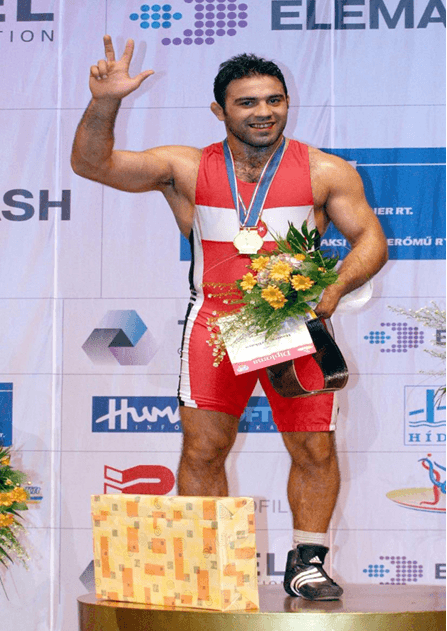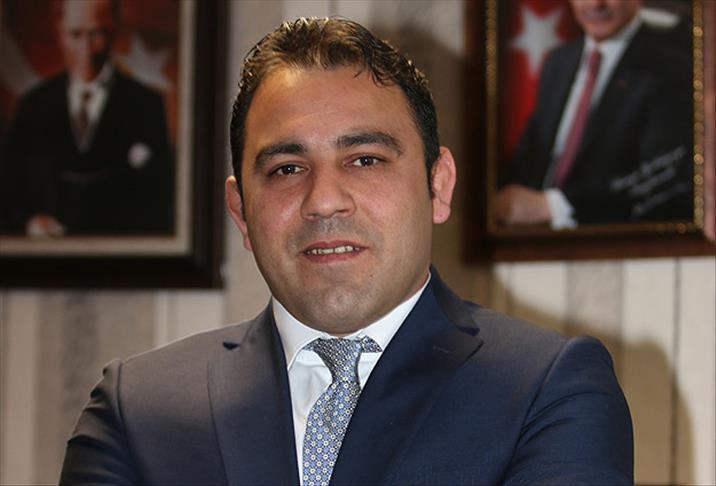

Full Name | Hamza Yerlikaya | ||||||||
|---|---|---|---|---|---|---|---|---|---|
Spouse | Ebru Küçük | ||||||||
Date of Birth | 1976-06-03 | ||||||||
Place of Birth | Kadıköy İstanbul | ||||||||
Hometown | Sivas | ||||||||
Mother | Emine Yerlikaya | ||||||||
Father | Mustafa Yerlikaya | ||||||||
Sibling | Muttalip Yerlikaya | ||||||||
Child | Father of Three Children | ||||||||
Education | Süleyman Demirel University (Bachelor's) Sakarya University (Master's) | ||||||||
Specialty | Wrestling (Greco-Roman) | ||||||||
Weights | 85 kg 96 kg 84 kg 82 kg | ||||||||
International Achievements | World Championships: 3 golds Olympic Games: 2 golds European Championships: 8 golds | ||||||||
Title | The Wrestler of the Century Sportsman of the Year (Various years) | ||||||||
Political Positions | Member of the National Education, Youth and Sports Commission of the Grand National Assembly of Türkiye Member of Parliament for Sivas, Justice and Development Party, 23rd Term of the Grand National Assembly of Türkiye | ||||||||
Administrative Positions | Advisor to the President of Türkiye Deputy Minister of Youth and Sports Presidency of the Turkish Wrestling Federation Membership of the Turkish National Olympic Committee | ||||||||
Hamza Yerlikaya (b. 1976), is a Turkish athlete and politician who won two Olympic, three World, and eight European championships in Greco-Roman wrestling. He is renowned for achieving a world championship title in the senior category at a young age and being known as “The Wrestler of the Century.” After his athletic career, he served as a member of parliament, presidential advisor, and deputy minister.
Hamza Yerlikaya was born in 1976 in the Kadıköy district of Istanbul as the second child of a family from Sivas. The family had migrated from Sivas to Istanbul and possessed a strong generational connection to wrestling, with his grandfather Mehmet Yerlikaya and father Mustafa Yerlikaya significantly influencing Hamza’s early interest in the sport. Shortly after his birth, at the request of his elders, Yerlikaya was taken to Sivas, where his name was chosen as “Hamza” upon his grandfather’s suggestion. His grandfather passed away shortly thereafter, and the family returned to Istanbul.
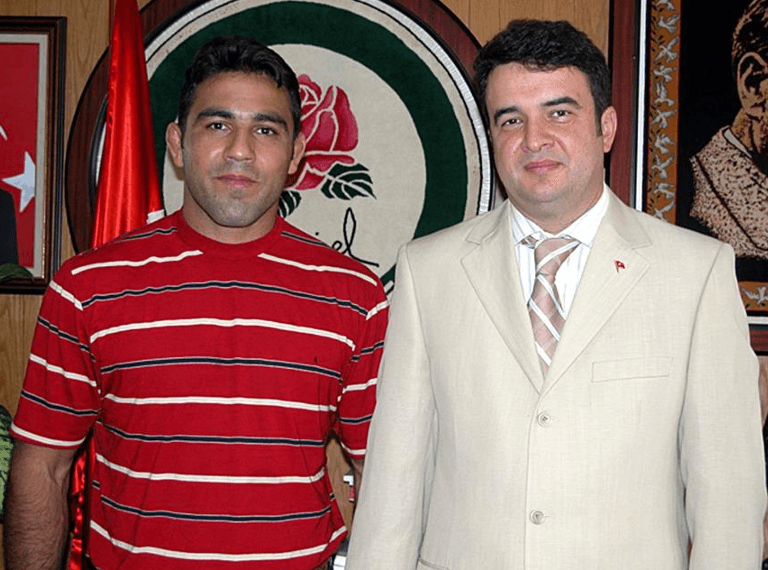
Hamza Yerlikaya and the Rector of Süleyman Demirel University (Güreşiyorum)
Mustafa Yerlikaya’s own involvement in wrestling during his youth and his transmission of this experience to his children helped establish a strong family sports culture. Family guidance enabled both brothers to engage regularly in sports; the early achievements and experience of the elder brother, Muttalip Yerlikaya, served as both a model and a source of motivation for the younger. This spirit of athletic solidarity continued into training and camp periods in later years.
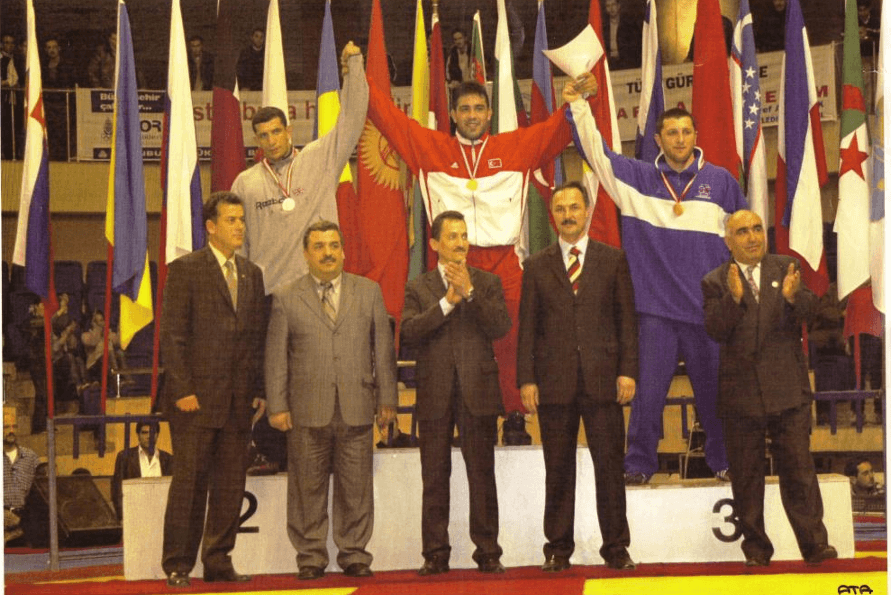
Celebration of the World Championship at Age 17 (Güreşiyorum)
Yerlikaya spent his childhood in Kadıköy, where he devoted time to activities such as swimming and played for a period in a football youth system. His focus on wrestling became more pronounced toward the end of adolescence, and with family support, he began regular attendance at sports clubs and training facilities.
Hamza Yerlikaya completed his undergraduate studies at the Faculty of Physical Education and Sports of Süleyman Demirel University in Burdur. He later earned his master’s degree at Sakarya University of Applied Sciences with a thesis titled “Examining Career Satisfaction and Organizational Citizenship Levels of Personnel in the General Directorate of Sports.”
Yerlikaya’s first professional club affiliation was with Demirspor, where systematic strength and technical training began. The Hamit Kaplan Wrestling Hall in Kadıköy-Haydarpaşa served as the primary venue for his early training sessions, with coaches Salih Bora and Muzaffer Aydın playing decisive roles in his development.
Until adolescence, Yerlikaya engaged in various sports, especially swimming and football, before specializing in Greco-Roman wrestling. His fundamental technical repertoire was established early, with repeated practice of techniques such as “künde,” “suplex,” and “crab” both standing and on the mat preparing his tactical preferences in later years. Matches against peers and older athletes during training camps helped raise his technical standard and adapt him to competition tempo.
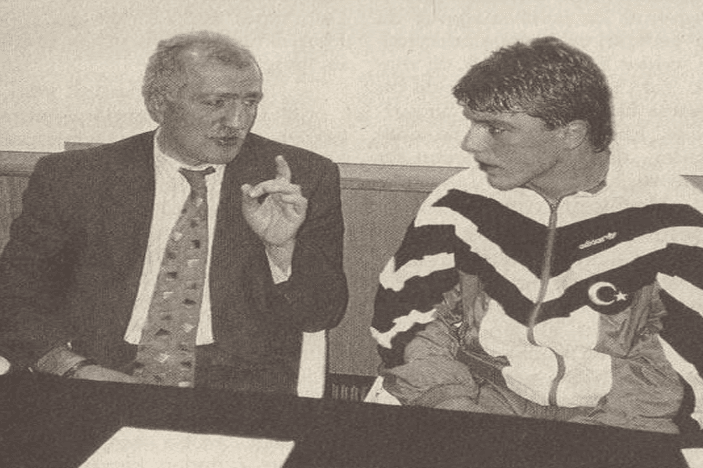
Conversation Between Sadettin Tantan and Hamza Yerlikaya (Güreşiyorum)
His first contact with the national team occurred in 1991. The preparatory camp at Sarıyer-Mersinli Ahmet Facilities marked his first exposure to high-level training routines. Concepts such as camp discipline, load-recovery cycles, and weight management were practically implemented at this stage. In the same year, Yerlikaya placed fourth at the Youth World Championships (65 kg), an experience that marked the beginning of his international competition exposure. In 1992, he won gold at the Youth World Championships in Istanbul and silver at the Junior World Championships in the same year. These early results established foundational performance indicators before his transition to the senior level.
Yerlikaya’s performance at the beginning of 1993 in the Vehbi Emre Greco-Roman Wrestling Tournament proved decisive for his selection to the A national team. At this stage, despite his young age, he acquired practical experience in the physiological and tactical demands of competing regularly in the senior category—match tempo management, opponent analysis, and short recovery intervals. By the end of this period, he was included in the European Championship squad, earning his first continental experience at the senior level.
1993 marked a turning point in Yerlikaya’s visibility at the senior level. After joining the A national team, he reached the final of the European Championships in the 82 kg category, winning silver after losing to Thomas Zander. Later that year, at the World Championships in Stockholm, he became world champion at age 17 in the senior category, demonstrating consistent technical and tactical performance against a field that included Devlet Turliykanov. This achievement laid the foundation for his recognition in international literature as “The Wrestler of the Century.” The 1993 season also concluded with bronze at the Mediterranean Games and gold at the Junior European Championships, expanding his multi-category experience during the transition from junior to senior levels.
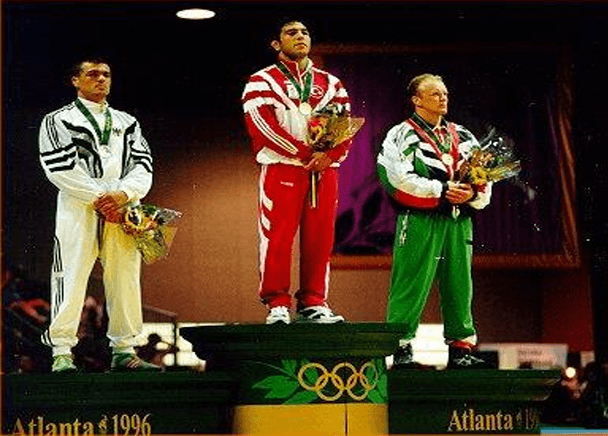
A Scene from the 1996 Atlanta Olympic Gold Medal Ceremony (Güreşiyorum)
The 1994 season drew attention for results that fell short of high expectations. His fifth-place finish at the European Championships in Athens and his medalless performance at the World Championships in Tampere necessitated recalibration in weight management, match tempo, and tactical adaptation. Conversely, his gold medals at the Junior European and Junior World Championships that year confirmed his continued dominance in his age group. The core techniques of “künde,” “suplex,” and “crab” became central to opponent preparation; Yerlikaya responded to opponents’ defenses against “künde” with variations of “crab” and “salto.”
After finishing seventh at the 1995 Senior European Championships, his gold medal at the Junior World Championships provided morale; the real breakthrough came at the 1995 World Championships in Prague. Yerlikaya first defeated his 1993 final opponent Zander, then beat Gocha Tsitsiashvili in the final to become world champion for the second time. During this period, camp planning, load-recovery cycles, and weight stabilization during match week became more systematic; the coaching staff, especially before major tournaments, deepened opponent analysis and scenario planning.
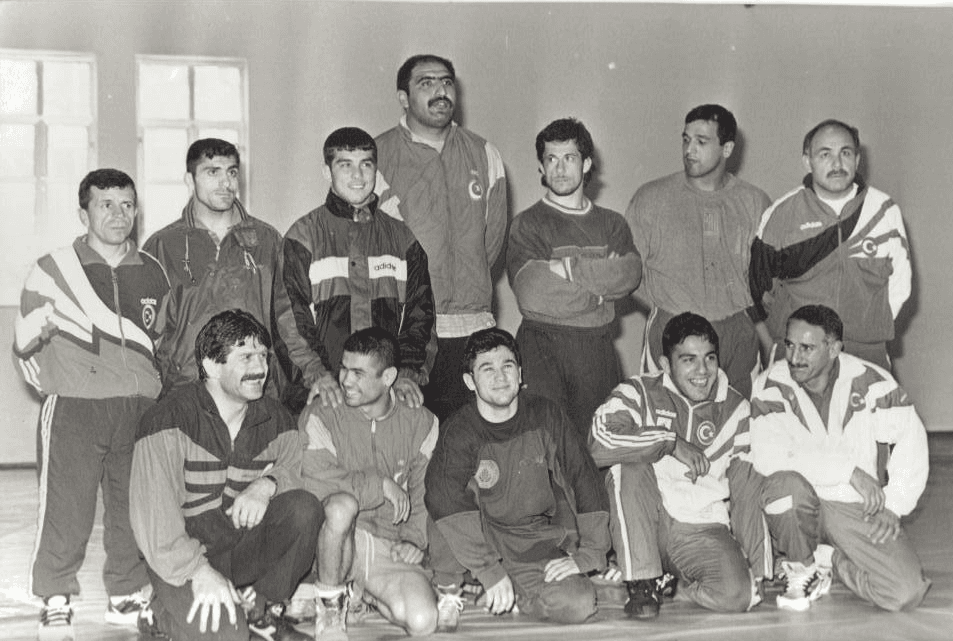
Pre-Olympic Training Camp (Güreşiyorum)
The gold medal won at the 1996 Budapest European Championships served as a specific indicator before the Atlanta Olympics. In Atlanta, scoring and risk management stood out against opponents such as Turliykanov and Lidberg; victory over Zander in the final secured his first Olympic gold. This ascent phase was characterized by early stability at the senior level, rapid adaptation to rule changes, and tactical flexibility in repeated encounters with key opponents. These traits formed the foundation of the performance profile that would later enable him to win additional European and World titles and a second Olympic gold.
1. Atlanta 1996 (82 kg): Advanced through the elimination and semifinal rounds without conceding points; won gold by defeating Thomas Zander with a scoring advantage in the final. This tournament marked his first Olympic victory immediately following his European gold at the senior level.
2. Sydney 27 September 2000 (85 kg): Reached the final by defeating Cuban Luis Enrique Méndez in the quarterfinal and Georgian Mukharn Vakhtangadze in the semifinal; won his second Olympic gold by defeating Hungarian István (Sándor) Bárdosi in overtime, based on passive criteria and technical scoring.
3. Athens 2004 (84 kg): Advanced to the semifinals by defeating representatives of Ukraine, Bulgaria, and Estonia in the first three rounds; lost to Swedish wrestler Ara Abrahamyan in the semifinal; lost the bronze medal match to Belarusian Makarenko, finishing fourth.
1. Stockholm 1993 (82 kg): Won the world championship at age 17 in the senior category, defeating Kazakh Devlet Turliykanov in the final.
2. Prague 1995 (82 kg): Won his second world title by defeating Gocha Tsitsiashvili in the final.
3. Budapest 2005 (96 kg): After rule changes and a move to a higher weight class, advanced to the final through matches against Fritz Aannes, Marek Sitnic, Mirko Englich, and Vasiliy Teploukhov in the semifinal; won his third world gold by defeating host nation athlete Lajos Virág in two periods.
4. Other years: Won silver in Wrocław 1997; placed fifth in Gävle 1998; ninth in Patras 2001; sixth in Moscow 2002; and seventh in Créteil 2003.
1. Gold medals: 1996 Budapest (82 kg), 1998 Minsk (85 kg), 1999 Sofia (85 kg), 2001 Istanbul (85 kg), 2002 Seinäjoki (84 kg), 2003 (85/84 kg category), 2005 Warsaw/Bucharest season (96 kg), 2006 Moscow (96 kg).
2. Others: Achieved second place at the 1993 European Championships (82 kg) and placed in the top five in various years. In addition to individual gold at the 2001 Istanbul European Championships, he also won the team championship.
1. Thomas Zander (Germany): Yerlikaya prevailed over Zander in the 1993 European final, the 1993 and 1995 World Championships, and the 1996 Atlanta Olympic final.
2. Martin/Jimmy Lidberg (Sweden): Won tactically decisive victories against Martin Lidberg in the 1996 Atlanta group final, against Jimmy Lidberg in the 1999 Sofia European final, and again in the 2005 European Championships.
3. Ara Abrahamyan (Sweden): Had critical matches against him at the 2002 Moscow World Championships and 2003 Créteil; suffered defeat in the semifinal at the 2004 Athens Olympics.
4. István (Sándor) Bárdosi (Hungary): The 2000 Sydney final was decided by overtime and passive criteria.
5. Devlet Turliykanov (Kazakhstan): Played decisive matches against him in the early rounds of the 1993 World Championships and 1996 Atlanta Olympics.
1991 – World Championships (Youth, 65 kg): 4th
1992 – World Championships (Youth, 76 kg): Gold
1992 – World Championships (Junior, 74 kg): Silver
1993 – European Championships (Senior, 82 kg): Silver
1993 – World Championships (Senior, 82 kg): Gold
1993 – European Championships (Junior, 81 kg): Gold
1993 – Mediterranean Games (Senior, 82 kg): Bronze
1994 – European Championships (Senior, 82 kg): 5th
1994 – European Championships (Hope, 82 kg): Gold
1994 – World Championships (Junior, 88 kg): Gold
1994 – World Championships (Senior, 82 kg): 12th
1995 – European Championships (Senior, 82 kg): 7th
1995 – World Championships (Hope, 82 kg): Bronze
1995 – World Championships (Senior, 82 kg): Gold
1996 – European Championships (Senior, 82 kg): Gold
1996 – Olympic Games, Atlanta (Senior, 82 kg): Gold
1997 – European Championships (Senior, 85 kg): Gold
1997 – Mediterranean Games (Senior, 85 kg): Gold
1997 – World Championships (Senior, 85 kg): Silver
1997 – World Cup (Senior, 85 kg): Gold
1998 – European Championships (Senior, 85 kg): Gold
1998 – World Championships (Senior, 85 kg): 5th
1999 – European Championships (Senior, 85 kg): Gold
1999 – World Championships (Senior, 85 kg): 21st
2000 – Olympic Games, Sydney (Senior, 85 kg): Gold
2001 – European Championships (Senior, 85 kg): Gold
2001 – World Cup (Senior, 97 kg): 5th
2001 – World Championships (Senior, 85 kg): 9th
2002 – European Championships (Senior, 84 kg): Gold
2002 – World Championships (Senior, 84 kg): 6th
2002 – World Cup (Senior, 96 kg): Silver
2003 – World Championships (Senior, 84 kg): 7th
2004 – Olympic Games, Athens (Senior, 84 kg): 4th
2005 – European Championships (Senior, 96 kg): Gold
2005 – World Championships (Senior, 96 kg): Gold
2006 – World Cup (Senior, 96 kg): Gold
2006 – European Championships (Senior, 96 kg): Gold
During this period, the core of his technical repertoire consisted of “künde” (particularly in ground wrestling from clinch positions), “suplex,” and “crab.” Rule changes, such as the increased emphasis on initiating ground wrestling from 0–0 periods, influenced outcomes in some tournaments. Multiple weight class transitions, adaptation to rule changes, and tactic diversification based on opponent analysis emerged as key factors supporting his final performances.
Following his early senior world championship victory, Hamza Yerlikaya began to be referred to in international literature as “The Wrestler of the Century.” Throughout his athletic career, he was repeatedly selected as “Sportsman of the Year” or “Wrestler of the Year” in evaluations by national and international institutions and ranked highly in surveys by press organizations and sports writers’ associations. Among the most notable institutional recognitions was his receipt of the “Olympic Torch” award from the Turkish National Olympic Committee.
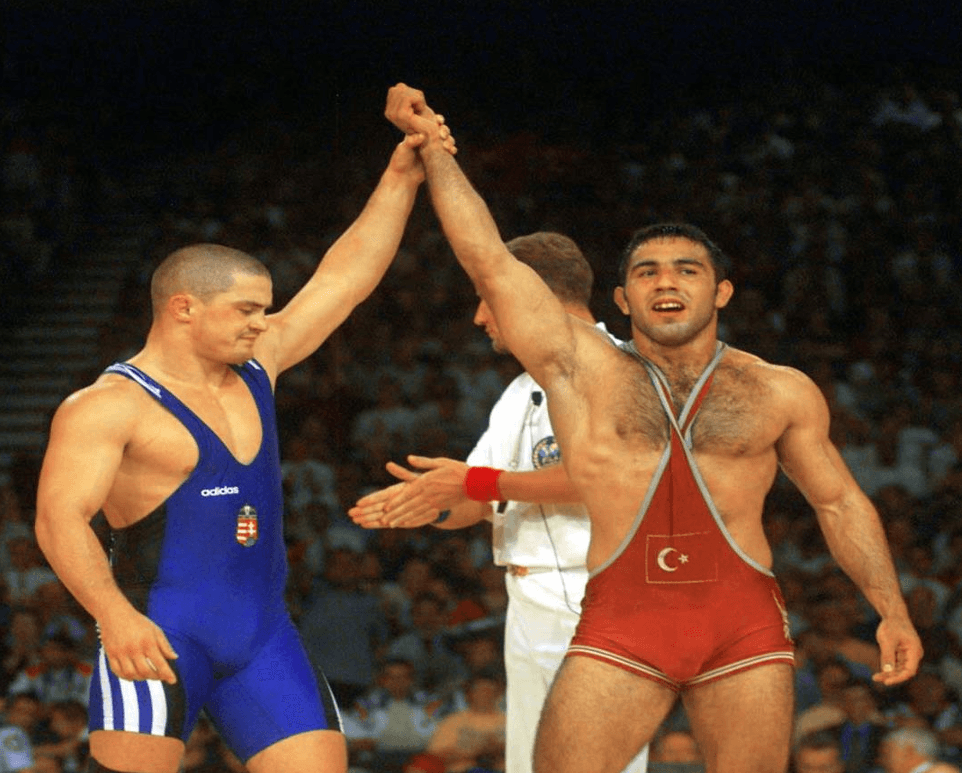
A Scene from the Sydney Olympics (Güreşiyorum)
Awards from the press and professional organizations include year-end selections by the International Federation of Sports Writers and European wrestling bodies, as well as national media polls for “Sportsman of the Year.” In these selections, Yerlikaya’s seasonal performances at senior European, World, and Olympic levels were decisive; multiple medal achievements within the same year were frequently cited as reference points for award presentations.
Yerlikaya’s name also appeared in spatial and ceremonial forms of visibility beyond sporting awards.
Sports complexes bearing his name have become part of accessible local sports infrastructure, serving multiple disciplines including wrestling in multi-purpose halls and facilities. Additionally, symbolic roles such as carrying the torch at the opening ceremonies of major international sporting events have been recorded as extensions of his career’s ceremonial representation.
Yerlikaya’s Greco-Roman approach is distinguished by his preference for close-range standing engagements and control of the upper body. Key characteristics include maintaining the center line at match start, positioning the torso parallel to the opponent’s shoulder line, and using short explosive movements to disrupt balance. Rapid rhythm changes (sudden pull-push, direction breaks) and increased pressure near the edge line helped turn passive penalties to his advantage. During this phase, locking the arms through head-chest contact and seeking to “close” the opponent’s torso created advantages when opportunities for ground holds arose.
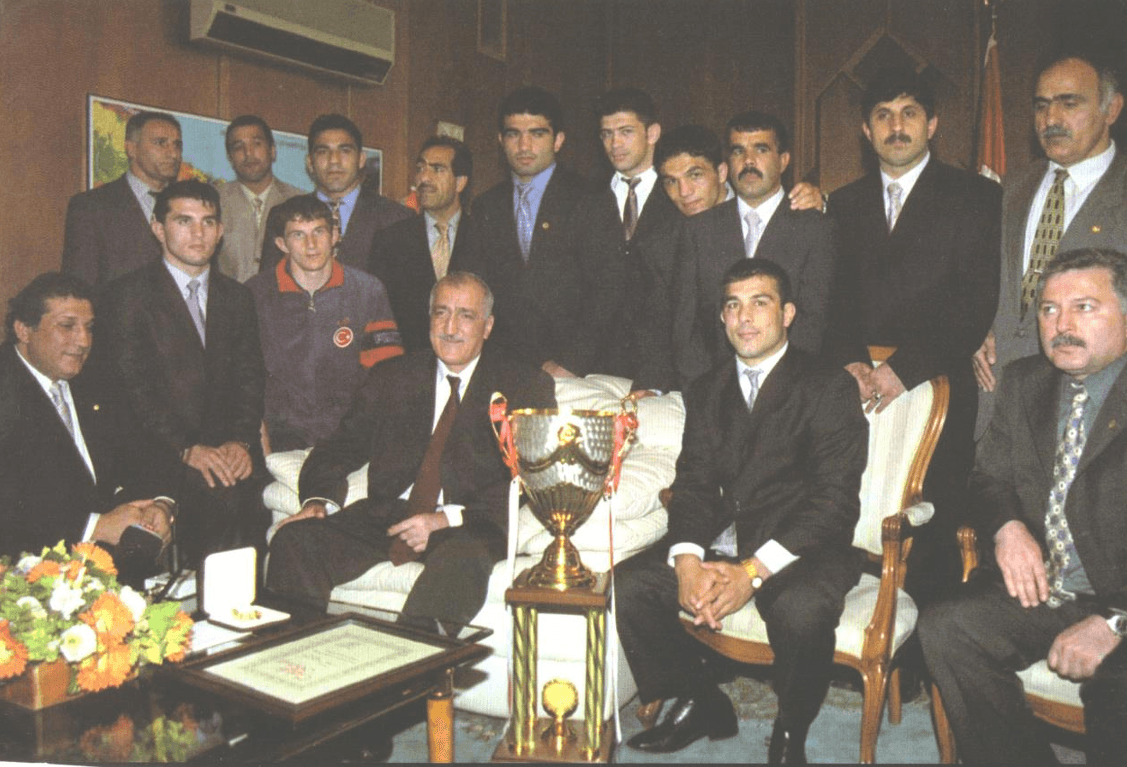
After the 2001 European Championship (Güreşiyorum)
In ground wrestling, variations of “künde” form a foundational core. After establishing a hold, he combines hip-shoulder alignment with pushing and turning movements to break the opponent’s bridge resistance, enabling low-risk point production. When opponents strengthen their “künde” defense, he employs wider-range suplexes and speed- and momentum-based crab attempts. In transitions between standing and ground positions, he frequently preserves the lock while executing short-distance lifts and directional changes to generate point combinations.
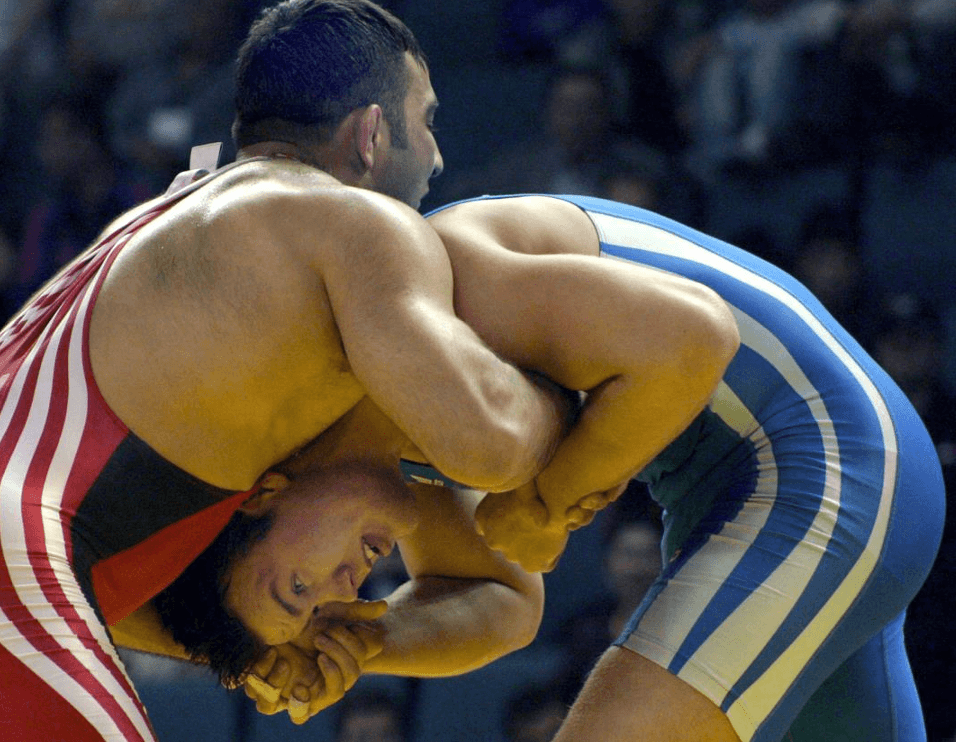
A Scene from the 2005 Hungary World Championships (Güreşiyorum)
Adaptation to periodic rule changes is a defining feature of his style. During the transition from the 1990s to the 2000s, when ground initiation and clinching during 0–0 periods became more frequent, he used low-risk entry-exit maneuvers to ensure “position cleaning” and active visibility before clinching. In weight class transitions (82–85–84/96 kg), he maintained a low center of gravity and resistance-based defense to preserve standing power transfer, which proved instrumental in preparing for ground wrestling at higher weights. His match management emphasized controlled tempo, relying on positional superiority toward the end of periods rather than early point seeking.
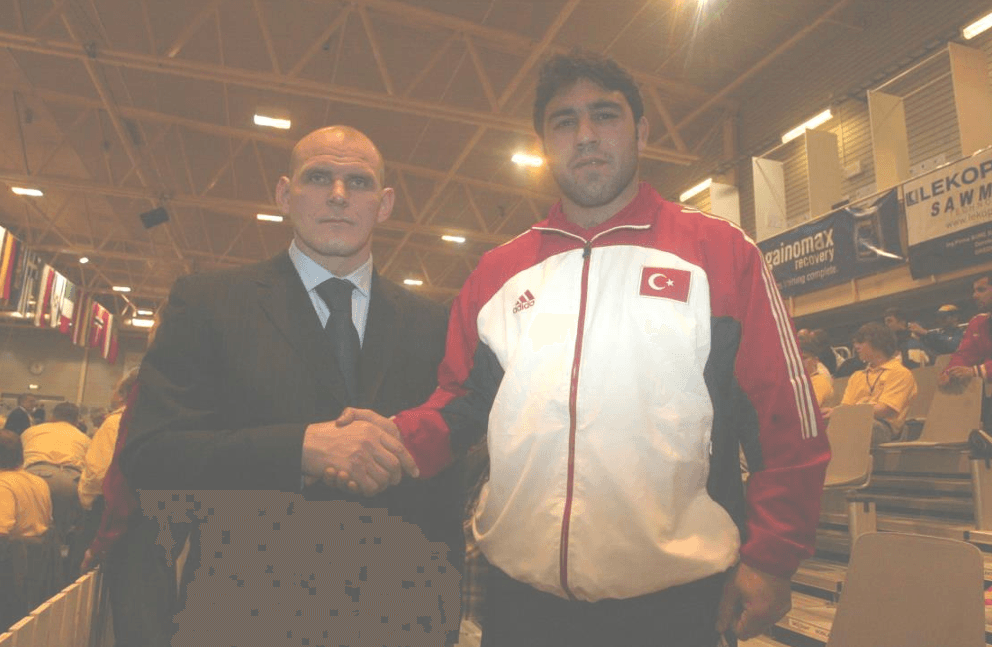
Hamza Yerlikaya with Russian Wrestler Karalin (Güreşiyorum)
Tactical adaptation to opponent profiles is also evident. Against opponents with long arm reach and strong “chest closure” (e.g., Zander), he targeted close-range arm retraction and shoulder line disruption; against agile opponents prone to balance disruption (e.g., the Lidberg brothers), he focused on edge pressure and creating ground opportunities. Against opponents with strong upper body defense (e.g., Abrahamyan), he employed prolonged pre-clinch setups and repeated contact-break cycles to exhaust them. Overall, controlled risk based on standing clinch struggles, ground “künde”-centered point production, and adaptation to rule and weight dynamics define Yerlikaya’s technical-tactical profile.
After his active athletic career, Hamza Yerlikaya entered politics within the Justice and Development Party (AK Party) and served as a member of the Grand National Assembly of Türkiye representing Sivas. In legislative activities, he emphasized sports policy, youth initiatives, and regulations concerning sports infrastructure.
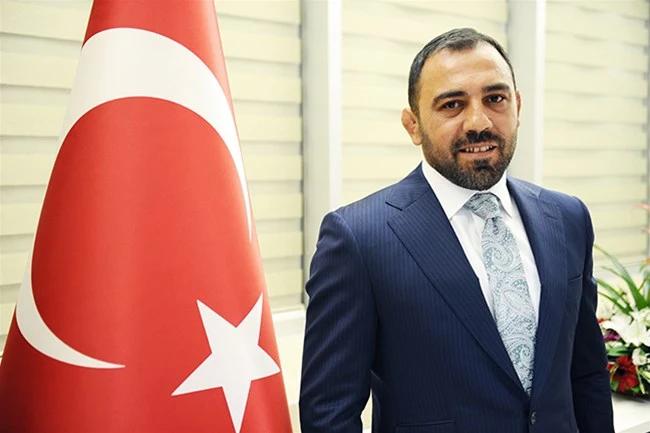
Official Photograph of Hamza Yerlikaya at the Ministry of Youth and Sports (Ministry of Youth and Sports)
After his term as a member of parliament, he was appointed as presidential advisor, providing counsel on coordination with sports institutions, youth programs, and legislative monitoring. He was subsequently appointed Deputy Minister of Youth and Sports, assuming responsibility in administrative areas such as youth centers, facility investments, athlete support, and event planning.
Following his transitions between roles, he continued public engagement through party structures and field programs, contributing to institutional functioning in politics and public administration as a figure with an athlete’s background.
Hamza Yerlikaya was born in Istanbul. His father’s name is Mustafa Yerlikaya; he was raised in a family environment with strong ties to wrestling. His brother Muttalip Yerlikaya also engaged in wrestling.
Yerlikaya married Ebru Küçük in 2010 and is the father of three children. Their wedding ceremony was held at the Feshane International Fair and Culture Center in Istanbul; the witnesses to the marriage were then-President Abdullah Gül, Speaker of the Grand National Assembly Mehmet Ali Şahin, and Prime Minister Recep Tayyip Erdoğan.
The ceremony was officiated by then-Istanbul Metropolitan Mayor Kadir Topbaş. Also in attendance were then-Kırıkkale Governor Ali Kolat and his wife İlksen Kolat.
Anadolu Ajansı. “Asrın Güreşçisi Hamza Yerlikaya Cumhurbaşkanı Başdanışmanı Oldu.” Accessed September 26, 2025.https://www.aa.com.tr/tr/turkiye/asrin-gurescisi-hamza-yerlikaya-cumhurbaskani-basdanismani-oldu/489168.
Anadolu Ajansı. “Yerlikaya Yeniden ‘Siyaset’ Dedi.” Anadolu Ajansı. Accessed September 26, 2025.https://www.aa.com.tr/tr/spor/yerlikaya-yeniden-siyaset-dedi/74308.
Biyografiler. "Hamza Yerlikaya." Biyografiler.com. Accessed September 26, 2025.https://www.biyografiler.com/kimdir/hamza-yerlikaya.
Curling Federasyonu. "Bakan Yardımcıları." Curling Federation. Accessed September 26, 2025.https://www.curling.gov.tr/detaylar/159/bakan-yardimcilari.
Güreşiyorum. *Hamza Yerlikaya*. Accessed September 26, 2025.https://guresiyorum.com/wp-content/uploads/2022/04/Hamza-Yerlikaya.pdf.
Hamza Yerlikaya Middle School. “Hamza Yerlikaya Kimdir?” Hamza Yerlikaya Middle School. Accessed September 26, 2025.https://hamzayerlikayaoo.meb.k12.tr/icerikler/hamza-yerlikaya-kimdir_8439816.html.
Ministry of Youth and Sports (GSB). "Hamza Yerlikaya." GSB. Accessed September 26, 2025.https://gsb.gov.tr/tr/sayfa/3128-hamza-yerlikaya.
Olimpédya / Olimpiyat.org.tr. "Hamza Yerlikaya." Olimpédya. Accessed September 26, 2025.
Sivas Valiliği. "Sivas Milletvekili Yerlikaya ‘Dünya Evine Girdi’." Sivas Valiliği. Accessed September 26, 2025.http://www.sivas.gov.tr/sivas-milletvekili-yerlikaya-d-nya-evine-girdi.
Yerlikaya, Hamza. *Spor Genel Müdürlüğü Personelinin Kariyer Tatmini ve Örgütsel Vatandaşlık Düzeylerinin İncelenmesi*. Master's thesis, 2019. Accessed. Ulusal Tez Merkezi.https://tez.yok.gov.tr/UlusalTezMerkezi/TezGoster?key=Mir2lXQK1dkmQ9Ige3PZbjBbXTzQGK2yxfRrY_5hY_8HAsJmg7dXhRZO2UZl8TfB

Full Name | Hamza Yerlikaya | ||||||||
|---|---|---|---|---|---|---|---|---|---|
Spouse | Ebru Küçük | ||||||||
Date of Birth | 1976-06-03 | ||||||||
Place of Birth | Kadıköy İstanbul | ||||||||
Hometown | Sivas | ||||||||
Mother | Emine Yerlikaya | ||||||||
Father | Mustafa Yerlikaya | ||||||||
Sibling | Muttalip Yerlikaya | ||||||||
Child | Father of Three Children | ||||||||
Education | Süleyman Demirel University (Bachelor's) Sakarya University (Master's) | ||||||||
Specialty | Wrestling (Greco-Roman) | ||||||||
Weights | 85 kg 96 kg 84 kg 82 kg | ||||||||
International Achievements | World Championships: 3 golds Olympic Games: 2 golds European Championships: 8 golds | ||||||||
Title | The Wrestler of the Century Sportsman of the Year (Various years) | ||||||||
Political Positions | Member of the National Education, Youth and Sports Commission of the Grand National Assembly of Türkiye Member of Parliament for Sivas, Justice and Development Party, 23rd Term of the Grand National Assembly of Türkiye | ||||||||
Administrative Positions | Advisor to the President of Türkiye Deputy Minister of Youth and Sports Presidency of the Turkish Wrestling Federation Membership of the Turkish National Olympic Committee | ||||||||
Family and Education
Beginnings and Early Years in Wrestling
Rise of the Athletic Career
International Achievements
Olympic Games
World Championships
European Championships (Selected Results)
Notable Matches and Opponents
Complete List of Results
Awards and Titles
Wrestling Style and Technical Features
Politics and Public Service
Personal Life