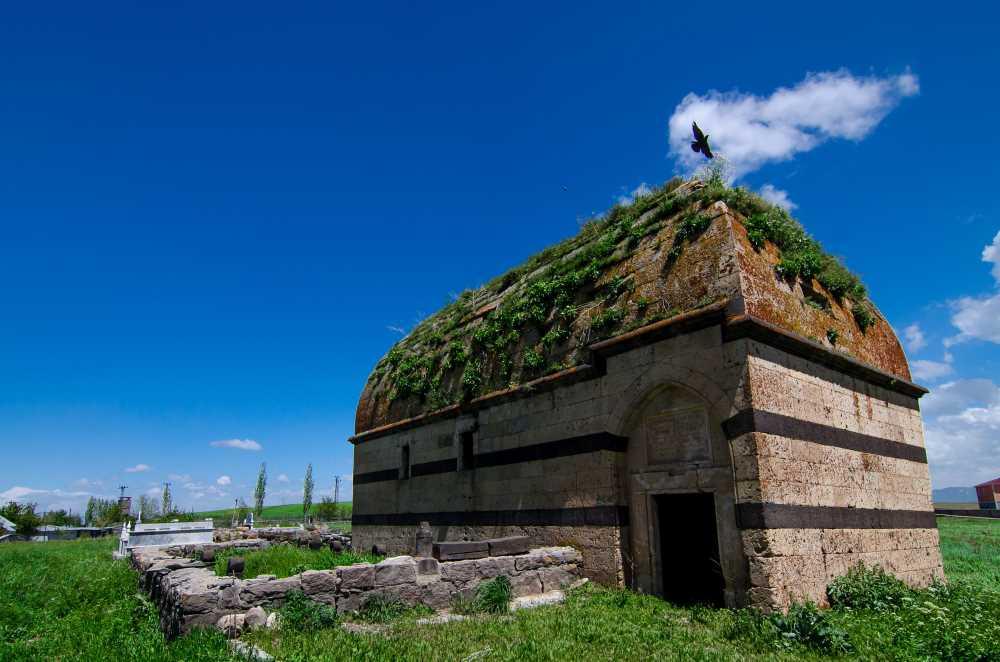


Hamur Kümbeti
Stone buildings passed down from the past tell us how people lived in ancient times and what they valued. In our province of Ağrı, the Hamur Kümbeti is a particularly unique structure that, like a time machine, transports us back approximately 200 years. Let us explore together the secrets of this fascinating stone construction!
Where Is the Hamur Kümbeti?
Hamur Kümbeti is located in the Hamur district of Ağrı, from which it takes its name. It stands at the center of an ancient cemetery, directly above a valley just at the entrance to the district center. If your route takes you along the Ağrı-Van highway, you can see this striking structure gazing out at you from within the cemetery.

Hamur Kümbeti (Generated by Artificial Intelligence)
What Does This Structure Look Like?
From a distance, the Hamur Kümbeti resembles a giant stone chest or coffin. Its shape is distinct from many other historical structures. Two different types of stone were used in its construction: soft, dirty-white stones and black, hard basalt stones that encircle it like a band.
These black bands wrap around the structure in four rows, giving it a highly dynamic appearance. The roof is not flat but shaped like the back of a fish, curved and oval. This architectural style gives it a unique character unlike any other kümbet in our country.
What Is Inside?
When you enter the kümbet, you are greeted by two distinct rooms. The first is an entrance courtyard, through which a small door leads to the main burial chamber. Inside, there are tombs believed to belong to İbrahim Paşa, who commissioned the structure, and his family.
Originally, the tombs were adorned with plant motifs, eight-pointed stars, and beautiful inscriptions. Although some of these decorations have deteriorated over time, they still whisper to us the artistry of that era. On the walls of the structure, there are small compartments known as “çıralık,” which were once used for lighting.
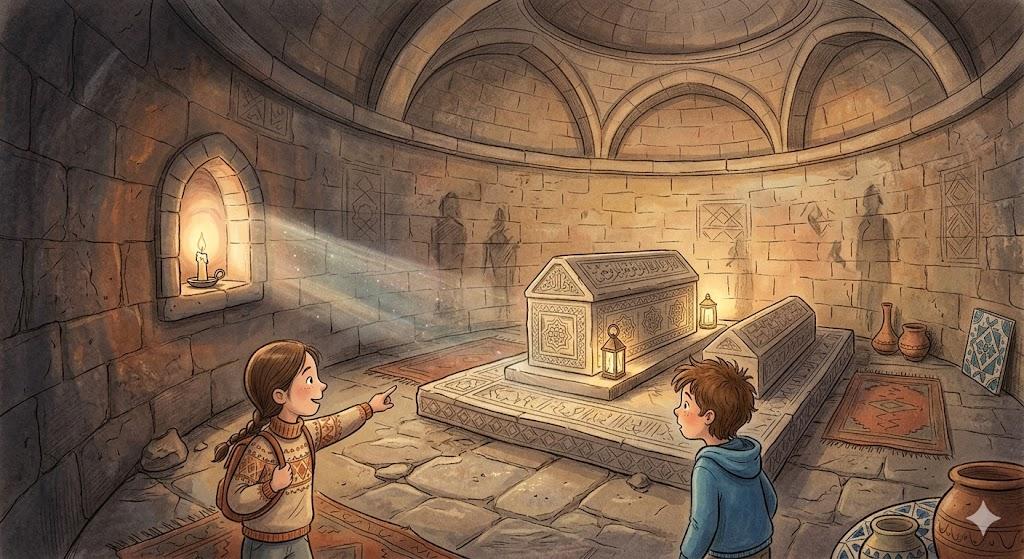
The main burial chamber inside the kümbet (Generated by Artificial Intelligence)
Time Travel: Who Commissioned It?
Approximately 222 years ago, in 1802, it was commissioned by İshak Paşa’s grandson, İbrahim Paşa, for his family. In those times, people built grand and durable monumental tombs to honor their loved ones.