


This article was automatically translated from the original Turkish version.
+1 More
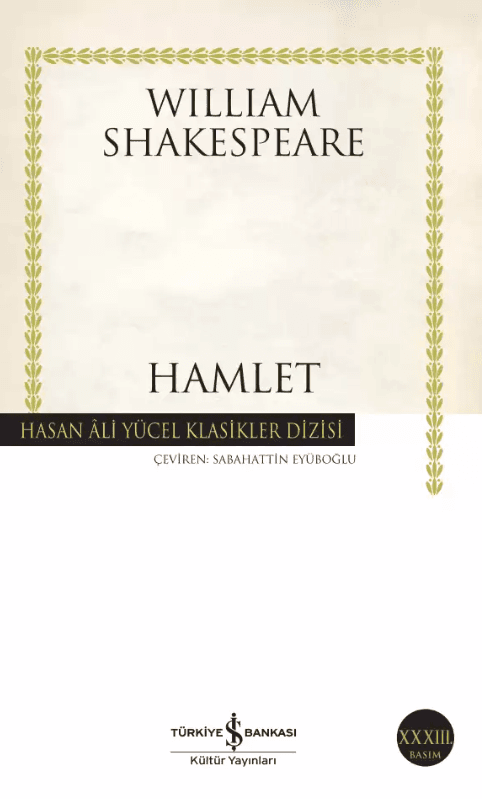
Author(s) | William Shakespeare | ||||||||
|---|---|---|---|---|---|---|---|---|---|
Translator(s) | Sabahattin Eyüboğlu | ||||||||
Publisher(s) | Türkiye İş Bankası Kültür | ||||||||
Publication Date | 28.09.2019 | ||||||||
Page | 188 | ||||||||
Language(s) | Turkish | ||||||||
Genre | Tragedy | ||||||||
Hamlet is set in the Kingdom of Denmark and centers on the psychological disintegration and quest for revenge of the young Prince Hamlet following the sudden death of his father. King After Hamlet’s death, his brother Claudius ascends the throne and marries Gertrude, the late king’s widow, short duration. Prince Hamlet is deeply troubled by his father’s death and harbors secret distrust toward his uncle. These suspicions are confirmed by the apparition of his father’s ghost, who reveals that Claudius murdered him by poisoning and demands revenge.
To verify the truth of the ghost’s claims, Hamlet stages a theater play to catch Claudius in the act. However, he is confronted by indecision, feigned madness, and inner turmoil. Hamlet’s failure to act promptly leads to the tragic ends of those around him: Ophelia’s descent into madness and suicide, the accidental killing of Polonius, Laertes’ pursuit of vengeance, and the final duel all result in the deaths of multiple characters. Game ends tragically with Hamlet killing Claudius and immediately dying himself stage.
Hamlet’s desire to avenge his father’s murder by Claudius forms the central plot of the play. Yet this pursuit of revenge does not proceed directly but through a complex process of inner conflict. Hamlet’s delay in taking action opens a discussion on the personal, moral and social dimensions of revenge.
Claudius’s unjust seizure of the throne raises questions about the legitimacy of rule. Hamlet’s search for justice is addressed not merely as a personal vendetta but on a broader ethical and political plane.
Hamlet’s behavior raises the question of whether he is feigning madness or has genuinely lost his sanity. Ophelia’s madness, in contrast, is presented as the result of psychological breakdown and social pressure.
In the play, death is not merely a physical end but a philosophical inquiry. Hamlet’s “To be or not to be” soliloquy centers on the human relationship between life and death. The graveyard scene and the ghost figure reinforce this theme.
Hamlet’s constant thinking, questioning, and ultimate inability to decide are the core causes of his tragedy. Inaction is viewed as both an individual and structural sign of collapse.
The tension between what appears to be and what is real is frequently emphasized. Claudius presents himself as a composed and honest king like yet is a murderer; Hamlet’s act of madness and the duplicity of other characters reinforce this theme.
Hamlet’s anger toward his mother, his loyalty toward his father, and his fragile relationship with Ophelia reveal conflicts arising from familial bonds. Similarly, Laertes’ loyalty toward his family supports this theme.
Claudius’s method of seizing power demonstrates the boundless nature of ambition. Hamlet’s rightful claim to the throne transforms him from a personal figure into a political threat.
Prince of Denmark. After his father’s death, he withdraws inward and is further shaken by his mother’s hasty marriage to Claudius. He is a character given to deep contemplation and philosophical questioning, time at times feigning madness. His indecision and inaction are the causes of both his own tragedy and the destruction of those around him. His intellectual nature and moral introspection distinguish him from a conventional revenge hero.
Hamlet’s uncle and King of Denmark. He has seized the throne by poisoning Hamlet’s father. Though outwardly a calm and orderly ruler, he is tormented by guilt. His ambition for power and desire to preserve his own existence lead him to commit further crimes.
Hamlet’s mother. She marries Claudius shortly after her husband’s death. She fails to understand the emotional collapse her son is experiencing complete. Although it is not definitively established whether she is complicit in the crime, most interpretations portray her as a passive figure. Her death becomes symbolic of the court’s disintegration.
The king’s advisor. He exhibits excessive protectiveness toward his daughter and son attitude. He is deeply loyal to the state but is also gossipy and cunning. His accidental killing by Hamlet is one of the triggering events of the court’s tragedy.
Daughter of Polonius. A romantic relationship with Hamlet is implied. She suffers psychological collapse following her father’s death and Hamlet’s erratic behavior, ultimately drowning. Her madness and death are directly linked to the play’s theme of lost innocence.
Polonius’s son. He is studying Paris when his father’s murder prompts him to return to Denmark and seek revenge against Hamlet. The duel he conspires with Claudius together results in the chain of deaths at the play’s climax. He is a character driven by rage movement who ultimately feels remorse.
Hamlet’s loyal friend. He accompanies Hamlet throughout the events, supports him, and assumes the role of narrator at the play’s end. Throughout the play, he represents reason and common sense.
The spirit of the deceased King Hamlet. He informs his son that Claudius murdered him and demands revenge. This figure serves not only as the catalyst for the narrative’s beginning but also as a force shaping Hamlet’s inner transformation.
Shakespeare, William. Hamlet. Translated by Sabahattin Eyüboğlu. Istanbul: Türkiye İş Bankası Kültür Yayınları, 2019.

Author(s) | William Shakespeare | ||||||||
|---|---|---|---|---|---|---|---|---|---|
Translator(s) | Sabahattin Eyüboğlu | ||||||||
Publisher(s) | Türkiye İş Bankası Kültür | ||||||||
Publication Date | 28.09.2019 | ||||||||
Page | 188 | ||||||||
Language(s) | Turkish | ||||||||
Genre | Tragedy | ||||||||
Summary
Themes
Themes in Hamlet
Revenge
Justice and Legitimacy
Madness and Sanity
Death and Existence
Indecision and Inaction
Appearance and Reality
Family and Loyalty
Power and Struggle for Authority
Characters and Traits
Hamlet
Claudius
Gertrude
Polonius
Ophelia
Laertes
Horatio
Ghost