This article was automatically translated from the original Turkish version.
+1 More
Construction Date(s) | 1608 | ||||||||
|---|---|---|---|---|---|---|---|---|---|
Location | Ali Ağa quarter Gürcü Kapı neighborhood Yakutiye Erzurum | ||||||||
Founder(s) | Yeniçeri Ağası Zakreci (Zahreci) Ali Ağa | ||||||||
Minaret | Single minaret on the northwest, with a brick body, and entrance provided from inside the mosque | ||||||||
Building Type | Square-plan harem and three-bay final prayer space | ||||||||
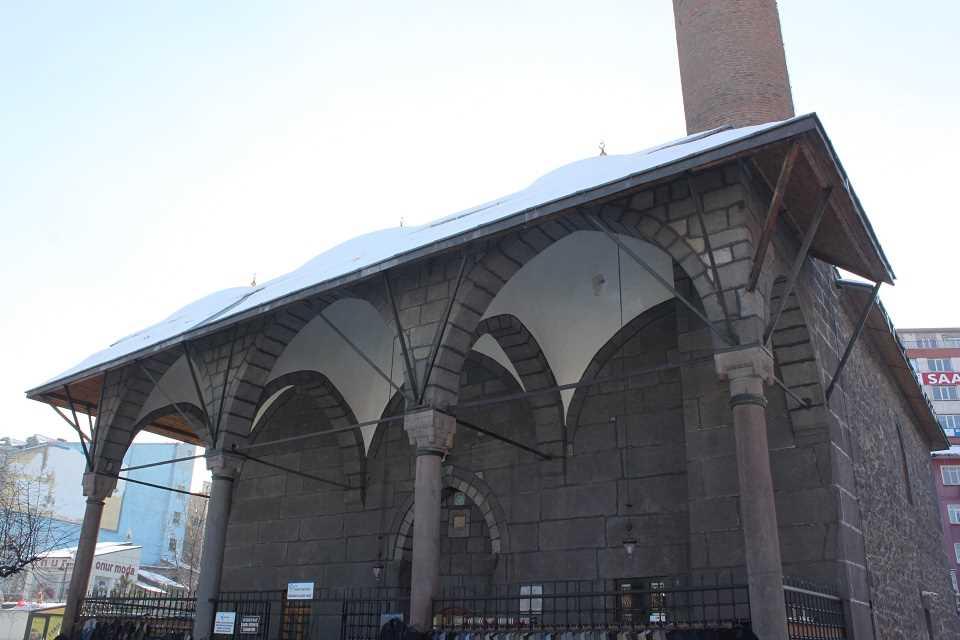
Erzurum’s Gürcü Kapı neighborhood is home to the Gürcü Kapı (Ali Ağa) Camii, located in Ali Ağa Mahallesi. It is one of the examples of Classical Ottoman architecture in the city. The mosque was commissioned by Zakreci (Zahreci) Ali Ağa, a Janissary agha serving in Erzurum. An endowment deed dated 1608 (H. 1017) in the General Directorate of Foundations archives confirms the construction date and founder. The structure, also known as Ali Ağa Camii, is classified architecturally within the Ottoman single-dome mosque typology.
The building consists of a square prayer hall and a three-bay rear prayer area. The main space is covered by a central octagonal drum dome, supported by two-tiered pointed arches with squinches. Each face of the drum features a plaster-lattice window for illumination. The load-bearing walls are constructed with regularly cut stone at the corners and rubble stone in between; wall thickness decreases progressively toward the top. The rear prayer area on the north facade is covered by three pointed arch domes resting on four muqarnas-capped columns. This roofing system is externally enclosed by a conical roof.
On the southern wall inside the mosque is a mihrab made of regularly cut stone, featuring a simple niche framed by profiled moldings. Opposite it, on the north side, is a wooden gallery supported by eight pillars. The lighting system consists of six rectangular mazgal windows in the lower row and pointed arch plaster-lattice windows in the upper row. The entrance door is set within a two-tiered pointed arch niche. On the north wall, above the windows opening into the rear prayer area, are calligraphic inscriptions with religious themes.
The minaret, located at the northwestern corner of the building, is accessed from within the mosque. It stands on a cubic base of cut stone and has a cylindrical shaft built of brick. Stone is used for the balcony and the section beneath it; the lower balcony section is decorated with two rows of stone moldings. The structure suffered damage in the 1859 (H. 1276) earthquake and was subsequently repaired by a philanthropist. A marble inscription documenting this repair is mounted above the entrance door. The building underwent comprehensive restoration in 2006.
Situated in the Gürcü Kapı neighborhood, one of the city’s historic entry points and a center of socio-cultural activity, the mosque is one of Erzurum’s significant public buildings from the Ottoman period.
Erzurum Ansiklopedisi. "Gürcü Kapı (Aliağa) Camii." Accessed January 5, 2026. https://erzurumansiklopedi.com/gurcu-kapi-aliaga-camii/.
Erzurum Portalı. "Gürcü Kapı (Ali Ağa) Cami." Accessed January 5, 2026. https://erzurumportali.com/shf/122/Gurcu-Kapi-Ali-Aga-Cami.
Türkiye Kültür Portalı. "Gürcü Kapı Ali Ağa Camisi - Erzurum." Accessed January 5, 2026. https://www.kulturportali.gov.tr/turkiye/erzurum/gezilecekyer/gurcu-kapi-camisi.
Türkiye Turizm Ansiklopedisi. "Gürcü Kapı (Ali Ağa) Camii." In Alimurat Aktemur, ed. Nazmi Kozak, 2019. Accessed January 5, 2026. https://turkiyeturizmansiklopedisi.com/gurcu-kapi-ali-aga-camii
Construction Date(s) | 1608 | ||||||||
|---|---|---|---|---|---|---|---|---|---|
Location | Ali Ağa quarter Gürcü Kapı neighborhood Yakutiye Erzurum | ||||||||
Founder(s) | Yeniçeri Ağası Zakreci (Zahreci) Ali Ağa | ||||||||
Minaret | Single minaret on the northwest, with a brick body, and entrance provided from inside the mosque | ||||||||
Building Type | Square-plan harem and three-bay final prayer space | ||||||||
No Discussion Added Yet
Start discussion for "Gürcü Kapı (Ali Ağa) Camii" article
Architectural Structure and Plan Features
Interior Space and Decoration
Minaret and Restorations