This article was automatically translated from the original Turkish version.
+2 More
Event Name | Gunpowder Plot | ||||||||
|---|---|---|---|---|---|---|---|---|---|
Original Name | Gunpowder Plot | ||||||||
Primary Purpose | King James I To eliminate government members and parliament to establish Catholic rule | ||||||||
Date | 5 November 1605 | ||||||||
Leader | Robert Catesby | ||||||||
Key Figure | Guy Fawkes | ||||||||
Location | House of Lords Westminster London | ||||||||
Method | The detonation of 36 barrels of gunpowder placed in a cellar beneath the House of Lords | ||||||||
Outcome | the other conspirators were either killed in the clash or executed for treason Guy Fawkes was caught in the act The plot failed | ||||||||
Reason for Decryption | An anonymous warning letter sent to Lord Monteagle | ||||||||
Historical Legacy | Guy Fawkes Night (Bonfire Night), celebrated annually on 5 November with fireworks and bonfires | ||||||||
The Gunpowder Plot was a failed assassination attempt in 1605 targeting King James I and the Parliament of England. Planned by a group of Catholic conspirators, the plot aimed to blow up the House of Lords during the State Opening of Parliament, thereby eliminating the king, the royal family, and government members. The conspirators’ primary motivation was to depose the Protestant King James I and replace him with a Catholic monarch, reestablishing Catholic dominance in England.【1】
The roots of religious tension in England lie in the reign of Henry VIII of the Tudor dynasty, who severed ties with the Roman Catholic Church and established the Anglican Church. From this period onward, England entered a phase of religious instability oscillating between Catholicism and Protestantism. Henry VIII’s successor, Mary I, strongly embraced Catholicism, sought to restore papal authority, and pursued a repressive policy against Protestants. However, after Mary’s death, Elizabeth I (1558–1603) adopted a Protestant stance and made it the official state policy.【2】
The accession of James I (James VI of Scotland) from the Stuart dynasty in 1603, following Elizabeth’s death, marked one of the most critical turning points in English history. As the son of a Catholic mother, Mary Stuart, James inspired high hopes among persecuted English Catholics for religious freedom and tolerance. Yet despite his Catholic lineage, James himself was a Protestant raised under Calvinist influence and maintained this religious orientation upon ascending the throne. The situation for Catholics deteriorated further just months before the plot was devised, when Catholic priests were forced to leave England, provoking widespread anger among Catholic subjects.【3】 From a historical perspective, this attempt has been viewed as a predictable, albeit extreme, human response to religious and political oppression against Catholics.【4】
The conspirators’ primary motivation was not only religious discontent but also historical precedents of success. Robert Catesby and his associates are believed to have drawn inspiration from Mary Tudor’s rebellion nearly fifty years earlier, which had restored Catholicism to the throne. Catesby’s family history of royal assassinations and political maneuvering significantly influenced the shaping of the plan. The conspirators’ ultimate goal was to eliminate the Protestant King James I—viewed as a foreigner due to his Scottish origins—during the State Opening of Parliament and replace him with a Catholic monarch to permanently reestablish Catholic authority in England.【5】
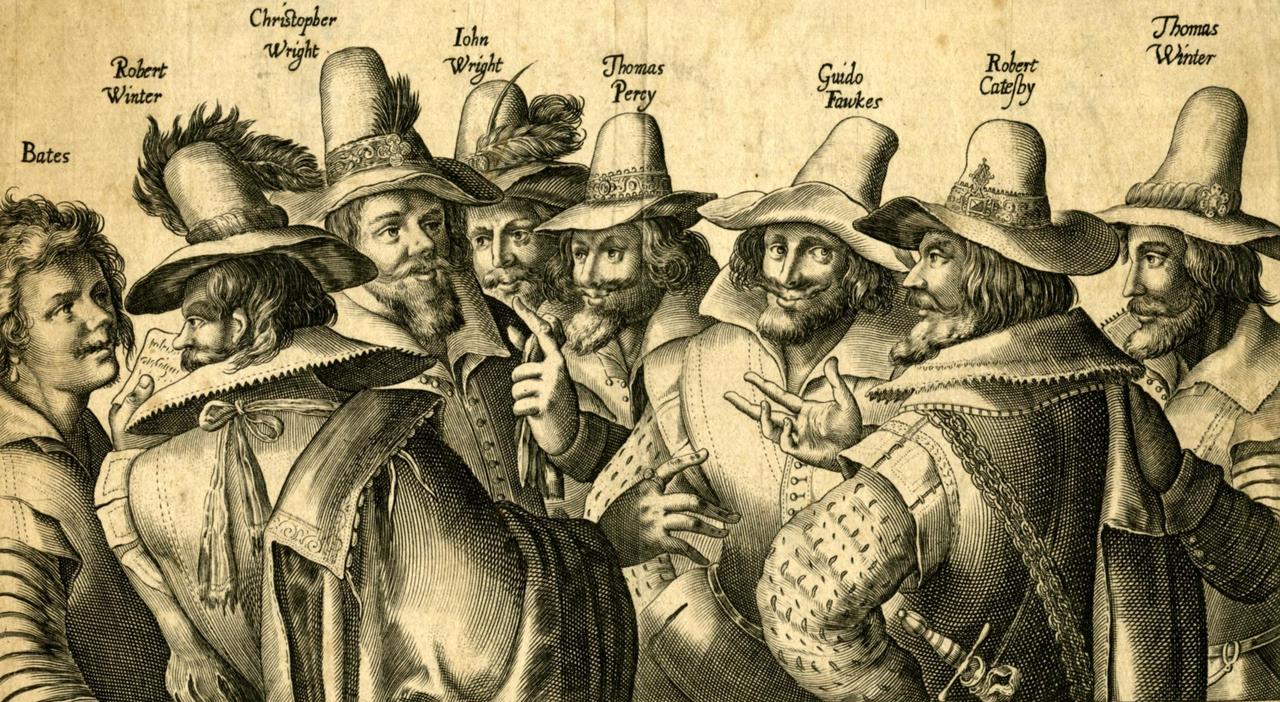
The core structure of the plot rested on Robert Catesby’s pragmatic approach to assembling a team of individuals with complementary skills. The inner circle consisted of Catesby himself, his cousin Thomas Winter, and John Wright of Yorkshire. Thomas Winter was both a skilled swordsman and described as “universally learned,” possessing deep command over the plan’s strategic and logistical details. Thomas Percy was the fourth key figure to join the group. As the steward to the Earl of Northumberland, Percy enjoyed considerable prestige and mobility within court circles.【6】 Percy’s position played a crucial role in securing the lease of a cellar directly beneath the House of Lords.【7】
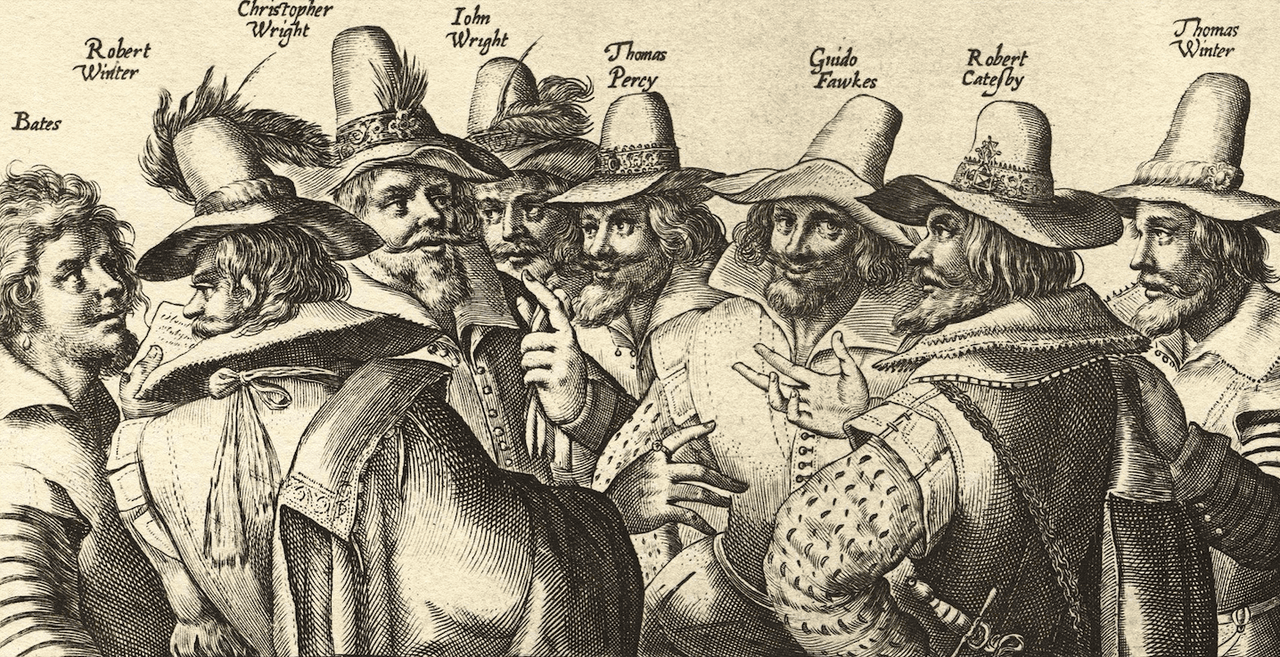
The Gunpowder Plot Conspirators (World History Encyclopedia)
The organization expanded over time to include thirteen core conspirators. Among them were Robert Winter, Christopher Wright, John Grant, Robert Keyes, Thomas Bates, and Sir Everard Digby. Wealthy figures such as Ambrose Rookwood and Francis Tresham were also recruited to provide financial support and supply horses. Catesby implemented a cell-based secrecy system, ensuring that no member knew all the details of the plot, thereby enhancing operational security. In the logistical phase, a building near Westminster was initially rented, followed by the acquisition of the cellar where the gunpowder barrels would be stored.【8】
Guy Fawkes (or in its Spanish form, Guido Fawkes) was selected as the most critical figure for the technical execution of the plot. Born in 1570 in York to a Protestant family, Fawkes converted to Catholicism and joined the Spanish army as a mercenary in 1593 in the Netherlands. His decade of military service abroad rendered him an unknown figure in London during James I’s reign—a significant advantage for the conspirators. During his service with the Spanish army, he gained extensive experience in siege warfare, tunneling, and explosives.【9】
Within the organizational structure, Fawkes assumed the role of Thomas Percy’s servant under the alias “John Johnson” and was tasked with guarding the gunpowder barrels in the cellar.【10】 In the final phase of the plan, he was assigned the task of igniting the fuses and then escaping by sea to continental Europe. At the time of his arrest, he was found in possession of fuses and other tools necessary to detonate the gunpowder. His calm demeanor during interrogation and refusal to name his co-conspirators despite torture have been attributed in modern texts to his unwavering resolve and religious conviction.【11】
The core strategy of the plot was designed as a destructive strike against a parliamentary session followed by a subsequent uprising. In the spring of 1604, the exact timing of the king’s target was still uncertain, but by the autumn of that year, when it became clear that the king would convene Parliament on a specific date, preparations turned into active action. At this stage, the conspirators began intense efforts to dig a tunnel beneath the House of Lords.
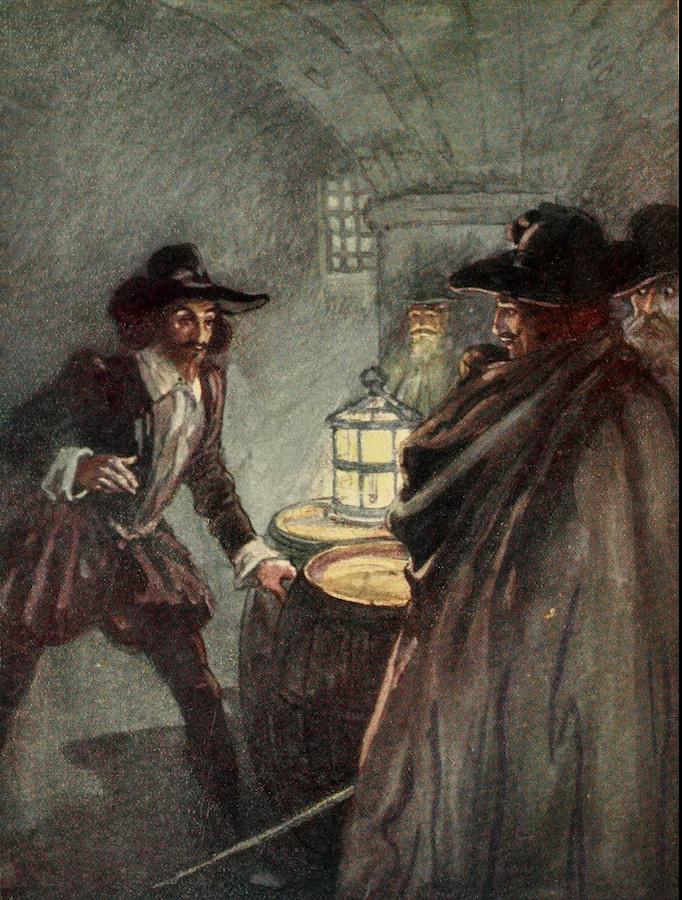
Guy Fawkes and the Gunpowder Plot (World History Encyclopedia)
As part of logistical preparations, the conspirators first rented a building adjacent to the House of Lords and then secured a cellar directly beneath it. This cellar served as a strategic center for storing explosives and other equipment. Approximately thirty-six barrels of gunpowder were placed inside. To enhance the explosive effect and conceal the barrels, iron rods, hammers, heavy mallets, and stones were piled on top.
The plot’s design extended beyond a simple assassination to include a political dimension on how governance would be seized after the king’s death. Some proposals, such as kidnapping King James’s surviving second son Charles, were deemed impractical and discarded. Instead, it was decided to capture the king’s eldest daughter, nine-year-old Princess Elizabeth, and install her as a Catholic monarch.【12】
The operational phase of the plan consisted of two main components: the explosion in London and a second phase of rebellion initiated in the countryside. Some conspirators left London to begin the rural uprising. During this phase, a notable incident occurred when conspirators attempted to dry dampened gunpowder near a fire, creating a dangerous risk of premature detonation.
King’s Secretary Robert Cecil (Earl of Salisbury) had been aware of increased activity among Catholic circles months before the plot was uncovered. Anstruther notes that Cecil received reports in the summer of 1605 through his agent William Turner in the Low Countries, mentioning Catesby and Fawkes by name.【13】 The most critical turning point in the plot’s failure was an anonymous warning letter delivered to Catholic Lord Monteagle on 26 October 1605, advising him to avoid Parliament due to an “invisible and dreadful blow” planned for that session. The letter is believed to have been sent by Francis Tresham, a conspirator who had joined the group later and was a relative of Lord Monteagle. Monteagle immediately forwarded the ambiguous letter to Secretary Cecil. King James I and government officials, upon examining the letter, became suspicious of the “extraordinary accumulation of wood and coal” beneath the House of Lords.【14】
Acting on these suspicions, a search of the cellars was launched at midnight on 4 November, led by Sir Thomas Knyvett. During the raid, Guy Fawkes was apprehended in the act of guarding thirty-six barrels of gunpowder, ready to be ignited, and identifying himself as Thomas Percy’s servant “John Johnson.” On his person, authorities found three fuses, a lantern, and other tools necessary for detonation. After his arrest, Fawkes was taken to the Tower of London and interrogated under questions prepared personally by King James. Under severe torture, he was forced to confess the names of his co-conspirators.【15】
Upon learning of Fawkes’s arrest, the other conspirators in London fled the city to initiate the second phase of the rebellion in the countryside. Robert Catesby and his companions first gathered in Dunchurch, then continued their escape through the Midlands, taking refuge at Holbeach House in Staffordshire. On the morning of 8 November, during a confrontation with local sheriffs and townspeople surrounding the house, the plot’s leader Robert Catesby, Thomas Percy, and the Wright brothers were killed. Other members who managed to escape, such as Robert Winter, were soon captured and brought to London to stand trial for treason.【16】
The captured conspirators were brought to the Tower of London for interrogation. At the time, no purpose-built cells existed in the Tower, so prisoners were held in whatever available spaces suited their rank and wealth. Some were permitted to roam freely within the castle walls, while others were confined to cells.【17】 Guy Fawkes initially refused to name his co-conspirators after his arrest, but after five interrogations, he confessed under severe torture beginning on 9 November.
During the interrogation process, Attorney General Sir Edward Coke meticulously documented inconsistencies and suspicious details in witness testimonies to develop new lines of inquiry. However, it is noted that the court’s primary aim was not to understand the conspirators’ actions within a rational strategic framework, but rather to portray them as dangerous villains and justify their punishment.【18】
The trial for high treason began on 27 January 1606 in Westminster Hall. All defendants except one pleaded “not guilty,” claiming innocence. However, it is recorded that the outcome of the trial was predetermined, and all defendants were found guilty and sentenced to death. The term “treason” was used over a hundred times in court records, emphasizing that this crime was considered the gravest offense under the law.【19】
Executions were carried out in two groups at the end of January 1606. The first group, executed on 30 January 1606 in the garden of St. Paul’s Cathedral, included Sir Everard Digby, Robert Winter, John Grant, and Thomas Bates—conspirators who joined the plot in its later stages. The second group, the original conspirators (Thomas Winter, Ambrose Rookwood, Robert Keyes, and Guy Fawkes), were executed on 31 January 1606 in Old Palace Yard, directly opposite the Parliament building.
The executions were carried out using the medieval method of punishment for high treason: hanging, drawing, and quartering. The condemned were hanged but cut down while still alive, then disemboweled and dismembered. It is reported that Guy Fawkes jumped from the scaffold, breaking his neck and thus avoiding the full execution process. The heads and body parts of the executed were displayed in strategic locations across London as a warning to the public.【20】
The execution process did not end with the conspirators; Jesuit priest Henry Garnet was also tried and convicted for “concealing treason,” having learned of the plot through confessions made during the sacrament of confession but failing to report it to authorities. Garnet was found guilty and executed in the latter months of 1606.【21】
The thwarting of the plot was institutionalized in 1606 when Parliament declared 5 November an official Day of Thanksgiving.【22】 This date acquired religious and political significance as a symbol of divine intervention saving the king and the state. The plot had long-lasting and severe consequences for English Catholics. Religious persecution intensified, and legal penalties against recusants—those who refused to attend Anglican services—were harshened. This process strengthened the Protestant identity of the English state and accelerated the exclusion of Catholics from public life.【23】
V for Vendetta Official Trailer (Warner Bros)
The most visible legacy of the event is the annual celebration known today as “Bonfire Night” or “Guy Fawkes Night.” For over 400 years, on 5 November each year, fireworks are set off, large bonfires are lit, and effigies of the conspirator known as “Guy” are burned.
This tradition has become embedded in popular culture through the rhyme: “Remember, remember the 5th of November.”【24】 The rhyme and the event have also inspired numerous modern references, including in works such as V for Vendetta. Over time, the nature of the celebrations has shifted from a religious commemoration to a social festival and a reminder of civic vigilance.
Guy Fawkes and the Gunpowder Plot (Historic Royal Palaces)
The Gunpowder Plot profoundly influenced the literary world of its time and subsequent centuries. Many historians accept that William Shakespeare’s play Macbeth was inspired by the political atmosphere and the theme of regicide created by the plot.【25】
Moreover, the renowned poet John Milton remained engaged with the event throughout his career, making symbolic allusions to the plot in numerous works, from his early poem “In Quintum Novembris” to his masterpiece Paradise Lost. These literary works reinforced the plot’s place in the collective memory of society.【26】
Academic approaches to the Gunpowder Plot have evolved over time from sectarian polemics toward objective analysis. In 17th- and 18th-century records, the conspirators were labeled as “papist terrorists” or “bigots.” Beginning in the late 19th century, more impartial examination of documents initiated a shift in interpretation. By 1961, European historiography had fully detached itself from religious rhetoric and focused on seeking objective truth.【27】 In modern literature, the plot is analyzed as one of history’s significant examples of terrorism due to its intent to destroy civil institutions and civilian populations, and is frequently compared to contemporary definitions of terrorism.【28】
Anstruther, Godfrey. "Powder Treason." *Blackfriars* 33, no. 392 (November 1952): 450–459. Accessed April 19, 2026. https://www.jstor.org/stable/43814470
BBC. "Who Were the Other Gunpowder Plotters?" BBC Bitesize. Accessed April 19, 2026. https://www.bbc.co.uk/bitesize/articles/zjyjkmn
DeLoach, William M. "God, Man, and Thirty-Six Barrels of Gunpowder: A Historiographical Analysis of the Gunpowder Plot." *Tenor of Our Times* 13, Article 22 (2024). Accessed April 19, 2026. https://scholarworks.harding.edu/cgi/viewcontent.cgi?article=1296&context=tenor
H.E. Marshall. "Discovery of Guy Fawkes & the Gunpowder Plot." *World History Encyclopedia*, April 27, 2021. Accessed April 19, 2026. https://www.worldhistory.org/image/13907/discovery-of-guy-fawkes--the-gunpowder-plot/
Hadfield, Andrew. "Shakespeare and Politics in the Time of the Gunpowder Plot." *The Review of Politics* 78, no. 4 (2016): 571–588. Accessed April 19, 2026. https://www.jstor.org/stable/24890018
Historic Royal Palaces. "Guy Fawkes and the Gunpowder Plot – The Real Story." YouTube. Accessed April 19, 2026. https://www.youtube.com/watch?v=myJ6OFgBk6I.
Historic Royal Palaces. "Teacher Resource Pack: The Gunpowder Plot." 2018. Accessed April 19, 2026. https://www.hrp.org.uk/media/2092/2018-10_gunpowderplot_resource.pdf
Kayapınar, Levent, and Erhan Afyoncu, eds. *Ortaçağ-Yeniçağ Avrupa Tarihi*. Eskişehir: Anadolu Üniversitesi Yayınları, 2019. Accessed April 19, 2026. https://www.academia.edu/42932410/Ortacag_Yenica%C4%9F_Avrupa_Tarihi
National Portrait Gallery. "The Gunpowder Plot Conspirators." *World History Encyclopedia*, April 27, 2021. Accessed April 19, 2026. https://www.worldhistory.org/image/13882/the-gunpowder-plot-conspirators/
Nicholls, Mark. "Strategy and Motivation in the Gunpowder Plot." *The Historical Journal* 50, no. 4 (December 2007): 787–807. Accessed April 19, 2026. https://www.jstor.org/stable/20175128
Quint, David. "Milton, Fletcher and the Gunpowder Plot." *Journal of the Warburg and Courtauld Institutes* 54 (1991): 261–268. Accessed April 19, 2026. https://www.jstor.org/stable/751498
UK Parliament. "The Gunpowder Plot." Factsheet G8 General Series. September 2010. Accessed April 19, 2026. https://www.parliament.uk/globalassets/documents/commons-information-office/g08.pdf
Warner Bros. Entertainment. "V for Vendetta - 4K Trailer." YouTube. Accessed April 19, 2026. https://www.youtube.com/watch?v=V5VGq23aZ-g.
York, Jill. "MOST BARBAROUS AND DAMNABLE TREASON: The Gunpowder Plot and how it is viewed in the Past and Present." Research Seminar, University of Wisconsin Eau Claire, 2008. Accessed April 19, 2026. https://minds.wisconsin.edu/bitstream/handle/1793/28769/YorkSpring08.pdf
[1]
Nicholls, Mark. "Strategy and Motivation in the Gunpowder Plot." The Historical Journal 50, no. 4 (December 2007): 787-807. Accessed 19 April 2026. https://www.jstor.org/stable/pdf/20175128.pdf?refreqid=fastly-default%3A65c0ca220d63027c7107a7d8352c3f31&ab_segments=0%2Fbasic_search_gsv2%2Fcontrol&initiator=&acceptTC=1
[2]
Medieval and Early Modern European History. Edited by Levent Kayapınar and Erhan Afyoncu. Eskişehir: Anadolu University Publications, 2019. pp 95-96. Accessed 19 April 2026. https://www.academia.edu/42932410/Ortacag_Yenica%C4%9F_Avrupa_Tarihi
[3]
York, Jill. "“MOST BARBAROUS AND DAMNABLE TREASON”: The Gunpowder Plot and how it is viewed in the Past and Present." Research Seminar, University of Wisconsin Eau Claire, 2008. pp 9, 13. Accessed 19 April 2026. https://minds.wisconsin.edu/bitstream/handle/1793/28769/YorkSpring08.pdf;jsessionid=A7FEFDFCF48FB438F7A3ACFEE3DD8990?sequence=2
[4]
DeLoach, William M. "God, Man, and Thirty-Six Barrels of Gunpowder: A Historiographical Analysis of the Gunpowder Plot." Tenor of Our Times 13, Article 22 (2024). pp 21-22. Accessed 19 April 2026. https://scholarworks.harding.edu/cgi/viewcontent.cgi?article=1296&context=tenor
[5]
Nicholls, Mark. "Strategy and Motivation in the Gunpowder Plot." The Historical Journal 50, no. 4 (December 2007): 787-807. p 796. Accessed 19 April 2026. https://www.jstor.org/stable/pdf/20175128.pdf?refreqid=fastly-default%3A65c0ca220d63027c7107a7d8352c3f31&ab_segments=0%2Fbasic_search_gsv2%2Fcontrol&initiator=&acceptTC=1
[6]
Nicholls, Mark. "Strategy and Motivation in the Gunpowder Plot." The Historical Journal 50, no. 4 (December 2007): 787-807. pp 788-789. Accessed 19 April 2026. https://www.jstor.org/stable/pdf/20175128.pdf?refreqid=fastly-default%3A65c0ca220d63027c7107a7d8352c3f31&ab_segments=0%2Fbasic_search_gsv2%2Fcontrol&initiator=&acceptTC=1
[7]
UK Parliament. "The Gunpowder Plot." Factsheet G8 General Series. (September 2010). Accessed 19 April 2026. https://www.parliament.uk/globalassets/documents/commons-information-office/g08.pdf
[8]
UK Parliament. "The Gunpowder Plot." Factsheet G8 General Series. (September 2010). Accessed 19 April 2026. p 4. https://www.parliament.uk/globalassets/documents/commons-information-office/g08.pdf
[9]
UK Parliament. "The Gunpowder Plot." Factsheet G8 General Series. (September 2010). Accessed 19 April 2026. p 7. https://www.parliament.uk/globalassets/documents/commons-information-office/g08.pdf
[10]
York, Jill. "“MOST BARBAROUS AND DAMNABLE TREASON”: The Gunpowder Plot and how it is viewed in the Past and Present." Research Seminar, University of Wisconsin Eau Claire, 2008. pp 19, 13. Accessed 19 April 2026. https://minds.wisconsin.edu/bitstream/handle/1793/28769/YorkSpring08.pdf;jsessionid=A7FEFDFCF48FB438F7A3ACFEE3DD8990?sequence=2
[11]
DeLoach, William M. "God, Man, and Thirty-Six Barrels of Gunpowder: A Historiographical Analysis of the Gunpowder Plot." Tenor of Our Times 13, Article 22 (2024). p 3. Accessed 19 April 2026. https://scholarworks.harding.edu/cgi/viewcontent.cgi?article=1296&context=tenor
[12]
Nicholls, Mark. "Strategy and Motivation in the Gunpowder Plot." The Historical Journal 50, no. 4 (December 2007): 787-807. pp 789, 792-793. Accessed 19 April 2026. https://www.jstor.org/stable/pdf/20175128.pdf?refreqid=fastly-default%3A65c0ca220d63027c7107a7d8352c3f31&ab_segments=0%2Fbasic_search_gsv2%2Fcontrol&initiator=&acceptTC=1
[13]
Anstruther, Godfrey. "Powder Treason." Blackfriars 33, no. 392 (November 1952): 450-459. pp 452-453. Accessed 19 April 2026. https://www.jstor.org/stable/43814470
[14]
DeLoach, William M. "God, Man, and Thirty-Six Barrels of Gunpowder: A Historiographical Analysis of the Gunpowder Plot." Tenor of Our Times 13, Article 22 (2024). pp 1-2. Accessed 19 April 2026. https://scholarworks.harding.edu/cgi/viewcontent.cgi?article=1296&context=tenor
[15]
UK Parliament. "The Gunpowder Plot." Factsheet G8 General Series. (September 2010). Accessed 19 April 2026. pp 4-5. https://www.parliament.uk/globalassets/documents/commons-information-office/g08.pdf
[16]
York, Jill. "“MOST BARBAROUS AND DAMNABLE TREASON”: The Gunpowder Plot and how it is viewed in the Past and Present." Research Seminar, University of Wisconsin Eau Claire, 2008. pp 16, 13. Accessed 19 April 2026. https://minds.wisconsin.edu/bitstream/handle/1793/28769/YorkSpring08.pdf;jsessionid=A7FEFDFCF48FB438F7A3ACFEE3DD8990?sequence=2
[17]
"Teacher Resource Pack: The Gunpowder Plot." Historic Royal Palaces, 2018. Accessed 19 April 2026. https://www.hrp.org.uk/media/2092/2018-10_gunpowderplot_resource.pdf
[18]
Nicholls, Mark. "Strategy and Motivation in the Gunpowder Plot." The Historical Journal 50, no. 4 (December 2007): 787-807. pp 796, 805. Accessed 19 April 2026. https://www.jstor.org/stable/pdf/20175128.pdf?refreqid=fastly-default%3A65c0ca220d63027c7107a7d8352c3f31&ab_segments=0%2Fbasic_search_gsv2%2Fcontrol&initiator=&acceptTC=1
[19]
UK Parliament. "The Gunpowder Plot." Factsheet G8 General Series. (September 2010). Accessed 19 April 2026. p 5. https://www.parliament.uk/globalassets/documents/commons-information-office/g08.pdf
[20]
UK Parliament. "The Gunpowder Plot." Factsheet G8 General Series. (September 2010). Accessed 19 April 2026. p 5. https://www.parliament.uk/globalassets/documents/commons-information-office/g08.pdf
[21]
UK Parliament. "The Gunpowder Plot." Factsheet G8 General Series. (September 2010). Accessed 19 April 2026. p 5. https://www.parliament.uk/globalassets/documents/commons-information-office/g08.pdf
[22]
UK Parliament. "The Gunpowder Plot." Factsheet G8 General Series. (September 2010). Accessed 19 April 2026. p 5. https://www.parliament.uk/globalassets/documents/commons-information-office/g08.pdf
[23]
Medieval and Early Modern European History. Edited by Levent Kayapınar and Erhan Afyoncu. Eskişehir: Anadolu University Publications, 2019. p 107. Accessed 19 April 2026. https://www.academia.edu/42932410/Ortacag_Yenica%C4%9F_Avrupa_Tarihi
[24]
UK Parliament. "The Gunpowder Plot." Factsheet G8 General Series. (September 2010). Accessed 19 April 2026. p 6. https://www.parliament.uk/globalassets/documents/commons-information-office/g08.pdf
[25]
Hadfield, Andrew. "Shakespeare and Politics in the Time of the Gunpowder Plot." The Review of Politics 78, no. 4 (2016): 571-588. Accessed 19 April 2026. p 573. https://www.jstor.org/stable/pdf/24890018.pdf?refreqid=fastly-default%3A414c9b5b7d8add5ee6d5ffd2d1acae6d&ab_segments=0%2Fbasic_search_gsv2%2Fcontrol&initiator=&acceptTC=1
York, Jill. "“MOST BARBAROUS AND DAMNABLE TREASON”: The Gunpowder Plot and how it is viewed in the Past and Present." Research Seminar, University of Wisconsin Eau Claire, 2008. p 7. Accessed 19 April 2026. https://minds.wisconsin.edu/bitstream/handle/1793/28769/YorkSpring08.pdf;jsessionid=A7FEFDFCF48FB438F7A3ACFEE3DD8990?sequence=2
[26]
Quint, David. "Milton, Fletcher and the Gunpowder Plot." Journal of the Warburg and Courtauld Institutes 54 (1991): pp 261-268. Accessed 19 April 2026. https://www.jstor.org/stable/pdf/751498.pdf?refreqid=fastly-default%3A2fcddd17a4fb762df9ce3ec5d1a2e7fb&ab_segments=0%2Fbasic_search_gsv2%2Fcontrol&initiator=&acceptTC=1
[27]
DeLoach, William M. "God, Man, and Thirty-Six Barrels of Gunpowder: A Historiographical Analysis of the Gunpowder Plot." Tenor of Our Times 13, Article 22 (2024). pp 2, 15, 16. Accessed 19 April 2026. https://scholarworks.harding.edu/cgi/viewcontent.cgi?article=1296&context=tenor
[28]
Nicholls, Mark. "Strategy and Motivation in the Gunpowder Plot." The Historical Journal 50, no. 4 (December 2007): 788. Accessed 19 April 2026. https://www.jstor.org/stable/pdf/20175128.pdf?refreqid=fastly-default%3A65c0ca220d63027c7107a7d8352c3f31&ab_segments=0%2Fbasic_search_gsv2%2Fcontrol&initiator=&acceptTC=1


Event Name | Gunpowder Plot | ||||||||
|---|---|---|---|---|---|---|---|---|---|
Original Name | Gunpowder Plot | ||||||||
Primary Purpose | King James I To eliminate government members and parliament to establish Catholic rule | ||||||||
Date | 5 November 1605 | ||||||||
Leader | Robert Catesby | ||||||||
Key Figure | Guy Fawkes | ||||||||
Location | House of Lords Westminster London | ||||||||
Method | The detonation of 36 barrels of gunpowder placed in a cellar beneath the House of Lords | ||||||||
Outcome | the other conspirators were either killed in the clash or executed for treason Guy Fawkes was caught in the act The plot failed | ||||||||
Reason for Decryption | An anonymous warning letter sent to Lord Monteagle | ||||||||
Historical Legacy | Guy Fawkes Night (Bonfire Night), celebrated annually on 5 November with fireworks and bonfires | ||||||||
No Discussion Added Yet
Start discussion for "Gunpowder Conspiracy" article
Historical Background and Causes
The Conspirators and Organization
Guy Fawkes: Military Expertise and Identity
Preparation and Plan
Discovery and Failure of the Plot
Interrogation and the Tower of London
Trial Proceedings
Executions and Methods
Henry Garnet and the Role of the Jesuits
Historical Legacy and Commemoration
Official Recognition and Political Impact
Cultural Tradition and Guy Fawkes Night
Literary Reflections
Historiography and Modern Perception