


This article was automatically translated from the original Turkish version.
+1 More
Gümüşler Monastery
Location | Gümüşler Village Niğde (8 km from the city center of Niğde) | ||||||||
|---|---|---|---|---|---|---|---|---|---|
Region(s) | Cappadocia | ||||||||
Construction Date(s) | From the 8th century onward most likely the 11th–12th centuries | ||||||||
Architectural Type | Rock-carved open courtyard monastery complex | ||||||||
Plan | Four-pillared closed Greek cross-plan church | ||||||||
Protection Status | First-degree archaeological site since 1973 | ||||||||
Artistic Value | One of the best-preserved examples of Byzantine fresco art in Central Anatolia; wall paintings are iconographically significant | ||||||||
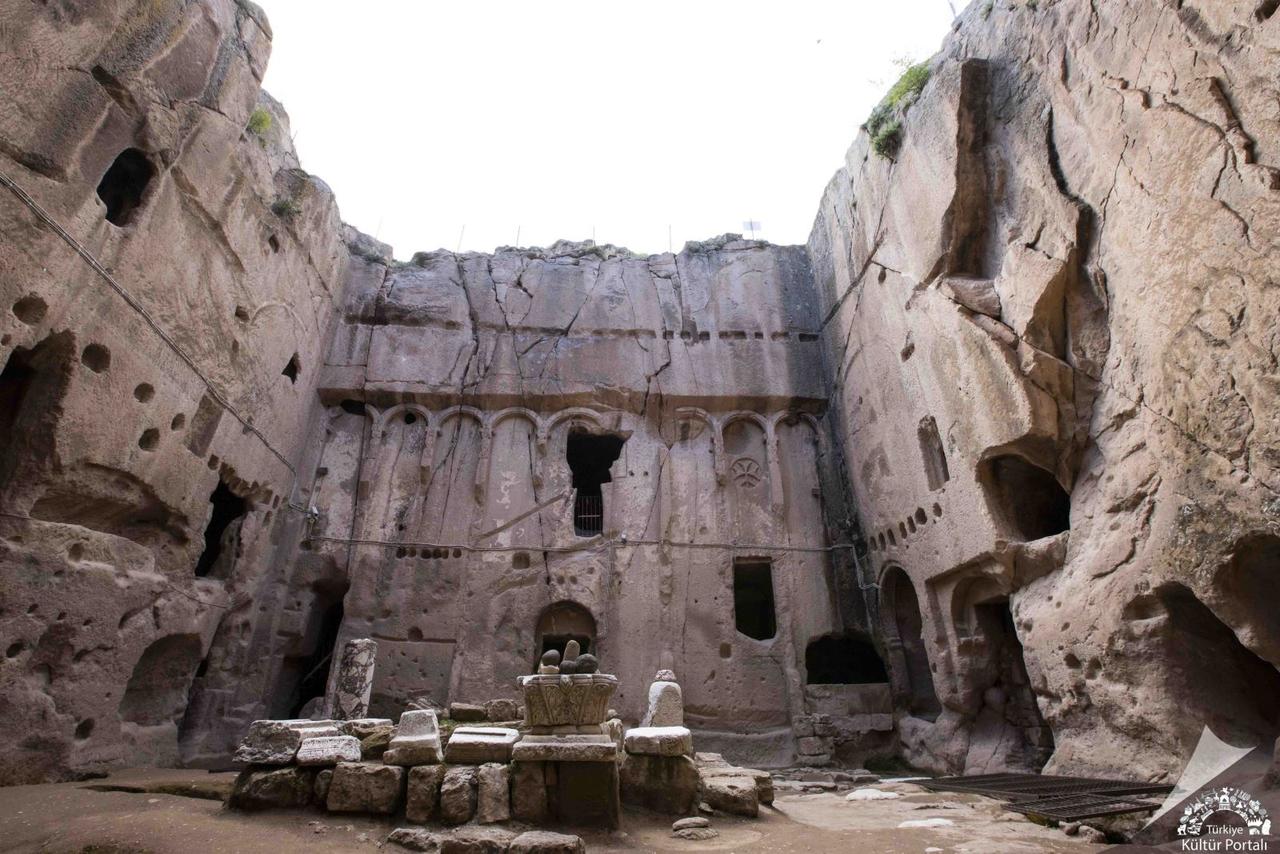
Gümüşler Monastery is one of the medieval structures carved into a large rock mass in the village of Gümüşler, approximately 8 km east of the city center of Niğde. Gümüşler is among the best-preserved rock monastery complexes to have survived from the Cappadocia region and is regarded as a significant example of Byzantine art in Anatolia due to its architecture, frescoes, and interior spatial organization.
The monastery was designated as an archaeological site in 1973. Its subterranean sections, extensive cemetery areas, defensive elements, and living quarters indicate that it served not only as a place of worship but also as a protected residential complex.
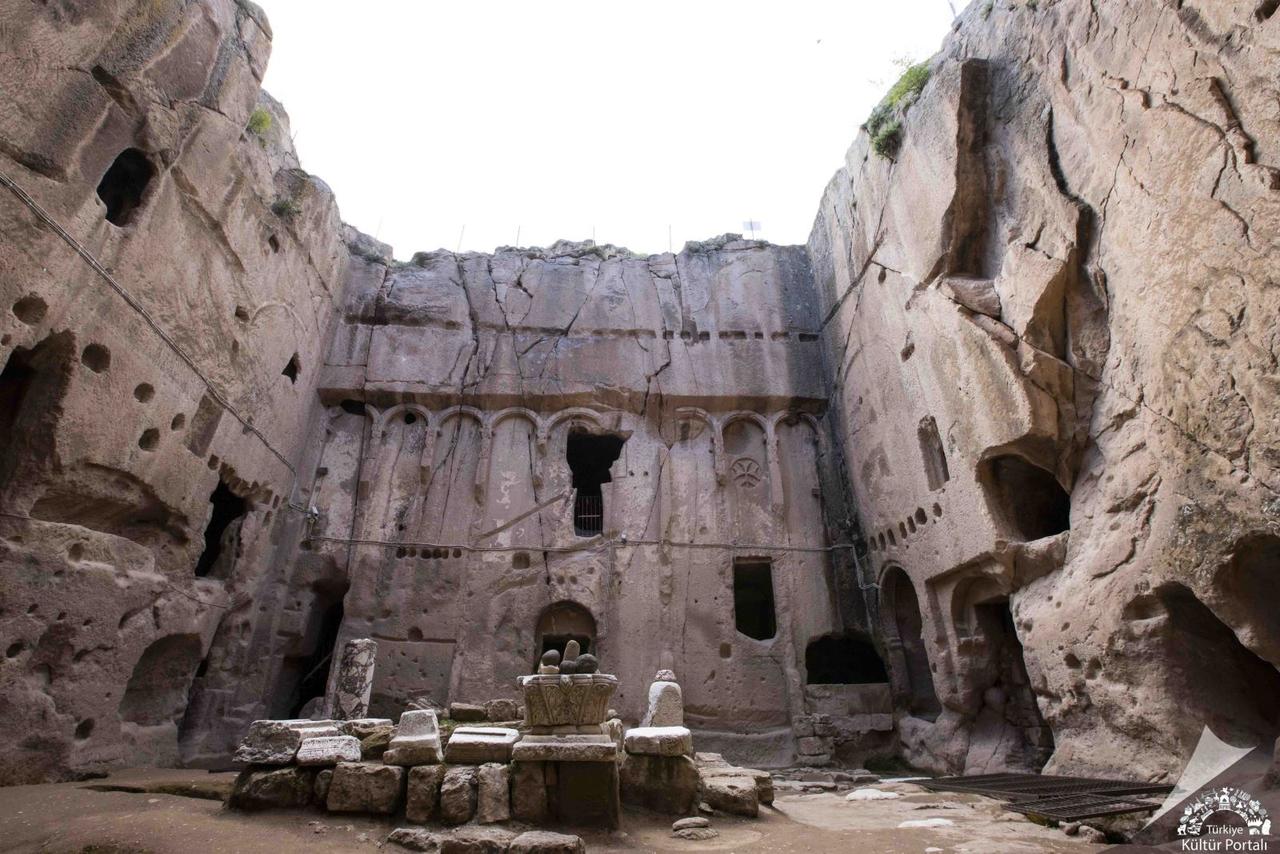
According to the general classification of rock-cut monasteries in Cappadocia, Gümüşler Monastery belongs to the open courtyard group. The church located in the northern part of the complex constitutes its most important section. The church has a closed Greek cross plan supported by four free-standing pillars. Two burial niches are situated to the north of the northern arm of the cross, while two entrance spaces with barrel-vaulted ceilings lie to the west of the naos. Although rooms, galleries, and various other spaces surround the courtyard, the exact function of all these areas has not been definitively determined.
Analysis of the frescoes adorning the church walls reveals the work of at least three different artists. The colors used in the frescoes have retained much of their original vibrancy, and the narrative style is richly detailed with figurative elements.
In the main apse, compositions are arranged in three horizontal bands. The uppermost band depicts Christ seated on a throne, flanked by angels and the symbolic representations of the Evangelists. This scene is followed by the “Desis” composition, showing Christ with the Virgin Mary on his right, John the Baptist on his left, and the apostles. The lowest band features depictions of the Church Fathers: Basil the Great of Caesarea, Gregory of Nyssa, and Gregory of Nazianzus.
The frescoes in the northern arm of the cross illustrate the Annunciation to the Virgin, the Nativity of Christ, the Presentation in the Temple, as well as images of John the Baptist and Saint Stephen.
On the southern facade of the doorway leading from the inner narthex to the naos, the Virgin Mary with the Child Jesus is depicted alongside the archangels Gabriel and Michael above them.
On the upper level of the narthex, a rich composition featuring hunting scenes and animal figures stands out, as no similar examples are found in other rock churches of Cappadocia. This scene highlights the symbolic and aesthetic dimensions of the monastery complex that extend beyond its religious narratives.
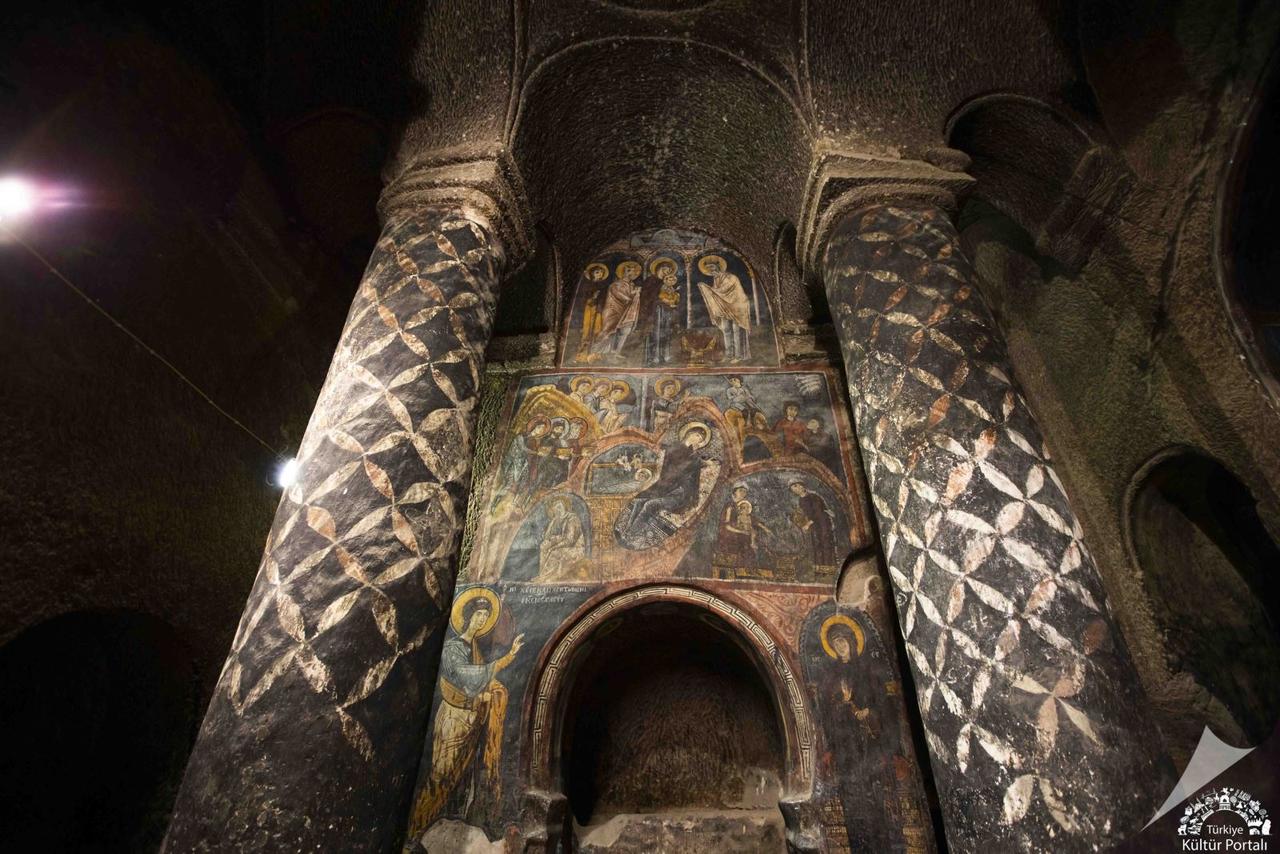
The Gümüşler Church is dated to the 11th or 12th century based on its stylistic and iconographic characteristics. Some researchers suggest that the construction and development of the monastery complex spanned a prolonged period from the 8th to the 12th century. In this regard, the structure exemplifies Christian architecture and art as it developed in Cappadocia during the Byzantine era.
Unlike many similar sites in Cappadocia, Gümüşler Monastery is one of the rare structures to have preserved a substantial portion of its frescoes in good condition. Its colorful and well-preserved wall paintings reflect the visual memory of early Christian iconography in Anatolia. Both the architectural organization and the artistic craftsmanship of the monastery elevate it beyond the status of a local place of worship, establishing it as a significant religious, cultural, and defensive structure of Byzantine Anatolia.
Accessed November 26, 2025.
Anadolu Ajansı. "Gümüşler Manastırı Gülümseyen Meryem Ana Freskiyle Öne Çıkıyor." Accessed May 14, 2025.
Kültür Portalı. "Gümüşler Manastırı." Accessed May 14, 2025.
T.C. Kültür ve Turizm Bakanlığı. "Gümüşler Manastırı." Accessed May 14, 2025.

Gümüşler Monastery
Location | Gümüşler Village Niğde (8 km from the city center of Niğde) | ||||||||
|---|---|---|---|---|---|---|---|---|---|
Region(s) | Cappadocia | ||||||||
Construction Date(s) | From the 8th century onward most likely the 11th–12th centuries | ||||||||
Architectural Type | Rock-carved open courtyard monastery complex | ||||||||
Plan | Four-pillared closed Greek cross-plan church | ||||||||
Protection Status | First-degree archaeological site since 1973 | ||||||||
Artistic Value | One of the best-preserved examples of Byzantine fresco art in Central Anatolia; wall paintings are iconographically significant | ||||||||
Architectural Features
Frescoes and Iconography
Dating and Artistic Evaluation
Artistic and Cultural Significance