


This article was automatically translated from the original Turkish version.
Dünya cultures’ creation narratives are generally built upon binary oppositions such as chaos and order, the unknown and the known, darkness and light. These narratives place chaos and the unknown before the beginning of history and human existence. Darkness and the unknown have given rise in the human mind to the creation of malevolent monsters. These monsters are not merely products of the human imagination but also represent a fear embedded in the physical environment, nature, and the collective memory of societies.
Gulyabani is the embodiment of this fear. This figure, carried by humanity from antiquity to the present, has become synonymous with darkness, evil, and terror. Known as “gul” in Arabic culture and “gul-i biyâban” in Persian culture, this being has found widespread recognition in Turk folk culture under the name “gulyabani.” As a demonic figure, it occupies a unique place among evil spirits and monsters.
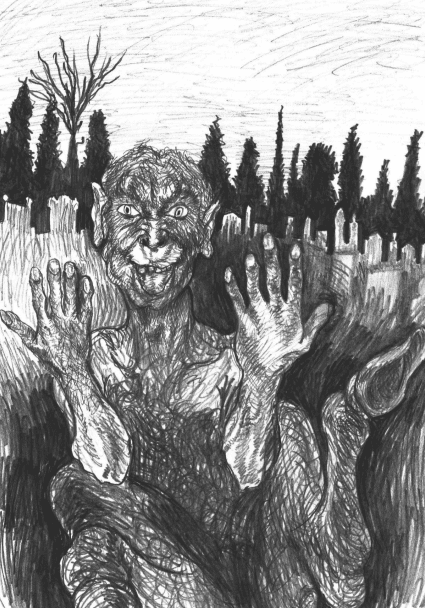
Depiction of Gulyabani (Source: Sarpkaya Seçkin, Yazıcı Ömer Faruk, Mehmet Berk Yaltırık. "Gulyabani in Turkish Culture." İncelemeler/İllüstrasyonlar.)
In Arabic culture, “gul” is known as the spirit of the desert and darkness. This being, similar to the hortlak, causes people to lose their way, be deceived, and meet their doom. Its acts of plundering graveyards, feeding on the dead, and shape-shifting embody concrete manifestations of fear.
In Persian folk culture, this figure is known as “gul-i biyâban” (desert gul) and is regarded as a being that disturbs the peace of the dead and devours them. In Islamic belief, “gul” is classified as a type of jinn. The female jinn are called “gul,” while the male ones are named “qutrub.” Their abilities to change shape, deceive, and kill their prey make them even more dangerous.
The “ghoul” of Western culture, derived from “gul,” appears in Gothic literature and horror tales, particularly known for grave-robbing and the habit of consuming the dead. Today, “ghoul” appears in numerous popular culture works, horror films, and fantasy literature.
In Turkish culture, gulyabani is described in folk beliefs as a being akin to a jinn, hortlak, or shaytan. This entity typically wanders in desolate places, deceives humans, and leads them to destruction. From the Ottoman period onward, various dictionaries have defined “gul” and its derivatives as frightening and deceptive beings. In Şemseddin Sâmi’s Kâmûs-ı Türkî, gulyabani is described as “the manifestation of fear in darkness.”
In folk tales, gulyabani is a figure that roams graveyards or remote areas, calls out to people to lead them astray, and then kills them. Associated with jinn beliefs, gulyabani has gradually acquired an important place in Turkish literature and folklore.
In classical Turkish literature, gulyabani is mentioned under names such as “gul,” “gulyabani,” and “gul-i biyâban.” In this literary tradition, gulyabani generally represents malevolent forces and is often mentioned alongside demonic entities. In divan poetry, gulyabani is identified with the rival or ascetic figure. It is portrayed as a being that distracts the beloved’s mind, leads them onto the wrong path, or draws the poet away from his spiritual course.
In ghazals, gulyabani is not merely an element of fear but also serves as a vehicle for social critique and Sufi messages. Gulyabani is depicted as an obstacle or enemy that hinders the soul’s spiritual journey.
Spanning from folk narratives to modern times, gulyabani has found a place in Turkish cinema and literature. Hüseyin Rahmi Gürpınar’s work Gulyabani is a significant representation of this figure in modern Turkish literature. In cinema, gulyabani has appeared in various interpretations as both a frightening and humorous character.
Today, gulyabani is a figure used across a broad spectrum in popular culture, symbolizing childhood fears, appearing in cartoons and collectible figures. This reflects its transformation from Turkish folk beliefs into modern culture.
Gulyabani is typically portrayed as weak, with prominent bones and a pale complexion. Its face is terrifying, with sharp teeth and a threatening expression. This figure, which wanders graveyards and feeds on the dead, is believed to have a pale skin tone as a result. Its long and alluring hair enhances its allure but does not conceal its danger.
Sarpkaya Seçkin, Yazıcı Ömer Faruk. Mehmet Berk Yaltırık. "Türk Kültüründe Gulyabani." İncelemeler/İllüstrasyonlar.

Gul and Gulyabani in World Cultures
Gulyabani in Turkish Folk Culture
Gulyabani in Classical Turkish Literature
Gulyabani in Popular Culture
Depiction of Gulyabani