


This article was automatically translated from the original Turkish version.
+1 More
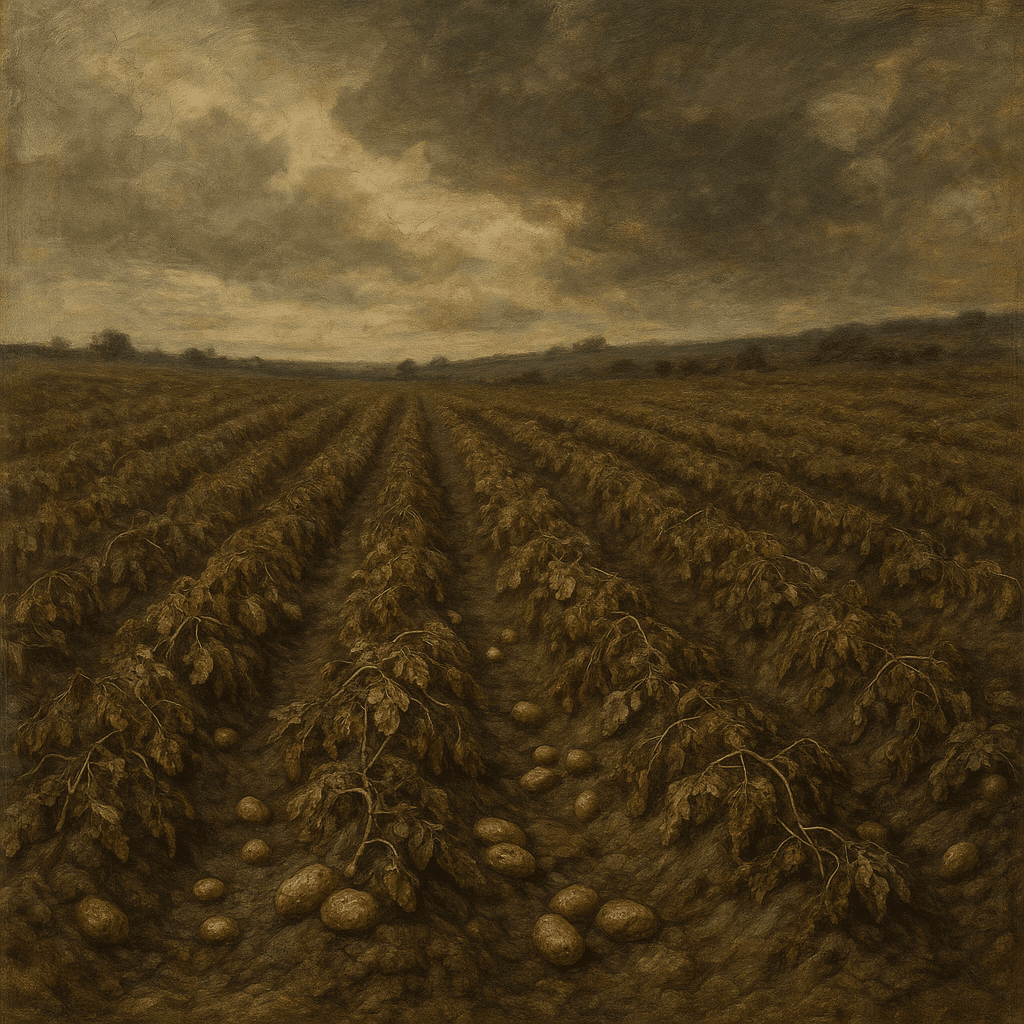
Sick Potato Fields (Generated by Artificial Intelligence)
Event | Famine | ||||||||
|---|---|---|---|---|---|---|---|---|---|
Date | 1845 – 1852 | ||||||||
Place | Ireland | ||||||||
Root Cause | Destruction of the potato crop by the Phytophthora infestans fungus plus colonial land system | ||||||||
Outcome | Approximately one million deaths Population decreased by 25% More than two million emigrations | ||||||||
Ottoman Assistance | Sultan Abdülmecid provided 1,000 pounds sterling and three ships with food and medicine; they arrived at the port of Drogheda | ||||||||
The Great Famine of 1845–1852, also known as the Irish Potato Famine, is regarded as one of the most devastating famines in European history. In Ireland, this period is referred to as An Gorta Mór, meaning “The Great Hunger.” In English-language literature, it is commonly called the Great Famine or Irish Potato Famine. Some sources also describe the event as a Silent Genocide or the Irish Catastrophe due to the scale of the affected population and the severity of its consequences.
The famine was not merely a natural disaster; it was a multidimensional humanitarian crisis deepened by political decisions, economic structures, and colonial governance. The outbreak of the fungus Phytophthora infestans, which destroyed the potato crop, led to widespread starvation, mass mortality, and forced emigration among millions.
During these years, Ireland was a constituent country of the United Kingdom, governed from London. The laissez-faire economic policies implemented during the famine restricted central government intervention, while food exports from Ireland continued despite widespread hunger within the country. These developments intensified the suffering of the Irish people and created lasting distrust in Ireland’s relationship with Britain.
At the same time, the humanitarian initiative of Ottoman Sultan Abdülmecid exemplified the international impact of the catastrophe and represented a rare instance of solidarity between the Ottoman Empire and Ireland.
In 19th-century Ireland, agriculture was the cornerstone of the economy and livelihood. However, this agricultural system was fragile due to social inequality and colonial land ownership structures. The majority of land was owned by English or Anglo-Irish landlords residing in Britain. Catholic Irish access to land had been largely prohibited by the Penal Laws enacted in the 17th and 18th centuries. As a result, Irish tenant farmers could cultivate land only by leasing it.
These tenant farmers typically worked their plots under short-term, insecure contracts arranged through intermediaries known as middlemen, who were often Irish themselves. As available land diminished, the size of plots allocated to tenants shrank, forcing them to maximize yields from these tiny plots to survive. These conditions rendered Ireland extraordinarily dependent on a single crop: the potato. The potato was favored because of its high yield on small plots, nutritional value for both humans and livestock, and ease of storage. Nearly all the daily caloric needs of an average adult were met by potatoes. Tenant families relied almost exclusively on this single crop for their own sustenance and that of their animals, often lacking regular access to any other food.
This economic and social structure created profound vulnerability by tying the Irish population’s survival to a single agricultural product. When the fungal disease Phytophthora infestans struck potato fields in 1845, it did not merely trigger an agricultural crisis—it caused the complete collapse of this system. Millions of people, with no alternative food sources or income, faced starvation. Moreover, tenants unable to pay rent due to crop failure were evicted en masse from their land.
The Irish famine was directly linked to this unequal land system and the fragile, monoculture-dependent economy. The famine was not simply a natural disaster but the result of historically entrenched structural problems.
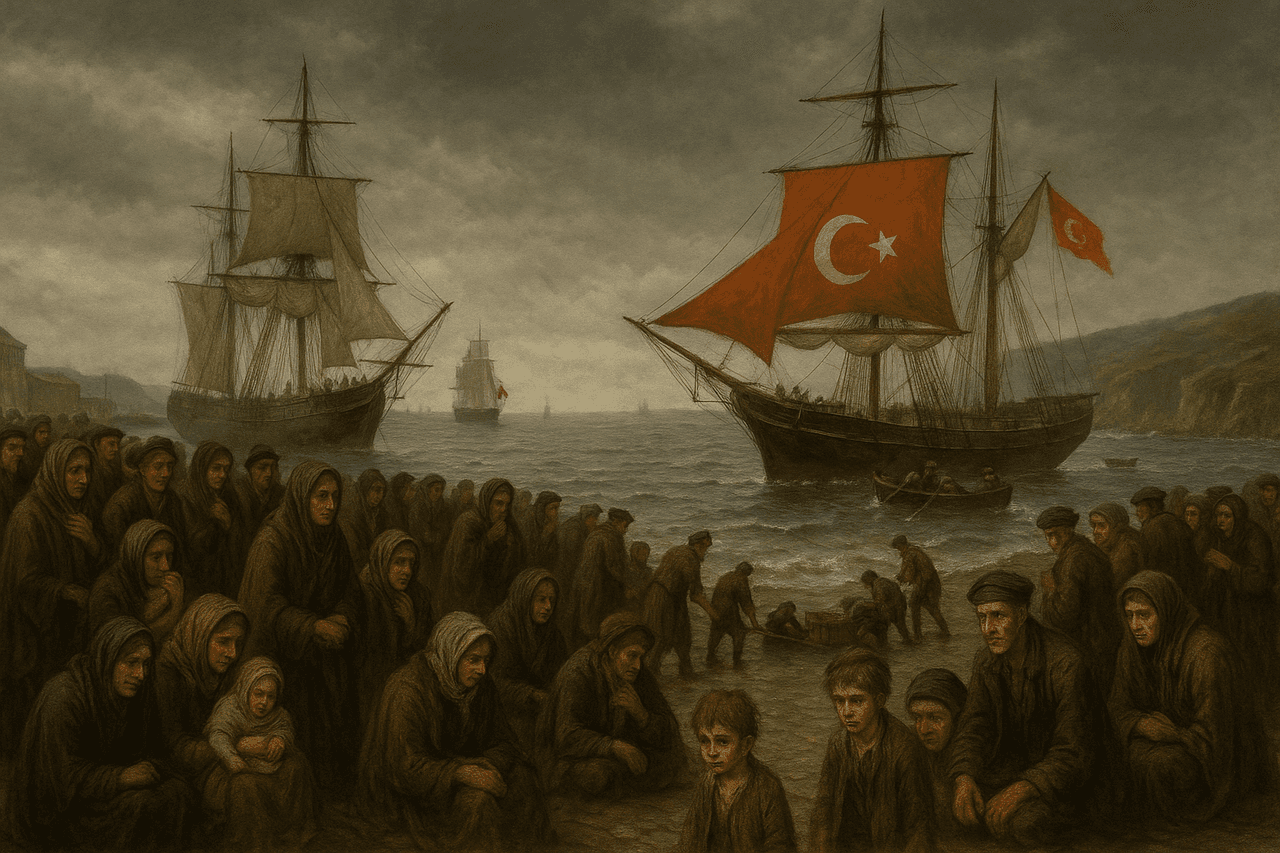
Büyük Kıtlığı Temsil Eden Bir Çizim (Yapay Zeka İle Oluşturulmuştur)
In the summer of 1845, the fungus Phytophthora infestans, believed to have been transported from America to Europe via a shipment of fertilizer, rapidly infected and destroyed potato crops. By 1846, nearly the entire harvest had been lost. The disease reappeared in 1847, turning the crisis into a full-scale famine that persisted until 1852.
During the famine, Ireland was part of the United Kingdom under the 1801 Act of Union and administered from London. Initially, the government under Prime Minister Robert Peel attempted to alleviate hunger through limited interventions such as importing maize from America. Public works programs and relief commissions for the poor were also established. Peel also succeeded in repealing the Corn Laws, which had restricted grain imports, aiming to liberalize the market.
However, these measures quickly lost effectiveness. Peel’s government fell in 1846 and was replaced by the Whig administration, which adhered strictly to economic liberalism and largely rejected state intervention in the market. Prime Minister Lord John Russell and his cabinet viewed direct state aid during the famine as inappropriate and significantly curtailed relief efforts.
In addition to the efforts of relief organizations, public works programs initiated by the government were gradually dismantled. In many regions, the population was directed toward low-wage weekly labor projects under famine conditions. Yet these projects were both inadequate and physically unsuitable for people already weakened by hunger.
In the British press, particularly in The Times, the appeals of the Irish for aid were sometimes portrayed as evidence of laziness and ingratitude. Such reporting exposed not only the natural dimensions of the famine but also its political and social underpinnings.
The famine was not merely a natural disaster; it was a stark revelation of the economic, political, and cultural control exerted by British rule over Ireland. The manner in which the crisis was managed intensified anti-British sentiment in Ireland and fueled the movement toward independence. Simultaneously, this period led to the mass formation of the Irish diaspora in America and British colonies.
The Irish Potato Famine was one of the first global humanitarian relief efforts:
Sultan Abdülmecid learned of the famine through an Irish court dentist. He initially intended to send £10,000 in aid; however, upon learning that Queen Victoria had donated only £2,000, he reduced his contribution to £1,000 to avoid appearing to outdo the British monarch. Nevertheless, Abdülmecid ordered three ships to be dispatched carrying food and medical supplies. Due to the British navy blocking ports, these ships were redirected to the northern port of Drogheda.
The aid delivered by Ottoman ships in Drogheda was not forgotten. In 1995, a commemorative plaque was installed in the town center to honor this gesture.
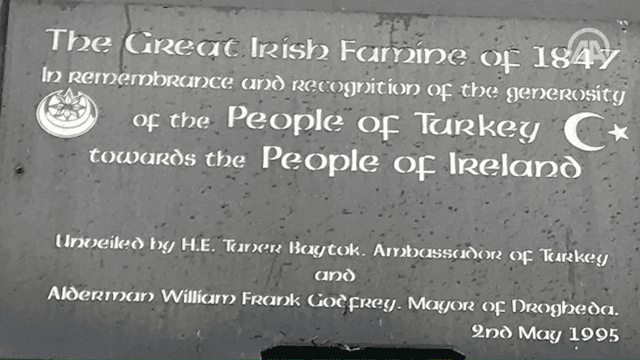
The plaque located in Drogheda City Centre (Anadolu Ajansı)
“In Memory of the Generosity of the Turkish People Toward the Irish People During the Great Famine of 1847.”
In commemoration of this aid, the Drogheda Unitedfootball club incorporates the Ottoman crescent and star into its crest. Symbols of the Turkish flag are also displayed on various buildings in the town. Drogheda continues to preserve this act of solidarity in its cultural memory.
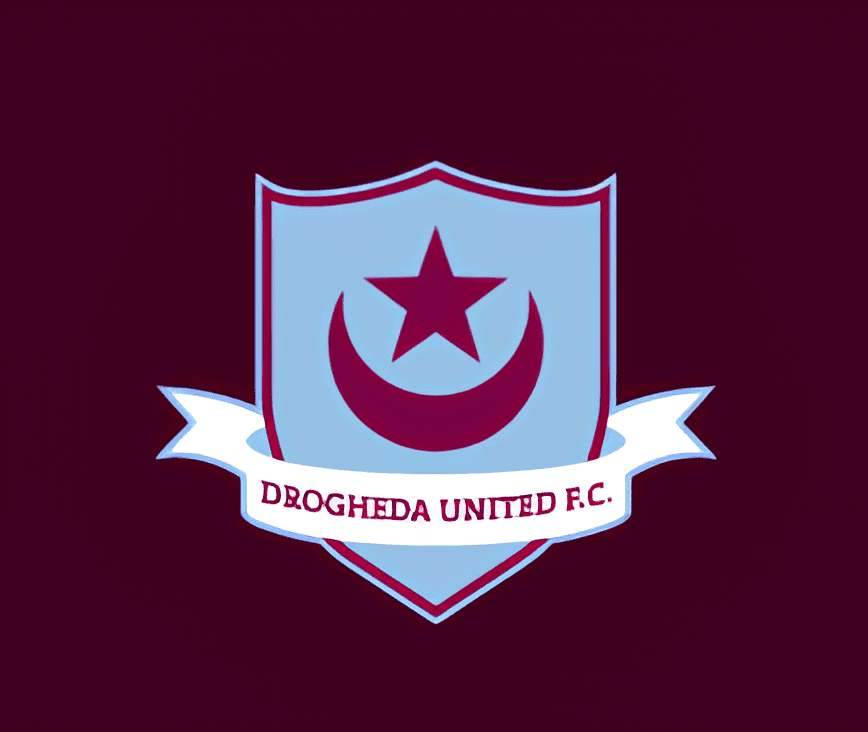
Drogheda United Futbol Takımının Arması (Drogheda United)
The Irish Potato Famine was interpreted differently by governments and the press of the era. In particular, the British newspaper The Times shaped public opinion and reflected government policy. Initially dismissing the severity of the blight, the paper later reported on conditions in Ireland but often did so with bias and accusatory language. The plight of the Irish was described using terms such as “national laziness,” “ingratitude,” and “irresponsibility,” and appeals for aid were framed as politically dangerous and insurrectionary.
This perspective aligned with the prevailing British liberal economic ideology. The Times criticized those who advocated state intervention, arguing that market interference would cause long-term harm. While the paper somewhat supported Peel’s relief policies, it remained distant from criticisms of the subsequent Whig administration, which it viewed as overly interventionist. Yet even as hunger and destitution reached their peak, the paper’s tone toward Ireland remained cold, centralized, and detached. In contrast, some Irish priests and citizens wrote letters to the paper, vividly describing the horror of the situation and openly condemning both government policy and media prejudice.
The Ottoman press, by contrast, presented the events in a more detached manner, relying on translations and reports from European newspapers. Publications such as Ceride-i Havadis and Takvim-i Vekayi informed the public about developments related to the famine, primarily reporting on initiatives such as public works programs and maize imports from America. These publications made no commentary on British government policy; instead, they focused on the causes of the famine, the spread of the disease, and the measures taken. They also reported neutrally on changes in the British government and the economic decisions made. Unlike the British press, no accusatory tone toward the Irish people or the British government was adopted.
In conclusion, the press of the era followed two distinct paths in covering the famine. The British press often interpreted the famine’s effects through political and ideological lenses, adopting a critical stance toward Irish demands. The Ottoman press, by contrast, prioritized information dissemination over interpretation, presenting the catastrophe to its readers through translated foreign reports. This difference reflects the contrasting political positions and levels of press freedom in the two nations at the time.
Ireland’s Great Hunger Museum (Músaem An Ghorta Mhóir) is a museum affiliated with Quinnipiac University in the U.S. state of Connecticut. It was established to commemorate the Irish Potato Famine of 1845–1852 (An Gorta Mór) and to investigate its political, social, economic, and historical causes. It also aims to document the impact of the famine on the Irish people and the human rights violations that occurred during this period.
The museum houses the world’s largest collection of art related to the famine. This collection includes works by 19th-century Irish artists as well as contemporary Irish and Irish-American artists. Additionally, the Lender Family Special Collection Room within the museum provides a vital resource for researchers and students.

Ireland's Great Hunger Museum(Ireland's Great Hunger Müzesi Web Sitesi)
The museum was initiated by John L. Lahey, former president of Quinnipiac University, as the culmination of a process that began in 1997 with the theme of “Ireland’s Great Hunger” featured in the New York City St. Patrick’s Day Parade. This initiative contributed significantly to raising awareness and understanding of the Irish famine among broader audiences.
The museum not only offers a historical perspective but also seeks to introduce Irish culture and art. In this regard, Ireland’s Great Hunger Museum serves as an important center for education and public awareness for both academic communities and the general public.
Boyle, Alan. “Scientists Identify the Mystery Killer Behind Ireland's Potato Famine.” NBC News, May 21, 2013. Accessed May 2025.https://www.nbcnews.com/sciencemain/scientists-identify-mystery-killer-behind-irelands-potato-famine-6c10057354
Doğan Kader, Merve, and Kezban Acar Kaplan. *İrlanda Patates Kıtlığı’nın Osmanlı Basınına Yansımaları (1845–1852)*. İzmir: Ege Üniversitesi, 2021. Accessed May 24, 2025.https://dergipark.org.tr/tr/pub/egetid/issue/67350/1050199
Drogheda United Football Club. "About." Accessed May 2025.https://droghedaunited.ie/about/
Ireland's Great Hunger Museum. "About the Museum." Quinnipiac University. Accessed May 2025.
Kartal, Ahmet Gürhan. AA (Anadolu Ajansı). “Ireland Remembers How 19th-Century Aid from Sultan Abdulmejid Changed Fate of Thousands.” Accessed May 24, 2025.https://www.aa.com.tr/en/europe/ireland-remembers-how-19th-century-aid-from-sultan-abdulmejid-changed-fate-of-thousands/1734689

Sick Potato Fields (Generated by Artificial Intelligence)
Event | Famine | ||||||||
|---|---|---|---|---|---|---|---|---|---|
Date | 1845 – 1852 | ||||||||
Place | Ireland | ||||||||
Root Cause | Destruction of the potato crop by the Phytophthora infestans fungus plus colonial land system | ||||||||
Outcome | Approximately one million deaths Population decreased by 25% More than two million emigrations | ||||||||
Ottoman Assistance | Sultan Abdülmecid provided 1,000 pounds sterling and three ships with food and medicine; they arrived at the port of Drogheda | ||||||||
No Discussion Added Yet
Start discussion for "Great Famine (Ireland)" article
Causes of the Famine
Land System and Dependence on the Potato
The Phytophthora infestans Outbreak
British Government Policies
Consequences of the Famine
International Aid
Ottoman Aid
Impact of Ottoman Aid in Drogheda
Press Coverage
Ireland’s Great Hunger Museum