


This article was automatically translated from the original Turkish version.
+1 More
Rising energy demand, the depletion of fossil fuels, increasing environmental pollution, and concerns about global warming have directed countries worldwide toward clean and renewable energy sources. In this context, international protocols such as the Paris Agreement have required countries to set voluntary emission reduction targets and encouraged the transition to renewable energy to reduce greenhouse gas (GHG) emissions. Among renewable sources such as hydropower, wind, solar, biomass, and geothermal energy, geothermal energy stands out due to its continuous availability and low carbon footprint.
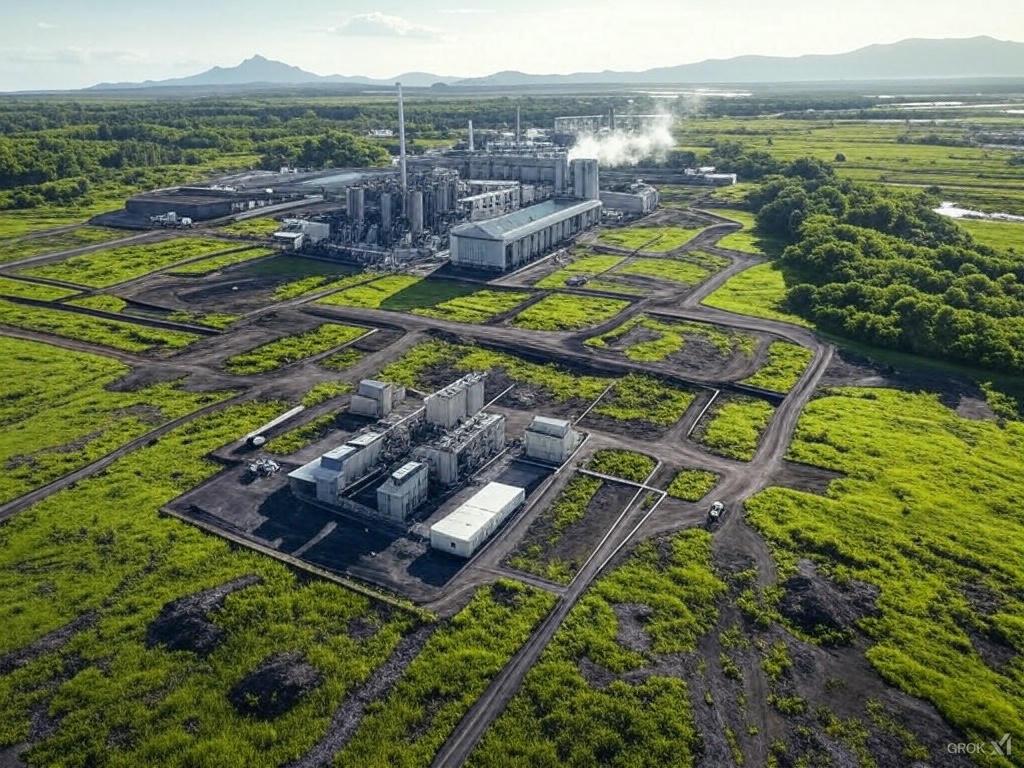
Geothermal Power Plant (Generated by Artificial Intelligence.)
Geothermal is a term derived from the Greek words “geo” (earth) and “therme” (heat), referring to the heat energy stored within the Earth’s interior. This energy is continuously generated by the slow decay of radioactive isotopes (such as potassium-40 and thorium-232) in the Earth’s core. The Earth has four main layers: an inner core composed of solid iron about 1,500 miles in diameter, an outer core of molten magma approximately 1,500 miles thick, a mantle 1,800 miles thick made of magma and rock, and a crust ranging from 15 to 35 miles thick beneath continents or 3 to 5 miles thick beneath oceans. While temperatures in the core exceed 5,000°C (approximately 10,800°F), temperatures at the mantle boundaries vary between 392°F and 7,230°F. This heat rises toward the surface along the edges of tectonic plates and manifests naturally through features such as volcanoes, geysers, and hot water springs.
Geothermal energy is renewable because the heat production in the Earth’s core has continued for billions of years and will persist unless an unforeseen event occurs. Humans have used this energy for thousands of years for purposes such as bathing, cooking, and heating. Today, geothermal power plants have been developed to generate electricity.
Geothermal power plants convert the Earth’s internal heat into electrical energy. These plants operate similarly to coal or nuclear power plants but use the Earth’s natural heat instead of a boiler or reactor as the heat source. Three essential elements are required for electricity generation: heat (abundant energy stored in deep rocks), a fluid (water or steam that carries heat to the surface), and permeability (small pathways allowing the fluid to move through rocks). Systems where these elements naturally coexist are called “conventional hydrothermal resources.”

Principle of Operation of a Geothermal Power Plant
Power plants operate by extracting hot water or steam from underground. Typically, high-pressure hot water is pumped to the surface through wells at depths of 1 to 2 miles. When the pressure is reduced at the surface, the water turns into steam, which drives turbines to generate electricity. The used water is usually reinjected into the reservoir, making the system sustainable. Geothermal power plants are classified into three main types: dry steam, flash steam, and binary cycle.
1. Dry Steam Plants: These use naturally occurring dry steam from underground. The steam is directed directly from wells to turbines, and after electricity generation, it condenses and is reinjected into the reservoir. This type is the oldest geothermal plant technology, with the first example built in 1904 in Larderello, Italy. The Geysers in northern California, USA, is the largest example of this technology, operating with a capacity of approximately 1.5 GW. However, due to its high temperature requirements, it is applicable only in limited areas.
2. Flash Steam Plants: This is the most common type and uses reservoirs with water temperatures above 182°C. High-pressure water from underground enters a low-pressure tank at the surface and “flashes” into steam. This steam drives turbines, and the remaining water can be reused in a second flash tank or reinjected. This technology is widespread in volcanic regions such as Iceland and provides both electricity and heating.
3. Binary Cycle Plants: These utilize lower-temperature resources (107–182°C). Hot water passes through a heat exchanger to vaporize a secondary fluid with a low boiling point, such as pentane or butane. This vapor drives the turbines. Since the water and secondary fluid remain separate, emissions are minimal. Binary cycle technology is expected to become more prominent in the future due to its potential for broader application.
In addition, when natural conditions are insufficient, Enhanced Geothermal Systems (EGS) are employed. EGS creates artificial reservoirs by injecting water into hot but dry or low-permeability rocks. The 2019 GeoVision analysis in the USA estimated that EGS could supply energy to 40 million households by 2050, while the 2023 Enhanced Geothermal Shot analysis projected this number could reach 65 million.
Türkiye is one of the world’s top five countries in geothermal energy production, alongside the USA, the Philippines, New Zealand, and Indonesia. The country’s geothermal potential stems from its location in regions with active tectonic plates. Installed capacity rose from 1,064 MW in 2017 to 1,696 MW in 2021, with an annual compound growth rate (CAGR) of 12.3%. It is projected that capacity will reach 2,785 MW by 2030, growing at a CAGR of 5.61% between 2020 and 2030. Electricity generation was 8,151 GWh in 2021 and is expected to reach 13,183 GWh by 2030. In 2023, geothermal energy accounted for 2% of Türkiye’s total installed capacity and 3% of its energy production.
Amendments to the Renewable Energy Law in 2011 aimed to promote the installation and widespread adoption of geothermal plants by offering incentives such as fixed price guarantees, low license fees, priority grid connection rights, and easier land acquisition.
Geothermal energy produces about one-sixth of the average carbon dioxide emissions of natural gas plants and, unlike other renewable sources such as solar or wind, is continuously available. It offers advantages such as a compact plant structure, long lifespan (decades), and low water consumption. However, challenges remain, including high initial costs, the risk of micro earthquakes, and the potential for reservoirs to cool over time. While technologies like EGS offer hope for overcoming these issues, implementation costs and technical development requirements remain high.
Geothermal power plants provide a sustainable and clean energy source by harnessing the Earth’s internal heat. Countries with high geothermal potential such as Türkiye are utilizing this resource for both electricity generation and direct heating, and efforts continue to expand its adoption.
GlobalData. "Power Generation and Cumulative Capacity of Geothermal Power Plants in Turkey (2017-2021)." Accessed February 22, 2025.https://www.globaldata.com/data-insights/power-and-utilities/power-generation-and-cumulative-capacity-of-geothermal-power-plants-in-turkey-2017-2021/.
National Geographic Education. "Geothermal Energy." Accessed February 22, 2025.https://education.nationalgeographic.org/resource/geothermal-energy/.
U.S. Department of Energy. "Geothermal Basics." Accessed February 22, 2025.https://www.energy.gov/eere/geothermal/geothermal-basics.
U.S. Energy Information Administration. "Geothermal Energy Explained." Accessed February 22, 2025.https://www.eia.gov/energyexplained/geothermal/.
U.S. Energy Information Administration. "Geothermal Power Plants." Accessed February 22, 2025.https://www.eia.gov/energyexplained/geothermal/geothermal-power-plants.php.
U.S. Environmental Protection Agency. "Geothermal Energy." Accessed February 22, 2025.https://archive.epa.gov/climatechange/kids/solutions/technologies/geothermal.html.

No Discussion Added Yet
Start discussion for "Geothermal Power Plant" article
Principles of Operation of Geothermal Power Plants
Geothermal Power Plants in Türkiye
Advantages and Disadvantages