

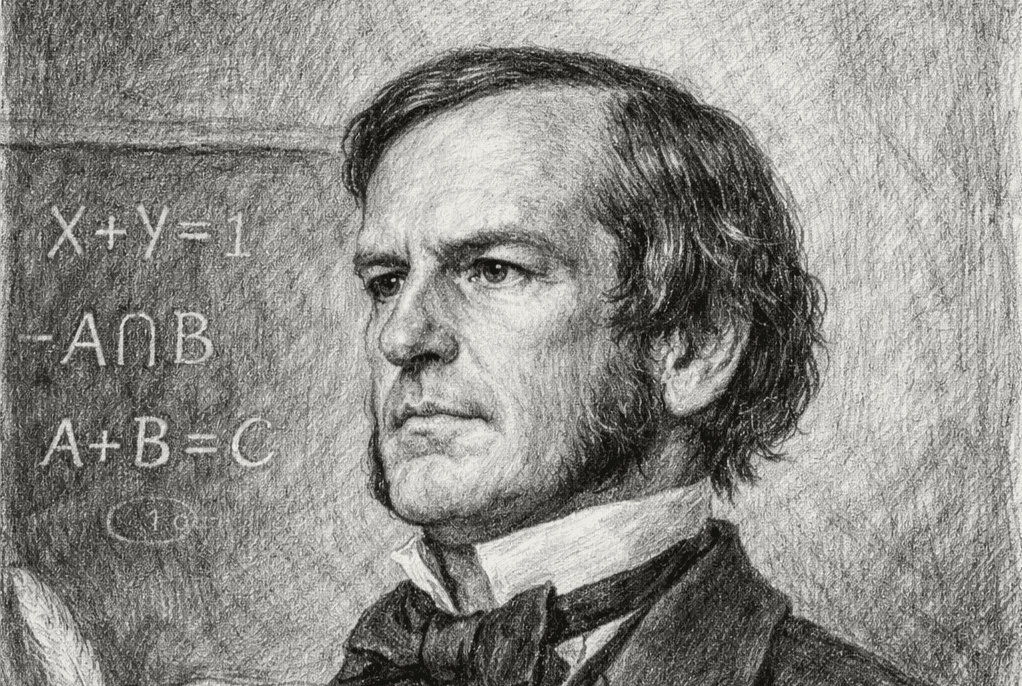

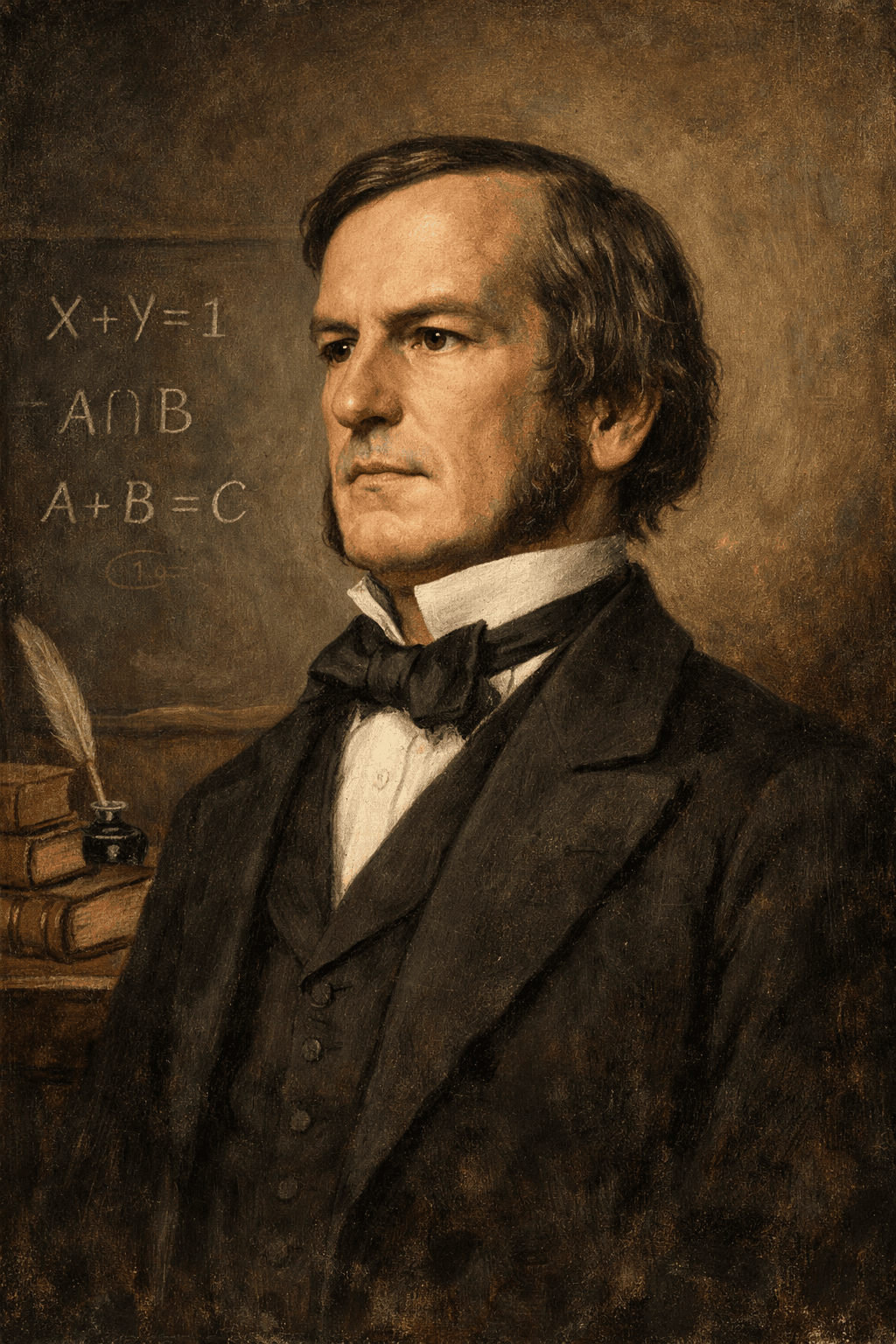
George Boole (Generated with Artificial Intelligence).)
George Boole
Areas of expertise | Logic Differential Equations Probability Theory Mathematics | ||||||||
|---|---|---|---|---|---|---|---|---|---|
Achievements and awards | Fellow of the Royal Society (FRS) Keith Medal Royal Society Gold Medal | ||||||||
Burial place | St Michael's Churchyard, Blackrock, Cork | ||||||||
Place of birth | Lincoln, Lincolnshire, England | ||||||||
Place of death | Ballintemple, Cork, Ireland | ||||||||
Important work | An Investigation of the Laws of Thought (1854) A Treatise on Differential Equations (1859) A Treatise on the Calculus of Finite Differences (1860) The Mathematical Analysis of Logic (1847) | ||||||||
Spouse | Mary Everest (Married: 1855) | ||||||||
Date of death | 1864-12-08 | ||||||||
Date of birth | 1815-11-02 | ||||||||
Child | Margaret Alicia Lucy Everest Ethel Lilian Mary Ellen | ||||||||
George Boole (1815–1864) was an English mathematician and logician who systematized logic using symbolic algebra, laying the theoretical foundations for modern information technology and digital computers. After winning the gold medal from the Royal Society in 1844, he was appointed in 1849 as the first mathematics professor at Queen’s College, Cork. In his seminal works The Mathematical Analysis of Logic (1847) and The Laws of Thought (1854), he systematized logic using algebraic methods and established what is now known as "Boolean Algebra".
George Boole was born on 2 November 1815 in Lincoln, a town in the county of Lincolnshire, England. Born into a modest family, his father John Boole was a shoemaker by trade but deeply interested in science and technology; he was an amateur science enthusiast actively involved in community institutions such as the Lincoln Mechanics’ Institution. Boole’s mother was Mary Ann Joyce. Boole inherited his passion for learning from his father and pursued it despite limited resources and distance from academic circles.
Boole never had the opportunity to attend an elite school but educated himself with the support of his family and access to libraries of local figures such as Sir Edward Bromhead. By age 16 he could read French, German and Italian, and began advanced mathematical studies by examining Lacroix’s Calcul Différentiel. He also taught himself Latin and Greek, and at age 14 attracted attention with poetry translations published in a local newspaper. Arguing that the human mind suffers from over-focusing on a single subject, he pursued simultaneous studies in mathematics, logic, philosophy and language. 【1】
After his father’s financial situation deteriorated, Boole began teaching at age 16 to support his family. After three years at private schools, he opened his own school in Lincoln at age 19 and served as its headmaster for approximately 15 years. Despite this demanding workload, he continued his research, particularly studying the works of Laplace and Lagrange in their original languages and focusing on differential equations. His 1839 meeting with mathematician Duncan F. Gregory paved the way for his research to be published in academic journals. In 1844 he was awarded the Royal Society’s first gold medal ever given to a mathematician for his paper “On a General Method in Analysis.” Despite lacking a university degree, these achievements led to his appointment in 1849 as professor of mathematics at the newly established Queen’s University (Cork) in Ireland.
Boole’s most significant contribution to science was transforming logic into a mathematical discipline through symbolic algebra. He reconstructed Aristotelian logic using an algebraic language and developed algorithms applicable to diverse arguments. His first major work, The Mathematical Analysis of Logic, was published in 1847. In 1854 he published his more comprehensive work, An Investigation of the Laws of Thought. In these works, Boole established a system incorporating logical operators such as “AND,” “OR,” and “NOT,” now known as Boolean Algebra. This system formed the theoretical foundation of the modern computer age when Claude Shannon applied it to electrical circuits in 1938. 【2】
In 1850, Boole met Mary Everest, niece of John Ryall, professor of Greek at the university in Cork. The couple married in 1855 and had five daughters: Mary Ellen, Margaret, Alicia (known for her contributions to four-dimensional geometry), Lucy Everest and Ethel Lilian. Boole was known for his dedication and support toward his students in Cork. Throughout his career he received honorary degrees: LL.D. from Dublin University in 1851 and D.C.L. from Oxford University in 1859, and was elected a Fellow of the Royal Society in 1857.
In the autumn of 1864, George Boole walked from home to the university in heavy rain and delivered his lecture in wet clothing. He subsequently contracted pneumonia and died on 8 December 1864 at the age of 49 in Ballintemple, Cork. Although claims have been made that his wife Mary Everest attempted unconventional remedies to save him, official records list the cause of death as complications from pneumonia. 【3】Boole’s work laid the foundation for digital electronics and computer technology approximately a century after his death. He is buried in the churchyard of St Michael’s Church in Cork.
Burris, Stanley, and Marcel Jackson. “George Boole.” Stanford Encyclopedia of Philosophy. Accessed May 14, 2026. https://plato.stanford.edu/entries/boole/
Sertöz, Ali Sinan. "Önce Matematik Vardı George Boole." Bilim ve Teknik (December 2015): 72–77. Accessed May 14, 2026. https://bilimteknik.tubitak.gov.tr/wp-content/uploads/sites/154/2025/09/7df2f510-afbd-4630-b74a-27dd09d1f6da-1.pdf
University College Cork. “Professor George Boole.” Accessed May 14, 2026. https://www.ucc.ie/en/heritage/history/people/ucc-staff/professor-george-boole/
[1]
TÜBİTAK. Bilim ve Teknik. Erişim 14 Mayıs 2026. https://bilimteknik.tubitak.gov.tr/wp-content/uploads/sites/154/2025/09/7df2f510-afbd-4630-b74a-27dd09d1f6da-1.pdf
[2]
TÜBİTAK. Bilim ve Teknik. Erişim 14 Mayıs 2026.https://bilimteknik.tubitak.gov.tr/wp-content/uploads/sites/154/2025/09/7df2f510-afbd-4630-b74a-27dd09d1f6da-1.pdf
[3]
TÜBİTAK. Bilim ve Teknik. Erişim 14 Mayıs 2026. https://bilimteknik.tubitak.gov.tr/wp-content/uploads/sites/154/2025/09/7df2f510-afbd-4630-b74a-27dd09d1f6da-1.pdf

George Boole (Generated with Artificial Intelligence).)
George Boole
Areas of expertise | Logic Differential Equations Probability Theory Mathematics | ||||||||
|---|---|---|---|---|---|---|---|---|---|
Achievements and awards | Fellow of the Royal Society (FRS) Keith Medal Royal Society Gold Medal | ||||||||
Burial place | St Michael's Churchyard, Blackrock, Cork | ||||||||
Place of birth | Lincoln, Lincolnshire, England | ||||||||
Place of death | Ballintemple, Cork, Ireland | ||||||||
Important work | An Investigation of the Laws of Thought (1854) A Treatise on Differential Equations (1859) A Treatise on the Calculus of Finite Differences (1860) The Mathematical Analysis of Logic (1847) | ||||||||
Spouse | Mary Everest (Married: 1855) | ||||||||
Date of death | 1864-12-08 | ||||||||
Date of birth | 1815-11-02 | ||||||||
Child | Margaret Alicia Lucy Everest Ethel Lilian Mary Ellen | ||||||||
Family Origins
Early Education and Self-Education
Teaching Years and Academic Rise
Algebraization of Logic and Key Works
Personal Life and Family Structure
Final Years, Death and Scientific Legacy