


This article was automatically translated from the original Turkish version.
+1 More
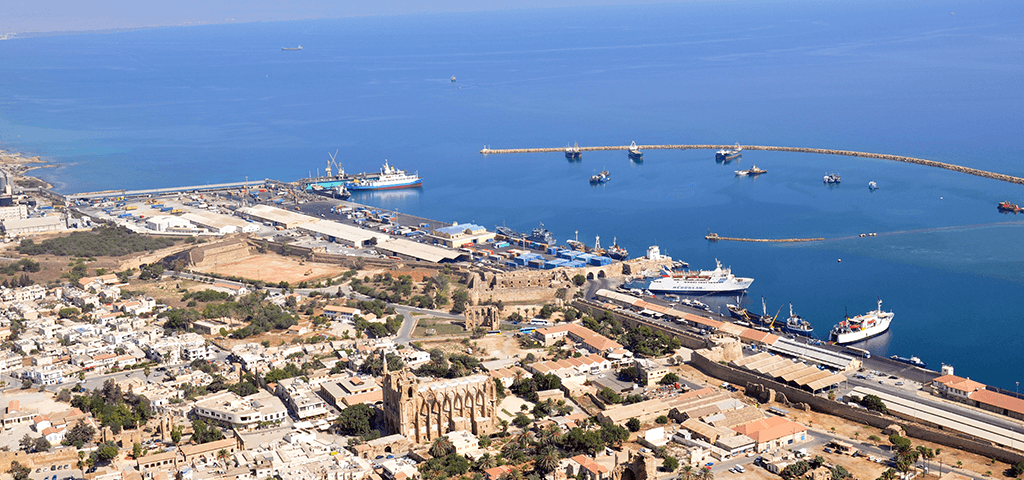
Gazimağusa Port
Location | Gazimağusa Bay Turkish Republic of Northern Cyprus (TRNC) Latitude: 35°07′N | Longitude: 33°57′E | ||||||||
|---|---|---|---|---|---|---|---|---|---|
History | Transition to TRNC administration: 1974 British Period: 1878–1960 (construction of modern port) Ottoman Period: 1571–1878 (used as a military base) Venetian fortifications: 15th–16th centuries Decline: 1373 (Genoese siege) Rise as a trade center: 13th–14th centuries (Lusignan Period) Foundation: 3rd century BCE (as Arsinoe) | ||||||||
Structural Features | 710 m² total open and covered area Storage areas: 8 Wooden pier: 99 m Max vessel length: 131 m in inner harbor - 220 m in outer harbor Outer Harbor: 655 m quay length - 9.75 m depth Inner Harbor: 540 m quay length - 7.3 m depth | ||||||||
Historical Structures | Defensive walls and ramparts Customs House - Loggias - St. George Latin Church Chain Harbor Entrance Shipyard and Shipyard Gate Sea Gate (Porta del Mare) Canbulat Bastion (Torion del Arsenale) Inner Castle | ||||||||
Strategic Importance | A port not subject to official embargo by the European Union Potential common port for TDT countries Geopolitical center for the Turkish world and TRNC in the Eastern Mediterranean | ||||||||
Gazimağusa Port is located at the far end of the Gazimağusa Bay on the coast of the Turkish Republic of Northern Cyprus (TRNC). Throughout history, it has served as a vital gateway in Mediterranean trade. Due to its natural defensive advantages, military structures, urban fabric, and commercial heritage, the port holds a central role in both the economic and political history of the island.
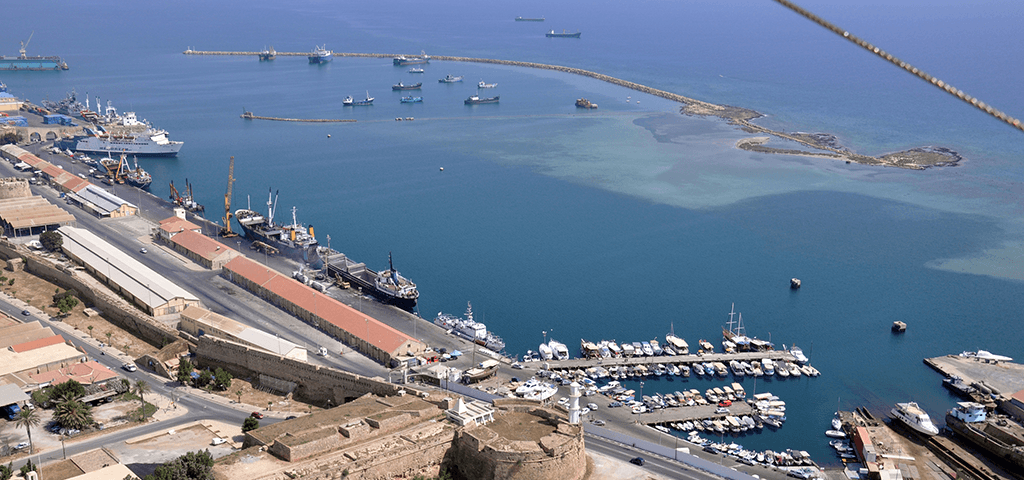
The name Gazimağusa emerged on the historical stage from the 10th century onward following the decline of the city of Salamis. After its capture by English King Richard I in 1191 and its subsequent transfer to King Guy de Lusignan in 1192, it became a major port and center during the Lusignan Kingdom period (1192–1373). Following the loss of Acre, the last Crusader stronghold in 1291, Gazimağusa assumed the commercial functions of the Syrian and Palestinian ports and became one of the new hubs of Eastern Mediterranean trade.
During this period of growth, Gazimağusa Port functioned as a transit point for goods such as silk, grain, spices, and textiles, supported by its inner and outer harbor structures, defensive castles, and towers. Its proximity to regions such as the Kingdom of Cilicia (also known as “Armenian Cilicia”) and the Holy Lands (Palestine and Jerusalem regions) further established it as a strategic military and commercial base.
By the end of the 14th century, the port’s physical infrastructure was largely completed. The port is distinguished by its defensive features, particularly the inner citadel, Canbulat (Torion del Arsenale), the Sea Gate (Porta del Mare), the arsenal, and structures reinforced by chains at the harbor entrance. These structures retained their functionality largely until the Ottoman period.
During the Genoese period (1373–1464), the connection between the city and the rest of the island was severed, the port became exclusively a military defense line, and its commercial activity declined. Subsequently, the Venetian administration (1489–1570) renewed the port’s defenses, strengthening its walls and harbor structures.
During the Ottoman period (1571–1878), the port continued to serve a strategic military function; however, over time it lost its role as a commercial center and fell behind other ports. This decline negatively affected port activity and urban development, leading to the surrounding areas being converted into agricultural land.
During the British period (1878–1960), the port underwent physical development. Three expansion projects carried out between 1902 and 1904, 1925 and 1933, and 1959 and 1965 brought it close to its current infrastructural form.
Following the establishment of the Republic of Cyprus in 1960, Gazimağusa Port once again became one of the island’s most important commercial centers and transformed into a hub for imports and exports. However, intercommunal conflicts between 1963 and 1974 disrupted port operations. After the 1974 Peace Operation, control of the port was fully transferred to the Turkish Cypriot side. In the 2000s, particularly between 2003 and 2005, the port reached record levels in import and export volumes and became the leading economic artery of the TRNC.
Gazimağusa Port is divided into an inner harbor and an outer harbor. The inner harbor, naturally sheltered, has a length of 540 meters. The outer harbor, with a quay length of 655 meters and a depth of 9.75 meters, is suitable for large vessels. The inner harbor accommodates vessels up to 131 meters in length, while the outer harbor can handle ships up to 220 meters.
In 2023, the TRNC applied for Gazimağusa Port to be included in the Turkish Republic of Northern Cyprus “Port Projects” program, aiming to facilitate its use by member countries of the Turkish Cooperation and Development Agency. This initiative is expected to elevate the port’s strategic function both economically and geopolitically.
The Gazimağusa Station Command, responsible for maritime safety, oversees search and rescue (SAR) operations as well as the maintenance of lighthouses, beacons, and navigation aids. Lighthouses at Canbulat, İç, and Dış contribute to navigational safety within the port.
Gazimağusa Port has also become embedded in Turkish collective memory through the folk song “Mağusa Limanı” featured in Turkish music. Since 1974, the port has drawn attention due to its association with military-political developments and its proximity to the buffer zone.
Gazimağusa Port continues to maintain its status as one of the Mediterranean’s significant ports through its centuries-old historical accumulation, cultural richness, military-commercial infrastructure, and geopolitical position. This port, stretching from the past to the present, holds the potential to remain a vital node for regional cooperation and economic development in the future.
Anadolu Ajansı. "KKTC Gazimağusa Limanı’nı TDT Üyesi Devletlerin Gemilerinin Kullanımına Sunmak İstiyor." Accessed April 8, 2025. https://www.aa.com.tr/tr/dunya/kktc-gazimagusa-limanini-tdt-uyesi-devletlerin-gemilerinin-kullanimina-sunmak-istiyor/3272007.
Anadolu Ajansı. "KKTC’nin Gazimağusa Limanı’nın TDT Limanlar Programına Dâhil Edilmesi İçin Başvuru Yapıldı." Accessed April 8, 2025. https://www.aa.com.tr/tr/dunya/kktcnin-gazimagusa-limaninin-tdt-limanlar-programina-dahil-edilmesi-icin-basvuru-yapildi/2941773.
Cyprus Turkish Coast Guard and Maritime Rescue. "Gazimağusa İstasyon Command." Cyprus Turkish Coast Guard and Maritime Rescue Official Website. Accessed April 8, 2025. https://www.ktgemikurtarma.org/birimlerimiz/gazimagusa-istasyon-amirligi/.
GZT. "Mağusa Limanı ve Terk Edilmiş Bir Şehir: Kapalı Maraş." Skyroad/GZT. Accessed April 8, 2025. https://www.gzt.com/skyroad/magusa-limani-ve-terk-edilmis-bir-sehir-kapali-maras-3770946.
Northern Cyprus Turkish Republic Port Directorate. "Gazimağusa Liman Directorate." Accessed April 8, 2025. http://limanlar.gov.ct.tr/LİMAN-BAŞKANLIKLARI/GAZİMAĞUSA-LİMAN-BAŞKANLIĞI.
Northern Cyprus Turkish Republic Port Directorate. "Resmî Web Sitesi." Accessed April 8, 2025. http://limanlar.gov.ct.tr.
Tümer, Ege Uluca. “Gazimağusa Limanı: 13. Yüzyıldan 20. Yüzyıla Bir Akdeniz Limanının Gelişimi.” İTÜDERGİSİ/a, 2009.

Gazimağusa Port
Location | Gazimağusa Bay Turkish Republic of Northern Cyprus (TRNC) Latitude: 35°07′N | Longitude: 33°57′E | ||||||||
|---|---|---|---|---|---|---|---|---|---|
History | Transition to TRNC administration: 1974 British Period: 1878–1960 (construction of modern port) Ottoman Period: 1571–1878 (used as a military base) Venetian fortifications: 15th–16th centuries Decline: 1373 (Genoese siege) Rise as a trade center: 13th–14th centuries (Lusignan Period) Foundation: 3rd century BCE (as Arsinoe) | ||||||||
Structural Features | 710 m² total open and covered area Storage areas: 8 Wooden pier: 99 m Max vessel length: 131 m in inner harbor - 220 m in outer harbor Outer Harbor: 655 m quay length - 9.75 m depth Inner Harbor: 540 m quay length - 7.3 m depth | ||||||||
Historical Structures | Defensive walls and ramparts Customs House - Loggias - St. George Latin Church Chain Harbor Entrance Shipyard and Shipyard Gate Sea Gate (Porta del Mare) Canbulat Bastion (Torion del Arsenale) Inner Castle | ||||||||
Strategic Importance | A port not subject to official embargo by the European Union Potential common port for TDT countries Geopolitical center for the Turkish world and TRNC in the Eastern Mediterranean | ||||||||
Historical Development
Administrative Periods and Physical Structures
Republic Era and Modernization
Technical Structure and Equipment
Current Status and Strategic Projects
Coastal Safety and Technical Support
Cultural Significance and Collective Memory