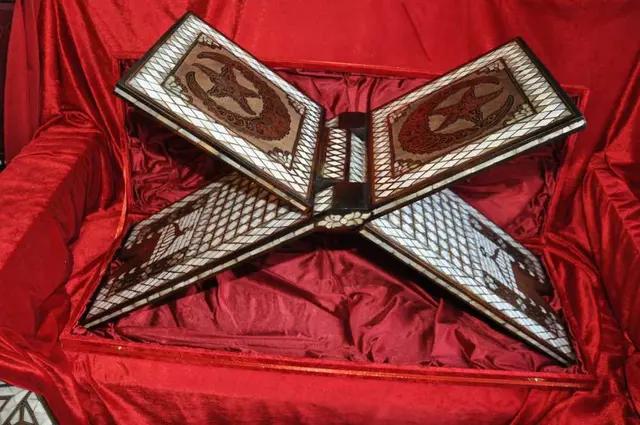
Registration Number | 160 | ||||||||
|---|---|---|---|---|---|---|---|---|---|
Registration Date | June 5, 2012 | ||||||||
Applicant/Registrant(s) | Gaziantep Coppersmiths’ Chamber | ||||||||
Province(s) | Gaziantep | ||||||||
Geographical Indication Type(s) | Geographical Indication | ||||||||
Product / Product Group(s) | Handicraft products excluding carpets and textiles rugs | ||||||||
Gaziantep mother-of-pearl inlay craftsmanship is a traditional decorative art that involves inlaying mother-of-pearl, ivory, and wire filigree onto hardwoods such as walnut and hornbeam using the inlay technique. Registered as a Geographical Indication on July 22, 2010, with the application submitted by the Gaziantep Coppersmiths’ Chamber, this craft is distinguished by its regional motifs, techniques, and material usage, embodying a significant cultural heritage.
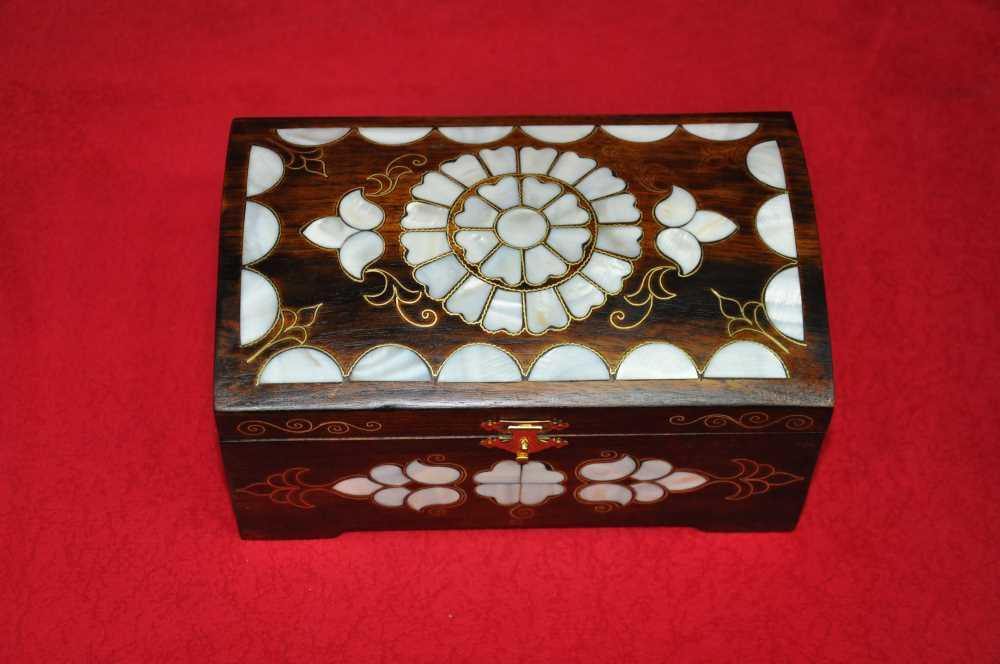
Gaziantep Mother-of-Pearl Inlay Craftsmanship (Kültür Portalı)
Mother-of-pearl inlay employs three main techniques: inlay (kakma), cladding, and filling. In Gaziantep, four primary styles are used: Istanbul Style, Damascus Style, Vienna Style, and Jerusalem Style, with Istanbul and Damascus styles being more prevalent.
Motifs prominently feature Seljuk and Ottoman influences, with Baroque and Rumi arabesque patterns occasionally used. Dominant colors are red and black.
The walnut and hornbeam used in the craft must be dried for at least two years and selected to be free of knots and cracks. The cut wood is rested for one week before being sorted based on the product type. Motifs are drawn, and filigree work is performed using steel chisels. The wires (brass, aluminum, silver, or gold) are annealed and hammered into channels.
Mother-of-pearl is sourced from freshwater mussel shells, such as those from the Euphrates River. These shells are broken with a keltepen tool, shaped with diamond stones, and placed into carved spaces. The mother-of-pearl pieces are adhered using a paste made from yogurt glue and walnut sawdust, with a minimum drying time of 24 hours.
During the leveling process, kerosene is used to prevent damage to the wires. Coloring is achieved with nitric acid and olive oil, while black coloring is obtained through torch burning. Finally, a polish of shellac and alcohol is applied, and upholstery or accessories are added if needed.
Gaziantep mother-of-pearl inlay products are inspected at least twice a year for compliance with production techniques, proper use of the geographical indication, and packaging standards. The inspection committee comprises representatives from the Gaziantep Chamber of Industry and the Union of Chambers of Craftsmen and Artisans. Products must be packaged in stretch film and boxes, accompanied by a warranty certificate and user manual.
Türk Patent ve Marka Kurumu. " Gaziantep Sedef El İşlemeciliği. Accessed October 19, 2025. https://ci.turkpatent.gov.tr/cografi-isaretler/detay/38031.
Türk Patent ve Marka Kurumu. Gaziantep Sedef El İşlemeciliği Coğrafi İşaret Tescil Belgesi. Accessed October 19, 2025. https://ci.turkpatent.gov.tr/Files/GeographicalSigns/160.pdf.
Türkiye Cumhuriyeti Kültür ve Turizm Bakanlığı. "Sedef Kakmacılığı." Kültür Portalı. Accessed October 19, 2025. https://www.kulturportali.gov.tr/turkiye/gaziantep/nealinir/sedef--kakmaciligi.
Registration Number | 160 | ||||||||
|---|---|---|---|---|---|---|---|---|---|
Registration Date | June 5, 2012 | ||||||||
Applicant/Registrant(s) | Gaziantep Coppersmiths’ Chamber | ||||||||
Province(s) | Gaziantep | ||||||||
Geographical Indication Type(s) | Geographical Indication | ||||||||
Product / Product Group(s) | Handicraft products excluding carpets and textiles rugs | ||||||||
No Discussion Added Yet
Start discussion for "Gaziantep Mother-of-Pearl Inlay Craftsmanship" article
Technical Features and Motif Structure
Production Process
Inspection and Protection
This article was created with the support of artificial intelligence.