This article was automatically translated from the original Turkish version.
Architect(s) | François Baron de Tott (observation tower and general design) | ||||||||
|---|---|---|---|---|---|---|---|---|---|
Current Status | In a state of disrepair, it must be protected | ||||||||
Building Type | Stone Defense Structure (Fortress) | ||||||||
Construction Period | Reign of Mustafa III (1757–1774) | ||||||||
Location | Türkiye Istanbul Sarıyer | ||||||||
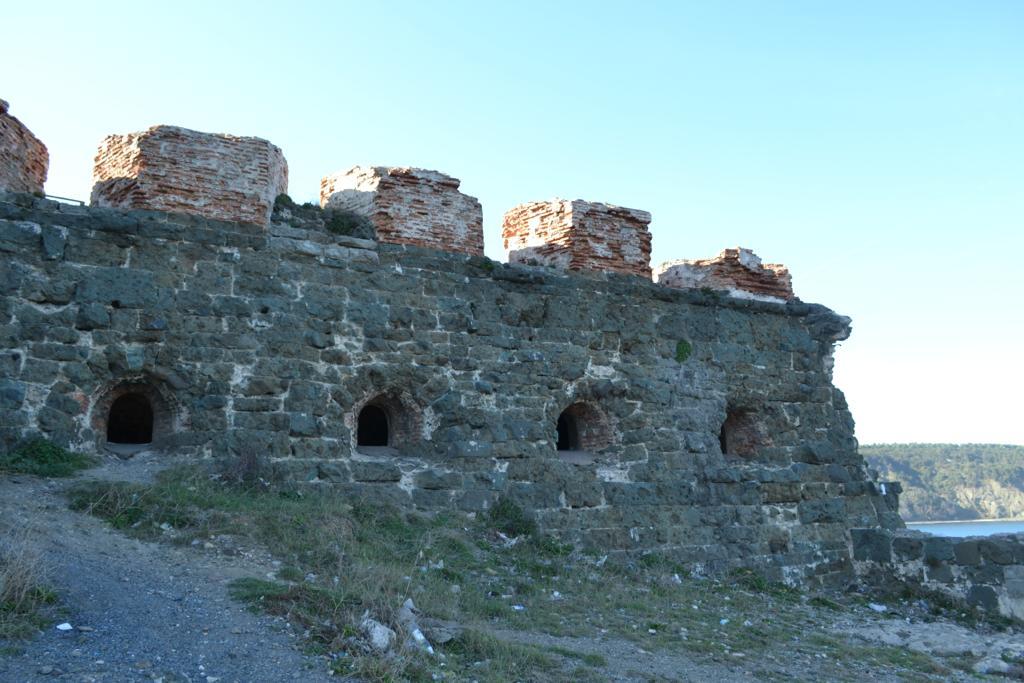
Garipçe Kalesi is a stone defensive structure from the Ottoman period located on the Garipçe ridges in the Sarıyer district of Istanbul. It is positioned opposite the Poyraz Kalesi on the Anatolian shore, at the point where the Bosphorus opens into the Black Sea. The primary purpose of the structure was to protect the Ottoman capital from potential military threats coming from the north and via the Black Sea.
The construction of the fortress dates to the reign of the 26th Ottoman sultan, III Mustafa (1757–1774). According to documents in the Prime Ministry Ottoman Archives, the earliest records mentioning the construction of the fortress are from 1772–1773.【1】 The observation tower of the fortress was constructed around 1778 by the French military advisor François Baron de Tott; he is also believed to have been the overall architect of the fortress.
After its construction, the fortress maintained its strategic importance and underwent various repairs up until 1829–1830, including during the reign of III Selim, according to archival records. It has been determined that a camii once existed within the fortress and was used by the local population until 1925.
Garipçe Kalesi is shaped to conform to the topography of its location and has a slightly skewed rectangular plan. Plans of the structure, drawn at a scale of 100 zira-i Osmani, appear on 1838 maps of the Bosphorus.【2】 The defensive layout was designed to counter attacks from the sea, and the curtain walls were constructed using a stone masonry system.
During the Republican period, the fortress was used for a time by the Turkish Armed Forces. Damaged and collapsed sections were previously repaired using reinforced concrete. Having lost its military function over time, the structure is now abandoned and continues to deteriorate due to natural conditions. As a historical monument, the fortress requires a comprehensive restoration project that respects its original architecture.
Karadağ, Reyhan Evrim. "Rumelifeneri Kalesi Restorasyon Projesi." Master's thesis, İstanbul Teknik Üniversitesi, 2003. Accessed March 30, 2026. https://polen.itu.edu.tr/bitstreams/86c516e6-9795-47b3-8238-e1b10474c973/download
Medipol Üniversitesi. "Garip Bir Köy: Garipçe." *Medipol Üniversitesi Öğrenci Uygulama Gazetesi*, (2019): 1–20. Accessed March 30, 2026. https://www.medipol.edu.tr/sites/default/files/2023-01/BG_Dergi_Sayi4.pdf
T.C.Sarıyer Kaymakamlığı Governorship. "Garipçe Kalesi." sariyer.gov.tr. Accessed March 30, 2026. https://www.sariyer.gov.tr/garipce-kalesi
[1]
Reyhan Evrim Karadağ, "Rumelifeneri Kalesi Restorasyon Projesi," İstanbul Teknik Üniversitesi, Yüksek Lisans Tezi, 2003, 27. https://polen.itu.edu.tr/bitstreams/86c516e6-9795-47b3-8238-e1b10474c973/download
[2]
Reyhan Evrim Karadağ, "Rumelifeneri Kalesi Restorasyon Projesi," İstanbul Teknik Üniversitesi, Yüksek Lisans Tezi, 2003, 27. https://polen.itu.edu.tr/bitstreams/86c516e6-9795-47b3-8238-e1b10474c973/download

Architect(s) | François Baron de Tott (observation tower and general design) | ||||||||
|---|---|---|---|---|---|---|---|---|---|
Current Status | In a state of disrepair, it must be protected | ||||||||
Building Type | Stone Defense Structure (Fortress) | ||||||||
Construction Period | Reign of Mustafa III (1757–1774) | ||||||||
Location | Türkiye Istanbul Sarıyer | ||||||||
History
Architectural Features
Current Condition