


This article was automatically translated from the original Turkish version.
Fourier Transform
Area(s) | Mathematics Statistics Physics Signal Processing | ||||||||
|---|---|---|---|---|---|---|---|---|---|
History | Developed by Joseph Fourier (late 18th century – early 19th century) | ||||||||
Basic Features | Linearity, Time/Frequency shifting, Convolution property, Parseval's Theorem | ||||||||
Example Signals | Square wave, Gaussian function, Sawtooth wave, Harmonic signals | ||||||||
The Fourier transform is a mathematical tool that decomposes a function (typically a signal defined in time or space) into its frequency components. Named after the French mathematician Jean-Baptiste Joseph Fourier, this transform is one of the fundamental analytical methods in fields ranging from engineering to statistics. Mathematically:
Where:
Signals in the time domain often appear complex. However, the Fourier transform decomposes this signal into simple waves (sine and cosine) at different frequencies.
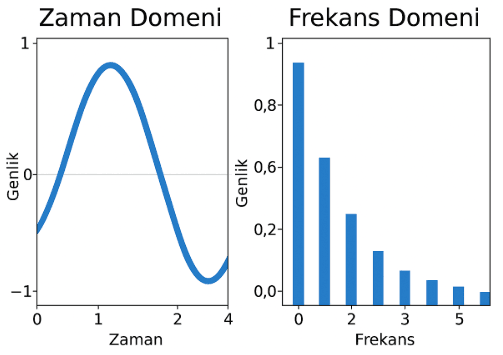
Comparison of Time and Frequency Domains (Generated by Artificial Intelligence)
The energy of the signal in the time domain equals its energy in the frequency domain:
The convolution of two functions in the time domain becomes multiplication in the frequency domain:
This property is used in the analysis of system responses.
A periodic square wave in the time domain contains harmonic components in the frequency domain (approximated by a Fourier series).
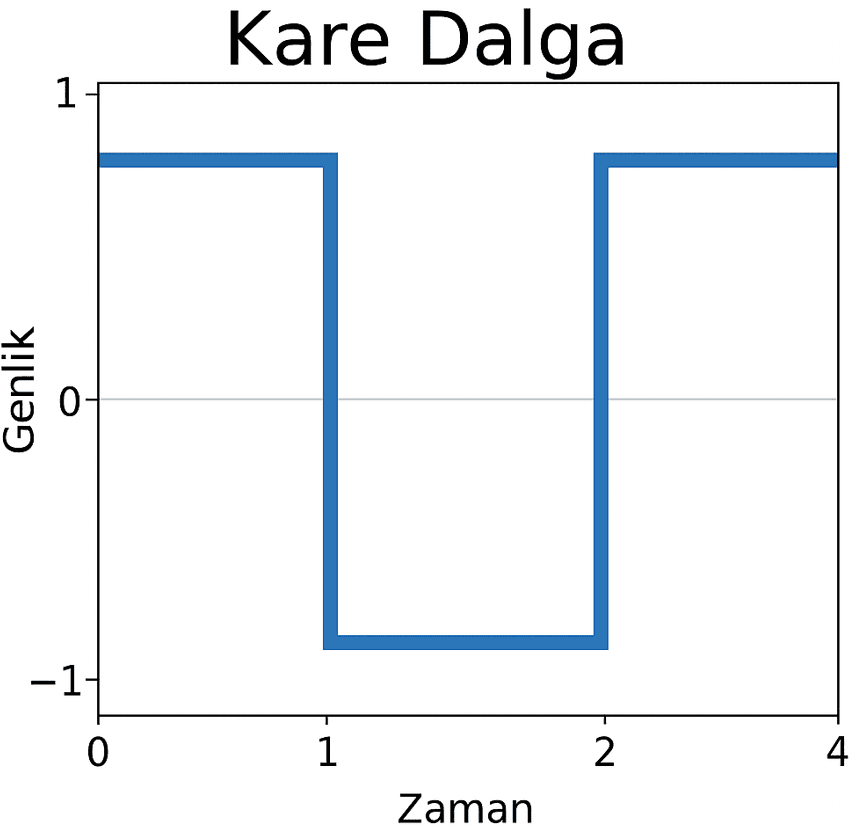
Square Wave Time Domain – Generated by Artificial Intelligence.
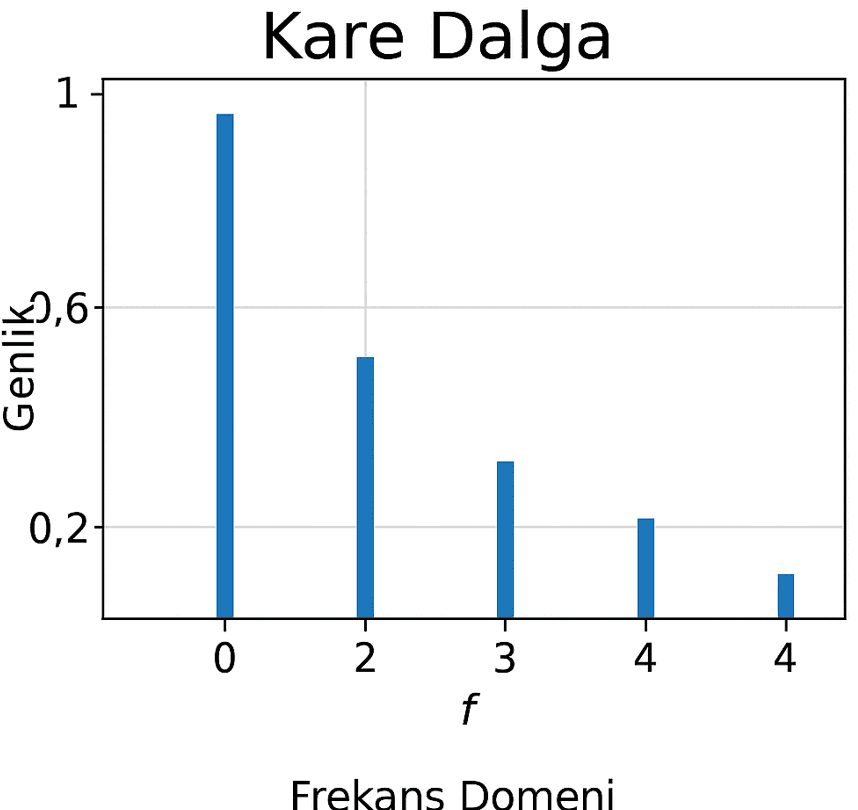
Square Wave Frequency Domain (Generated by Artificial Intelligence)
This spectrum shows that only odd harmonics are present in the signal.
The Fourier transform is again a Gaussian function:
This property makes the Gaussian function “ideal” in both time and frequency domains.
In probability theory, the statistical counterpart of the Fourier transform is the characteristic function:
If , then:
This transform carries information about the moments of the distribution. It is particularly used in proving results such as the Lévy Continuity Theorem and the Central Limit Theorem.
To apply the Fourier transform on a computer, the signal is sampled into a discrete version. In this case:
The FFT is an algorithm that accelerates the computation of the DFT, reducing the time complexity from to .
Example applications:
Baştürk, Özgür. 2021. Ders 08: Fourier Dönüşümleri. Astronomide Sayısal Çözümleme II. Accessed May 2025.
Dündar, Samim. 2020. Fourier Dönüşümü ve Karakteristik Fonksiyon. Uygulamalı Matematik ve İstatistik Dersi Notları. Accessed May 2025.
Sarıoğlu, S., and Değişik, M. 2019. Fourier Dönüşümleri ile Karakteristik Fonksiyonların İlişkisi. İstatistiksel Dağılımlar Üzerine Notlar. Accessed May 2025.

Fourier Transform
Area(s) | Mathematics Statistics Physics Signal Processing | ||||||||
|---|---|---|---|---|---|---|---|---|---|
History | Developed by Joseph Fourier (late 18th century – early 19th century) | ||||||||
Basic Features | Linearity, Time/Frequency shifting, Convolution property, Parseval's Theorem | ||||||||
Example Signals | Square wave, Gaussian function, Sawtooth wave, Harmonic signals | ||||||||
Transition from Time to Frequency
Mathematical Properties and Theorems
Parseval’s Theorem
Convolution Property
Fourier Transform with Signal Examples
Square Wave
Gaussian Function
Relation to Characteristic Functions
Example: Normal Distribution
Discrete Fourier Transform (DFT) and FFT
FFT (Fast Fourier Transform)
Application Areas