badge icon

This article was automatically translated from the original Turkish version.

Article

Fordist Production

Quote

Fordism is an industrial production model that dominated from the 18th century until the 1970s. It is the organizational model of industrial capitalism based on mass production mass consumption and mass labor utilization. Developed by Henry Ford this system increased productivity through assembly line practices and created an economic structure that enabled workers to access the products they produced. However over time the diversification and rapid change in consumer demand rendered this rigid production model inadequate. Moreover Fordist mass production is also referred to as serial production due to its reliance on conveyor belt systems.

Origins and Development

The Fordist production system takes its name from Ford automobile factory founder Henry Ford (1863–1947). Ford produced the Model T automobile in 1908 using a moving assembly line system. This system became symbolic of concepts such as the eight-hour workday five-dollar wage and continuous flow and influenced not only the automotive industry but also all other sectors and even culture.
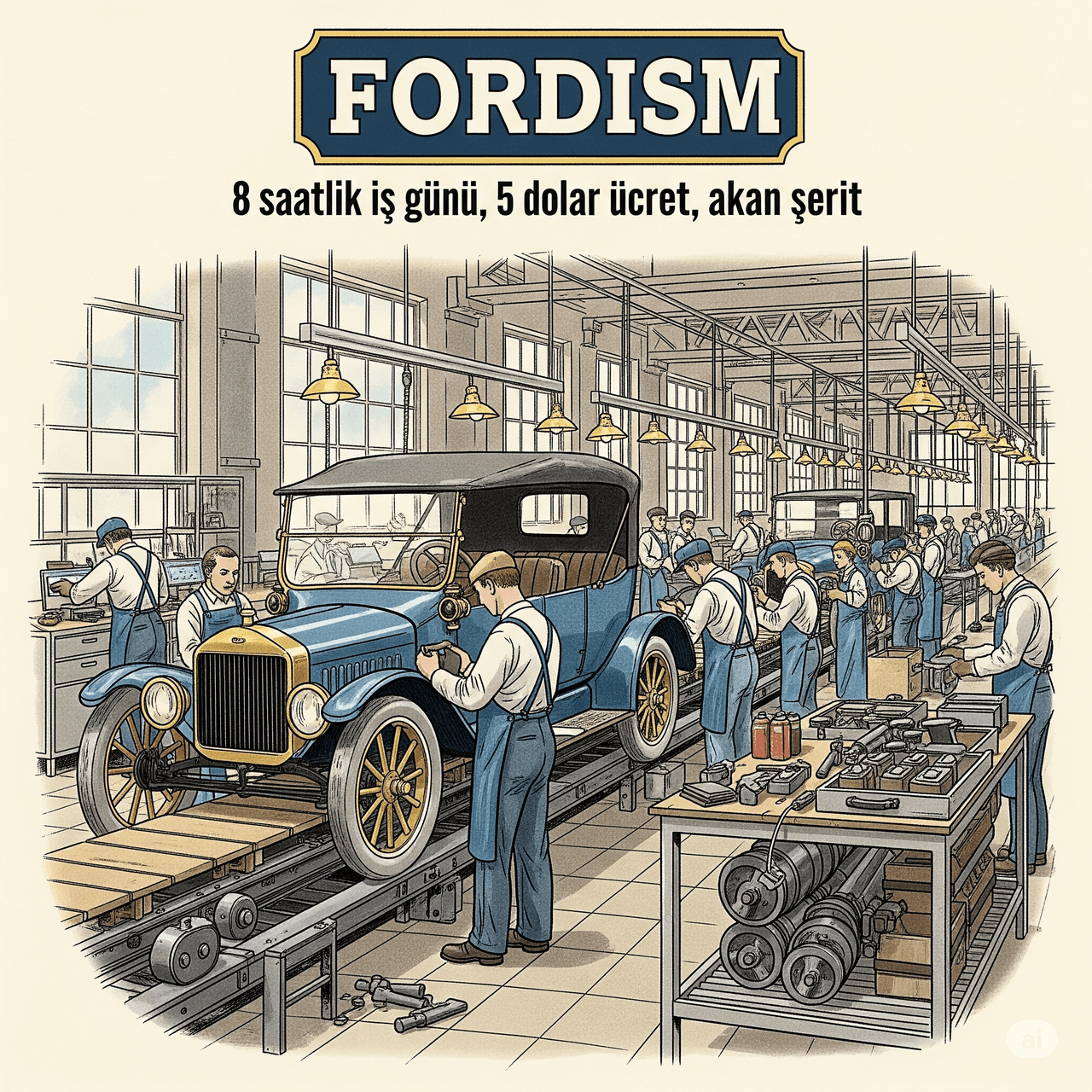

An image illustrating Henry Ford’s assembly line the production of the Model T automobile and the impact of Fordism on industry and culture. (Generated by Artificial Intelligence.)

Principles of Fordism

The core principles of Fordism are as follows:


  • Product Standardization: Products and every component and task are standardized. This is crucial for reducing costs. The goal is mass production of standardized products with identical designs.


  • Mechanization and Taylorism: Some tasks can be mechanized. The remaining tasks are subject to Taylorism; each task is broken down into components redesigned according to time-and-motion principles and workers are given explicit instructions on how to perform them. Mental and manual labor are separated.


  • Moving Assembly Line: The fixed workstation is replaced by a moving conveyor belt and the product moves past the worker.


  • Mass Production through Automation: The goal is to minimize operational costs and achieve stable profits. This is achieved by technologically automating the mass production of standardized products.


  • Centralized Organization and Taylorist Management: Decisions are made by a centralized management and implemented hierarchically from top to bottom. Taylorist management principles are applied with strict control and supervision of workers during production. Labor is hierarchically organized into two main categories: managers and direct workers.


  • Concentration of Mass Labor in Large Enterprises: A largely unskilled labor force performs routine tasks with minimal qualifications. Strict control discipline and surveillance of workers are fundamental.


On the Fordist Work System (Daniel López Iglesias)
Characteristics of Fordist Production

  • Mass Consumption: Fordism presupposes mass consumption and relies heavily on mass advertising.
  • Protected National Market: It is linked to a protected national market system; competition applies only to the global market.
  • Demand Sensitivity: Serial producers are sensitive to sudden drops in demand.
  • Semi-Skilled Labor and Collective Bargaining: Semi-skilled labor collective bargaining directed national markets and centralized organization are integral to Fordism.
  • Rigid Division of Labor: Labor division and job definitions are rigidly structured and based on deskilling.
  • Immutability Principle: There is a principle of immutability in two areas: the unchanging nature of consumer characteristics and demands (predictable demand) and the unchanging nature of the labor market and labor relations.
  • Rigidity: Fordism is not a flexible production style; it is rigid. Achieving a specific production volume is mandatory to ensure profitability.
  • Stock-Based Production and Quality Control: Production is stock-based and delivery follows production. Goods undergo quality control after manufacturing and defective items are corrected.
  • Large Corporate Organizations: Large corporate organizations carry out functions through specialized departments. In vertically organized work environments rigid hierarchical structures prevail.


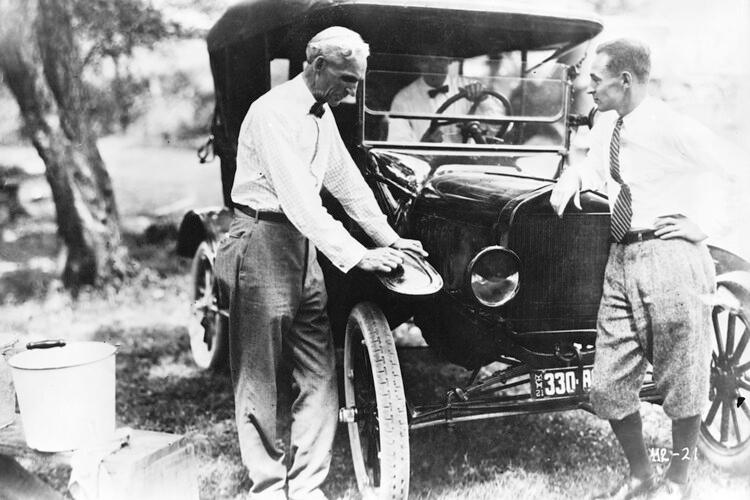
Henry Ford and Edsel Ford (flickr)

Social and Economic Structure under Fordist Production

  • Unions and Collective Bargaining: There exists a system of unions and collective bargaining.


  • Role of the State: The state acts as a mediator in disputes between capital and labor. Public legal guarantees for working conditions and rights are essential. The state assumes responsibility for education and health services that is social reproduction.


  • Keynesian Economic Policies: Keynesian economic policies are implemented. The Keynesian state increases spending and demand through income-boosting policies to ensure market stability and growth thereby insuring mass production with mass consumption. Keynesian economics is based on stimulating and directing demand aims for full employment and emphasizes the importance of state intervention. The state is tasked with ensuring social justice and constructing a social safety net.


On Keynesian Economics (KhanAcademyTurkce)

Crisis of Fordism

The end of Fordism coincided with capitalism’s crisis of overaccumulation. Throughout capitalist history periods of capital accumulation have always been followed by stagnation. Fordism entered crisis alongside its accumulation regime and capitalism needed to transition to a new mode of accumulation.


Reasons for the Crisis of Fordism:


  1. The rigidity of Fordist production.
  2. The rise of neighboring countries with favorable conditions.
  3. Saturation of domestic markets (late 1960s).
  4. Failure of advanced countries to expand their markets declining productivity and profitability.
  5. Developing countries emerging as competitors to the industries of advanced nations.
  6. Inability to respond to changing demand conditions.
  7. Saturation of demand for mass-produced goods.
  8. The technological equipment used lacked flexibility to enable production of different types of goods.
  9. Deterioration of industrial relations during crises.


Today no single production system has completely dominated. Sectors employing Fordist and traditional production methods still persist. Not all sectors or production processes are either Fordist or flexible; they can coexist simultaneously.

Impact of Globalization and Post-Fordism

The economic crises of the 1970s particularly the 1973 Oil Crisis reduced the effectiveness of the Fordist system. Increased competition brought about by globalization created a need for flexibility initiating a transition to post-Fordist production models. Post-Fordism refers to a structure based on diversity flexibility and technological adaptability. This system offers advantages such as faster response to consumer demand lower production costs and increased efficiency.

Managerial and Ideological Transformation

The centralized bureaucratic and welfare-oriented management style of the Fordist era has been replaced in the post-Fordist period by a more local flexible and market-driven structure. This transition has brought with it principles such as individualization service diversity user-centeredness and performance-based management.

Bibliographies

Saklı, Ali Rıza. “Fordizm’den Esnek Üretim Rejimine Dönüşümün Kamu Yönetimi Üzerindeki Etkileri.” *Elektronik Sosyal Bilimler Dergisi* 12, no. 44 (2013): 107–131.https://dergipark.org.tr/tr/download/article-file/70441.

Yavan, Nuri. "Hafta 9: Üretim Sistemi – Fordist Üretim Tarzı." *Sanayi Coğrafyası*. Ankara Üniversitesi Açık Ders Malzemeleri. Accessed May 31, 2025.https://acikders.ankara.edu.tr/pluginfile.php/90983/mod_resource/content/0/Hafta%209-%C3%9Cretim%20Sistemi-Fordist%20%C3%9Cretim%20Sistemi.pdf.

Yertüm, Umut. “Küreselleşmenin Fordist-Kitlesel Üretim Tarzına Etkisi.” *Fırat Üniversitesi İktisadi ve İdari Bilimler Dergisi* 1, no. 1 (2017): 67–86.https://dergipark.org.tr/tr/download/article-file/531536

Author Information

Avatar
AuthorNursena ŞahinJuly 6, 2026 at 3:59 PM

Discussions

No Discussion Added Yet

Start discussion for "Fordist Production" article

View Discussions

Contents

  • Origins and Development

  • Principles of Fordism

  • Characteristics of Fordist Production

  • Social and Economic Structure under Fordist Production

  • Crisis of Fordism

  • Impact of Globalization and Post-Fordism

  • Managerial and Ideological Transformation