


This article was automatically translated from the original Turkish version.

Hello fellow blog enthusiasts, I’m delighted to welcome you to the first article in my “For the Curious” series. Today, I invite you on a journey behind the screens you’re so familiar with, into the heart of the digital world, toward the very nature of transistors.
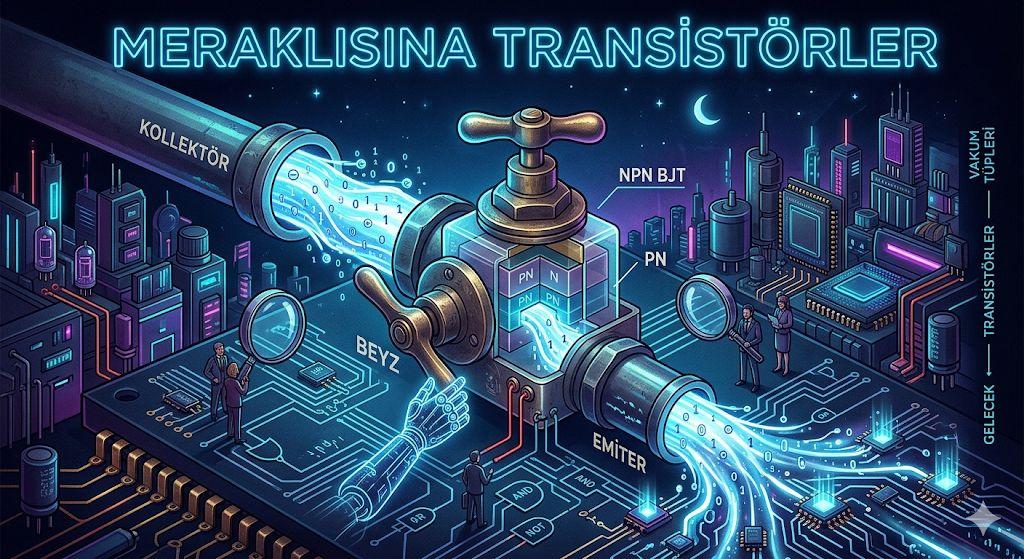
For the Curious: Transistors (generated by artificial intelligence)
The very reason you can read this article by touching your screen, the algorithms we coded that power it, or the complex network systems it manages—all of these exist within a vast ecosystem whose central, nameless hero is the transistor. To many of us, these three-legged silicon pieces on circuit boards appear black, small, and insignificant. Yet they may well be one of humanity’s greatest inventions since the wheel. These tiny semiconductors, the foundational building blocks of electronic engineering, form the decision-making mechanism behind everything from microprocessors to signal processing technologies.
So what exactly are these miraculous elements that launched the digital age, and how do they work? Let us take a closer look at this topic without getting lost in excessive detail, while still honoring the spirit of engineering.
The word “transistor” is derived from the combination of the English words “transfer” and “resistor.” At its most basic definition, a transistor is a semiconductor device that uses a small electrical signal at its input to control a much larger electrical current at its output, thereby amplifying or switching electronic signals. That is perhaps the simplest way to put it.
Transistors freed us from the bulky, overheating, and energy-hungry structure of vacuum tubes by combining P-type (Positive) and N-type (Negative) semiconductor crystals in specific arrangements. Materials like pure silicon or germanium, which are naturally insulators under normal conditions, can have their conductivity precisely controlled by doping them with elements such as boron or phosphorus—a process known in electronics as “doping.” These microscopic chemical arrangements enable us to manage the direction and intensity of electric current with incredible precision.
Transistors are fundamentally divided into two major families: BJT (Bipolar Junction Transistor) and FET (Field Effect Transistor). BJTs, which are always the first and most important topic in university electronics courses, provide an excellent example for understanding their operating principle.
A BJT transistor has three terminals: the Emitter, the Base, and the Collector. You can think of this like a large water pipe with a valve on top:
The more you open the valve (Base), the more water (current) flows from the Collector to the Emitter. If you close the valve completely, the water flow stops (cutoff region); if you open it fully, water flows at maximum capacity (saturation region).
The binary system of “0” (off) and “1” (on) that our computers understand is precisely based on this opening and closing action of the valve. All those thousands of lines of complex code we write in modern high-level languages—like React or similar frameworks—along with massive user interfaces and database queries—when compiled down to machine language, ultimately become nothing more than voltage levels that tell these transistors to “open” or “close.”
Right now, billions of transistors behind your screen or beneath your keyboard are working nonstop to deliver you this flawless experience. If we were to draw an analogy, they resemble the human brain, constantly communicating through its neurons, don’t they?
Eliminating the need for massive switches or noisy mechanical relays to control circuits allowed electronics to shrink to microscopic scales. Today, in our smartphones and computers, the evolved cousins of BJTs—MOSFETs (Metal-Oxide-Semiconductor Field-Effect Transistors)—are used. Inside the processors of the phones we carry in our pockets, billions of transistors are manufactured at the nanometer scale (one billionth of a meter).
Had transistors never been invented, it would be physically impossible for us to speak today of modern mobile interfaces, cloud systems, artificial intelligence, or advanced automation networks.
In short, without them, we might still be living in the world of those bulky machines, perhaps even stuck in the early 19th century. Sometimes, humanity may long for those slower, simpler years, because today’s incredible pace of technology and digitalization can sometimes leave us utterly defenseless. Yet we are grateful to them, for they enable us to make our voices heard, bring our code to life, and break down boundaries. Thank you, transistors...
Numanoğlu, Mustafa. "Temel Yarı İletken Elemanlar: Transistör 2". Ankara Üniversitesi Açık Ders Malzemeleri. Accessed May 7, 2026. https://acikders.ankara.edu.tr/pluginfile.php/154972/mod_resource/content/0/6.%20Temel%20Yar%C4%B1%20%C4%B0letken%20Elemanlar_Transist%C3%B6r%202.pdf
What Is a Transistor and What Is It Used For?
How Does It Work? A Water Valve Analogy
Why Are They So Important?