


This article was automatically translated from the original Turkish version.
+1 More
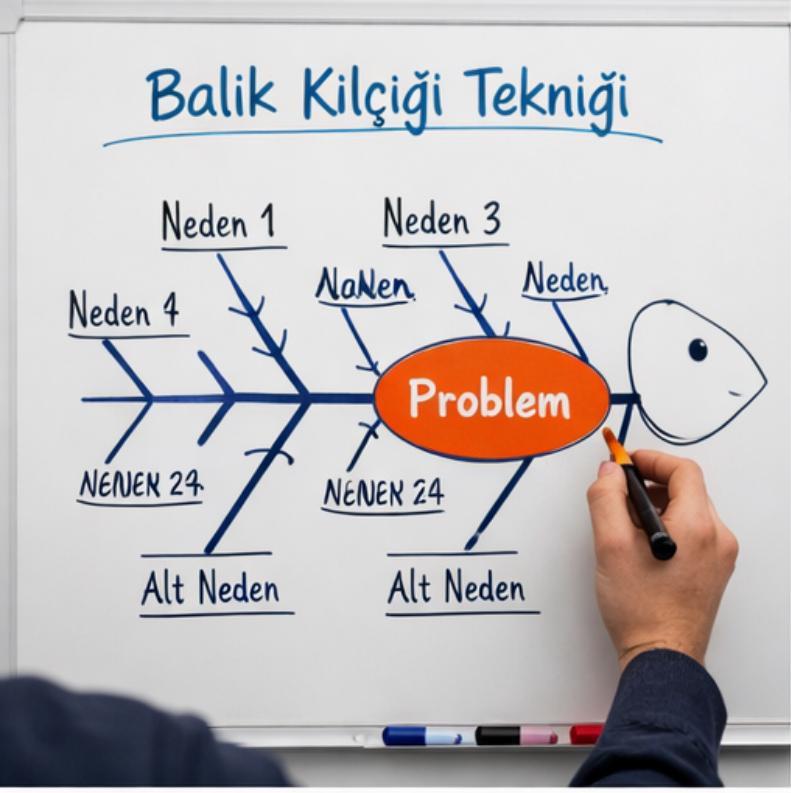
Balık Kılçığı Şeması
(Yapay Zeka ile Oluşturulmuştur)
Fish Bone Technique
Advantage(s) | Provides root cause-focused solutions Supports team collaboration Visualizes cause-and-effect relationships | ||||||||
|---|---|---|---|---|---|---|---|---|---|
Application Area(s) | Analysis of educational problems Project management Quality management Business process analysis | ||||||||
Limitations | Analysis depends on user experience May involve excessive detail in complex problems | ||||||||
Fundamental Elements | Sub-causes (detailed factors) Categories (6M: Man/Machine/Material/Method/Measurement/Environment) Main problem (title) | ||||||||
Fishbone Technique is an analysis and decision-making method used to identify the root causes leading to a specific outcome or problem and to systematically examine their effects. It is called the fishbone technique because potential causes are classified into main and subgroups, and the diagram’s appearance resembles a fish skeleton. The method is based on collecting participants’ opinions through brainstorming and organizing them on a diagram shaped like a fishbone.
The fishbone technique is a method designed to systematically uncover the factors contributing to a problem. It is used to identify elements that cause a specific outcome and to examine their interrelationships.
The core feature of the technique is the hierarchical organization of causes. Potential causes are first grouped into main cause categories. Subsequently, subcauses that influence or are influenced by these main causes are identified and placed in appropriate sections of the diagram. This presents all factors related to the problem in a visual and structured format.
This method enables the analysis of both individual and organizational issues. Presenting causes in a structured format allows multiple aspects of the problem to be evaluated simultaneously.
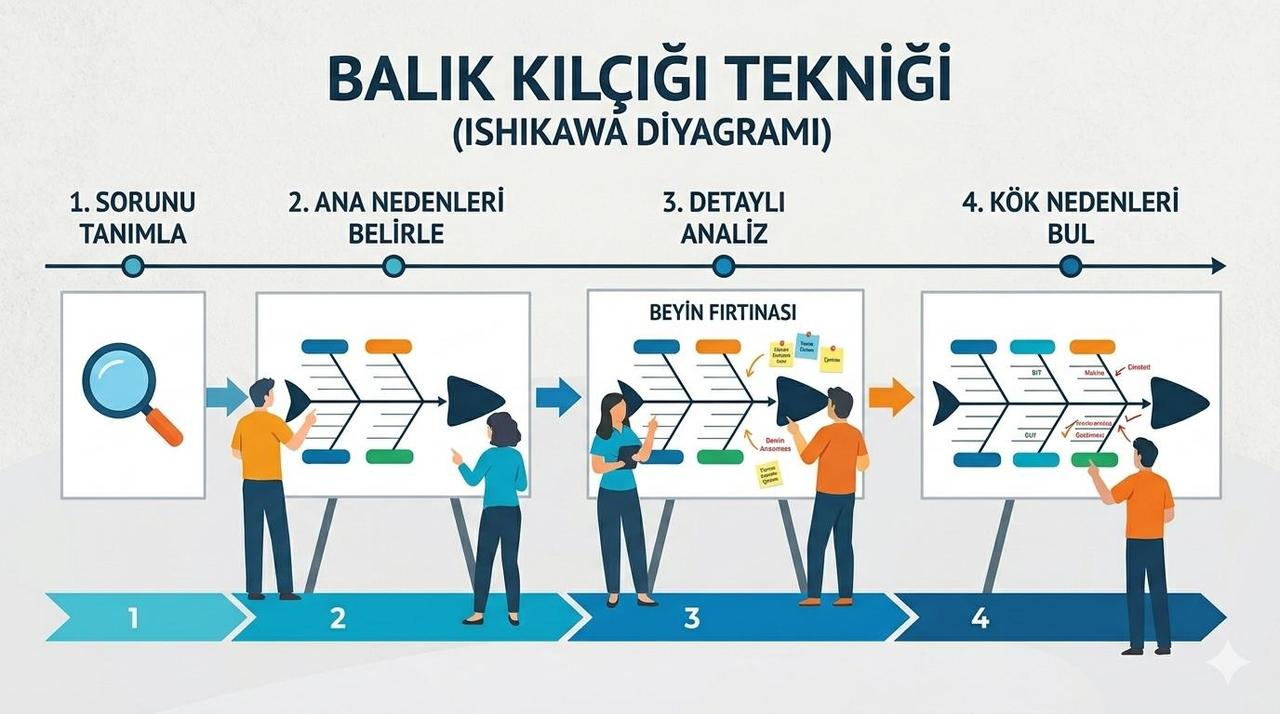
Stages of the Fishbone Technique
(Generated by Artificial Intelligence)
The fishbone technique is applied through a diagram that visually resembles a fish skeleton.
The main components of the diagram are organized as follows:
This structure reveals the relationships between causes in a visual format, clearly demonstrating that a problem may stem not from a single cause but from multiple factors at different levels.
The application of the fishbone technique occurs through a process in which participants contribute their perspectives.
The key stages of the process are as follows:
During this process, participants’ ideas are gathered using the brainstorming technique. The ideas expressed are recorded on the diagram and classified into a structured format.
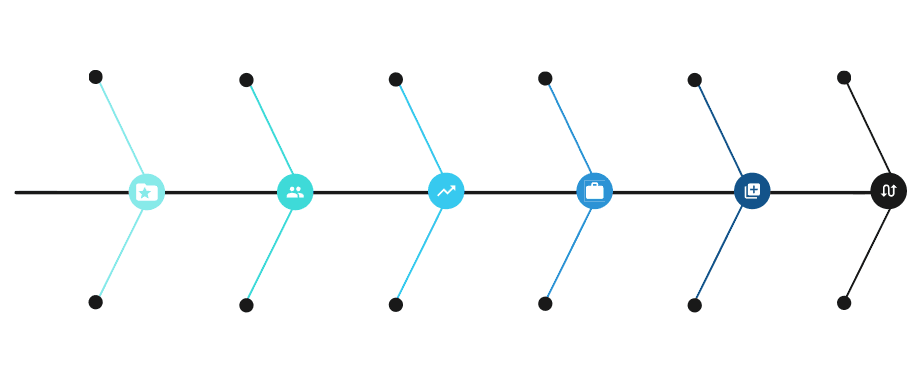
Fishbone Diagram
(Generated by Artificial Intelligence)
The fishbone technique is a method used in situations where cause-and-effect relationships are analyzed. It can be applied to the analysis of both individual and organizational problems.
Examining contributing factors at both main and sublevels allows multiple elements to be evaluated together. Therefore, the technique is used to identify potential causes of a problem and to illustrate the relationships among these causes.
Because the fishbone technique examines the relationship between the causes of a problem and its resulting outcome, it is also known as cause-and-effect analysis. The structure of the diagram is based on systematically organizing the factors that lead to a specific outcome.
In this approach, the outcome is expressed at a single point, while the causes leading to it are divided into main and subgroups and placed on the diagram. This enables the systematic examination of all elements influencing the problem’s development within a structured schema.
Andersen, Bjørn, and Tom Fagerhaug. *Root Cause Analysis: Simplified Tools and Techniques*. 2nd ed. Milwaukee, WI: ASQ Quality Press, 2006. Accessed March 5, 2026. https://books.google.com/books/about/Guide_to_quality_control.html?id=MsNTAAAAMAAJ
Hürriyet. "Balık Kılçığı Tekniği Nedir ve Özellikleri Nelerdir? Balık Kılçığı Yöntemi Neden ve Nasıl Uygulanır?" Accessed March 5, 2026. https://www.hurriyet.com.tr/egitim/balik-kilcigi-teknigi-nedir-ve-ozellikleri-nelerdir-balik-kilcigi-yontemi-neden-ve-nasil-uygulanir-42041328
Ishikawa, Kaoru. *Guide to Quality Control*. Tokyo: Asian Productivity Organization, 1976. Accessed March 5, 2026. https://openlibrary.org/books/OL4595409M/Guide_to_quality_control
Sevinç, A. *Güvenlik Sektöründe İnsan İlişkileri*. 2014. Academia.edu. Accessed March 5, 2026. https://www.academia.edu/download/64991890/Bolum_6_Problem_Cozme_Teknikleri.pdf

Balık Kılçığı Şeması
(Yapay Zeka ile Oluşturulmuştur)
Fish Bone Technique
Advantage(s) | Provides root cause-focused solutions Supports team collaboration Visualizes cause-and-effect relationships | ||||||||
|---|---|---|---|---|---|---|---|---|---|
Application Area(s) | Analysis of educational problems Project management Quality management Business process analysis | ||||||||
Limitations | Analysis depends on user experience May involve excessive detail in complex problems | ||||||||
Fundamental Elements | Sub-causes (detailed factors) Categories (6M: Man/Machine/Material/Method/Measurement/Environment) Main problem (title) | ||||||||
No Discussion Added Yet
Start discussion for "Fishbone Technique (Ishikawa Diagram)" article
Key Features
Diagram Structure
Application Process
Applications
Relationship to Cause-and-Effect Analysis