


This article was automatically translated from the original Turkish version.
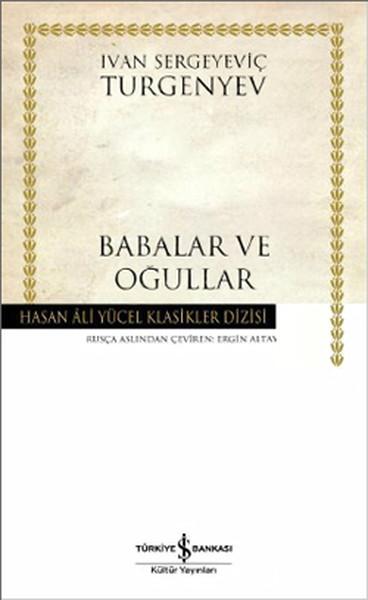
Fathers and Sons
Publisher(s) | İş Bankası Yayınları | ||||||||
|---|---|---|---|---|---|---|---|---|---|
Number of Pages(Number) | 256 | ||||||||
Translator(s) | Ergin Altay | ||||||||
Author(s) | Ivan Sergeyevich Turgenev | ||||||||
Year of Publication | 2008 | ||||||||
Fathers and Sons is a classic written by Russian author Ivan Sergeyevich Turgenev and first published in 1862. Roman explores the ideological conflicts between generations during the social processes of the 19th century Russia. Through the intellectual divisions between the “fathers” who represent old aristocratic values and the “sons” who champion nihilist and revolutionary ideas the novel interrogates the cultural and political structure of the era. The novel is written from a broad perspective that extends from individual psychology to social structure.
Work begins with Arkady Kirsanov returning to his father’s estate after completing his education, accompanied by his friend Yevgeny Bazarov whose radical ideas attract attention. together Arkady’s father Nikolay Petrovich and his aristocratic uncle Pavel Petrovich welcome Arkady’s return with joy but Bazarov’s blunt temperament and destructive ideas gradually generate growing unease within the family.
Bazarov’s nihilism—the rejection of all traditional values and authority—triggers intense ideological debates especially with Pavel Petrovich. These debates reveal the intellectual chasm between the old and new generations of Russian society. Although Arkady appears influenced by Bazarov’s ideas he eventually realizes they are incompatible with his own personality and undergoes an internal transformation.
The novel does not confine itself to ideological conflicts alone; it also delves deeply into the emotional lives of its characters. Bazarov’s love for Anna Odintsova a wealthy and independent woman exposes the conflict between his beliefs and his feelings. Viewing love as a weakness Bazarov cannot reconcile himself to this emotion and chooses to withdraw. Arkady on the other hand develops a more harmonious and balanced relationship with Katya the cousin of Anna.
In the later parts of the novel Bazarov’s story concludes with his death from typhus contracted while serving in a village during his medical training. His death symbolically marks the collapse of his denial of life and humanity. In this context Fathers and Sons is a multifaceted work that addresses not only generational conflict but also the variability of human nature the transformative power of love individual development and the delicate boundary between life and death.
Yevgeny Bazarov: The central character of the novel. A nihilist who dedicates himself entirely to science and reason and opposes emotions and tradition. Proud cold and distant his vulnerability in the face of Love and death reveals his human side.
Arkady Kirsanov: Bazarov’s loyal friend. Initially appearing close to nihilist views he gradually recognizes his loyalty to family and tradition. His personal growth and inner conflicts are pivotal to the novel’s important building stones.
Pavel Petrovich Kirsanov: Represents the old Russian aristocracy. A composed courteous and principled man. His philosophical debates with Bazarov serve as a symbol of the generational conflict in the novel.
Nikolay Petrovich Kirsanov: Arkady’s father. A gentle intellectual Soil. With his soft nature he strives to understand his son but struggles to adapt to his ideas.
Anna Sergeyevna Odintsova: A wealthy and independent woman. She becomes an emotional breaking point in Bazarov’s life. A measured woman who filters love through rationality.
Generational Conflict: The clash between the fathers representing the old order and the innovative revolutionary sons forms the foundation of the novel.
Nihilism: Through Bazarov’s character the novel examines the individual’s indifference toward God society tradition like concepts.
Rejection of Love and Emotions: The psychological struggles characters face when confronted with emotions like love despite their prioritization of scientific reason is a major theme.
Social Change: Processes of societal transformation such as the abolition of serfdom and the emancipation of peasants form the historical backdrop of the novel.
Death and Loneliness: The losses experienced at the end of the novel provoke profound reflections on individual isolation and the transience of life.
Turgenev’s language is plain his descriptions vivid and natural. The novel conveys its philosophical and psychological depth through a simple narrative style. Dialogues clearly reflect the characters’ intellectual worlds and conflicts. Occasional symbols and depictions of nature form a metaphorical structure that mirrors the characters’ spirit states. Turgenev adopts a style that bridges romanticism and realism.
Fathers and Sons is set in 1860s Tsarist Russia during a period of major social change including the abolition of serfdom and the emancipation of peasants. The novel illustrates the impact of this transitional period on individuals and generations. It also addresses the influence in Russia of 19th century Europe intellectual currents such as positivism materialism and nihilism. Through the character of Bazarov Turgenev introduced to literature the nihilistic youth who were beginning to exert influence in Russian society.
Turgenyev, Ivan Sergeyeviç. Babalar ve Oğullar. Çev: Ergin Altay. İş Bankası Yayınları, 2008.

Fathers and Sons
Publisher(s) | İş Bankası Yayınları | ||||||||
|---|---|---|---|---|---|---|---|---|---|
Number of Pages(Number) | 256 | ||||||||
Translator(s) | Ergin Altay | ||||||||
Author(s) | Ivan Sergeyevich Turgenev | ||||||||
Year of Publication | 2008 | ||||||||
No Discussion Added Yet
Start discussion for "Fathers and Sons (Book)" article
Plot Summary
Character Typology
Themes
Narrative and Style
Historical Context