This article was automatically translated from the original Turkish version.
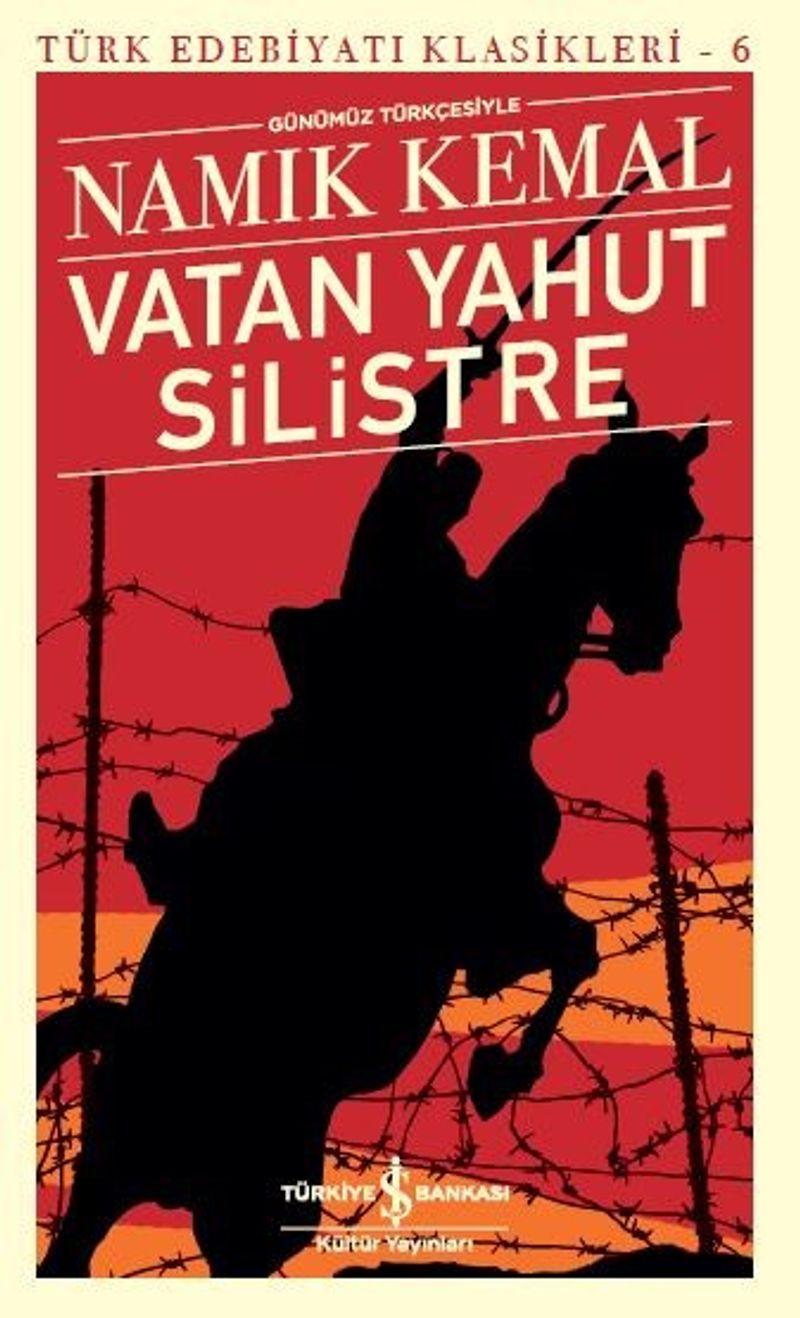
Cover Image of the Book Vatan Yahut Silistre (Türkiye İş Bankası Kültür Yayınları)
Written by Namık Kemal in 1873, the play Vatan yahut Silistre is one of the pioneering works that explore the themes of patriotism and national consciousness. While presenting these two central themes with passionate language, the play also establishes a clear contrast: on one side are the inadequate and corrupt state institutions that fail to fulfill their duties; on the other are the people who make the greatest sacrifices for their homeland. In Vatan yahut Silistre, Namık Kemal criticizes the corrupted state institutions and, through idealized folk heroes such as İslam Bey and Zekiye, transforms the concept of “homeland” from a bureaucratic obligation into a civil value rooted in the will and sacrifice of the nation.
In the scenes set in Silistre, Namık Kemal uses his characters to deliver fundamental criticisms of the state’s bureaucratic weaknesses, indifference, and inadequacy—even at a critical moment such as the defense of the homeland. When Sıtkı Bey tells İslam Bey, “No help is coming, no provisions, no money... not even a single officer remains...”【1】 this statement signifies that the homeland’s territory has been abandoned or ignored by the state (the center). Similarly, even in İslam Bey’s impassioned speech to Zekiye about the homeland, there are sharp critiques of the state’s weakness and its loss of former power. Through İslam Bey’s words—that the homeland once sustained several states with its sword but now survives “only thanks to the goodwill of a few states”【2】—Namık Kemal highlights the state’s profound decline. Although Namık Kemal voices these shortcomings through his characters, he implies that the real problem lies not in individual failures but in a broader failure of governance, underscoring the vacuum created by the state.
In the play, the people’s will is positioned in direct opposition to administrative failures and inadequacies, allowing Namık Kemal to emphasize through the characters of Zekiye and İslam Bey that the true guardian of the homeland is the self-sacrificing populace. Zekiye’s decision to dress as a man and join the front, and her declaration—“I am talking about giving you my life. As for dying, rest assured, I will die more easily and more peacefully than you”【3】—reveals that her love for the homeland is not imposed by command but flows from an inner conviction. Likewise, Abdullah Çavuş’s remark after a mission with İslam Bey and Âdem (Zekiye)—“İslam Bey seems to be in love with death, trying to embrace the bullets”【4】—elevates İslam Bey as a true hero emerging from the people. These scenes clearly reflect Namık Kemal’s method of glorifying the populace and his view of death for the homeland as a sacred sacrifice.
This contrast between an inadequate state and a self-sacrificing people reveals the ideological meanings Namık Kemal attaches to the concept of “homeland.” The state’s duty to protect the homeland has ceased to be its primary and essential responsibility; instead, it has been replaced by indifference, neglect, and incompetence resulting from corruption and decay. Consequently, defending the homeland cannot be treated as a bureaucratic obligation. On the other hand, from the perspective of the people’s will, the protection of the homeland now occurs through the hands of self-sacrificing individuals like İslam Bey, “in love with death,” and Zekiye, who embodies “an inner love for the homeland.” This reflects Namık Kemal’s nationalist and patriotic ideology: the homeland becomes a sacred value, defended and claimed by the nation’s own will. Even if the state fails, the nation will protect the homeland. Thus, the author transforms the notion of claiming the homeland from a duty imposed by command into a civil responsibility directly rooted in the people’s will.
Vatan yahut Silistre juxtaposes two opposing poles to reveal the social and ideological dimensions of the concept of “homeland.” In the play, the central authority’s indifference and inadequacy demonstrate that the state alone cannot safeguard the homeland; meanwhile, the sacrifices of characters who hold deep loyalty to their homeland represent the protective power of the nation’s will. Thus, Namık Kemal transforms the defense of the homeland from a cold bureaucratic task into a sacred value upheld by the conscience of the people.
Namık Kemal. Vatan Yahut Silistre. İstanbul: Türkiye İş Bankası Kültür Yayınları, 2022.
Türkiye İş Bankası Kültür Yayınları. “Vatan Yahut Silistre Kapak Görseli.” iskultur.com. Accessed June 16, 2026. https://www.iskultur.com.tr/vatan-yahut-silistre.aspx?srsltid=AfmBOoreX7p1Iz9RUrVxIpNm9CIapgRXGW7kjMEYwTENYQ9I1ua7ocoU
[1]
Namık Kemal, Vatan Yahut Silistre (İstanbul: Türkiye İş Bankası Kültür Yayınları, 2022), 42.
[2]
Namık Kemal, Vatan Yahut Silistre (İstanbul: Türkiye İş Bankası Kültür Yayınları, 2022), 11.
[3]
Namık Kemal, Vatan Yahut Silistre (İstanbul: Türkiye İş Bankası Kültür Yayınları, 2022), 25.
[4]
Namık Kemal, Vatan Yahut Silistre (İstanbul: Türkiye İş Bankası Kültür Yayınları, 2022), 57.
The inertia of the Center and Bureaucratic Failures
Civil Will and the People’s Sacrifice
The New Owner of the Homeland: The People