

This article was automatically translated from the original Turkish version.
Scientific Name(s) | Eurytides marcellus | ||||||||
|---|---|---|---|---|---|---|---|---|---|
Kingdom(s) | Animalia | ||||||||
Phylum | Arthropoda | ||||||||
Family(ies) | Papilionidae | ||||||||
Order | Lepidoptera | ||||||||
Wingspan | It is approximately 6.4-10.4 cm. | ||||||||
Class | Insecta | ||||||||
Common Name | Zebra Swallowtail | ||||||||
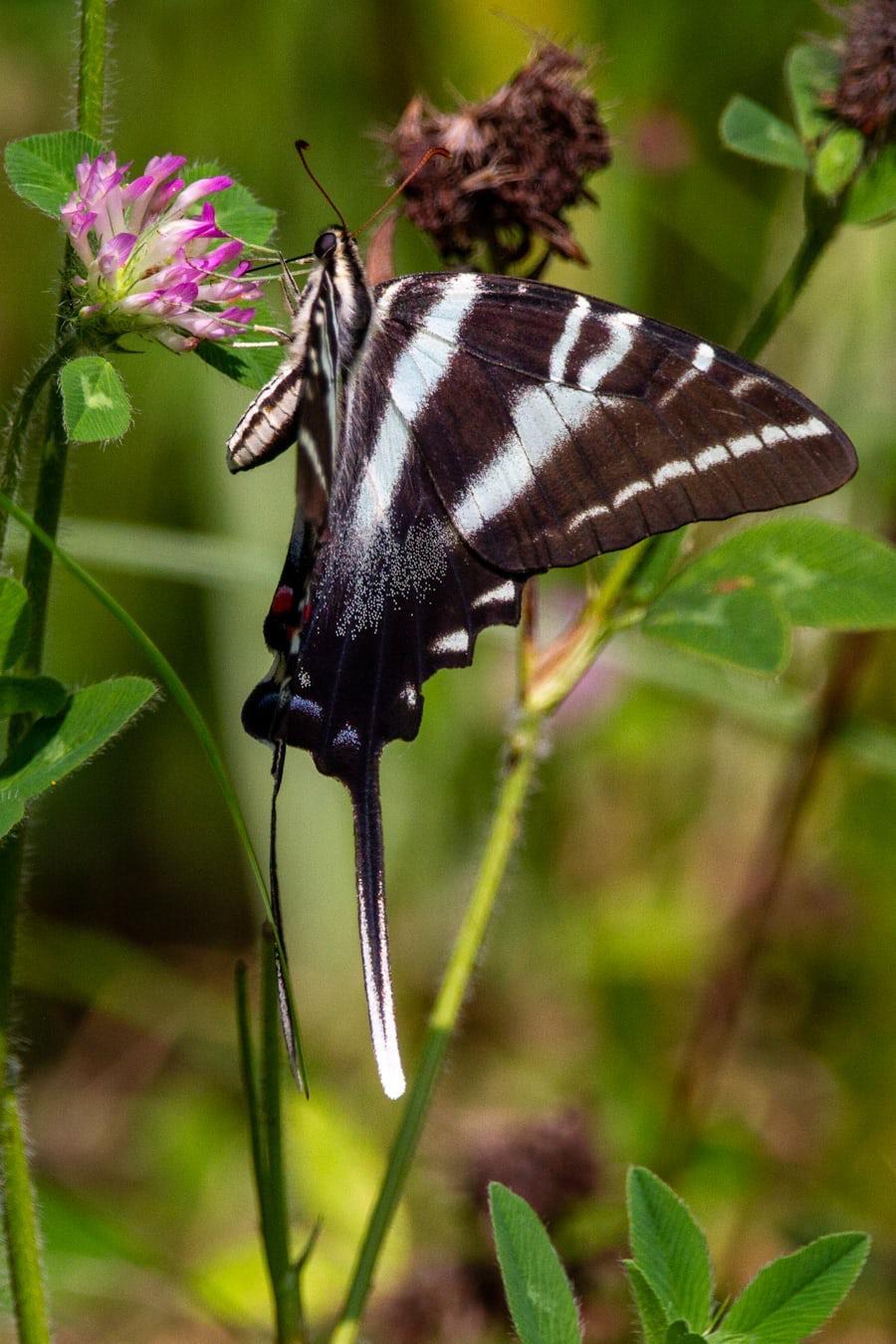
Eurytides marcellus, Papilionidae (swallowtail butterflies) family is a species of butterfly. The species is distributed in the eastern regions of North America and is characterized by its black-and-white striped wing pattern and elongated tail-like projections on the hindwings.
Zebra Swallowtail (Unsplash)
Eurytides marcellus is a species belonging to the kingdom Animalia, phylum Arthropoda, class Insecta, and order Lepidoptera. It is classified within the family Papilionidae, subfamily Papilioninae, and tribe Leptocircini. The taxonomic placement of this species at the genus level has varied over time in the scientific literature. Initially described as Papilio ajax, the species has since been reassigned to different genera. While Eurytides marcellus is the widely accepted name, some systematic studies have also referred to it as Protographium marcellus or Neographium marcellus. These are synonyms resulting from historical reclassifications. The English common name for the species is “zebra swallowtail”.
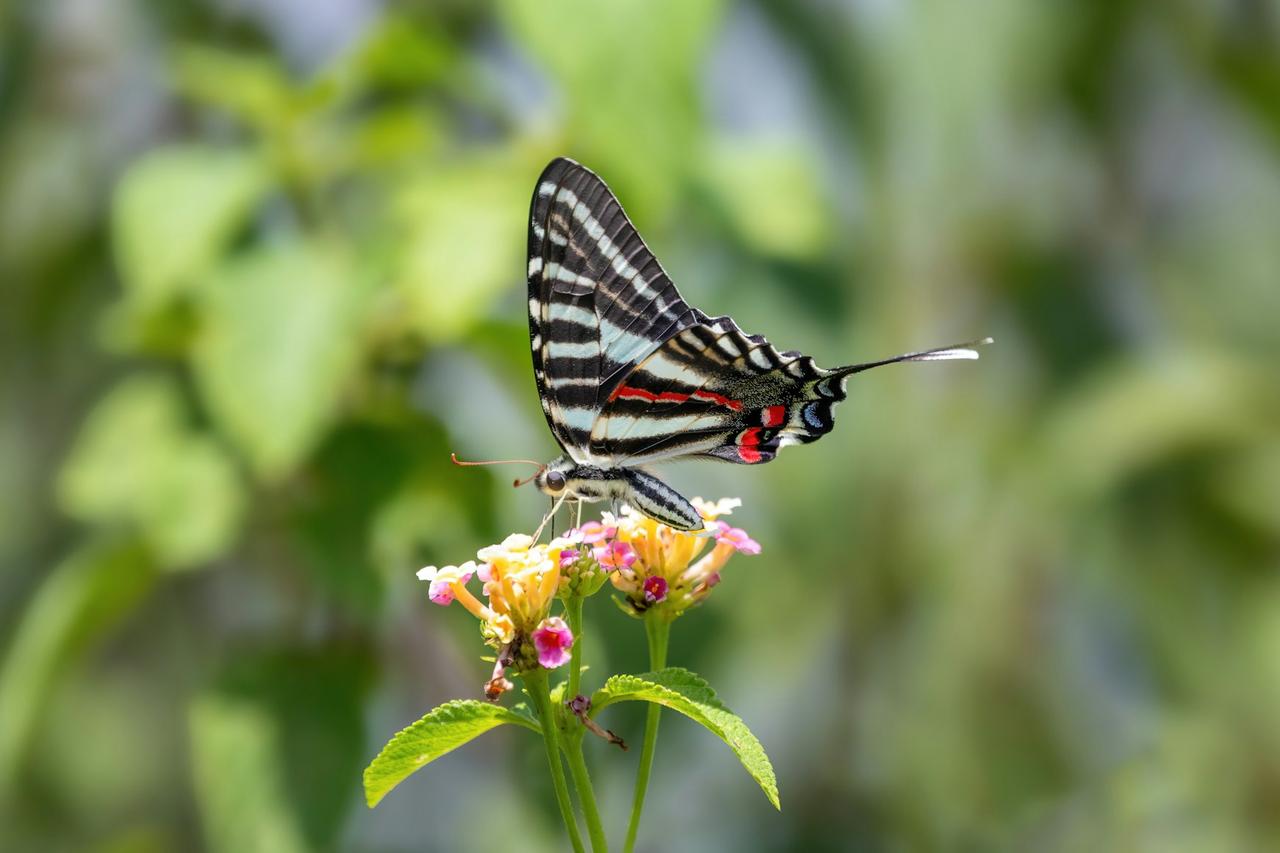
Adult individuals of Eurytides marcellus exhibit black and white banded wings. Dark transverse stripes running along the forewings and hindwings create a striking contrast against the light background. The hindwings feature prominent elongated tail-like projections, a characteristic feature of the Papilionidae family and a key diagnostic trait of this species. The wingspan ranges from approximately 6.4 to 10.4 cm.【1】 Morphological differences exist between seasonal forms; variations in the intensity of color and markings on the wings have been observed between spring and summer generations. Larvae initially appear dark with light spots but later develop a transversely banded pattern on a green background. The pupal stage typically exhibits coloration that blends with the surrounding environment and may vary depending on the substrate.
Eurytides marcellus is a species native to North America, with its distribution concentrated in the eastern and southeastern regions of the United States. Its habitat consists primarily of deciduous forests, forest clearings, and riparian zones. The development of larvae is closely associated with plants of the family Annonaceae, establishing a direct link between the species’ distribution and habitat selection. Phylogenetic analyses within the Papilionidae family confirm its placement within the tribe Leptocircini and support the biogeographical association of this group with North America.
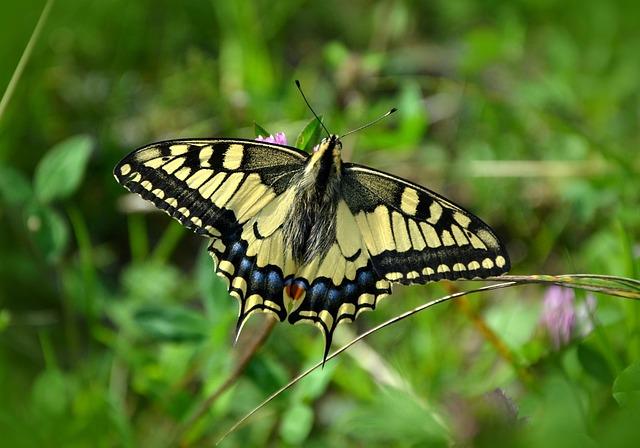
Zebra Swallowtail (Pixabay)
Eurytides marcellus larvae feed primarily on plants of the family Annonaceae. Species of the genus Asimina are particularly noted as host plants. Larvae feed on the leaves of these host plants. Adults feed on nectar. In addition, adults have been observed to imbibe fluids from muddy soil, wet earth, and other moist surfaces. This behavior is associated with the acquisition of minerals and other soluble nutrients.
Eurytides marcellus reproduces sexually and undergoes complete metamorphosis through the stages of egg, larva, pupa, and adult. Females lay eggs singly on the leaves of Annonaceae plants, which serve as food sources for the larvae. The hatched larvae feed on the host plant, grow through several molts, and then enter the pupal stage. Upon completion of the pupal stage, the adult emerges and the reproductive cycle begins anew. The species can produce multiple generations per year; the number of generations and development time vary according to geographic location and climatic conditions.
Eurytides marcellus is a diurnal butterfly. Adults are typically active in open areas and forest edges, engaging in feeding and mate-seeking behaviors during daylight hours. Adults feed on flower nectar and have been observed to obtain fluids from moist surfaces such as muddy soil and wet earth. This behavior, particularly common in males, is linked to mineral uptake. Larvae live and feed exclusively on their host plants. The ecology of this species is closely tied to Annonaceae plants, whose presence directly influences local distribution and habitat selection. Some chemical compounds acquired by larvae from their host plants are believed to contribute to defense mechanisms. Differences between seasonal forms are regarded as an adaptive response to ecological conditions. Furthermore, its phylogenetic position within the Papilionidae family confirms its placement in the tribe Leptocircini and supports its ecological characterization within this group.
No specific global threat category or official conservation status has been assigned to Eurytides marcellus. The species is reported to be widespread in North America, particularly in the eastern regions of the United States, and has been documented across various localities. However, no assessment equivalent to that of the IUCN has been published.
Butterflies and Moths of North America. "Zebra Swallowtail (Neographium marcellus)." Butterflies and Moths of North America. Accessed February 21, 2026. https://www.butterfliesandmoths.org/species/neographium-marcellus
Cotten, Joshua J. “A Black and White Butterfly Sitting on a Flower.” Unsplash. Accessed February 24, 2026. https://unsplash.com/photos/a-black-and-white-butterfly-sitting-on-a-flower-aMIO-pBTRO8
Davila, Leticia. “Eurytides marcellus (Zebra Swallowtail).” Animal Diversity Web. Accessed February 21, 2026. https://animaldiversity.org/accounts/Eurytides_marcellus/
Hall, Donald W., and Jerry F. Butler. “Zebra Swallowtail *Protographium marcellus* (Cramer) (Insecta: Lepidoptera: Papilionidae).” *University of Florida IFAS Extension*. Accessed February 21, 2026. https://edis.ifas.ufl.edu/publication/IN215
Martin, John M., Stephen R. Madigosky, Zhe-Ming Gu, Dawei Zhou, Jinn Wu, and Jerry L. McLaughlin. “Chemical Defense in the Zebra Swallowtail Butterfly, Eurytides marcellus, Involving Annonaceous Acetogenins.” Journal of Natural Products 62, no. 1 (1999): 2–4. Accessed February 21, 2026. https://pubmed.ncbi.nlm.nih.gov/9917274/
Stovall, Richard. “a black and white butterfly sitting on top of a flower.” Unsplash. Accessed February 24, 2026. https://unsplash.com/photos/a-black-and-white-butterfly-sitting-on-top-of-a-flower-TMv_hnknZHc
congerdesign. "Kelebek Böcek Çayır." Pixabay. Accessed February 24, 2026. https://pixabay.com/tr/photos/kelebek-b%C3%B6cek-%C3%A7ay%C4%B1r-491166/
zkrej. “Doğa Kelebek Swallowtail Meyve.” *Pixabay*. Accessed February 24, 2026. https://pixabay.com/tr/photos/do%C4%9Fa-kelebek-swallowtail-meyve-4367268/
[1]
Donald W. Hall and Jerry F. Butler, ''Zebra Swallowtail Protographium marcellus (Cramer) (Insecta: Lepidoptera: Papilionidae),'' University of Florida IFAS Extension, accessed 21 February 2026, https://edis.ifas.ufl.edu/publication/IN215.

Scientific Name(s) | Eurytides marcellus | ||||||||
|---|---|---|---|---|---|---|---|---|---|
Kingdom(s) | Animalia | ||||||||
Phylum | Arthropoda | ||||||||
Family(ies) | Papilionidae | ||||||||
Order | Lepidoptera | ||||||||
Wingspan | It is approximately 6.4-10.4 cm. | ||||||||
Class | Insecta | ||||||||
Common Name | Zebra Swallowtail | ||||||||
No Discussion Added Yet
Start discussion for "Eurytides Marcellus" article
Taxonomy and Nomenclature
Morphological Characteristics
Distribution and Habitat
Feeding
Reproduction
Behavior and Ecology
Conservation Status