


This article was automatically translated from the original Turkish version.
+2 More
Epic of Edige is a heroic narrative belonging to the shared cultural sphere of the Turkic peoples. This epic has been created by various Turkic communities and transmitted orally from generation to generation. The events it contains reflect social values, national ideals, and the emotions of the people.
The Epic of Edige has become a major folk narrative among Turkic communities living across the Golden Horde region, the Central Asian steppes, and the Western Siberian areas. The existence of this epic has been identified among many Turkic tribes inhabiting this vast geography. Traces of this work are found in the epic traditions of the Tatars, Bashkirs, Nogais, Kazakhs, Karakalpaks, Uzbeks, Kyrgyz, and Turkmens. In particular, the Nogais and Crimean Tatars hold a special place in preserving and transmitting the epic.
The geographic spread of the Epic of Edige encompasses a vast area stretching from the northern shores of the Black Sea to the lower reaches of the Volga (Idil) and Ural (Yayik) rivers, and from there extending into the Western Siberian and Central Asian steppes. This distribution marks a region characterized by intense political and cultural interactions. Most of the events recounted in the epic take place within the area historically known as Deşt-i Kıpçak. This region served as one of the political centers of Turkic communities during the Golden Horde period and played a decisive role in the development of the epic tradition.
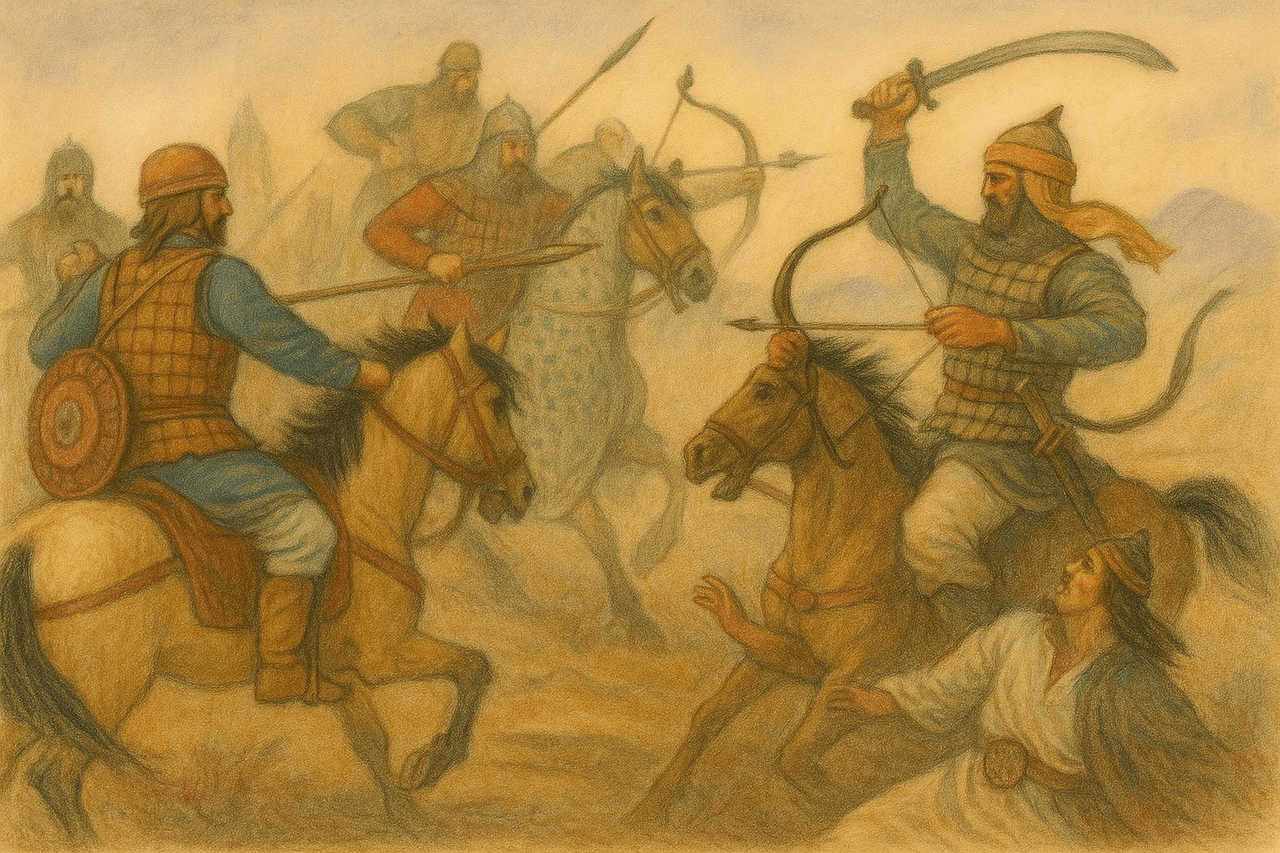
Visual Representing the Epic of Edige (Generated by Artificial Intelligence)
The Epic of Edige has been preserved for centuries within the oral tradition, evolving in the memory of various Turkic communities until reaching the present day. In the Turkic world, epics are typically recited by storytellers. The Epic of Edige is a significant example of this tradition.
Among the Kyrgyz, epic narrators are called “manasçı”, among the Kazakhsand Karakalpaks “cırav”, and among the Uzbeks and Turkmens “bahşı”. These individuals are not merely narrators but cultural bearers who keep the collective memory alive and express social values in poetic form. These epic narrators typically perform with musical accompaniment using instruments such as the dombra or the kıl kopuz. The narratives are sometimes improvised and sometimes passed down through generations by memorization. This mode of performance transforms the epic from a mere literary work into something akin to a living theater.
Thanks to the efforts of these narrators, the Epic of Edige has survived across vast territories. Different versions are recited in the Kazakh steppes, Bashkir villages, the Karakalpak region, and among the Nogais. Each variant reflects the dialect, lifestyle, and historical conditions of its community. Thus, the epic has taken on different cultural forms rooted in a common origin.
Scholarly interest in the Epic of Edige began to grow in the 19th century. As European and Russian researchers turned their attention to the Turkistanregion and its oral literature, the epic attracted notice. However, until the early 20th century, collection and publication efforts remained limited.
During the 1930s and 1940s, under the Soviet Union, the epic acquired a political dimension and was subjected to censorship. Especially during the Stalin era, its publication was banned on the grounds that it strengthened nationalist sentiments among Turkic peoples. Existing texts were censored or altered. During this period, folk narrators continued to preserve the epic in secret, and in some regions it was transmitted orally only.
With the onset of political and cultural liberalization movements in the 1980s, scholarly research on the Epic of Edige revived. Researchers began gathering different variants and conducting comparative analyses. In this context, the 2007 study by Karl Reichl holds great significance for epic studies. Reichl published a version of the Epic of Edige collected from Jumabay Bazarov, a renowned narrator within the Karakalpak epic tradition, providing a detailed examination of the epic’s textual and musical structure.
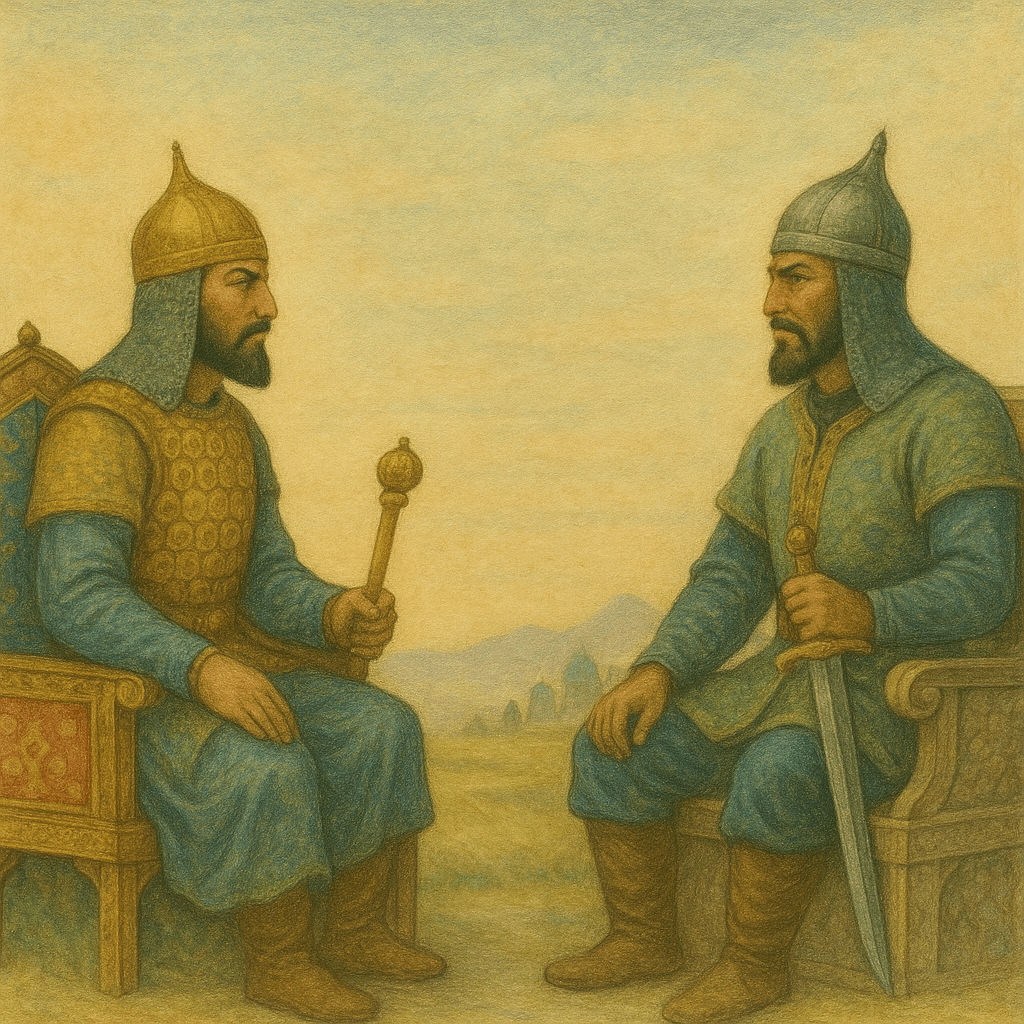
Visual Representing the Epic of Edige (Generated by Artificial Intelligence)
The Epic of Edige is one of the most important heroic narratives to emerge during the medieval period of Turkic history, particularly within the boundaries of the Golden Horde Khanate. The Golden Horde was a vast Turkic-Mongol empire established under the rule of descendants of Jochi, the son of Genghis Khan. At its height, the khanate ruled over a vast territory stretching from the steppes of Eastern Europe to Western Siberia and from the Idil-Ural region to the Caucasus. However, in the second half of the 14th century, central authority began to weaken, and political rivalries intensified as local beys gained power.
The most prominent example of these rivalries is seen in the conflicts between Tokhtamysh Khan and Emir Timur. Tokhtamysh Khan, as a descendant of Jochi, was regarded as the legitimate heir to the Golden Horde throne, while Timur wielded political power centered in Samarkand. Initially, Tokhtamysh ascended to the throne with Timur’s support, but their alliance later broke down. The conflicts between the two rulers were not merely struggles for political dominance but represented the confrontation between two distinct centers of theTurkic world.
Within this historical context, the Epic of Edige (Emir Edige)evolved into a narrative that explores power dynamics, loyalty, and themes of betrayal within the Golden Horde. In historical sources, Edige is referred to as the son of Kutlukaya and, since he was not of Genghis lineage, he could not assume the title of “khan.” Instead, he was known by the title “emir” due to his military and political abilities. Edige rose to a prominent position in Tokhtamysh’s court, earning the khan’s trust through his intelligence and bravery. Over time, however, Tokhtamysh grew suspicious and questioned Edige’s loyalty. This tension forms the central conflict of the epic. Facing Tokhtamysh’s hostility, Edige was forced to seek refuge withEmir Timur, where he found support and fought to protect both his honor and his people.
Although Edige’s objectives vary across different versions of the epic, his primary motivation remains centered on defending his homeland, establishing justice, and resisting the existing regime. These themes are particularly prominent as literary elements in the Bashkir,Tatar, and Kazakh versions. In the text, the character of Edige is portrayed not only as an individual hero but also as a figure embodying collective social identity.
Moreover, Edige’s war against Tokhtamysh and his khanate symbolizes the dissolution of the Golden Horde and the political transformation of the Kipchak steppes. As a result of these conflicts, the khanate fragmented, giving rise to regional principalities such as Kazan, Crimea, Astrakhan, and Nogai. This historical rupture is symbolically linked in the epic to Edige’s fate and the collapse of the Golden Horde.
The Epic of Edige is a folk narrative that embodies the shared structural features of the Turkic epic tradition. The text incorporates numerous archetypal motifs, including supernatural birth, noble lineage, dreams, kut, formulaic numbers, and battles against supernatural beings. These elements reveal that the epic possesses not only historical depth but also mythological richness.
Edige’s lineage is described in extraordinary terms. His mother is a fairy maiden, and his father is the holy saint or Baba Tükles Hoca Ahmet. This ancestry underscores that the hero is no ordinary human. This narrative of origin reflects the common Turkic mythological archetype of the “semi-divine hero.” His birth is miraculous, signaling that he will accomplish great deeds and alter the fate of his people. Thus, Edige is portrayed as a figure endowed with kut and called to a divine mission, much like Oghuz KhanorManas.
One of the motifs in the epic is the hero’s struggle against supernatural forces. Edige confronts a giant named Kara Tiyen Alp (in some variants Kabardı Alıp or Alıp Baba Kara Tiyin). After Kara Tiyen Alp kidnaps Timur’s daughter Akbilek, Edige wages war against him. The battle is not merely a physical confrontation but also represents a metaphysical struggle between good and evil. Before dying, Kara Tiyen Alp reveals to Edige that they are brothers.
Dreams, as in the broader Turkic epic tradition, serve as guiding elements in the Epic of Edige. Both Edige and Tokhtamysh Khan receive signs about future events in their dreams. These dreams influence the heroes’ decisions, sometimes warning them and sometimes reminding them of fate’s inevitability.
The number “forty” is given special significance in the epic. The fact that Kara Tiyen Alp has forty warriors emphasizes the magnitude of the challenges Edige faces. In Turkic mythology, the number forty frequently symbolizes strength, endurance, sacredness, and completeness. In the Epic of Edige, this number also contributes to the rhythmic structure of its oral narration.
The expression that Edige’s lineage originates from a dry skull (aksuyek) symbolizes his nobility and sanctity. The concept of “kut” is used throughout the epic to denote fate, fortune, spirit, and divine power. The hero’s kut is the source of his success and legitimacy.
Since the epic took shape during a period of strong Islamic influence, it also contains Islamic elements. Terms such as “Azrail,” “Cebrail,” “shroud,” and “washing” are woven into the narrative. The heroes repent, pray, and the belief in divine reckoning after death is emphasized.
The horse is an inseparable companion of the hero in Turkic epic tradition, and this remains true in the Epic of Edige. The horses ridden by the heroes — such as argımak, doru, ak şal — are not merely means of transportation but living embodiments of the hero’s soul and power. Edige’s horse, Timgil Çuvar, serves as both friend and battle companion throughout his journey of destiny.
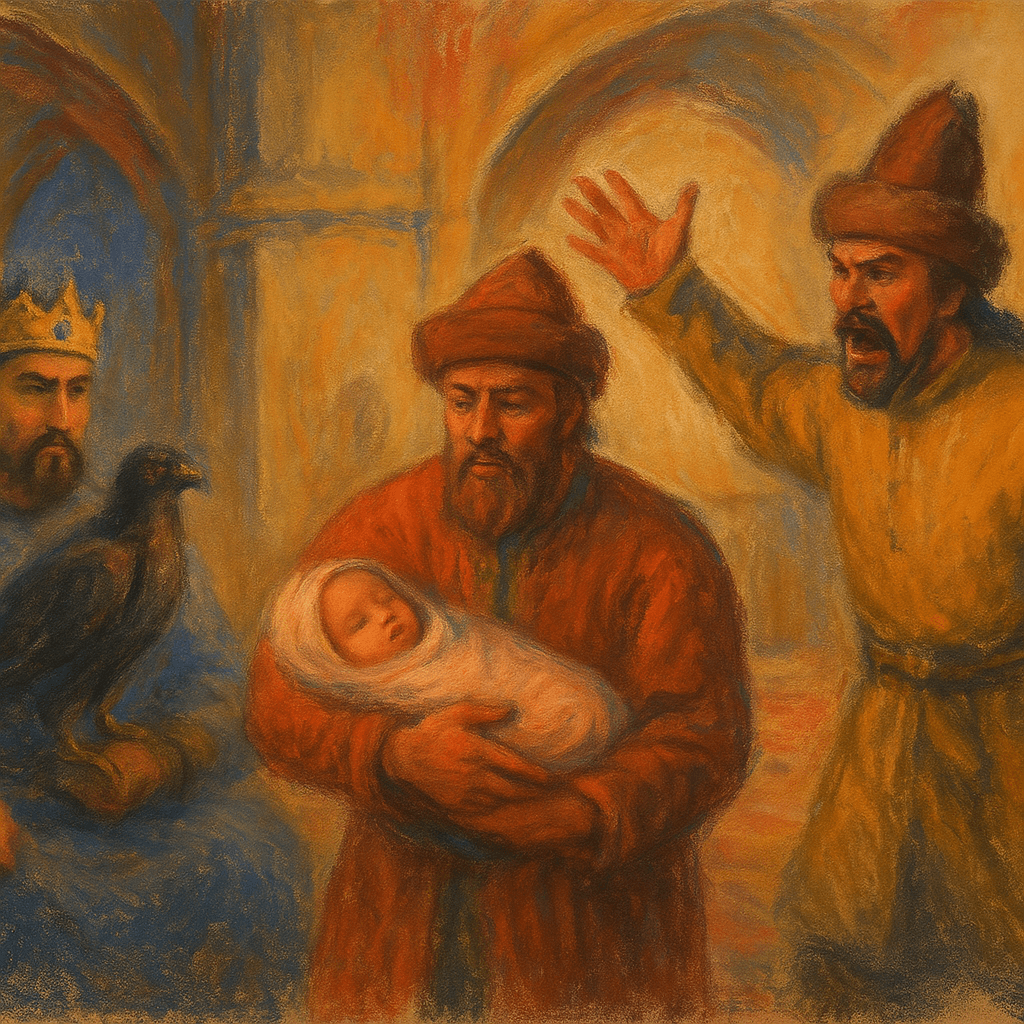
Visual Representing the Epic of Edige (Generated by Artificial Intelligence)
The plot of the epic begins during the period of the Golden Horde Khanate. At this time, Tokhtamysh Khan rules from the cities of Bolgar and Saray. Meanwhile, Emir Timur (Timur Bek) establishes his own political authority centered in Samarkand. The epic opens by narrating the power struggle between Tokhtamysh and Timur. One day, Timur demands that Tokhtamysh send him the famed hunting bird, Kara Laçin Tökli Ayak. This bird, renowned across nine lands, is considered sacred. However, Tokhtamysh refuses to give it up, as it is regarded as a symbol of Genghis lineage. This act breaks the friendship between the two rulers and initiates a long-lasting enmity.
When the birds begin to lay eggs, Tokhtamysh orders Kutlukaya Bey, who is responsible for their care, to bring him the chicks. But when Tokhtamysh sees that the chicks cannot fly, he suspects that Kutlukaya has swapped the eggs and secretly sent the chicks to Timur. This incident leads to Kutlukaya being falsely accused and sets in motion a new chain of events. Edige’s origins are described with extraordinary qualities: his mother is a fairy maiden and his father is the holy saint Baba Tükles Hoca Ahmet. This lineage emphasizes that Edige is born under a sacred and extraordinary destiny. When Kutlukaya’s loyalty is misunderstood, Tokhtamysh orders his execution and commands that his infant son Edige be killed as well — both to punish treason and to eliminate the lineage. However, before this order is carried out, a bey named Cantimir, who is Kutlukaya’s old friend and blood brother, intervenes.
Cantimir cannot accept the extinction of Kutlukaya’s lineage. Therefore, he substitutes his own youngest son, Kobogıl, for the infant Edige. Tokhtamysh’s men kill Cantimir’s son, while Edige is secretly saved. Cantimir hides and raises the child. Because Edige was concealed within the inner part (“ediğinde”) of Cantimir’s saddle, he is thereafter known as “Edige.”
Edige grows up as Cantimir’s sixth son. From an early age, he displays extraordinary physical strength and courage. Even at one year old, he wrestles with ninety boys and becomes their leader. This demonstrates his early qualities of heroism and leadership. Eventually, he enters Tokhtamysh’s court and, due to his intelligence and bravery, rapidly rises to the rank of bey. Impressed by his abilities, Tokhtamysh grants him permission to marry a beautiful woman named Aytulı. From this marriage, they have a son named Noradın (Muradım).
Edige’s rise at court quickly draws attention. Tokhtamysh’s wife, Hanbike (Yenike), becomes jealous of Edige’s growing fame, fearing it surpasses the khan’s. She incites Tokhtamysh by accusing Edige of seeing himself as equal to the khan. To test Edige’s loyalty, they offer him a drink laced with poison, but Edige senses the trap and refuses to drink. In response, Tokhtamysh summons a soothsayer named Bilge Sıska Subra Yırav (Habrav) to uncover Edige’s true identity. Using animal metaphors, Yırav reveals that Edige is not Cantimir’s son but the true son of Kutlukaya Bey.
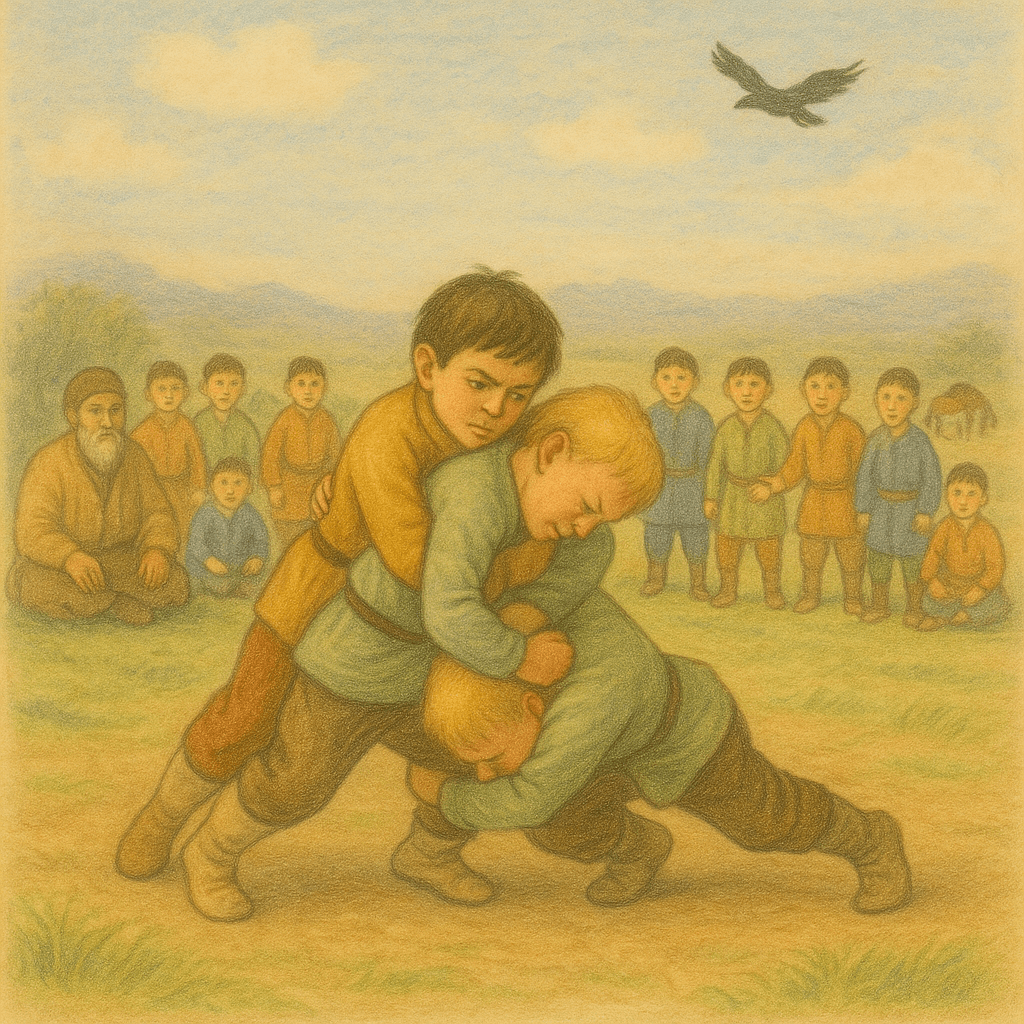
Visual Representing the Epic of Edige (Generated by Artificial Intelligence)
Realizing his life is in danger after his identity is revealed, Edige leaps onto his horse — Tulpar Timgil Çuvar — and flees the court. He takes nine loyal companions with him and crosses the Volga River, leaving Golden Horde territory behind. One of Tokhtamysh’s men, Yanbay, tries to persuade him to return, but Edige remains resolute. Edige declares his intention to seek refuge with Emir Timur and to one day take revenge on Tokhtamysh.
After his identity is exposed, Edige escapes from Tokhtamysh’s wrath and heads toward distant lands. His goal is to find a powerful ally and avenge his father’s injustice. This journey marks the beginning of his physical and spiritual maturation. As Edige leaves his homeland and travels toward Timur’s territories, he encounters one of the most striking figures in the epic: Kara Tiyen Alp. In some variants, this character is called Kabandın Alp or Kabardı Alıp. Kara Tiyen Alp is a giant endowed with superhuman strength and appears in the epic as both a supernatural and symbolic adversary.
This giant has kidnapped Timur’s daughter Akbilek and holds her captive with forty servants. This situation becomes both a test of heroism and a trial of fate for Edige. The hero confronts the giant alone; a battle lasting several days ensues. Edige ultimately defeats Kara Tiyen Alp. Before dying, the giant tells Edige that their mothers were the same fairy maiden and that they are, in fact, brothers.
After killing Kara Tiyen Alp, Edige rescues Timur’s daughter Akbilek and the forty servants who were taken with her. Timur admires Edige’s courage and integrity. He shows him great respect, bestows gifts upon him, and wishes to keep him in his service. In some variants, Timur even marries Akbilek to Edige, forging a bond of kinship between them. This marriage symbolizes the union of two great powers: Edige, expelled from the Golden Horde, and Timur, the ruler of Samarkand. Through this alliance, Edige gains not only a new homeland but also powerful support to reclaim his former land. Timur honors Edige with an important command in his army and integrates him among his emirs. Edige quickly becomes one of Timur’s most trusted commanders. The epic recounts that Timur entrusts Edige with the mission to “revive the sacred lands.”
This period is extensively covered in the Bashkir and Tatar narratives, where Edige’s struggles for the freedom of the Ural and Volga regions are highlighted. Edige fights for the liberty of the people in these lands. In his eyes, the homeland is not merely territory but a sacred concept — a “sacred land” and a “radiant realm”. During this time, Edige becomes legendary among the people. In the epics, he is remembered as a hero who “brings justice” and “eradicates tyranny.” His victories during this period foreshadow the great war he will later wage against Tokhtamysh.
After spending many years under Emir Timur’s protection, Edige begins to feel a deep longing for his homeland. Although he is held in great esteem in Timur’s lands, his heart always yearns for the steppes of the Volga and the Ural.
One day, Edige’s son Noradın (Muradım) comes to visit his father. Noradın criticizes his father for living far from his homeland and urges him to return to the Volga. He tells Edige that the people are weary of Tokhtamysh’s tyranny and long for him.
Edige asks Timur for permission to wage war against Tokhtamysh. Timur, aware of Edige’s loyalty and bravery, grants his request. He equips Edige with a large army and, as he bids him farewell, blesses him with the words, “Fight for the sacred land.” In some variants, Timur offers Edige strategic advice and emphasizes that the war must be fought for justice. Edige marches with his army toward the Volga. Upon reaching his homeland, he kisses the earth, looks to the sky, and prays, saying, “This radiant land, this sacred realm, has once again shown me its face.”
Tokhtamysh learns of Edige’s return and begins preparations for war. The two great armies meet on the steppes of Deşt-i Kıpçak. The battles last for days. In some versions of the epic, nature itself sides with Edige: the wind aids his army, and the horses run with supernatural speed. Eventually, Tokhtamysh’s forces are defeated. Unable to accept defeat, Tokhtamysh flees into the steppe. Edige then sends his son Noradın in pursuit. Noradın catches up with Tokhtamysh by a riverbank. Tokhtamysh begs for mercy, invoking memories of their past, but Noradın replies, “For justice,” and cuts off his head.
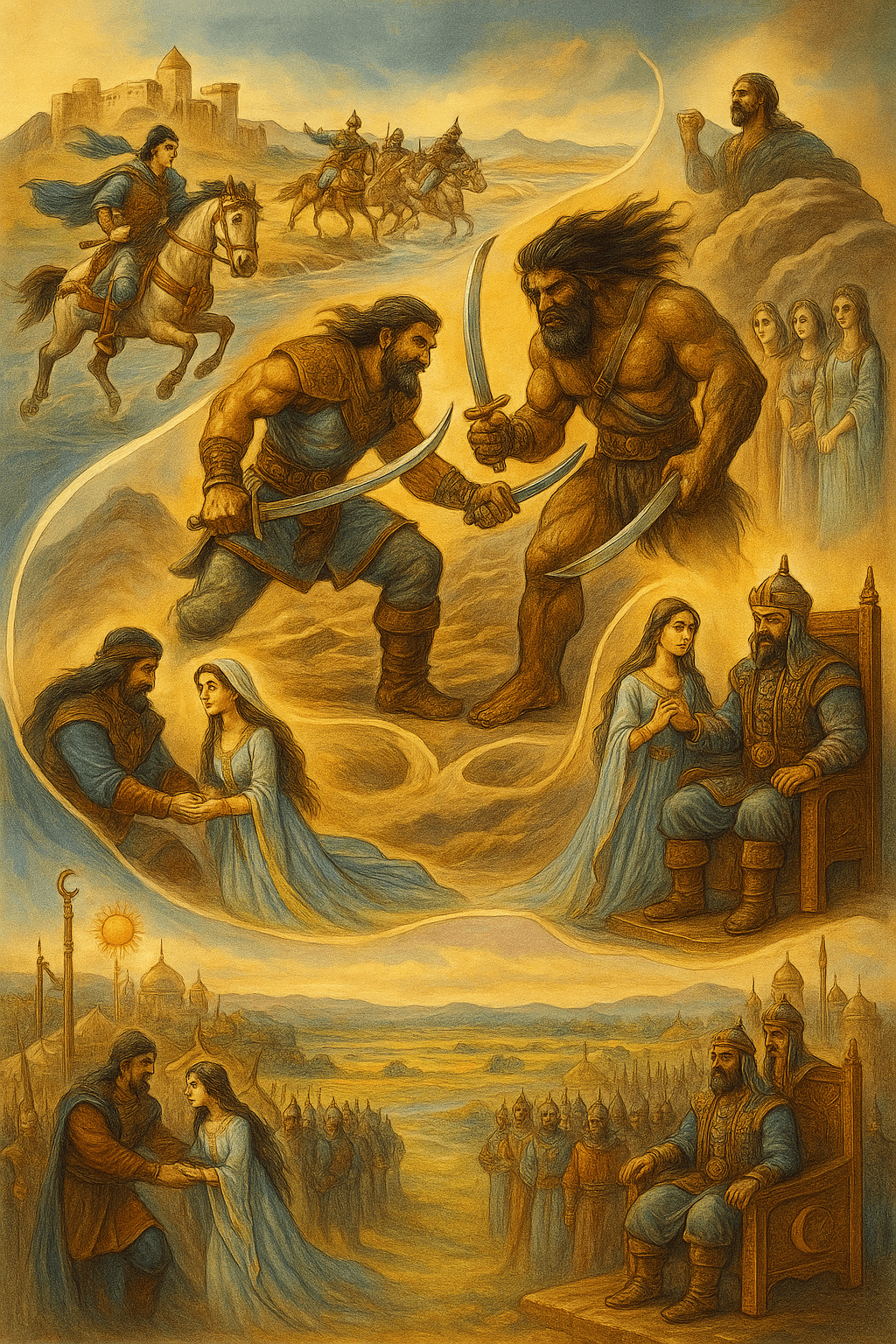
Visual Representing the Epic of Edige (Generated by Artificial Intelligence)
Noradın brings his father Tokhtamysh’s head. Edige feels not joy at his enemy’s death but the weight of the consequences it brings, for he now thinks of his people’s future. In some variants, Edige refuses to sit on the khan’s throne. Instead, he releases a “state bird.” The bird flies three times, each time landing on the head of Tokhtamysh’s son, Kadirbirdi. This sign determines who will inherit the throne. Yet Edige accepts authority only over half the land, restoring order to his people.
In the Bashkir narrative, this event is interpreted as the sharing of kut. Edige’s power is a divine gift, but he chooses to govern it not by force but by wisdom. After the war, Edige travels across the Volga lands, visiting every corner and bringing peace to his people. In the Tatar version, when Edige returns to the Volga, he kneels and weeps over the earth, saying, “This is my radiant homeland, this is my sacred realm.”
After Tokhtamysh’s defeat and the reorganization of the khanate, a new phase begins in Edige’s life. However, this period is defined not by external enemies but by internal conflicts. Edige wishes to reward his son Noradın for his heroism and courage in battle. He gives him Tokhtamysh’s daughter, Haneke (Hanike), as a wife. Although this marriage symbolizes peace between the two dynasties, it soon triggers a chain of betrayal.
Haneke falls under the influence of a traitor named Kin Canbay, who seeks revenge for Tokhtamysh. Canbay convinces Haneke that Edige has taken her by force. Following his scheme, Haneke binds a woolen pad to her belly and pretends to be pregnant, lying to Noradın. Enraged by these words, Noradın hurls his dombra in anger. The musical instrument strikes Edige in his right eye. This event signifies the hero’s physical and symbolic “darkening of the eye”. Edige is wounded by his son’s rage and loses sight in one eye.
Noradın soon realizes what he has done and is overcome with remorse. But his shame prevents him from facing his father. He leaves his homeland and travels to distant lands. Edige, in turn, curses his son but carries deep longing within him. This situation reveals that the bond between father and son is broken yet not severed.
Some time later, Noradın is captured while hunting birds near Çirüli Lake by Tokhtamysh’s son Kadirbirdi. Instead of killing him, Kadirbirdi is impressed by Noradın’s bravery and sets him free. Noradın returns to his father. Despite all the suffering, they reconcile. Edige forgives his son and restores his trust.
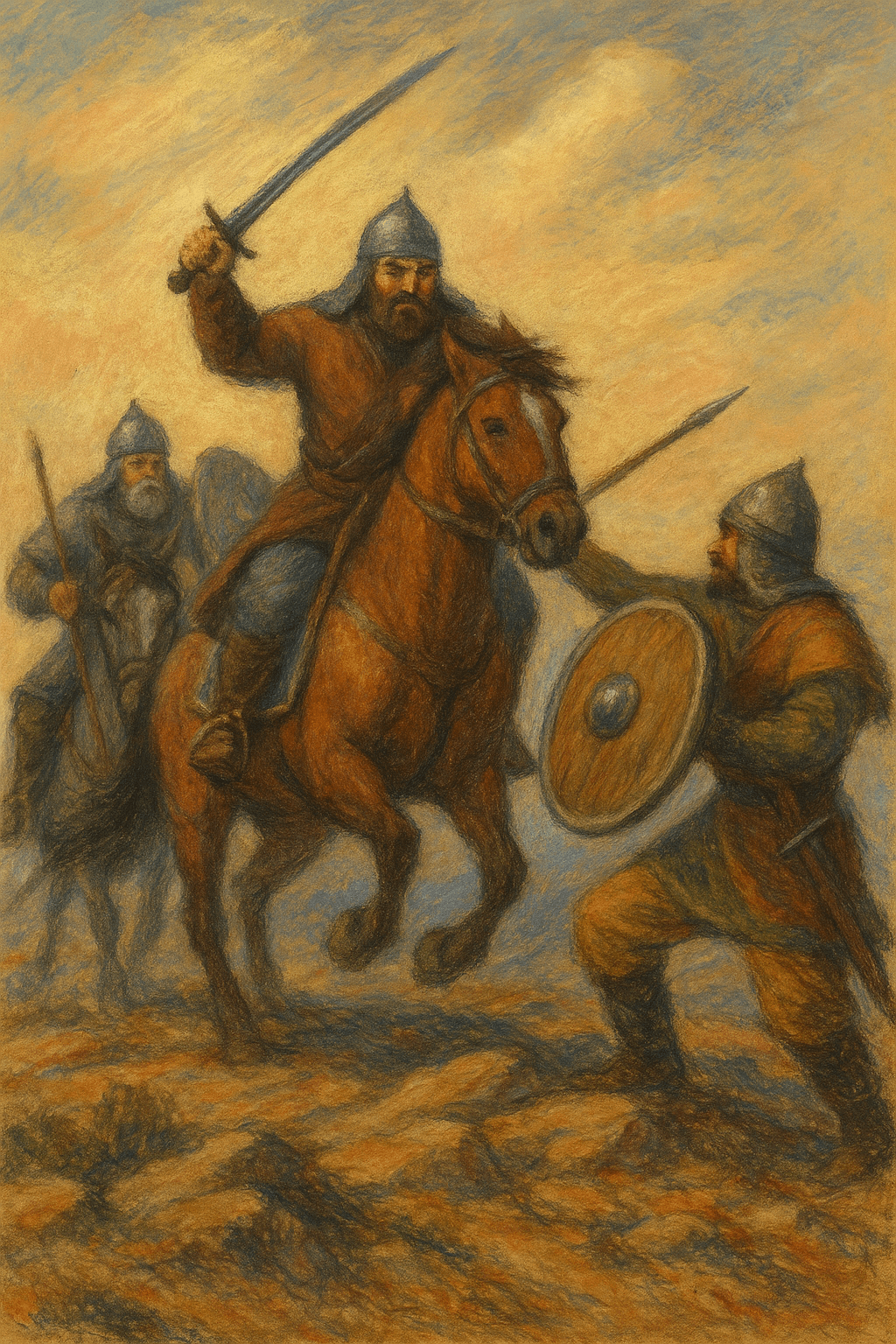
Visual Representing the Epic of Edige (Generated by Artificial Intelligence)
After Tokhtamysh’s death, his son Kadirbirdi gathers an army to avenge his father by confronting Edige. Kadirbirdi believes Edige’s existence threatens the khanate. The two armies meet once again. Despite his age and injuries, Edige enters the battlefield. He displays great courage and inflicts heavy losses on Kadirbirdi’s forces. However, during the battle, he suffers severe wounds.
At the end of the battle, Edige kills Kadirbirdi but is mortally wounded himself. In some variants of the epic, Edige’s head is severed by Barın Mirza. As he dies, Edige looks one last time to the sky, bows to the earth, drinks water from the Volga, and quietly surrenders his soul. In the Tatar version, Edige’s death is described as a supernatural scene: his severed head turns toward the sun, speaks one final time, and curses.
This curse is soon fulfilled: the Volga-Yurt becomes a land of blood, and the Golden Horde Khanatefractures into the Crimean, Kazan, Astrakhan, and Nogai principalities. Thus, the epic concludes not merely with the death of a hero but with the end of an era. With Edige’s death, the people elevate him as a hero and saint. The site of his grave is regarded by the people as a sacred place. His name lives on for centuries in folk songs and folk tales.
Ahmetov, S. and S. Bahadirova. Karakalpak Türkleri Destanları ve Özetleri. *Türk Dünyası Dil ve Edebiyat Dergisi* 5, no. (1998). Accessed October 10, 2025.https://dergipark.org.tr/en/download/article-file/136252
Kalafat, Yaşar. "Edige Destanında Olağanüstü Tipler." *Selçuk Üniversitesi Türkiyat Araştırmaları Dergisi* 13 (2003): 345–352. Accessed October 10, 2025.https://dergipark.org.tr/en/download/article-file/258156
Kalenderoğlu, İhsan. "Nogay Destanlarında At Motifi." *Türk Dünyası Dil ve Edebiyat Dergisi* 21 (2006): 97–117. Accessed October 10, 2025.https://dergipark.org.tr/en/download/article-file/135964
Kamalkızı, Canimgül. "Türk Halklarında Ortak ‘Edige Destanı’ ile Rahmankul Berdibay Çalışmaları." *Avrasya Uluslararası Araştırmalar Dergisi* 7.16 (2019): 1194–1202. Accessed October 10, 2025.https://dergipark.org.tr/en/download/article-file/677709
Küçüközen, Kamer. "Kazak Destanlarındaki Su, Hayvan ve Bitki Mitoslarının Tespiti." *KutBilim Sosyal Bilimler ve Sanat Dergisi* 4.1: 32–44. Accessed October 10, 2025.https://dergipark.org.tr/en/download/article-file/4120683
Tunç, Zekiye. "Edigey Destanında Vatan Teması (Tatar ve Başkurt Varyantlarına Göre)." *Karadeniz Araştırmaları* 71 (2021): 689–715. Accessed October 10, 2025.https://dergipark.org.tr/en/download/article-file/2277559
Turgunbayer, Caşteğin. "Türk Dünyası Destanlarında Ortak Motifler Üzerine." *Türk Dünyası Dil ve Edebiyat Dergisi* 24 (2007): 93–102. Accessed October 10, 2025.https://dergipark.org.tr/en/download/article-file/135936
Yıldırım, Ramilya Yarullina, and Çetin Yıldız. "Edigey Destanı’nda Hayvanların Fonksiyonları." Avrasya Uluslararası Araştırmalar Dergisi 1.1 (2012): 67–77. Accessed October 10, 2025.https://dergipark.org.tr/en/download/article-file/155136
Çetin, Pervin. Nogay Türklerinin Mamay Destanı’na Genel Bir Bakış. Kesit Akademi Dergisi 23 (2024): 257–277. Accessed October 10, 2025.
Öztürk, Göksel. *Edige Batır Destanının Başkurt Versiyonu.* Master's thesis, 2001. Accessed October 10, 2025.https://www.proquest.com/docview/2597556703?pq-origsite=gscholar&fromopenview=true&sourcetype=Dissertations%20&%20Theses
Şehriyar, Gumru. "Edigey Destanında Dinî-Mitolojik Motifler." *Gaziantep University Journal of Social Sciences* 19.1 (2020): 158–169. Accessed October 10, 2025.://dergipark.org.tr/en/download/article-file/945988

Research on the Epic
Historical Context and Subject Matter
Motifs and Supernatural Elements
The Birth of Edige
Struggles and Alliances
Tokhtamysh and Revenge
The Hero’s Return
The Final War and Edige’s Death