

This article was automatically translated from the original Turkish version.
Advantage(s) | It provides direct access to conflict zones and military information. | ||||||||
|---|---|---|---|---|---|---|---|---|---|
Definition(s) | Journalists produce news by living and working alongside military units in the operational area. traveling | ||||||||
Basic Rules | Journalists may travel only in military vehicles. Commanders can suspend or embargo reports if operational security is compromised. | ||||||||
Operation | Journalists wishing to join the program must sign a contract containing strict rules. | ||||||||
Emergence | The modern military embed format was created by the United States Department of Defense (Pentagon) prior to the 2003 Iraq War. | ||||||||
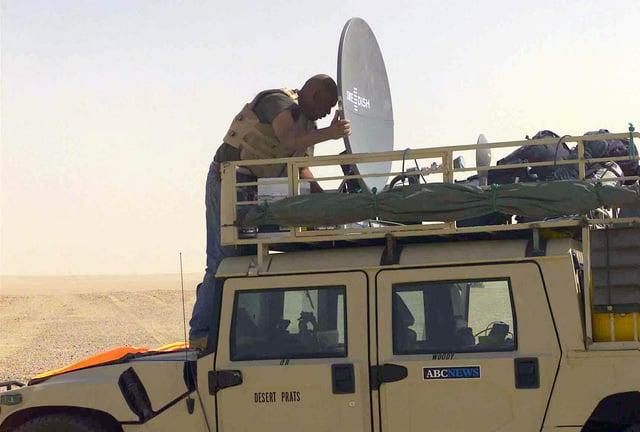
Embedded journalism is the practice in which journalists travel and integrate themselves within military units, politicians, sports teams, or other groups to produce news from within those environments. Known in English as "embedded journalism," this concept is translated into Turkish as "yapışmışlık," "gömülmüşlük," or "yamanmış." In practice, reporters live and work alongside the military forces protecting them or the political authorities who have accepted them.【1】
Embedded journalism in non-military political contexts first emerged during the early 1970s, when diplomatic rapprochement occurred between the United States and China. During this period, foreign journalists were highly dependent on government-appointed local guides and operated only within a restricted network of officially approved contacts.【2】
The modern military definition of the concept was formulated by Pentagon spokesperson Victoria Clarke, her advisors, and then U.S. Secretary of Defense Donald Rumsfeld during the U.S. invasion of Iraq. Operational rules were established through high-level military meetings in Washington between October 2002 and January 2003 and implemented through an official directive issued in February 2003 (Public Affairs Guidance). During the Iraq War, approximately 700 journalists lived and worked alongside U.S. and British military units under this system.【3】
Journalists participating in the embedded system must sign contracts with pre-established rules. Violations result in revocation of their accreditation and termination of their embedded status. The core military operational rules are as follows:【4】
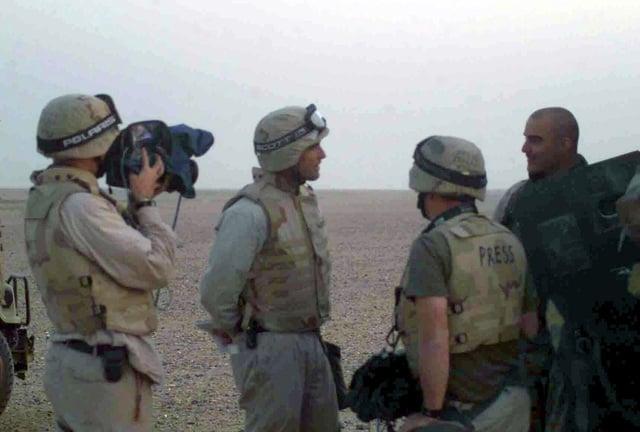
Embedded Journalism (getarchive.net)
Although the concept is primarily associated with military operations, other forms of embedded reporting exist in journalism practice. These are classified as commercial and political embedding.
Commercial Embedding: This occurs when journalists accept free travel, luxury accommodations, or gifts from news sources in exchange for favorable reporting or avoidance of critical coverage. Another commercial form of embedding involves deliberately blurring the distinction between editorial content and advertising or promotional material, thereby threatening journalistic independence.
Political Embedding: This refers to the deliberate and biased journalistic activity undertaken by media personnel to advance the goals of a specific political party, ideology, or ruling authority.【5】
The practice of embedded journalism has drawn both positive and negative criticism from journalists, military institutions, and the public.
Supporters of the system argue that it provides journalists with access to previously restricted information and direct entry into war zones.【6】 This structure is described as a mutual benefit mechanism ("win-win-win") in which the media gains access, the military secures favorable coverage, and the public obtains previously inaccessible detailed imagery.
However, the most significant criticisms focus on the damaging effects of the practice on journalistic ethics:
The legal framework for embedded journalism and the security of journalists in conflict zones is primarily governed by international public law through the Geneva Conventions and their Additional Protocols. Article 79 of Additional Protocol I to the Geneva Conventions grants journalists a non-combatant civilian status, provided they do not engage in any action that compromises or negatively affects this status.
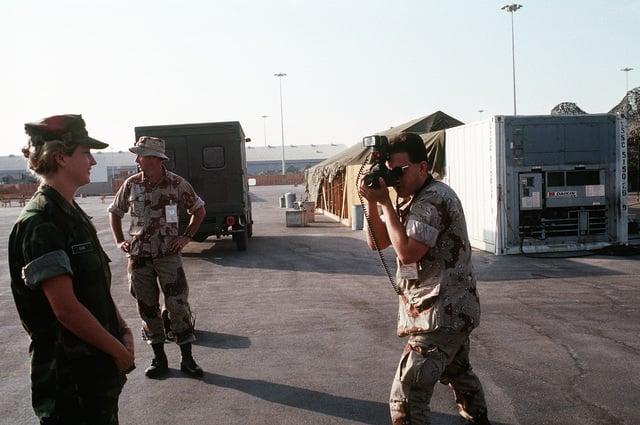
Embedded Journalism (getarchive.net)
However, in the embedded system, journalists travel, sleep, and eat alongside armed forces, and in some cases wear similar uniforms. This blurs their civilian identity and risks their being perceived as combatants by opposing forces. This perception directly undermines the civilian protection guaranteed by Article 79.【9】
There is a direct economic link between the rise of freelance reporters in conflict zones and the embedded journalism system. Today, the embedded system has become the most cost-effective method for media organizations to cover conflict. Independent journalists, who must bear the heavy logistical, insurance, accommodation, transportation, and translation costs of operating in conflict areas, often choose to be embedded with military units for periods of up to six months to avoid these expenses and gain free access to information.【10】
"A freelance ABC News crew embedded with US Marine Corps (USMC) Marines assigned to the 1ST Light Armored Reconnaissance Battalion (LARB), 1ST Marine Division..." GetArchive (National Archives and Records Administration Collection). Accessed April 13, 2026. https://nara.getarchive.net/media/a-freelance-abc-news-crew-embedded-with-us-marine-corps-usmc-marines-assigned-3b35fa
"Journalist 1st Class Joe Gawlowicz photographs LT. Case of Fleet Hospital Five while providing media support for Operation Desert Shield." Picryl (National Archives and Records Administration Collection). Accessed April 13, 2026. https://picryl.com/media/journalist-1st-class-joe-gawlowicz-photographs-lt-case-of-fleet-hospital-five-5a04f6
"Mr. F. Quincy Brown, an engineer with the ABC News crew embedded with US Marine..." GetArchive (National Archives and Records Administration Collection). Accessed April 13, 2026. https://nara.getarchive.net/media/mr-f-quincy-brown-an-engineer-with-the-abc-news-crew-embedded-with-us-marine-5c77c1
Alp, Hakan. "Embedded Journalism Within the Framework of Changing Ownership Structure of the Media." *Journalism and Mass Communication* 5, no. 6 (2015): 255-263. Accessed April 13, 2026. https://www.davidpublisher.com/Public/uploads/Contribute/55a4d7b511315.pdf
Froneman, J. D. and Thalyta Swanepoel. "Embedded Journalism: More Than a Conflict Reporting Issue." *Communicatio: South African Journal of Communication Theory and Research* 30, no. 1 (2004). Accessed April 13, 2026. https://www.tandfonline.com/doi/abs/10.1080/02500160408537994
Iturregui Mardaras, Leire, María José Cantalapiedra González, and Leire Moure Peñín. "Embedded Journalism and Its Implications in the Field." In *The Assault on Journalism: Building Knowledge to Protect Freedom of Expression*, edited by Ulla Carlsson and Reeta Pöyhtäri, pp. 257-266. Göteborg: Nordicom, 2017. Accessed April 13, 2026. https://www.researchgate.net/profile/Baris-Coban/publication/323935168_How_Safe_Is_It_Being_an_activist_citizen_journalist_in_Turkey
Paul, Christopher, and James J. Kim. "The Future of Embedded Press." In *Reporters on the Battlefield: The Embedded Press System in Historical Context*, 109-116. Santa Monica, CA: RAND Corporation, 2004. Accessed April 13, 2026. https://www.jstor.org/content/oa_chapter_monograph/10.7249/mg200rc.13?searchText=Embedded+journalism
Song, Yunya, and Chin-Chuan Lee. "Embedded Journalism: Constructing Romanticized Images of China by US Journalists in the 1970s." *Chinese Journal of Communication* 7, no. 2 (2014): 174–190. Accessed April 13, 2026. https://www.tandfonline.com/doi/full/10.1080/17544750.2013.854819
[1]
Yunya Song ve Chin-Chuan Lee, "Embedded Journalism: Constructing Romanticized Images of China by US Journalists in the 1970s," Chinese Journal of Communication 7, sy. 2 (2014): 1, Erişim 13 Nisan 2026.https://www.tandfonline.com/doi/full/10.1080/17544750.2013.854819
Hakan Alp, "Embedded Journalism Within the Framework of Changing Ownership Structure of the Media," Journalism and Mass Communication 5, sy. 6 (2015): 2, Erişim 13 Nisan 2026.https://www.davidpublisher.com/Public/uploads/Contribute/55a4d7b511315.pdf
J. D. Froneman ve Thalyta Swanepoel, "Embedded Journalism: More Than a Conflict Reporting Issue," Communicatio: South African Journal of Communication Theory and Research 30, sy. 1 (2004): 2, Erişim 13 Nisan 2026.https://www.tandfonline.com/doi/abs/10.1080/02500160408537994
[2]
Yunya Song ve Chin-Chuan Lee, "Embedded Journalism: Constructing Romanticized Images of China by US Journalists in the 1970s," Chinese Journal of Communication 7, sy. 2 (2014): 2,7. Erişim 13 Nisan 2026.https://www.tandfonline.com/doi/full/10.1080/17544750.2013.854819
[3]
Hakan Alp, "Embedded Journalism Within the Framework of Changing Ownership Structure of the Media," Journalism and Mass Communication 5, sy. 6 (2015): 4, Erişim 13 Nisan 2026.https://www.davidpublisher.com/Public/uploads/Contribute/55a4d7b511315.pdf
Leire Iturregui Mardaras, María José Cantalapiedra González ve Leire Moure Peñín, "Embedded Journalism and Its Implications in the Field," The Assault on Journalism: Building Knowledge to Protect Freedom of Expression in ed. Ulla Carlsson ve Reeta Pöyhtäri (Göteborg: Nordicom, 2017), 257. Erişim 13 Nisan 2026.https://www.researchgate.net/profile/Baris-Coban/publication/323935168_How_Safe_Is_It_Being_an_activist_citizen_journalist_in_Turkey
[4]
Hakan Alp, "Embedded Journalism Within the Framework of Changing Ownership Structure of the Media," Journalism and Mass Communication 5, sy. 6 (2015): 1. Erişim 13 Nisan 2026.https://www.davidpublisher.com/Public/uploads/Contribute/55a4d7b511315.pdf
[5]
J. D. Froneman ve Thalyta Swanepoel, "Embedded Journalism: More Than a Conflict Reporting Issue," Communicatio: South African Journal of Communication Theory and Research 30, sy. 1 (2004): 4,5,6,8. Erişim 13 Nisan 2026.https://www.tandfonline.com/doi/abs/10.1080/02500160408537994
[6]
Leire Iturregui Mardaras, María José Cantalapiedra González ve Leire Moure Peñín, "Embedded Journalism and Its Implications in the Field," The Assault on Journalism: Building Knowledge to Protect Freedom of Expression in ed. Ulla Carlsson ve Reeta Pöyhtäri (Göteborg: Nordicom, 2017), 258, Erişim 13 Nisan 2026.https://www.researchgate.net/profile/Baris-Coban/publication/323935168_How_Safe_Is_It_Being_an_activist_citizen_journalist_in_Turkey
[7]
Christopher Paul ve James J. Kim, "The Future of Embedded Press," Reporters on the Battlefield: The Embedded Press System in Historical Context in (Santa Monica, CA: RAND Corporation, 2004), 3-5. Erişim 13 Nisan 2026.https://www.jstor.org/content/oa_chapter_monograph/10.7249
[8]
Yunya Song ve Chin-Chuan Lee, "Embedded Journalism: Constructing Romanticized Images of China by US Journalists in the 1970s," Chinese Journal of Communication 7, sy. 2 (2014): 9, Erişim 13 Nisan 2026.https://www.tandfonline.com/doi/full/10.1080/17544750.2013.854819
[9]
Leire Iturregui Mardaras, María José Cantalapiedra González ve Leire Moure Peñín, "Embedded Journalism and Its Implications in the Field," The Assault on Journalism: Building Knowledge to Protect Freedom of Expression in ed. Ulla Carlsson ve Reeta Pöyhtäri (Göteborg: Nordicom, 2017), 262, Erişim 13 Nisan 2026.https://www.researchgate.net/profile/Baris-Coban/publication/323935168_How_Safe_Is_It_Being_an_activist_citizen_journalist_in_Turkey
[10]
Leire Iturregui Mardaras, María José Cantalapiedra González ve Leire Moure Peñín, "Embedded Journalism and Its Implications in the Field," The Assault on Journalism: Building Knowledge to Protect Freedom of Expression in ed. Ulla Carlsson ve Reeta Pöyhtäri (Göteborg: Nordicom, 2017), 264,265. Erişim 13 Nisan 2026.https://www.researchgate.net/profile/Baris-Coban/publication/323935168_How_Safe_Is_It_Being_an_activist_citizen_journalist_in_Turkey


Advantage(s) | It provides direct access to conflict zones and military information. | ||||||||
|---|---|---|---|---|---|---|---|---|---|
Definition(s) | Journalists produce news by living and working alongside military units in the operational area. traveling | ||||||||
Basic Rules | Journalists may travel only in military vehicles. Commanders can suspend or embargo reports if operational security is compromised. | ||||||||
Operation | Journalists wishing to join the program must sign a contract containing strict rules. | ||||||||
Emergence | The modern military embed format was created by the United States Department of Defense (Pentagon) prior to the 2003 Iraq War. | ||||||||
No Discussion Added Yet
Start discussion for "Embedded Journalism" article
Historical Development
Operation and Rules
Dimensions of Embedded Journalism
Effects and Criticisms
Legal Status and Security
Economic Factors in War Journalism